
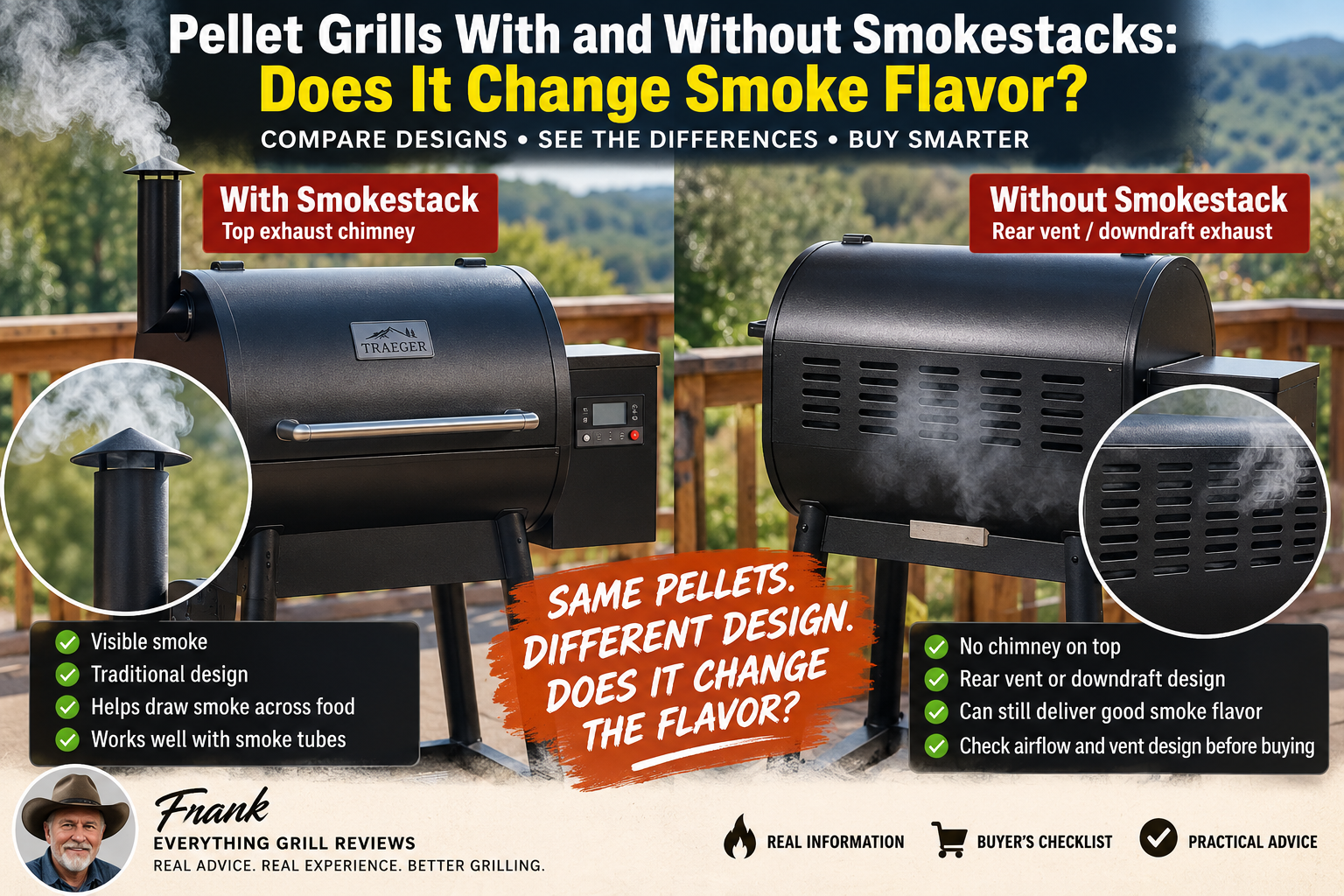
Updated and fact-checked: September 11, 2026. Pellet grills with and without smokestacks use different exhaust designs, and those differences can affect how smoke travels around your food.. Compare rear vents, airflow, smoke tubes, downdraft exhaust, and smoke flavor. When people shop for a pellet grill, they usually compare cooking area, temperature range, Wi-Fi controls, pellet capacity, and price. One feature that does not get nearly enough attention is the exhaust system. Some pellet grills use a traditional side smokestack. Others use rear vents, louvers, slots, or a designed downdraft exhaust system. That difference raises a good question: does a pellet grill with a smokestack give food more smoke flavor than a pellet grill without one?
Quick Answer
Key Points
- A smokestack does not create smoke; it mainly controls where exhaust leaves the cooker.
- Rear vents can work well when they are part of a deliberate downdraft or airflow design.
- Smoke flavor also depends on cooking temperature, wood pellets, time in smoke, and controller settings.
- A smoke tube works best when added smoke must travel across the food before reaching the exhaust.
How Does the Exhaust System on a Pellet Grill Work?
A pellet grill is not a sealed smoker. Pellets burn in a firepot while an electric fan supplies air and helps move heated air and smoke through the cooking chamber. That moving air cooks the food by convection while carrying smoke across and around the meat. The exhaust gives that air somewhere to leave the grill. Without adequate exhaust, the fan cannot create the intended flow through the cooking chamber. Too much restriction can also interfere with combustion and temperature control. This is why I do not judge a pellet grill only by how much visible smoke stays inside it. Good barbecue smoke should be moving. Traeger makes the same basic point in its Smoke Science guidance: moving smoke is important, while stagnant smoke can contribute to bitter deposits. The real question is therefore not, “Does this grill hold all the smoke?” It is, “Where does the smoke travel before it leaves?”
Smokestack vs. Rear-Vent Pellet Grills
| Feature | Smokestack Pellet Grill | Rear-Vent Pellet Grill |
|---|---|---|
| Exhaust location | Usually one side of the cooking chamber | Back wall, rear slots, louvers, or downdraft outlet |
| Smoke path | Often travels across the chamber toward one concentrated outlet | Depends heavily on vent placement and internal design |
| Airflow adjustment | Some chimneys have an adjustable cap | Often fixed, although some designs use adjustable dampers |
| Smoke flavor | Can be excellent, but the stack alone is not the reason | Can also be excellent when airflow is properly engineered |
| Easy to understand visually | Yes — smoke has an obvious outlet | Not always — the exhaust path may be less obvious |
What I Like About a Traditional Smokestack
A smokestack gives the grill one obvious exhaust point. In a basic barrel-style cooker, I like the idea of smoke entering the cooking chamber, moving across the food, and then leaving through a stack positioned away from the firepot. That does not mean every smokestack grill has perfect airflow. Stack diameter, stack location, chimney-cap clearance, fan speed, chamber shape, grease tray design, and controller programming can all change the way the grill behaves. In fact, Traeger’s chimney instructions warn that chimney-cap position matters. Too much opening can increase airflow and contribute to temperature swings, while too little opening can restrict airflow. That is a good reminder that “keeping more smoke in” is not automatically better.
What About a Grill With Vents Across the Back?
This is where I think buyers need to look more closely. A grill with several open slots or louvers across the rear may let smoke leave through several points instead of one concentrated outlet. Depending on how the rest of the cooker is designed, that can create a very different smoke path. But rear exhaust should not be treated as one single design. A simple row of holes across the back and an engineered downdraft system are not the same thing.
Does a Smokestack Create More Smoke Flavor?
Not automatically. The smokestack controls where exhaust leaves the cooker, but it does not create the smoke. Smoke comes from burning or smoldering wood pellets, and the final flavor depends on how much useful smoke contacts the food and for how long. A poorly designed smokestack grill could produce less noticeable smoke flavor than a well-designed chimney-less grill. On the other hand, a basic rear-vent cooker that lets smoke escape quickly across a large section of the back may not behave like a sophisticated downdraft design. So I would not buy a pellet grill because it has a smokestack and assume it will make smokier barbecue. I would, however, consider the exhaust design when comparing two otherwise similar grills.
My Experience With a Pellet Grill Without a Smokestack
I learned to pay attention to exhaust design after buying a pellet grill that did not have a smokestack. I did not realize that until the grill arrived at my house. Instead of a chimney, the back of the barrel had a series of vent openings. When I cooked a whole chicken, the chicken was good, but the smoke flavor was lighter than I expected. The grill also came with oak pellets, and oak is not the smoke flavor I personally like. I prefer a much stronger mesquite flavor. I later used a cold smoke tube with mesquite pellets, and the flavor improved noticeably to me. That experience made me start looking much harder at where smoke enters a pellet grill, where it travels, and where it leaves. I do not present that one cook as proof that all rear-vent pellet grills produce weak smoke. It was one grill, one exhaust design, one wood choice, and my own taste. But it is exactly the kind of detail buyers should think about before ordering a grill online.
A Downdraft Exhaust Is Not the Same as Simple Rear Louvers
Modern pellet-grill manufacturers have shown that a grill does not need a traditional chimney to deliberately manage smoke. Traeger, for example, uses a downdraft-style exhaust on a number of chimney-less models. The company says the system forces old smoke to exit below the food and is designed to increase smoke contact before the exhaust leaves the cooker. That is very different from assuming that any grill with holes in the back is doing the same thing. With an engineered downdraft system, the rear exhaust is part of the grill’s airflow strategy. This is why shoppers should ask a better question than “Does it have a smokestack?” Ask how the manufacturer designed smoke to move through the cooking chamber.
Does a Smoke Tube Work Better in a Pellet Grill With a Smokestack?
A smoke tube can add another source of smoldering wood smoke inside either type of pellet grill. It does not require a smokestack to work. However, airflow still matters. If I am using a smoke tube, I want the added smoke to travel across the food before it reaches the exhaust. In a grill with a side stack, that path can be easy to visualize: place the smoke source so the natural airflow carries smoke toward the food and then toward the stack. With a rear-vent grill, tube placement may take more experimenting because the grill can have several exhaust points. A tube that sits directly beside a large rear opening may lose part of its smoke quickly. Moving it farther from the exhaust may give the smoke more opportunity to cross the food. The important point is that a smokestack does not magically make a smoke tube stronger. The best placement is the position that puts the food between the smoke source and the main exhaust path without interfering with safe airflow.
What Really Controls Smoke Flavor on a Pellet Grill?
Exhaust design matters, but I would put several other factors ahead of the simple presence or absence of a chimney.
1. Cooking Temperature
Pellet grills generally make more noticeable smoke at lower cooking temperatures. At higher settings, pellets burn more efficiently and produce less visible smoke. This is why a long cook around traditional smoking temperatures usually develops more smoke character than cooking the same food hot and fast.
2. Time Exposed to Smoke
Smoke flavor builds over time. A chicken cooked quickly at a high temperature will usually taste less smoky than meat that spends hours in a lower-temperature smoking environment.
3. Wood Species and Pellet Blend
Wood choice can make a major difference in perceived flavor. Mesquite and hickory usually taste bolder than milder fruit woods. Pellet blends can also differ in how strong their flavor seems. This is one reason my experience improved when I changed from the oak pellets that came with my grill to mesquite in a smoke tube.
4. Controller and Fan Programming
A pellet grill’s controller decides when pellets feed and how the fan behaves. Some grills include special smoke settings that deliberately alter combustion or fan operation to increase smoke output at lower temperatures. Traeger’s Super Smoke system, for example, uses fan and fuel control to increase smoke delivery in a specified low-temperature range. Camp Chef also offers adjustable Smoke Control on some controllers. These systems show that smoke flavor is affected by much more than the shape of the exhaust pipe.
5. The Entire Airflow Path
The firepot, fan, heat diffuser, grease tray, cooking racks, chamber shape, food placement, and exhaust all work together. Looking only at the smokestack is like judging an engine only by the tailpipe.
Which Should You Buy: Smokestack or No Smokestack?
If two pellet grills are otherwise close in price and features, I personally like a traditional smokestack because the exhaust path is easy to understand and inspect. But I would not reject a chimney-less grill simply because it uses rear exhaust. I would look for evidence that the manufacturer deliberately designed the rear exhaust as part of the cooker rather than simply cutting a row of openings into the barrel. A downdraft system, adjustable rear dampers, internal smoke channels, or a well-documented convection path can all be signs that the exhaust system received real engineering attention. For a buyer whose top priority is stronger smoke flavor, I would also compare low-temperature performance, dedicated smoke modes, wood options, and whether the cooker has a safe way to add supplemental smoke.
Pellet Grill Exhaust Buyer’s Checklist
- Smokestack placement: Look for a stack positioned so smoke has to travel across the cooking grate before exiting, rather than leaving immediately beside the firepot.
- Rear vents: Check whether the grill uses a few deliberate exhaust openings, adjustable rear vents, or a true downdraft system instead of a large row of open louvers with no explanation of the airflow path.
- Airflow control: Prefer a design with documented airflow management, such as an adjustable chimney cap, rear damper, downdraft channel, or controller-managed fan and smoke settings.
- Smoke-tube compatibility: Make sure there is a safe spot for a smoke tube where added smoke can pass across the food before reaching the exhaust and where it will not interfere with the firepot, grease system, temperature sensor, or moving air.
- Look at the back before buying: Product photos often emphasize the front. Find a rear or side view so you know exactly how the grill exhausts smoke before you order it.
Bottom line: Do not judge a pellet grill only by whether it has a smokestack. Look at the entire smoke path—from the firepot, across the food, and out through the exhaust.
Should You Block Rear Vents to Keep More Smoke Inside?
No. Do not block or substantially restrict a pellet grill’s factory exhaust unless the grill manufacturer specifically approves the modification. I understand the temptation. If smoke appears to be pouring out the back, covering some openings may seem like an easy way to hold smoke around the meat longer. The problem is that pellet grills are powered combustion appliances. The fan, firepot, controller, and exhaust are designed to work together. Restricting the exhaust can change combustion, temperature stability, pressure inside the cooker, and the direction smoke takes. Manufacturer guidance also warns that restricted airflow can contribute to smoke backing up where it should not go. If a pellet grill gives you less smoke flavor than you want, safer first steps are to cook lower and slower, try a stronger wood, use the grill’s smoke setting if it has one, experiment with food placement, or use an approved smoke tube or smoke accessory. I would also avoid drilling a new chimney into a pellet grill unless the manufacturer approves that modification. Changing the exhaust system can affect how the grill operates and may affect warranty coverage.
Final Verdict: Smokestack or Rear-Vent Pellet Grill?
A smokestack is not automatically better, but exhaust design absolutely deserves a place on the pellet-grill shopping checklist. A traditional chimney gives smoke a clear exit point and can create an easy-to-understand path across the cooking chamber. That appeals to me. But modern downdraft systems prove that a chimney is not required for good smoke circulation. The bigger warning is against treating every chimney-less pellet grill as if it used the same engineering. A sophisticated downdraft exhaust and a row of simple rear louvers are two different things. If strong smoke flavor is your priority, look at the entire system: how pellets burn, how the fan moves air, where smoke travels, where it exits, what temperature you cook at, what wood you burn, and how long your food remains in the smoke. That will tell you much more than the smokestack alone.
FAQ: Pellet Grill Smokestacks and Rear Vents
Do pellet grills need a smokestack?
No. A pellet grill needs a properly designed exhaust path, but that exhaust can be a traditional chimney, rear vents, adjustable dampers, or a downdraft system. The important requirement is controlled airflow through the cooking chamber.
Does a smokestack make a pellet grill produce more smoke?
No. The smokestack does not produce smoke. Smoke production depends on pellet combustion, temperature, controller programming, airflow, and the wood being burned. The stack mainly affects how exhaust leaves the cooker.
Do rear-vent pellet grills have less smoke flavor?
Not necessarily. A well-designed rear or downdraft exhaust can circulate smoke very effectively. Simple open rear louvers may behave differently, which is why buyers should look at the specific airflow design rather than judging every rear-vent grill the same way.
Why does my pellet grill have very little visible smoke?
Pellet grills often produce thin smoke that can be difficult to see once they are running steadily. Higher cooking temperatures also tend to produce less visible smoke. Heavy white smoke is not the goal for most of a cook.
Can I cover the vents on the back of my pellet grill?
You should not block factory exhaust vents unless the manufacturer specifically says the change is safe. Restricting exhaust can interfere with airflow, combustion, and temperature control.
Can I add a smokestack to a pellet grill that did not come with one?
It may be physically possible on some cookers, but it is not a modification I recommend without manufacturer approval. Adding a stack while changing or restricting the original exhaust can alter the airflow the grill was designed to use.
Will a smoke tube add more smoke flavor?
It can. A smoke tube adds a separate smoldering wood source inside the cooking chamber. For best results, position it so smoke has to travel across the food before reaching the exhaust while keeping clear of components and following the grill and smoke-tube manufacturer’s safety instructions.
About the Author
Frank W. Roberts has been grilling and smoking meat since around 1970. His approach is based on practical backyard cooking experience, including decades of cooking with traditional smokers and more recent use of pellet grills. Everything Grill Reviews focuses on helping buyers understand how grills actually work before spending their money. Last updated: September 11, 2026.