
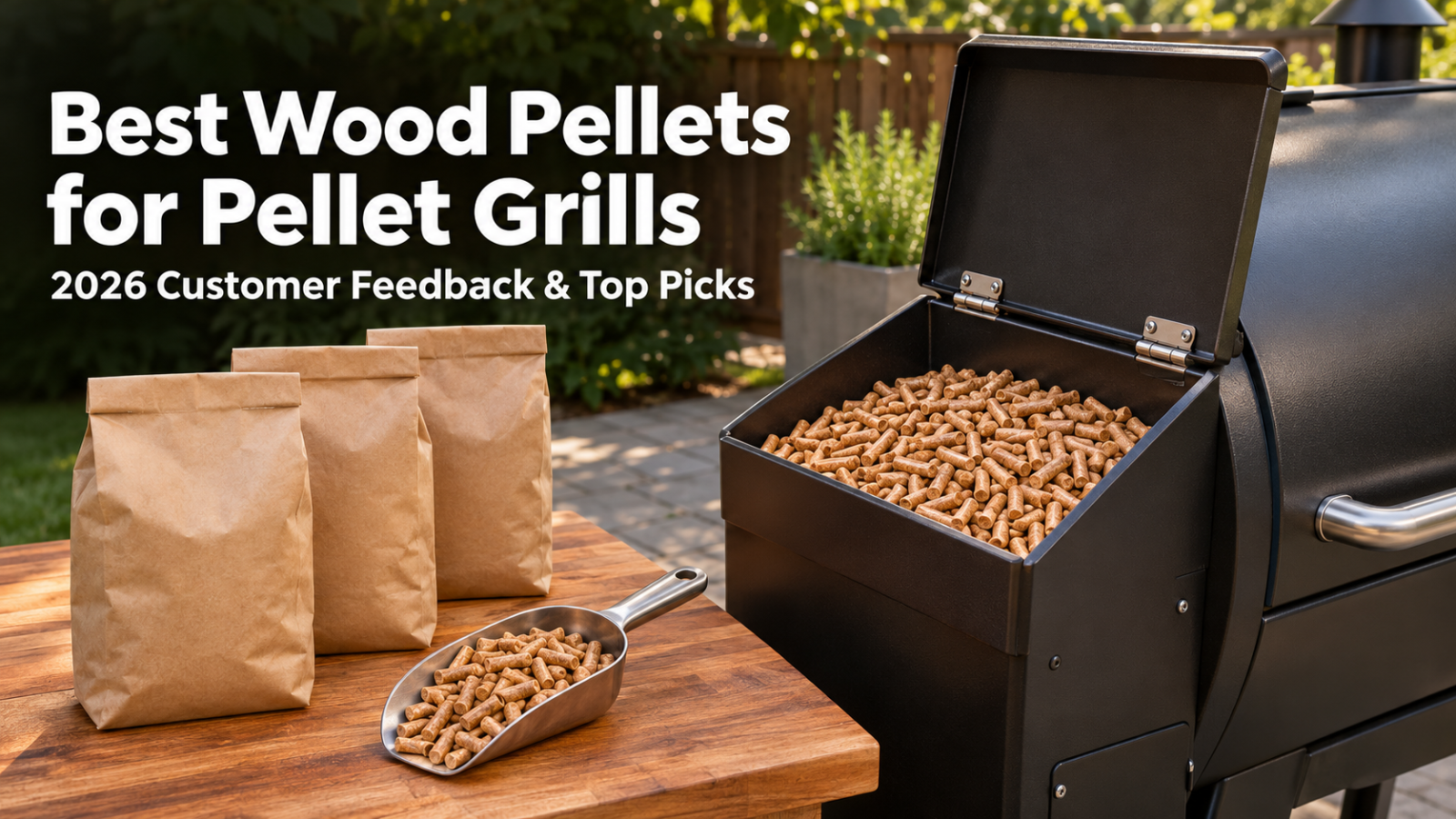
Best Wood Pellets for Pellet Grills in 2026: Customer Feedback and Top Picks
Best for: Backyard grill buyers
A solid option worth comparing before you buy.
Check Price on Amazon (paid link)As an Amazon Associate I earn from qualifying purchases.
Updated: November 8, 2026
The best wood pellets for pellet grills should burn reliably, arrive with little loose dust, add a useful smoke flavor, and cost enough less than dinner to make regular cooking practical. After comparing current manufacturer disclosures, retailer availability, and repeated customer-comment patterns, Bear Mountain Gourmet Blend is the best overall choice for most pellet-grill owners in 2026.
Quick Answer: Buy Bear Mountain Gourmet Blend if you want one dependable, widely available pellet for beef, pork, poultry, fish, and vegetables. Choose Lumber Jack Competition Blend when stronger smoke and clearly identified woods matter more than easy nationwide availability. CookinPellets Perfect Mix is the premium no-oak-or-alder option, while Pit Boss Competition Blend is the value choice for cooks who burn a lot of fuel.
Key Points
- Best overall: Bear Mountain Gourmet Blend for broad availability, balanced flavor, low observed price, and consistently positive customer feedback.
- Best stronger-smoke blend: Lumber Jack Competition Blend, made from maple, hickory, and cherry with bark and cambium included.
- Best premium composition: CookinPellets Perfect Mix, using hickory, cherry, hard maple, and apple without an oak or alder base.
- Best budget buy: Pit Boss Competition Blend, especially in a 40-pound bag when the pellets can be stored dry.
- Best easy Traeger match: Traeger Signature Blend for owners who prefer the grill maker’s own widely stocked fuel.
- Research limit: This is a source-and-customer-feedback comparison, not a controlled burn test or a claim that Frank personally cooked with every bag.
Which Wood Pellets Are Best Overall?
Bear Mountain Gourmet Blend is the best overall pick because it balances flavor, price, availability, and a large record of owner satisfaction without forcing the buyer into a narrow food pairing.
Bear Mountain says the blend uses 100% premium hardwood with no flavorings, fillers, or additives. The company also explains something many pellet labels leave vague: depending on the region, it uses oak or alder as a base wood for consistent burning. The exact Gourmet Blend recipe is proprietary, combining stronger smoke woods with sweeter fruitwoods.
That is not the same as saying every pellet contains only hickory, cherry, or another wood pictured on a bag. It is an all-purpose hardwood blend designed for dependable fuel behavior. For most people who want to fill the hopper and cook anything from chicken to brisket, that is a sensible trade.
How Were These Pellet Brands Compared?
The comparison used four things: disclosed wood composition, current U.S. availability and bag size, repeated customer-comment themes, and practical value at prices observed on November 7, 2026.
- Manufacturer facts: Exact named woods, base-wood disclosures, binders or additives, bag sizes, and compatibility claims came from current brand pages.
- Customer record: Recent retailer and manufacturer reviews were checked for patterns involving flavor, ash, dust, feeding, consistency, and price.
- Availability: A great pellet that requires expensive special shipping is not the best everyday recommendation for most readers.
- Honest limits: Customer reviews are self-selected, some are incentivized, and different grills burn the same pellet differently.
No laboratory moisture test, ash weighing, blind tasting, or side-by-side burn was performed for this article. Manufacturer performance claims are identified as claims, and customer patterns are not presented as controlled measurements.
How Do the Top Pellet Choices Compare?
Bear Mountain wins the all-around decision, but the better choice changes when the priority is stronger flavor, an exact wood recipe, the lowest price per pound, or manufacturer-branded fuel.
| Pellets | Current composition | Common bag | Best for | Main drawback |
|---|---|---|---|---|
| Bear Mountain Gourmet Blend | Proprietary 100% hardwood blend; oak or alder base varies by region | 20 or 40 lb | Best overall everyday bag | Exact species percentages are not disclosed |
| Lumber Jack Competition Blend | 33% maple, 33% hickory, 33% cherry | 20 or 40 lb | Stronger, clearly defined smoke blend | Retail availability varies by region |
| CookinPellets Perfect Mix | Hickory, cherry, hard maple, and apple; no oak or alder | 20 or 40 lb | Premium blend with no base wood | Usually costs more and may require shipping |
| Pit Boss Competition Blend | Hickory, cherry, maple, and oak | 20 or 40 lb | Budget and high-volume cooking | Large bags are a false economy without dry storage |
| Traeger Signature Blend | Hickory, maple, and cherry | 20 lb | Easy brand-matched choice for Traeger owners | Often costs more per pound than value blends |
Observed prices varied sharply by retailer and location. At the time of checking, Bear Mountain Gourmet Blend appeared around $17.95 for a 40-pound Home Depot bag, Lumber Jack Competition Blend around $10.99 for 20 pounds at Farm & Fleet, CookinPellets Perfect Mix around $39 for 40 pounds direct, Pit Boss Competition Blend around $18–$20 for 40 pounds, and Traeger Signature Blend around $19.99 for 20 pounds. Treat those as dated shopping examples, not permanent prices.
Why Is Bear Mountain Gourmet Blend the Best Overall?
It is the easiest recommendation because the blend works across many foods, the price is competitive, the brand is broadly stocked, and hundreds of current customer comments repeatedly mention good flavor, clean burning, and modest ash.
Home Depot and Lowe’s customer records were especially useful because they include a large number of purchases across different grill brands. Repeated positives were balanced smoke flavor, reliable feeding, value, and relatively little ash. The recurring cautions were occasional sawdust in the bag, packaging damage, and some cooks wanting more smoke at low settings.
Those negatives matter. Dust often comes from rough shipping or an old crushed bag, not necessarily the original pellet formula. A mild smoke result can also come from a clean-burning grill, high cooking temperature, damp fuel, or short exposure. The safest conclusion is not that every bag is perfect; it is that Bear Mountain offers the strongest combination of low risk and good value for the average buyer.
See the official Bear Mountain Gourmet Blend page for current composition and bag options.
When Is Lumber Jack Competition Blend the Better Choice?
Choose Lumber Jack Competition Blend when you want a more transparent three-wood recipe and a stronger traditional smoke profile, and you can buy it locally or at a reasonable delivered price.
Lumber Jack lists the formula as equal parts maple, hickory, and cherry. The company says the wood is ground before pelleting so each pellet contains the blend, and that bark and the cambium layer are included. It also says there are no oils, sprays, fillers, binders, or artificial ingredients.
Current Farm & Fleet feedback is smaller than the huge review records for Traeger or Pit Boss, but owners commonly praise the balanced flavor and value. The practical weakness is distribution. A bargain bag becomes a poor value when shipping doubles the cost or when a local store stops carrying it.
Is CookinPellets Perfect Mix Worth the Premium?
Yes, for buyers who specifically want hickory, cherry, hard maple, and apple without an oak or alder base. It is harder to justify when price matters more than the ingredient distinction.
CookinPellets identifies all four woods and says Perfect Mix contains no oak, alder, softwood, oils, or flavoring fillers. Customer comments repeatedly praise full smoke aroma, consistent feeding, and versatility from brisket to poultry. The most consistent criticism is price, especially when shipping is added.
Perfect Mix is not automatically better simply because it omits a base wood. Oak and alder are legitimate cooking hardwoods that help many blends burn consistently. The premium makes sense when the exact four-wood recipe is the reason you are buying it.
Are Pit Boss Competition Blend Pellets the Best Value?
They are the best value for high-volume cooking when a fresh 40-pound bag is available locally and you have a dry sealed container large enough to protect it.
Pit Boss lists hickory, cherry, maple, and oak in the Competition Blend and describes it as 100% natural North American hardwood with no artificial flavors, spray scents, glues, or chemicals. Current Lowe’s and Home Depot review records include thousands of ratings, with repeated comments about all-purpose flavor, steady feeding, and manageable ash.
The main buying mistake is choosing a large bag only because the per-pound price looks low. Pellets that sit in a humid garage can swell, soften, and break into auger-clogging dust. If it takes a year to burn 40 pounds, a smaller fresh bag may be the better bargain.
Should Traeger Owners Use Traeger Signature Blend?
Traeger Signature Blend is a safe, convenient choice for Traeger owners, but it is not necessary to pay the brand premium when the grill manual permits compatible food-grade hardwood pellets from other makers.
The PEL331 20-pound bag combines hickory, maple, and cherry. Traeger lists it as all-natural, made in the United States, binder-free, clean-burning, and low-ash. It is widely stocked, and its customer record is far larger than most specialty pellet brands.
Owners commonly describe a balanced, unobtrusive smoke and reliable operation. That makes Signature Blend easy to use across a mixed menu. The downside is value: at roughly $20 for 20 pounds during this check, it cost more per pound than several well-regarded 40-pound blends. Pay the difference for convenience and confidence, not because another brand cannot work.
Why Did Knotty Wood Not Make the Main Top Five?
Knotty Wood almond and plum-based pellets offer distinctive flavor and traceable orchard wood, but the recurring clinker reports make them a specialist recommendation rather than the safest general pick.
Many owners praise the rich smoke, high heat, and unusual nutty profile. Other verified customer comments describe hard mineral deposits, often called clinkers, forming in the fire pot. Knotty Wood acknowledges that some users notice small mineral deposits from bark-on almond pellets.
That does not make the product unusable. It means the buyer should check the grill maker’s fuel guidance, inspect the fire pot more often, and be willing to clean between long cooks. A distinctive flavor can be worth that maintenance, but it is not the simplest first bag for most readers.
What Do Customer Comments Actually Tell You About Pellets?
Customer comments are best for finding repeated practical problems—dust, damaged bags, weak smoke, excess ash, feed trouble, or poor value—not for proving which brand has objectively better flavor.
Flavor comments are subjective and depend on the meat, seasoning, grill design, temperature, and the cook’s preference. Ash comments also vary because different fire pots and fans burn the same fuel differently. A pattern across hundreds of comments deserves attention; one dramatic complaint does not settle the question.
Ratings may include incentivized reviews, and brand-site reviews are not independent. That is why this article compares patterns across manufacturer pages and large retailers instead of copying a single score or testimonial.
Do 100% Hardwood Pellets Mean One Wood Species?
No. “100% hardwood” means the pellet is made from hardwood, but it may still be a blend of species or use oak or alder as a base. Look for a separate statement if you want 100% hickory, oak, cherry, or another single species.
Bear Mountain openly says most flavored pellets use oak or alder as a regional base, while its Oak and Alder products are single-species. CookinPellets says Perfect Mix uses only its four named woods. Lumber Jack publishes exact percentages for Competition Blend. These are different formulations, not evidence that one company is secretly selling unsafe fuel.
Which Pellet Flavor Works Best With Each Food?
Use stronger woods for rich beef and pork, milder fruitwoods for poultry and fish, and a balanced blend when several foods share the grill.
| Food | Useful wood choice | Why |
|---|---|---|
| Brisket and beef ribs | Hickory, oak, mesquite blend | Bold meat can carry stronger smoke |
| Pork shoulder and ribs | Hickory, cherry, apple blend | Smoke backbone with a sweeter edge |
| Chicken and turkey | Apple, cherry, maple, balanced blend | Milder smoke is less likely to dominate |
| Fish and seafood | Alder, maple, apple | Clean, lighter smoke suits short cooks |
| Vegetables and baked dishes | Maple, cherry, pecan, all-purpose blend | Moderate smoke supports rather than buries the food |
| Mixed menu | Gourmet or competition blend | One hopper can cover several foods |
If the grill still tastes too mild after changing pellets, use the site’s guide to getting more smoke flavor from a pellet grill. Change one variable at a time. A stronger pellet, lower temperature, upper-rack placement, and smoke tube added all at once will not tell you what actually helped.
How Can You Tell Whether a Bag of Pellets Is Fresh?
Fresh pellets should feel hard, look smooth, snap rather than crumble, and contain little loose sawdust. Reject a wet, swollen, musty, or badly torn bag.
- Squeeze several pellets. They should not turn to powder in your fingers.
- Look through a clear section or open the bag carefully and check the bottom for excessive fines.
- Smell the pellets. They should smell like clean wood, not mildew, chemicals, or rancid oil.
- Check seams and corners for rain damage or patched holes.
- Buy from a store that keeps bags indoors or well protected from weather.
How Should Wood Pellets Be Stored?
Keep pellets indoors or in a dry, sealed container off concrete and away from temperature swings. Moisture is a bigger threat than brand choice.
Do not pour a fresh bag on top of damp old fuel. Empty and inspect the hopper if pellets have become soft. A gasketed container is useful, but bring only dry pellets into it. If a handful has swollen or turned to sawdust, discard the damaged fuel rather than feeding it through the auger.
For extra smoke without changing the hopper, the site explains how to use a pellet smoke tube safely.
Frequently Asked Questions
Can you use any brand of pellets in a pellet grill?
Usually, but use only dry, food-grade barbecue pellets and check the exact grill manual. Some manufacturers recommend or require particular fuel specifications for performance or warranty coverage.
Are heating pellets safe in a pellet grill?
No. Home-heating pellets may use wood or additives not intended for cooking. Buy pellets specifically labeled for barbecue grills and food smoking.
Do expensive pellets make food taste better?
Not automatically. Premium pellets may disclose specific woods or omit base woods, but freshness, grill temperature, cooking time, and personal taste matter as much as price.
Which pellets make the most smoke?
Hickory, mesquite, and bark-on blends are commonly chosen for stronger smoke. The grill usually produces more visible smoke at lower temperatures than during a hot, efficient burn.
Are blend pellets better than single-wood pellets?
Blends are more versatile and often burn consistently. Single-wood pellets are useful when you want a specific flavor or are testing what one wood contributes.
Why are there so many broken pellets in the bag?
Rough shipping, moisture, repeated handling, or poor screening can create fines. A little dust is normal; a bag with soft pellets and a thick layer of sawdust is a poor hopper load.
Can wood pellets go bad?
They do not spoil like food, but humidity can make them swell, crumble, feed poorly, and burn unevenly. Musty or water-damaged pellets should be discarded.
Should pellets stay in the hopper between cooks?
Only when the grill and weather keep them reliably dry. In humid or rainy conditions, empty the hopper according to the grill manual and store pellets in a sealed dry container.
Can you mix pellet brands or flavors?
Yes, when both are approved food-grade barbecue pellets. Mix a measured amount so you can repeat the result, and do not combine fresh pellets with damp old fuel.
How much pellet fuel does a grill use?
There is no universal rate. Grill size, set temperature, weather, lid opening, pellet density, and controller behavior all change consumption. Use the grill manual’s estimate for planning and keep reserve fuel dry.
Verdict: What Are the Best Wood Pellets for Pellet Grills?
Bear Mountain Gourmet Blend is the best wood pellet choice for most owners in 2026. It is affordable, widely stocked, compatible with major pellet-grill brands, and supported by a large customer record that repeatedly favors its balanced flavor and manageable ash.
Lumber Jack Competition Blend is the better pick for a clearly defined, stronger three-wood blend. CookinPellets Perfect Mix is worth paying more for when its no-oak-or-alder recipe is the point. Pit Boss Competition Blend is the budget winner for cooks who can keep a large bag dry, and Traeger Signature Blend remains the convenient brand-matched option.
The smartest first purchase is one fresh bag, not a pallet. Run it through several familiar cooks, note flavor and ash in your own grill, and compare only after you have controlled storage and temperature. Customer comments can narrow the field; your cooker and your taste make the final choice.
About the author: Frank W. Roberts has grilled since 1970 and writes Everything Grill Reviews to help backyard cooks spend wisely and avoid preventable problems. This research-based roundup uses current manufacturer disclosures, retailer availability, and clearly identified customer-feedback patterns checked November 7, 2026. It does not claim a controlled pellet test or personal use of every product listed.