
Updated: October 6, 2026
Updated and fact-checked: October 5, 2026
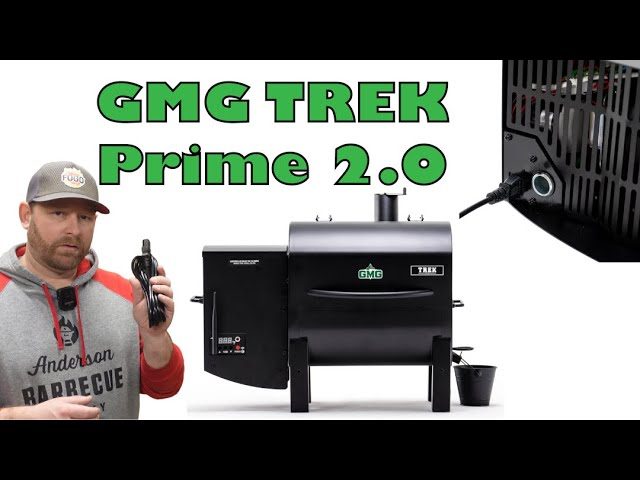
GMG Trek Prime 2.0 is a small pellet grill for a tailgate, a campsite with power, or a tight patio. It is not a backyard cooker that happens to have handles. Green Mountain lists it at $399. The cart, the cover, and the 12-volt cord cost extra. Frank has not cooked on this one. What follows comes from the 2024 owner’s manual, the Prime 2.0 catalog, and current listings.
Quick Answer: Is the GMG Trek Prime 2.0 Worth Buying?
Buy it for small cooks where you already have safe power. Do not buy it as the only grill in the house. The grate is 274 square inches, the hopper holds about 10 pounds, and the cart is not in the box.
Key Points
- Still sold. List price was $399 on October 5, 2026. Green Mountain’s own shop was out of stock. BBQGuys had it shipping.
- Catalog numbers: 274 square inches, 10-pound hopper, 24 by 36 by 18 inches, 61.5 pounds. Some stores still print 9 pounds, or the old Trek’s smaller grate. Check the badge.
- It runs from 150°F to 550°F in 5° steps. Leave it alone until it reaches 150°F on its own.
- One meat probe. The manual says it is not good above 257°F, so pull it before a hot finish.
- The home cord is included. The 12-volt cord is not. Do not run it in the rain, under a roof, or while you are moving it.
- Warranty is 3 years, limited, for the original buyer. It covers defects. It does not cover abuse, paint, commercial use, or cooking outside the manual.
Who Should Buy the Trek Prime 2.0, and Who Should Skip It?
Buy it if you usually cook for two to four people and the site already has power. A tailgate table, a small patio, an RV pad, or a second grill next to a bigger one is the right job. Skip it if the usual cook is a packer brisket, two racks of ribs side by side, or an overnight you plan to sleep through.
Also skip it if you need legs in the box. This grill does not stand on its own. The cart is a separate $199 piece. Without that cart, you set the body on a safe surface every time you cook.
The placement rules are stricter than the ads. The manual wants 36 inches from combustibles at the back and sides. It does not belong on a combustible floor unless that floor has an approved barrier, and it does not belong under a combustible roof or overhang. A wood deck, a covered porch, and an apartment balcony are questions for the fire marshal and the HOA, not for the product page.
What Are the Trek Prime 2.0 Specs That Actually Matter?
Five numbers decide this grill: grate, hopper, weight, power, and what is missing from the box. The table uses the Prime 2.0 catalog and the 2024 manual. Store sheets still mix in the older Trek, which was about 219 to 220 square inches with a 9-pound hopper. If the listing looks like that, it may be the wrong grill.
| What to check | Trek Prime 2.0 |
|---|---|
| Price and stock | $399 list on October 5, 2026. Direct shop out of stock. A major retailer was shipping. |
| Grate | 274 square inches. One level. No upper rack in the catalog spec. |
| Hopper | 10 pounds in the catalog. Some dealers still say 9. Plan on a refill for long cooks. |
| Size and weight | 24 inches high, 36 wide, 18 deep. 61.5 pounds empty. On the cart: 43 high, 90.5 pounds. |
| Heat range | 150°F to 550°F, in 5° steps, after it reaches 150°F by itself. |
| Power | Household power or 12-volt input. It runs inside on 12 volts. Draw is 2 to 145 watts. AC cord included. 12-volt cord extra. |
| Probe | One port. Not for food hotter than 257°F. |
| Warranty | 3 years, limited, original buyer. Defects only. |
| Easy to forget | Cart GMG-4028, $199. Cover GMG-6043, $29.50. Pizza attachment and 12-volt cord sold separately. |
Prices are list prices from that date. They will move.
How Is the Trek Prime 2.0 Built, and What Does That Change?
It is a short barrel with a better power supply, not a lighter toy. The lid is peaked, which buys a little headroom for a butt or a small bird. The firepot is the Venturi style Green Mountain uses, with slots meant to spin air through the pellets. A heat shield sits over that pot and slides left or right.
That shield is the part most people will ignore, and it is the part that evens the grate. The manual wants it about 4.75 inches from the left inside wall, lined up on the 0 mark of the rod. If the right side runs hot, move the shield toward the hot side a quarter inch and cook again. Mark the rod once you find the sweet spot. You will want that mark after the next deep clean.
Weight is the other honest limit. Empty, the catalog says 61.5 pounds. A full hopper puts you over 70 before food or the grease bucket. Two people can carry it. One person will feel it. The cart adds shelves and locking wheels, and it also adds weight, to 90.5 pounds together. The manual says the cart can get hot, and the grill has to be cold before you slide it on or off.
Power is the useful 2.0 change. You can plug it into a normal outdoor outlet, or into 12-volt power if you buy the cord and clips. Inside, it runs on 12-volt direct current, which is how Green Mountain varies the fan and auger instead of just switching them. The draw is modest, 2 to 145 watts in the manual. A weak inverter or a tired truck battery can still quit mid-cook. Wet pellets are worse. Water turns them to sawdust, and the auger will not push sawdust.
How Does the Trek Prime 2.0 Cook?
It can smoke, roast, and brown. It cannot feed a crowd or run all day on one hopper. Frank has not cooked on it. The times below are the manual’s chart, not a test log. Brisket and pork butt are listed at 225°F to 240°F for 8 to 16 hours. Ribs are 200°F to 250°F for 4 to 8 hours. Steaks and burgers are 450°F to 500°F. A whole chicken is 275°F to 325°F for an hour and a half to two and a half. Those times only work if the meat fits and someone watches the pellets.
Picture the grate as one sheet pan. A flat, a modest butt, one rack of ribs with air around it, a couple of chickens if you do not crowd them, or a round of burgers. That is the menu. A holiday spread is not. The taller lid helps more than the square inches do when a roast needs room above it. A thick packer still may not fit the length. Measure the cut before you promise the cook.
Smoke on a pellet grill is real hardwood smoke, and it is milder than charcoal with chunks. The manual gives the same advice an old cook would: hold 150°F to 160°F for the first hour if you want more smoke, then turn it up. Green Mountain names Gold, Texas, Fruitwood, and Apple Blend as the pellets it designed around. Other food-grade hardwood pellets may work. The company does not promise the same result. Heating pellets, softwood, charcoal, and anything with additives are out. The manual is blunt about softwood phenols and heating-pellet junk.
Searing is the short side, as it is on most pellet grills. The controller will go to 550°F, which is hot enough for burgers, brats, and thin steaks if the grate is preheated and the lid stays down between flips. It is not a steak station with flame under the meat. Open the lid and the heat leaves. The manual’s line is fair: if you are looking, you are not cooking. Heat also falls slowly, because the fire has to stay lit. If you need it cooler in a hurry, open the lid and let the extra heat out.
Doneness rules do not shrink with the grill. USDA wants 145°F and a 3-minute rest on steaks, chops, and roasts, 160°F on ground meat, 165°F on poultry, and 145°F on fish. Barbecue texture often takes a brisket or butt well past the safe minimum. The manual does not want poultry smoked below 185°F. Use the food probe for the meat. The number on the lid is the air at the sensor, not the center of the roast.
How Well Does the Temperature Control Work?
It holds a set point with the lid closed. The number on the display is not the grate temperature. Startup is a 0-1-2-3 cycle. The manual’s chart gives the auger about 55 seconds, the igniter about 90 seconds, then two short stages where the fan and igniter prove the fire. Proof of fire means 5 degrees above the air around the grill. No rise in 20 minutes, and the screen says FAL. Keep the lid shut for this. After it hits 150°F, you can set the cook. The manual figures about 15 minutes to the set point once that happens, longer in cold air.
The sensor sits at the top center. It is a PT100 probe, and the board reads it about 10 times a second, then averages the noise from wind, a lifted lid, grease, humidity, altitude, and a grill that is not level. A fast thermometer on the grate will not match that average. That mismatch is not automatically a broken grill. A slow blink means it has reached the set point. No light means it is still climbing or falling.
The hopper will huff. That is the fan metering air. The auger motor is strong and not quiet. Learn four codes before the first cook: FAL means it did not light, SEN means the sensor, NFD means no probe is plugged in, and PGA means the board. A temperature that jumps faster than steel can actually change is a sensor problem. Sifting the pellets will not fix it.
The app can set the heat and watch the probe. The manual still wants a person who knows the grill close enough to see it and deal with a fire. An app is a convenience. It is not a fire watch. Green Mountain’s new-owner page says the serial number on the back is the Wi-Fi password, and that the firmware should be updated before the first fire.
Is the Trek Prime 2.0 Easy to Own?
A normal cook is simple. The first start, the heat shield, and the grease path are where people get stuck. Prime the pot the first time, and any time the auger runs empty. Pull the grates, the tray, and the shield. Power on, wait for the display to leave 0, unplug, plug back in, and repeat until pellets drop into the pot. Put the parts back. Let it finish startup and reach 150°F before you pick a cook temperature. Season at 350°F for 30 minutes. Do not toss pellets into a running firepot by hand.
The grease tray goes in with the half-moon cutout on the left. Foil is fine if it is tight and that hole stays open. Cover the hole and the manual’s troubleshooting list says the temperature gets erratic. Ash on the igniter is the other common no-start. Vacuum the cold firepot every two or three bags, about 80 to 100 pounds of pellets. Keep water out of the auger tube.
Shut it down with the fan cycle. Press Power and leave it alone for about 15 minutes, until the screen reads oFF. Yanking the cord skips that burn-down and can overfill the pot next time. If grease or creosote catches, the manual says turn the control off, leave the lid closed, and do not unplug. Do not use water. Call the fire department if it gets away from you. Cold ash goes in a metal can with a lid, off to the side, until every ember is dead.
For an older cook, the buttons are few and the screen is plain. The hard parts are the lift, the bend to pull the tray, and the heat-shield rod. A cart fixes the bend. It does not fix the lift into a truck. The probe goes through a flap on the left side, which is easy. Pull that probe before you finish hot. It is not rated past 257°F.
The extra costs are ordinary and easy to forget. Cart, cover, a 12-volt cord if you travel, and pellets. A 10-pound hopper is a few hours of hot grilling, or a low cook you check. It is not a full day you walk away from. Store the pellets dry. The manual is right about that one: wet pellets become sawdust, and sawdust does not feed.
What Are the Honest Strengths and Weaknesses?
The good news is the price and the temperature span. The bad news is the size, and the cart that is not included.
What holds up:
- A current pellet grill with Wi-Fi at a $399 list price.
- A real low end at 150°F and a real top end at 550°F.
- Household power in the box, and 12-volt input if you buy the cord.
- A heat shield you can move, so a hot side is adjustable.
- A published support page, warranty registration, and a phone line at 530-347-9167.
What should stop the wrong buyer:
- One small grate. No upper rack in the spec.
- A hopper that needs a refill plan on long cooks.
- Another $199 if you want it at waist height.
- No flame under the meat. High heat is still pellet heat under a shield.
- One probe, and it comes out before a sear.
- Outdoor only, 36 inches from combustibles, no rain, no cooking in transit.
- Store pages that still describe the older Trek. Read the badge.
Can It Pass the $100 Brisket Test?
Yes, with these adjustments. I would not trust it for a packer you light and leave overnight. The test is simple. Can it hold barbecue heat long enough to get a real brisket tender, without the fire dying or the cook turning into a project? The controller can hold 225°F to 240°F. Space and fuel are the risks, not the set point.
Use a flat or a small packer that fits with air around it. Give it an hour at 150°F to 160°F if you want more smoke, then move to the 225°F range only after startup is finished. Look in the hopper before it is empty. If it runs out, the manual says cool it down and prime again. Do not feed the pot by hand. A windy tailgate and a full packer, with nobody watching the pellets, is the cook I would not give this grill. A 12-pound flat on a patio, with spare pellets and the lid staying closed, is a fair job.
How Does It Compare With a Tailgater or a Full-Size Pellet Grill?
Against the Traeger Tailgater 20, you pay less on list price and get Wi-Fi plus a hotter top end. Against a full-size pellet grill, you lose on every capacity number. Traeger’s Tailgater page lists 300 square inches, an 8-pound hopper, a 450°F max, one probe, folding legs, and no WiFIRE, at $499.99. Traeger’s support sheet lists 60.2 pounds assembled. The Trek’s stand is extra. The Tailgater’s legs come with the grill. Neither one replaces the cooker on the patio.
| Point | Trek Prime 2.0 | Traeger Tailgater 20 |
|---|---|---|
| List price, Oct. 5, 2026 | $399 | $499.99 |
| Grate | 274 sq. in. | 300 sq. in. |
| Hopper | 10 lb in the catalog | 8 lb |
| Top end | 550°F | 450°F |
| App | Wi-Fi | No WiFIRE on this model |
| Stand | Cart extra, $199 | Folding legs included |
| 12-volt | Yes, cord extra | AC cord included |
In Green Mountain’s own line, the Ledge is the patio size and the Peak is the big one. Buy the Trek when portable is the point. If the grill will live in one spot and feed a family, spend the money on grate space. The pellet grill comparison is the page for that choice.
What Does It Cost to Own?
The $399 is the grill. A patio setup is the grill, the cover, and usually the cart. On the October 5, 2026 manufacturer pages, that was $399 plus $29.50 plus $199, before pellets, a 12-volt cord, or tax. A travel setup can skip the cart and buy the cord instead. Do not treat the hopper as a full-day tank. Before you paste an Amazon link, make sure the listing says Prime 2.0.
Buy the Trek Prime 2.0 If, Choose Something Else If
Buy the Trek if the site has safe power, the meals are small, and you want Wi-Fi pellet heat under $400 before the extras. Pick the Tailgater 20 if legs in the box matter more than Wi-Fi, and you can live with 450°F. Pick a full-size pellet grill if brisket, two meats at once, or an afternoon away from the cooker are normal. Pick charcoal if you need no cord and a harder smoke. That split is in pellet versus charcoal.
Final Verdict: Should You Buy the GMG Trek Prime 2.0?
Yes for a small cook with power. No as the only grill you own. It is a current pellet grill with a low list price, a useful heat range, and a real app. The limits are printed on the spec sheet: 274 square inches, a 10-pound hopper, a cart that costs extra, a 12-volt cord that costs extra, and a probe that stops at 257°F. Match it to that job and it makes sense. Ask it to replace a full-size smoker and it does not.
Frequently Asked Questions
Does the Trek Prime 2.0 include the cart?
No. The cart is a separate buy. Green Mountain lists the Trek Cart 2.0 as GMG-4028 at $199. You can cook without it on a noncombustible surface. Do not slide it on or off while it is hot or running. The cart itself can get hot.
Can it run off a car battery?
It can take 12-volt power, but the cord is not in the box. Home use is the included AC cord. Travel use needs the separate cord and clips, a battery that can carry the load, and a site that still meets the outdoor rules. Do not run it in the rain or while the vehicle is moving.
How many pounds of pellets fit in the hopper?
The catalog says 10 pounds. Some store pages still say 9, which is the older Trek number. Until you weigh a fill, plan on 9 to 10 pounds and keep a spare bag for long cooks.
Why does my grate thermometer disagree with the display?
The display is the top-center sensor, averaged over time. Wind, an open lid, grease, humidity, altitude, and a grill that is not level all move that number. A big left-to-right split is a heat-shield job, starting from the 4.75-inch mark.
What stops a failed light?
Clean ash off the igniter, leave the grease hole open, and shut down on the fan cycle. Prime only when the auger is empty. Vacuum the pot every couple of bags. Close the hopper lid. Keep pellets dry. A FAL code after a dirty pot, or after turning it off and on over and over, is the failure the manual describes most clearly.
Related Reading
- Top pellet grills compared
- Pellet grill vs charcoal grill
- Pellet smoke vs charcoal smoke
- Pellet grills under $300
- Green Mountain Grills Trek Prime 2.0 product page
- USDA safe minimum internal temperature chart
About Frank W. Roberts
Frank W. Roberts is the author of Everything Grill Reviews. He has grilled since 1970 and brings more than 50 years of backyard cooking and cookoff experience to fire management, fuel behavior, smoke, and practical cooker use. This Trek Prime 2.0 review is based on the 2024 owner’s manual, the Prime 2.0 catalog, and current manufacturer and retailer listings. It is not a hands-on test. Last verified October 5, 2026.