
Updated: November 6, 2026
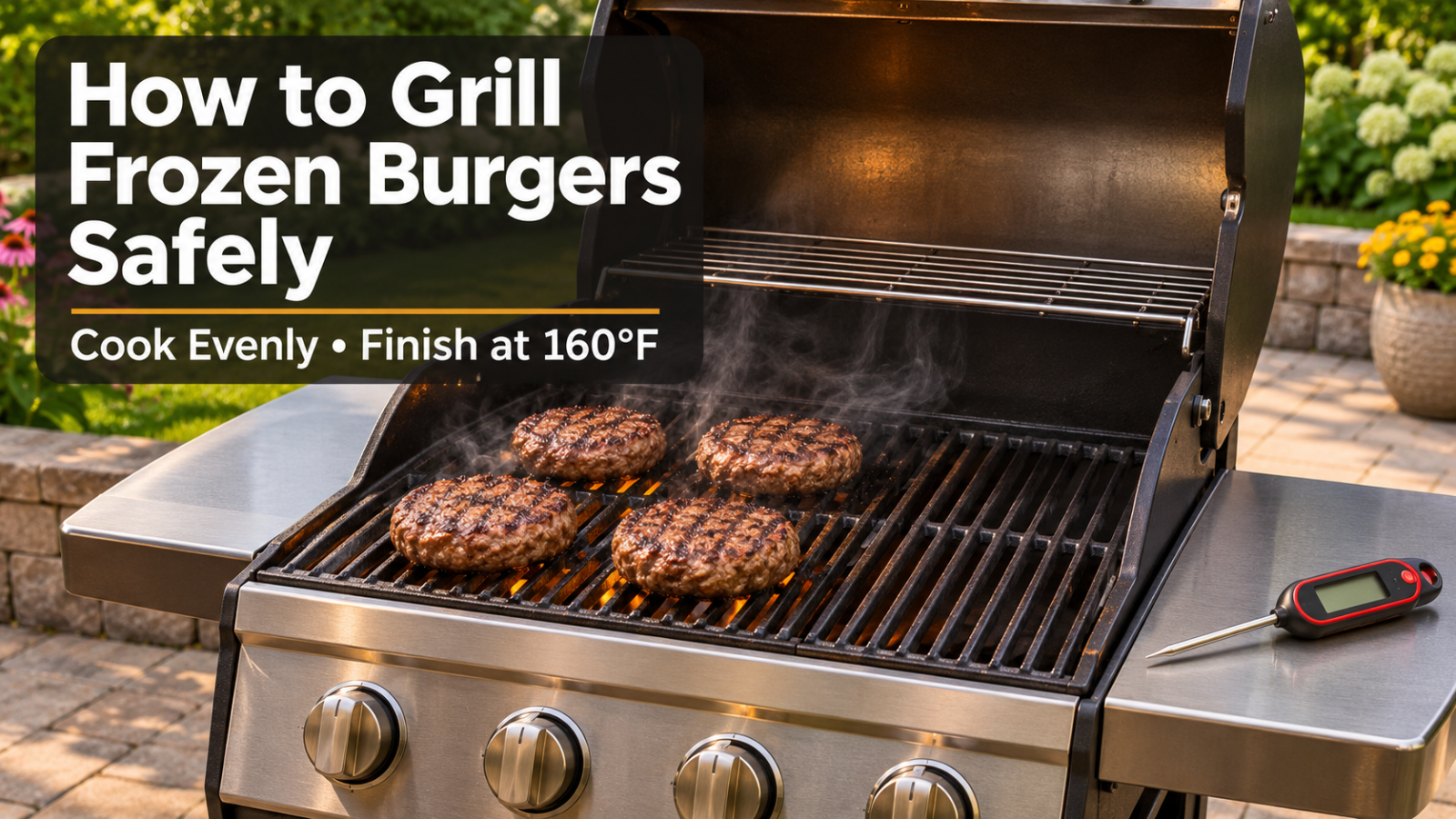
How to grill frozen burgers safely comes down to three things: moderate direct heat, enough time for the center to thaw and cook, and a thermometer reading of 160°F for ground beef. You do not need to thaw ordinary plain beef patties first, but you do need to remove every piece of packaging and cook by temperature rather than color.
Quick Answer: Preheat a clean grill to about 375–400°F and leave a cooler area available. Put unseasoned frozen beef patties over direct heat, close the lid, and cook for roughly 15–22 minutes, turning every 3–5 minutes after the patties release easily. Move them to the cooler side if the outside darkens too fast. Season after the first turn, add cheese near the end, and remove each burger only after an instant-read thermometer reaches 160°F in the center.
Key Points
- USDA guidance allows meat to be cooked from frozen, although it can take about 1.5 times as long as thawed meat.
- Ground beef must reach 160°F; ground poultry must reach 165°F.
- Use moderate direct heat and keep a cooler zone ready for flare-ups or fast browning.
- Turn frozen patties several times instead of waiting for one long sear on each side.
- Insert the thermometer from the side into the center of a thin patty and check more than one spot.
- Follow the package directions when a manufactured frozen burger gives specific cooking instructions.
Can You Put Frozen Burgers Straight on the Grill?
Yes. Plain frozen beef patties can go straight from the freezer to a fully preheated outdoor grill. The USDA Food Safety and Inspection Service says meat can be cooked from frozen and notes that cooking may take about one and a half times as long as cooking the same meat after thawing. Remove plastic film, paper dividers, absorbent pads, and cardboard before the patties reach the grate.
This method is meant for individual frozen patties that separate cleanly. If the burgers are frozen into one solid block, do not pry them apart with a knife over the grill. Thaw the block in the refrigerator until the patties can be separated without tearing. A microwave can also be used for thawing, but patties thawed that way should be cooked immediately.
Check the package before using a general method. Some frozen products contain cheese, fillings, breading, poultry, or a blend of meats. Their labels may call for a different grill setting, handling step, or final temperature. Package directions take priority for that product.
What Grill Temperature Works Best for Frozen Burgers?
A grate temperature near 375–400°F is a practical starting range. It is hot enough to brown the surface but moderate enough to give the frozen center time to cook. Very high heat can blacken the outside while the middle is still cold.
Set up two areas whenever the grill allows it. The direct side cooks and browns the patties. The cooler side gives you somewhere to move a burger if fat causes flames, the crust gets dark early, or one patty cooks faster than the rest.
- Gas grill: Preheat all burners, clean the grate, then lower the cooking burners to medium or medium-high. Leave one burner low or off for the cooler zone.
- Charcoal grill: Arrange lit coals over one-half to two-thirds of the charcoal grate. Leave the remaining area without coals.
- Pellet grill: Set the controller to 400°F and allow a complete preheat. A pellet grill has indirect heat, so browning may be lighter and cooking may take a few minutes longer. Use the model’s sear area only if the manual permits it.
Do not coat a hot grate with a cloud of aerosol cooking spray. If sticking is a concern, wipe the cold grate lightly with a high-heat oil before lighting, or brush a very thin film of oil on the frozen patty surface.
What Do You Need Before You Start?
You need frozen patties, simple seasoning, a clean two-zone grill, long tongs or a thin spatula, and an accurate instant-read thermometer. Having everything beside the grill matters because the lid should stay closed between turns.
Ingredients for Four Burgers
- 4 plain frozen beef patties, about 1/3 pound and 3/4 inch thick each
- 3/4 teaspoon kosher salt
- 1/2 teaspoon black pepper
- 4 cheese slices, optional
- 4 burger buns
- Lettuce, tomato, onion, pickles, mustard, ketchup, or other ready-to-serve toppings
Equipment
- Outdoor gas, charcoal, or pellet grill with a clean cooking grate
- Instant-read food thermometer with a thin probe
- Long-handled spatula or tongs
- Clean plate for cooked burgers
Do not put cooked patties back on the plate that held raw frozen beef. Even though the meat started frozen, its surface becomes raw and wet as soon as it warms.
How Do You Grill Frozen Burgers Step by Step?
Preheat the grill, separate the patties, cook them over moderate direct heat with several turns, and verify 160°F in the center. The thermometer decides when they are done; the clock is only a planning guide.
- Prepare the toppings first. Slice vegetables, open the buns, and set out condiments before handling the beef. Refrigerate cold toppings until serving time.
- Preheat the grill. Bring the grate to about 375–400°F. Clean it, then create a direct cooking side and a cooler side.
- Unwrap and separate the patties. Remove every divider and piece of packaging. Keep the burgers frozen until the grill is ready.
- Start over direct heat. Space the patties at least an inch apart and close the lid. Cook for about 4–5 minutes, or until the surface touching the grate releases without tearing.
- Turn and season. Flip the patties. Divide half the salt and pepper over the cooked surfaces. Close the lid and cook 3–4 minutes.
- Keep turning. Flip every 3–4 minutes so heat reaches the center without scorching one side. Season the second side after its first turn.
- Manage flare-ups. Move a patty to the cooler zone if flames rise around it. Close the lid and let the flames settle. Do not spray water onto a grease fire.
- Begin checking early. After about 14 minutes total, insert the thermometer from the side into the center of each patty. Check at least two spots on a thin burger.
- Finish to temperature. Return any undercooked patty to the grill. Remove beef burgers only at 160°F. Add cheese during the last 30–60 seconds and close the lid just long enough to melt it.
- Serve promptly. Transfer burgers to a clean plate. Toast the buns briefly if desired, then assemble and serve.
For the patties described here, 15–22 minutes is a reasonable estimate after preheating. Thin quarter-pound patties may finish sooner. Thick half-pound patties can take longer and are harder to cook evenly from frozen. Weather, grill type, patty composition, and actual grate temperature all change the schedule.
How Do You Check a Frozen Burger Without Guessing?
Use an instant-read thermometer from the side and push the tip into the center of the patty. The USDA says color is not a reliable doneness test and lists 160°F as the safe minimum for ground beef.
Side entry is important on a thin burger because it keeps more of the probe inside the meat. If you stab straight down from the top, the sensing area can pass through the center and read the hotter grate-facing surface. Check more than one spot, especially if the patty is irregular or stuffed.
Do not rely on brown juices, a firm feel, grill marks, or a gray center. Beef can brown before it is safe, and a safe burger can retain some pink. The site’s meat-thermometer guide explains side entry and multi-spot checks in more detail. The authority behind the number is the USDA FSIS hamburger safety guidance.
Should You Thaw Frozen Burgers First?
You do not have to thaw plain patties, but refrigerator thawing gives you faster cooking, more even browning, and easier seasoning. Grilling from frozen is most useful when dinner needs to start now or when you only want to cook part of a package.
| Method | Best Use | Main Tradeoff |
|---|---|---|
| Cook from frozen | Last-minute meal; individual patties | Longer cook and more turning |
| Thaw in refrigerator | Planned meal; best seasoning and browning | Requires advance time |
| Thaw in microwave | Fast backup when patties will be cooked immediately | Edges may begin cooking and texture can suffer |
Never thaw ground beef on the counter. If you thaw in cold water, keep the meat in a leakproof package, change the water every 30 minutes, and cook it immediately after thawing.
How Do You Keep Frozen Burgers From Burning or Drying Out?
Use moderate heat, turn several times, and move the burger away from direct fire when the crust is ready but the center is not. Pressing the patty with a spatula only squeezes out fat and moisture and can trigger flare-ups.
- Choose patties with some fat instead of extra-lean beef if juiciness matters.
- Do not start over maximum heat.
- Keep the lid closed between turns so the grill cooks from above as well as below.
- Use the cool zone rather than repeatedly opening the lid or lowering every burner.
- Stop cooking at 160°F instead of leaving the burger on for an arbitrary extra five minutes.
- Do not press, cut, or puncture the burger to inspect it.
If grease flames climb around the food, follow the site’s guide to preventing and controlling grill flare-ups. A cooler zone is especially useful with frozen patties because the surface can render fat before the center is finished.
Can You Use the Same Method for Turkey or Plant-Based Burgers?
No single temperature or schedule fits every product. Ground turkey and chicken must reach 165°F. Plant-based frozen burgers should be cooked according to their package directions because ingredients, thickness, and handling instructions vary by brand.
Keep meat and plant-based patties separate when cooking for someone who avoids meat. Use separate utensils and a clean section of grate if cross-contact matters. A turkey patty that looks pale is not necessarily undercooked, and a plant-based patty that looks pink is not necessarily raw; use the applicable temperature and label instructions.
What Mistakes Cause the Most Trouble?
The biggest mistakes are excessive heat, skipping the thermometer, forcing patties apart, and treating color as proof of safety. Most are easy to prevent with a two-zone setup and a little patience.
- Starting on a dirty grill: Old grease increases sticking, smoke, and flare-up risk.
- Leaving paper between patties: Paper can stick to the meat and reach the fire.
- Using steak doneness temperatures: Ground beef is not an intact steak; its minimum is 160°F.
- Cooking only by time: Patty thickness and grill temperature vary too much.
- Pressing the burgers: This loses juice and feeds flames.
- Adding sugary sauce too early: It can burn before the center is hot. Brush it on only near the end.
- Reusing the raw-meat plate: Move finished burgers to a clean plate.
How Should You Store and Reheat Leftover Burgers?
Refrigerate cooked burgers within two hours, use them within three to four days, and reheat leftovers to 165°F. Store patties separately from wet toppings so the buns and vegetables do not become soggy.
For reheating, place the patty in a covered skillet with a teaspoon of water, or warm it on a moderate grill over indirect heat. Check 165°F in the center. Add a fresh bun and cold toppings after the patty is hot.
Frequently Asked Questions
How long do frozen burgers take on a grill?
About 15–22 minutes is a useful estimate for frozen 1/3-pound beef patties on a 375–400°F grill. Thin patties may cook faster and thick patties may take longer. Always finish by temperature, not time.
Do you grill frozen burgers with the lid open or closed?
Keep the lid closed between turns. The trapped heat helps the center cook while the bottom browns. Open the lid to turn, move, season, and check temperature.
How often should you flip frozen burgers?
Make the first turn when the burger releases, usually after 4–5 minutes, then turn every 3–4 minutes. Several turns promote more even heating than one long cook per side.
Can you season a burger while it is frozen?
Seasoning does not stick well to an icy surface. Apply salt and pepper to each cooked face immediately after its first turn. If the patty surface is dry rather than frosty, a light coating can be added before grilling.
Why is my frozen burger burned outside but cold inside?
The direct heat is too high for the patty thickness. Move the burger to the cooler zone, close the lid, and let the center catch up. Next time, begin near 375–400°F rather than maximum heat.
Can you refreeze burgers after cooking them from frozen?
Yes. Meat cooked safely from frozen can be frozen again after cooking. Cool it promptly, wrap it well, and freeze it within the normal two-hour handling window.
Final Verdict: Is Grilling Frozen Burgers a Good Method?
Grilling frozen burgers is a safe and useful backup method when the patties are separated, the grill is kept at moderate heat, and each beef burger reaches 160°F. Thawed patties are easier to season and usually brown more evenly, but frozen patties can still make a good meal without a risky countertop thaw. Set up a cool zone, turn often, and let the thermometer—not the color or clock—make the final decision.
About the Author
Frank W. Roberts has been grilling since 1970 and brings more than five decades of backyard cooking and cookoff experience to Everything Grill Reviews. This guide combines established two-zone grilling practice with current USDA FSIS guidance for cooking from frozen and the 160°F minimum for ground beef. It does not claim a timed hands-on test on every grill or frozen-burger brand. Safety and method details were checked November 5, 2026.