
Updated: August 30, 2026
Updated and fact-checked: August 30, 2026 Set up a pellet grill after delivery by doing the work in this order: place it safely, pull every piece of packing material out of the firepot, prime the empty auger with food-grade pellets, run a high-heat burn-in with no food on the grates, then finish the shutdown cycle before you cook. Skip any of those and the first start often times out, smokes dirty, or puts packing foam and factory oil next to dinner.
Quick Answer: What should I do with a new pellet grill after delivery?
Assemble it outdoors, prime the auger until pellets drop into the firepot, then burn it in at high heat with the lid closed and no food on the grates. Most current manuals call for about 30 to 60 minutes at 350°F or higher after ignition, then a full shutdown cycle. Follow your model’s exact temperatures. Last verified August 30, 2026.
Key Points
- A new pellet grill ships with an empty auger. If you do not prime it, the igniter often times out before pellets reach the firepot.
- The first high-heat run is a burn-in, not a cook. Its job is to burn off manufacturing oil, packing residue, and factory dust.
- Use only food-grade hardwood BBQ pellets. Heating pellets, treated wood, and softwood stove pellets do not belong in a cooker.
- Plug into a grounded outdoor outlet. If you need an extension cord, manufacturers such as Traeger specify an outdoor-rated, grounded cord of at least 14 AWG on a GFCI outlet.
- Leave the grill plugged in through the entire shutdown cycle. Unplugging mid-cycle leaves unburned pellets in a hot firepot.
- The first real cook should be something forgiving, such as chicken thighs or a pork shoulder, not a competition brisket.
What to do before you open the box
Move the boxed grill to its outdoor spot before you assemble it. These cookers are heavy once the barrel, hopper, and cart are bolted together. Owners regularly report getting a finished grill stuck in a doorway or garage. Two people are the safe minimum for most mid-size models. Have these on hand before the truck leaves:
- The owner’s manual that shipped in the box, not a generic internet checklist.
- A grounded outdoor outlet. Confirm whether your model’s manual allows an extension cord.
- One 20-pound bag of food-grade hardwood pellets. Hickory, oak, or a competition blend is fine for burn-in.
- A bucket or bag for leftover packing bits and the first ash dump.
- A cover, if you bought one. Keep it off until the grill is cool and dry after burn-in.
Where should a pellet grill sit after delivery?
Put it outdoors on a level, non-combustible surface, clear of walls, eaves, and stored fuel. A pellet grill is an outdoor appliance with a live fire in a small firepot. It is not a patio heater and it is not an indoor cooker. Follow the clearance printed in your manual first. As a fire-code backdrop, NFPA 1 restricts many outdoor cooking appliances on balconies and under overhangs in multi-family buildings, and it keeps electrically powered outdoor cooking appliances a stated distance from the building unless the listing and the manufacturer say otherwise. Local codes can be stricter. If you live in an apartment or HOA, check the written rule before the first fire. Level matters more than people expect. An out-of-level barrel can send grease the wrong way, starve the firepot of airflow, or make the hopper lid sit proud so rain gets into the pellets. Lock the wheels once the grill is where it will live.
How do I unbox and assemble a pellet grill without creating a first-fire problem?
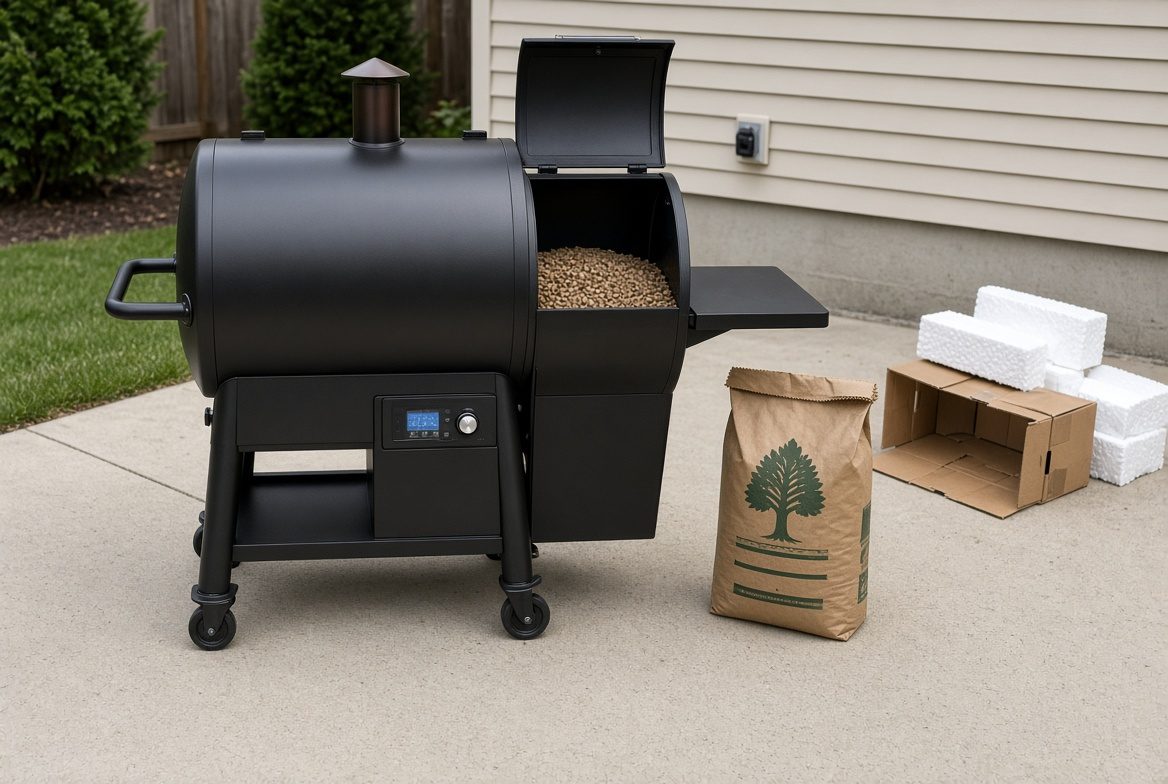
Get every foam block, zip tie, plastic bag, and paper sheet out of the barrel, hopper, and firepot before you plug the grill in. Styrofoam hides under the heat baffle and inside the firepot. Lighting that is a real fire, not a seasoning step.
- Inventory the hardware against the parts list before you start bolting. Missing legs or a bent hopper lid are easier to catch now than after the first fire.
- Assemble the cart and barrel per the manual. Do not fully tighten every bolt until the unit is square and the lid closes evenly.
- Install the heat baffle, drip tray, and grates only after you have looked into the empty firepot with a flashlight.
- Confirm the grease drain tube is seated and the bucket is hanging. A first burn-in still produces oil and ash.
- If the hopper has a dump chute or slide, close it before you pour pellets. An open dump dumps a $20 bag onto the patio.
Assembly time on current mid-size pellet grills commonly runs one to two hours with two people. That is not a race. Loose hardware shows up later as a wobbling hopper and a leaking grease path.
What power does a pellet grill need?
A pellet grill needs a grounded 120-volt outlet and a complete shutdown cycle. It is not a gas grill with a battery igniter. The controller, auger motor, draft fan, and hot-rod igniter all draw power. A weak cord or a tripped GFCI is one of the most common “it won’t start” calls on delivery day. Traeger’s current power-cord guidance is a useful baseline for many 120-volt pellet grills: use a GFCI outlet; if an extension cord is necessary, use an outdoor-rated cord with a ground pin and a minimum 14 AWG wire gauge; do not use a damaged cord. Check your own manual. Some brands are stricter and want the grill plugged directly into the wall. Do not remove the ground prong. Do not run the cord through a puddle. Do not daisy-chain two cheap indoor cords. If the outlet is on a shared kitchen circuit that already runs a fridge and a microwave, expect nuisance trips when the igniter kicks on.
Why do I have to prime the auger on a new pellet grill?
The auger tube ships empty. Priming fills that tube so pellets reach the firepot before the igniter times out. On many Pit Boss controllers the start cycle runs the igniter for a fixed window. If pellets have not arrived, the grill shuts down with no fire. That is a setup miss, not a broken grill. The same empty-tube problem returns any time the hopper runs dry. First use after delivery is simply the first time it happens. A typical priming sequence, used across several current manuals:
- Open the hopper and confirm there is no packing foam, tape, or hardware in the auger trough.
- Remove the grates, drip tray, and heat baffle so you can see the firepot.
- Pour food-grade pellets into the hopper. Do not dump the dusty fines from the bottom of a torn bag if you can help it. Dust packs an auger.
- Use the Prime, Feed, or Prime Auger function until you see or hear pellets drop into the firepot. Stop. Do not fill the pot to the rim.
- On brands that say so, run shutdown, then reinstall the internals before the burn-in fire.
Recteq’s published initial burn-in steps add one extra habit that helps on any brand: place only a small handful of pellets in the firepot by hand so the first ignition has fuel sitting on the hot rod while the auger is still catching up. Do not bury the air holes.
How do I burn in a pellet grill before the first cook?
Run the empty grill at high heat long enough to burn off manufacturing oil, then shut it down through the full cool-down cycle. Manufacturers call this seasoning, burn-in, or first-use burn-off. The purpose is the same. It is not the same process as seasoning a cast-iron skillet. Current manufacturer ranges, last verified August 30, 2026:
| Brand / series | Published first-use heat | Published time after it hits temp | Source type |
|---|---|---|---|
| Traeger WiFIRE models | 350°F for the first hold, then 450–500°F | 20 minutes at 350°F, then 30 minutes at 450–500°F | Traeger Support |
| Traeger Westwood series | 350°F, then 450°F | 15 minutes at 350°F, then 45 minutes at 450°F | Traeger Support |
| Pit Boss (current manuals) | Any setting over 350°F / 176°C | 30 to 40 minutes with the lid closed | Pit Boss owner manuals |
| Camp Chef Woodwind Pro | 350°F after FEED and a clean-out of extra pellets | 30 minutes with the lid closed | Woodwind Pro manual |
| recteq | 400°F after priming the firepot | One hour once it settles at 400°F | recteq Support |
A practical sequence that stays inside those published ranges:
- Prime the auger and put the heat baffle, drip tray, and grates back in.
- Open the lid for the ignition cycle if your manual says to. Many controllers want extra oxygen until the fire is established.
- When you see steady smoke and hear combustion, close the lid and set the published burn-in temperature.
- Start the timer only after the grill reaches that temperature, not when you press Ignite.
- Expect an odd smell, darker smoke than usual, and some ash. Traeger states that smell is normal while factory mineral oil burns off.
- When the hold time is done, run Shutdown. Leave the grill plugged in until the fan stops.
Washing the grates with mild soap and water before the burn-in is a common manufacturer step, including on recteq’s published first-cook page. A thin coat of high-smoke-point oil on the grates is optional. Several pellet brands do not require oiling the barrel walls. Do not soak the drip tray in oil. Extra oil makes a greasy first fire, not a better seasoning layer.
Do I need to pair the app before the first fire?
No. The grill will burn in without Wi-Fi. Pair the app after the fire is behaving, not instead of priming the auger. App pairing is useful. It is not the start-up procedure. If you do pair on day one, most current Wi-Fi pellet grills want a 2.4 GHz network. Traeger’s published WiFIRE requirements are typical: 2.4 GHz only, a short network name without special characters, and a usable signal at the grill. Mesh routers that hide both bands under one name often confuse pairing. Finish burn-in first. Fight the router later.
What pellets should I use for the first fire?
Use food-grade hardwood BBQ pellets, never heating-stove pellets. Heating pellets can include softwood, bark, binders, or recycled construction wood. That is the wrong smoke to put on food, and it can foul an auger. For burn-in, flavor barely matters. A plain oak, hickory, or “competition blend” bag is enough. Save the expensive cherry for the first real cook if you want. Keep the bag sealed and off a damp patio. Wet pellets swell, turn to mush, and jam the first week’s cooks. Do not mix a half-bag of mystery pellets from a friend into a fresh hopper until you know they are food-grade and dry. Dust and broken pellets are a first-week jam waiting to happen.
What should the first cook be after burn-in?
Cook something that can stand a temperature swing, not a $100 brisket. A new controller, a new probe, a new backyard wind pattern, and a cook you have never run on this machine do not belong on the same Saturday. Better first cooks:
- Bone-in chicken thighs to 165°F in the thickest piece, measured with a thermometer, not by color. USDA lists 165°F as the safe minimum for all poultry.
- A pork shoulder or picnic that can ride through a stall if the grill hunts a little.
- A pan of wings or sausage, so you learn lid-open recovery without wrecking dinner.
Leave the lid closed. Every peek dumps heat and makes the controller dump extra pellets. That extra fuel is how first-week owners get a sooty cook and then blame the brand. If you want cleaner smoke after burn-in, start the first food cook at a moderate set point and give the fire time to settle before the meat goes on. Thick white smoke on a brand-new grill is often leftover oil and a rich fire, not “more flavor.” For the difference between useful smoke and dirty smoke, see thin blue smoke versus white smoke.
What first-week problems mean the setup is wrong?
Most delivery-day failures are empty-auger, wet-pellet, packing-material, or power problems, not a dead controller. Work from the easy checks to the serious ones.
| What you see | Likely first-week cause | Safe first check |
|---|---|---|
| Igniter runs, then the grill shuts down with no fire | Auger never primed | Unplug when cool. Look in the firepot. Prime until pellets drop, then restart. |
| Controller never wakes up | No power, GFCI trip, or rear switch still off | Try a known-good grounded outlet. Check the hopper-side or rear power switch. |
| Heavy chemical smell after 20 minutes | Normal burn-in of factory oil, or leftover packing film | If the smell is sharp plastic, shut down, cool, and inspect for foam or film. |
| Temperature hangs 80–100°F below the set point | Lid left open, wind, or wet pellets | Close the lid. Feel a pellet. Soft or dusty pellets need to be dumped. |
| Grease on the patio, not in the bucket | Drip tray or drain tube not seated after shipping | Cool the grill. Reseat the tray and hang the bucket before the next fire. |
| App will not connect | 5 GHz Wi-Fi or a weak patio signal | Cook from the controller. Pair later on 2.4 GHz. |
Stop and get the brand’s service line involved if the hot rod never glows on a cold start, the auger motor never turns with pellets in the hopper, or you smell hot electrical insulation. Do not bypass a safety switch or jumper a failed igniter to “just get through the weekend.”
How should I shut the grill down after burn-in?
Use the published shutdown cycle and leave the cord plugged in until the fan stops. Shutdown is not the same as flipping a rear switch. The fan needs to burn down the firepot and cool the hopper so pellets do not smolder in the auger tube. After the fan stops and the grill is cool:
- Dump the first ash from the firepot or ash cup. First-fire ash is mostly paper-dry and easy to miss if you wait a week.
- Wipe the drip tray if factory oil baked into a sticky film.
- Confirm the hopper lid still seals. A warped lid after a high-heat run is uncommon, but it is cheaper to catch now.
- Cover the grill only when it is fully cool.
Frank’s Take
The first fire is a systems check, not a party. After 50-plus years of lighting cookers, I still treat a new firepot like it might hide packing foam. I want to see pellets drop, hear the fan, and watch the first smoke turn from ugly to usable before any meat goes on. That hour costs a couple dollars of pellets. It saves the first weekend. A pellet grill also changes how you manage fire compared with charcoal. The cooker feeds itself. Your job is placement, dry fuel, a primed auger, and a shutdown you do not short-circuit. If you bought the pellet grill because you wanted less fire-tending than a charcoal kettle, this setup sequence is how you actually get that. For the flavor tradeoff that comes with that convenience, see pellet grill smoke versus charcoal smoke and pellet grill versus charcoal grill.
Final Verdict: Is a new pellet grill ready to cook right after delivery?
No. It is ready to assemble, prime, and burn in. It is ready to cook after that cycle finishes and the grill has cooled or been reset for a real preheat. The owners who struggle on Saturday morning usually skipped priming, used an indoor extension cord, left foam in the firepot, or put food on during the oil burn-off. Do the setup once. The second start is the easy one.
Frequently Asked Questions
How long does it take to set up a pellet grill after delivery?
Plan on two to four hours from box to a finished burn-in, not counting cooling time. Assembly is commonly one to two hours with two people. Priming takes a few minutes. The burn-in itself runs 30 to 90 minutes of heat, plus a 10 to 30 minute shutdown cycle, depending on the brand.
Can I cook on a pellet grill the same day it arrives?
Yes, after the burn-in and shutdown are finished. You do not have to wait overnight. You do have to finish the high-heat cycle and let the controller complete shutdown before you start a food cook. Putting chicken on while factory oil is still burning off is how the first meal tastes like a hardware store.
Do I have to use the same brand of pellets as the grill?
No, but you do have to use food-grade BBQ pellets that stay dry and feed cleanly. Some warranties push house-brand pellets. The safety line that actually matters is food-grade hardwood versus heating-stove pellets. Cheap, dusty bags jam augers on any brand.
Why did my new pellet grill time out on the first start?
The igniter ran its timed cycle before pellets reached the firepot. Prime the auger until you see pellets drop, put a small handful in the pot if the manual allows it, then start the ignition cycle again. Do not keep restarting on an empty tube.
Is the smoke during burn-in supposed to smell bad?
Yes. A chemical or oily smell on the first high-heat run is the usual factory-oil burn-off. Traeger’s support pages call that smell normal. If you see melting plastic or packing foam, shut the grill down, let it cool, and pull the internals before you light it again.
Can I use an extension cord with a pellet grill?
Only if your manual allows it, and only with a short outdoor-rated grounded cord. Traeger’s published minimum is 14 AWG with a ground pin on a GFCI outlet. A thin indoor cord is a voltage-drop problem and a heat problem. Direct-to-outlet is still the cleanest setup.
Related Reading
- Pellet Grill vs. Charcoal Grill: Which Is Right for You?
- Pellet Grill Smoke vs Charcoal Smoke: Which Tastes Better?
- Thin Blue Smoke vs White Smoke for Barbecue Cooking
- What Is Traeger Super Smoke Mode? How to Use It
- Camp Chef Woodwind Pro 24 Review
Manufacturer first-use references: Traeger WiFIRE seasoning, recteq initial burn-in, Traeger power-cord and extension-cord guidance, NFPA outdoor cooking location notes, and the USDA safe temperature chart.
About Frank W. Roberts
Frank W. Roberts is the author of Everything Grill Reviews. He has grilled since 1970 and brings more than 50 years of backyard cooking and cookoff experience to fire management, fuel behavior, smoke, and practical cooker use. This article is based on current manufacturer first-use instructions, fire-code and food-safety references, and long experience lighting new cookers. It is not a hands-on test of every pellet grill named here. Last verified August 30, 2026.