
Updated: September 18, 2026
Updated and fact-checked: September 17, 2026
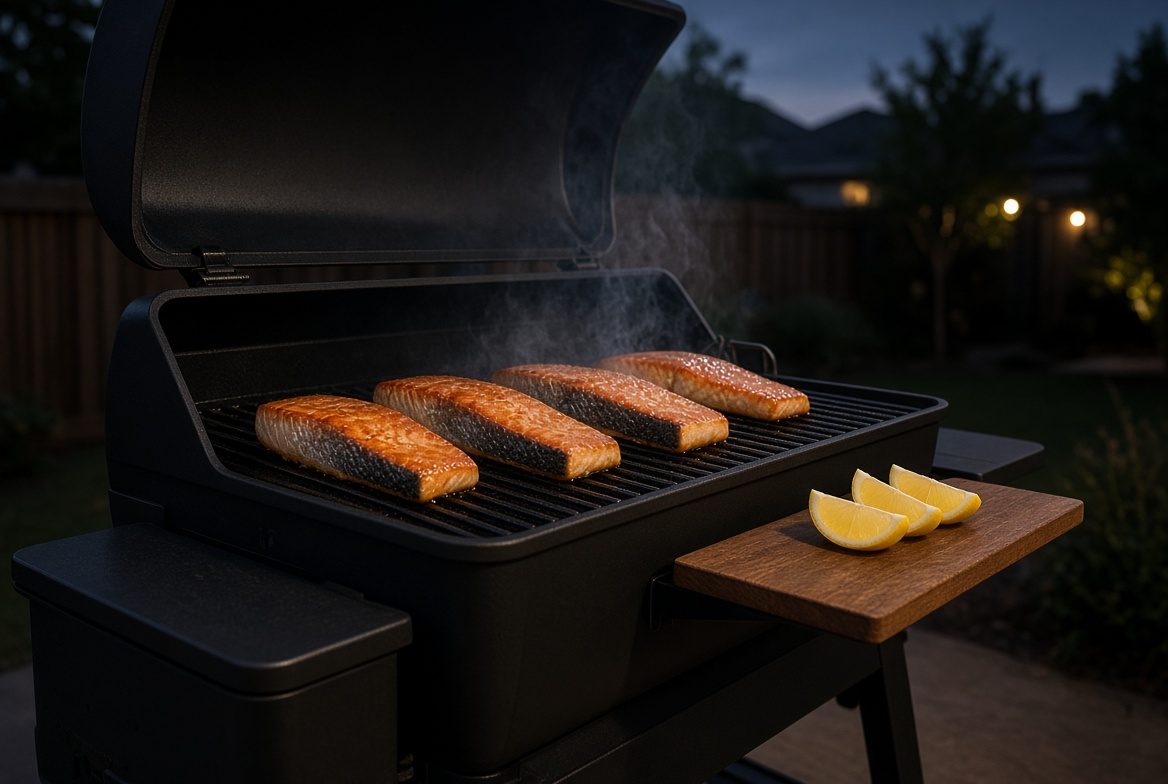
Pellet grill salmon is a short cook at 350°F until the thickest part of the fillet reaches 145°F. Skin-on fillets, a dry surface, mild wood, and a thermometer keep the fish from drying out. Time is only an estimate. Thickness, starting temperature, weather, and how often the lid opens all change the clock.
Quick Answer: How Do You Cook Salmon on a Pellet Grill?
Preheat the pellet grill to 350°F, place skin-on fillets skin-side down, and cook until the thickest part reaches 145°F. Plan on about 15–25 minutes after preheat for typical 1-inch fillets. Do not flip unless the skin is already off. The USDA safe minimum for fish is 145°F; the chart does not require a rest for fish.
Key Points
- Set the pellet grill to 350°F after a full preheat with the lid closed.
- Use skin-on fillets when you can. The skin protects the flesh and makes the fish easier to lift.
- The USDA and FoodSafety.gov safe minimum for fish is 145°F in the thickest part, measured with a food thermometer before the fish leaves the heat.
- Color alone is not a safety test. Albumin (the white protein beads) can show up before or after 145°F.
- Mild pellets such as alder, apple, or cherry suit salmon better than a heavy hickory load on a short cook.
- Leftover salmon must be refrigerated within 2 hours and reheated to 165°F if you reheat it.
Pellet Grill Salmon Recipe at a Glance
| Recipe detail | Target |
|---|---|
| Yield | 4 fillets, about 6 oz each |
| Prep time | About 10 minutes |
| Pellet grill setting | 350°F |
| Estimated grill time after preheat | 15–25 minutes for 3/4- to 1-inch fillets |
| Safe finish temperature | 145°F in the thickest part |
| USDA rest on the fish chart | None required |
| Pellets | Alder, apple, cherry, or a mild blend |
What Ingredients Do You Need for Pellet Grill Salmon?
You need four salmon fillets, a little oil or butter, salt, and pepper. Keep extras optional so the wood and the fish stay in front.
Salmon
- 4 salmon fillets, about 6 ounces each, 3/4 to 1 inch thick, skin on if available
- 1 tablespoon olive oil or melted butter
- 1 teaspoon kosher salt
- 1/2 teaspoon black pepper
Optional finish
- Lemon wedges
- 1/4 teaspoon garlic powder
- 1 teaspoon brown sugar or a thin maple brush for a light glaze
- Fresh dill or parsley after cooking
Equipment
- Pellet grill preheated to 350°F
- Instant-read or leave-in probe thermometer
- Wide spatula
- Paper towels
- Clean platter and foil only if you want a short hold after cooking
How Do You Cook Salmon on a Pellet Grill at 350°F?
Pat the fillets dry, season them, preheat to 350°F, cook skin-side down, and pull them at 145°F in the thickest part. Do not treat this like pork shoulder. You are not waiting for probe-tender collagen.
- Keep raw salmon cold until you are ready to season it. Separate it from ready-to-eat food on the cutting board.
- Pat both sides dry. Moisture on the surface steams instead of taking smoke and color.
- Brush with oil or melted butter. Season with salt and pepper. Add garlic powder or a light dusting of brown sugar only if you want that extra layer.
- Preheat the pellet grill to 350°F with the lid closed. Give the grates time to come up, not just the air around the probe.
- Place the fillets skin-side down on a clean grate with space between them. Close the lid.
- Cook without flipping if the skin is on. Check early. Thin tail pieces finish faster than a thick center cut.
- Insert the thermometer into the thickest part from the side, staying off the grate and off any bone.
- Remove the fillets when that center reading is 145°F and the flesh is opaque and flakes with a fork. Lift with a wide spatula so the fillet stays in one piece.
- Serve with lemon. A couple of minutes on the platter is enough. Fish does not need the 3-minute USDA rest that whole beef, pork, lamb, and veal cuts need.
What Internal Temperature Is Salmon Done?
The USDA safe minimum for fish and shellfish is 145°F, measured in the thickest part before the fish leaves the heat. FoodSafety.gov also accepts the visual cue of flesh that is no longer translucent and separates easily with a fork, but a thermometer is the reliable check on a grill.
The published USDA chart attaches a required rest to whole beef, pork, lamb, and veal cuts (145°F plus 3 minutes). It does not attach that rest to fish. Do not pull salmon early and hope carryover heat will finish the safety job. Measure on the grill.
Some restaurant cooks serve salmon well below 145°F for a softer, more translucent center. That is a texture preference, not the USDA minimum. Children, older adults, pregnant people, and anyone with a weakened immune system should stay with 145°F. See the USDA safe-temperature chart and the FoodSafety.gov temperature chart.
| Food | USDA minimum | Required rest on the chart |
|---|---|---|
| Fish (salmon fillet or steak) | 145°F | None |
| Beef, pork, lamb, veal steaks, chops, roasts | 145°F | At least 3 minutes |
| Ground meat | 160°F | None |
| Poultry | 165°F | None |
| Leftovers | 165°F | None |
For probe placement on thin food, use the same side-entry method described in how to use a meat thermometer on a grill.
How Long Does Salmon Take on a Pellet Grill at 350°F?
Most 3/4- to 1-inch fillets finish in about 15–25 minutes after the grill is preheated to 350°F. That range is a planning estimate, not a promise. A cold, thick center-cut piece in windy weather runs longer. A thin tail piece can pass 145°F in well under 15 minutes.
| Fillet thickness | Planning range at 350°F after preheat | Watch-out |
|---|---|---|
| About 1/2 inch | 10–15 minutes | Check early; thin fish overcooks in a closed cooker |
| About 3/4 to 1 inch | 15–25 minutes | Typical grocery fillet |
| Thicker than 1 1/4 inches | 25–35 minutes | Probe the center, not the thin edge |
Which Pellets Work Best for Salmon?
Mild fruitwood or alder is the better default on a 20-minute salmon cook. Heavy hickory or mesquite can dominate a delicate fillet before the center is even done. Oak is acceptable if that is already in the hopper. You do not need a special “fish pellet” bag.
| Pellet wood | General strength | Fit for this cook |
|---|---|---|
| Alder | Mild | Traditional pairing with salmon |
| Apple or cherry | Mild to moderate | Clean flavor without covering the fish |
| Oak or competition blend | Moderate | Fine if already loaded |
| Hickory or mesquite | Strong | Easy to overdo on a short fish cook |
A pellet grill makes the most smoke while it is producing clean combustion, not while it is pouring thick white smoke. If you want a longer low-smoke stage first, that is a different method than this 350°F weeknight cook. Traeger’s Super Smoke mode, where a model supports it, is built for lower set points, not for a 350°F finish. See what Traeger Super Smoke mode is and how to use it.
Should You Flip Salmon on a Pellet Grill?
No, not when the skin is still on. Skin-side down is the stable position. Flipping risks tearing the fillet and exposing the presentation side to the grate. If you bought skinless fillets, oil the grate well and use a wide spatula once, only if the fish is sticking. A small sheet of heavy-duty foil or a fish-safe grill mat is a practical backup for skinless pieces, but it reduces direct smoke on that surface.
Can You Cook Frozen Salmon on a Pellet Grill?
Thaw it first for even doneness. A frozen center lags while the thin edges race past 145°F. Thaw in the refrigerator, not on the counter. Pat the surface dry after thawing so ice melt does not steam on the grate. If you must cook from frozen in a pinch, expect a longer time, check several spots, and accept less even texture.
What Are the Common Pellet Grill Salmon Mistakes?
The usual failure is leaving the fish on until it looks dry and chalky. Salmon goes from moist to overcooked in a short window at 350°F.
| Problem | Likely cause | Fix next time |
|---|---|---|
| Dry, chalky fish | Cooked well past 145°F or left on by the clock | Probe early; pull at 145°F |
| Fish stuck and torn | Skinless fillet on a dirty or cold grate, or flipped too soon | Use skin-on fish, preheat fully, lift with a wide spatula |
| Bitter or harsh smoke | Dirty firepot, wet pellets, or a heavy wood on a short cook | Clean the cooker, use dry mild pellets |
| Uneven doneness | Mixed thicknesses on one grate, or probe placed in the thin tail | Group similar pieces; measure the thickest center |
| White protein all over the surface | Albumin squeezed out by heat; common and not a failure by itself | Do not keep cooking just because you see it; trust the thermometer |
How Do You Store and Reheat Leftover Salmon?
Refrigerate cooked salmon within 2 hours, eat it within 3–4 days or freeze it, and reheat leftovers to 165°F. USDA leftover guidance is 165°F, not 145°F. That higher number applies because the fish has already been cooked and then cooled. Cold leftover salmon in a salad does not need a second trip through 165°F if it was handled safely and kept cold, but any reheated portion should reach 165°F. See USDA leftover food safety.
A short rest on the platter is not the same as holding fish in the danger zone. Do not leave cooked salmon out on the picnic table for the afternoon. The rest discussion for steaks and chops is covered separately in how to rest meat after grilling.
Final Verdict: Is Pellet Grill Salmon Worth Cooking at 350°F?
Yes, for a weeknight fillet that needs smoke and a reliable finish without a long smoke schedule. 350°F is hot enough to cook through in a practical window and mild enough that most pellet grills can hold it. It is not a cedar-plank showpiece and it is not cold-smoked lox. Use the thermometer, keep the wood mild, and stop at 145°F.
Frequently Asked Questions
What temperature should you cook salmon on a pellet grill?
350°F is a dependable set point for skin-on fillets. Lower set points add more smoke time but also give the fish a longer window to dry if you lose track of internal temperature. Higher set points shrink the margin for error on thin pieces.
What internal temperature is salmon done?
145°F in the thickest part is the USDA safe minimum for fish. The flesh should also be opaque and flake with a fork. Serving salmon below 145°F is a texture choice, not the published safety number.
Do you need to rest salmon after grilling?
The USDA fish chart does not require a rest. A couple of minutes on the platter makes serving easier. Do not confuse that with the required 3-minute rest for whole beef, pork, lamb, and veal cuts.
Should salmon be skin-side down on a pellet grill?
Yes, when the skin is still on. The skin shields the flesh, reduces sticking, and gives you a handle for the spatula. You can serve it with or without the skin.
Can you use a cedar plank on a pellet grill?
Yes, if the plank is sold for cooking, soaked as the maker directs, and used within the grill’s published temperature limits. A plank changes heat transfer and can hide a stall under the fish, so you still probe the thickest part to 145°F. This article’s default method is the bare grate at 350°F.
Why is my smoked salmon still dark pink?
Salmon stays pink even when it is cooked. Color is not a safety test. Smoke and the natural pigment of the fish both keep a cooked fillet looking pink. Trust 145°F and the flake test, not the shade.
Can you cook trout the same way?
Yes for temperature. Trout is also fish under the USDA 145°F rule. Whole small trout may cook faster than a thick salmon fillet. Probe the thickest meat along the backbone and pull at 145°F.
Related Reading
- How to Use a Meat Thermometer Correctly on a Grill or Smoker
- How to Rest Meat After Grilling
- Smoked Meatloaf on a Pellet Grill
- How to Get Crispy Chicken Skin on a Pellet Grill
- What Is Traeger Super Smoke Mode?
About Frank W. Roberts
Frank W. Roberts is the author of Everything Grill Reviews. He has grilled since 1970 and brings more than 50 years of backyard cooking and cookoff experience to fire management, fuel behavior, smoke, and practical cooker use. This recipe is based on established fish-cooking technique, current USDA and FoodSafety.gov temperature guidance, and published pellet-grill methods. It is not presented as a documented cook-test of one named grill model. Last verified September 17, 2026.