
Updated: November 1, 2026
Updated and fact-checked: November 1, 2026
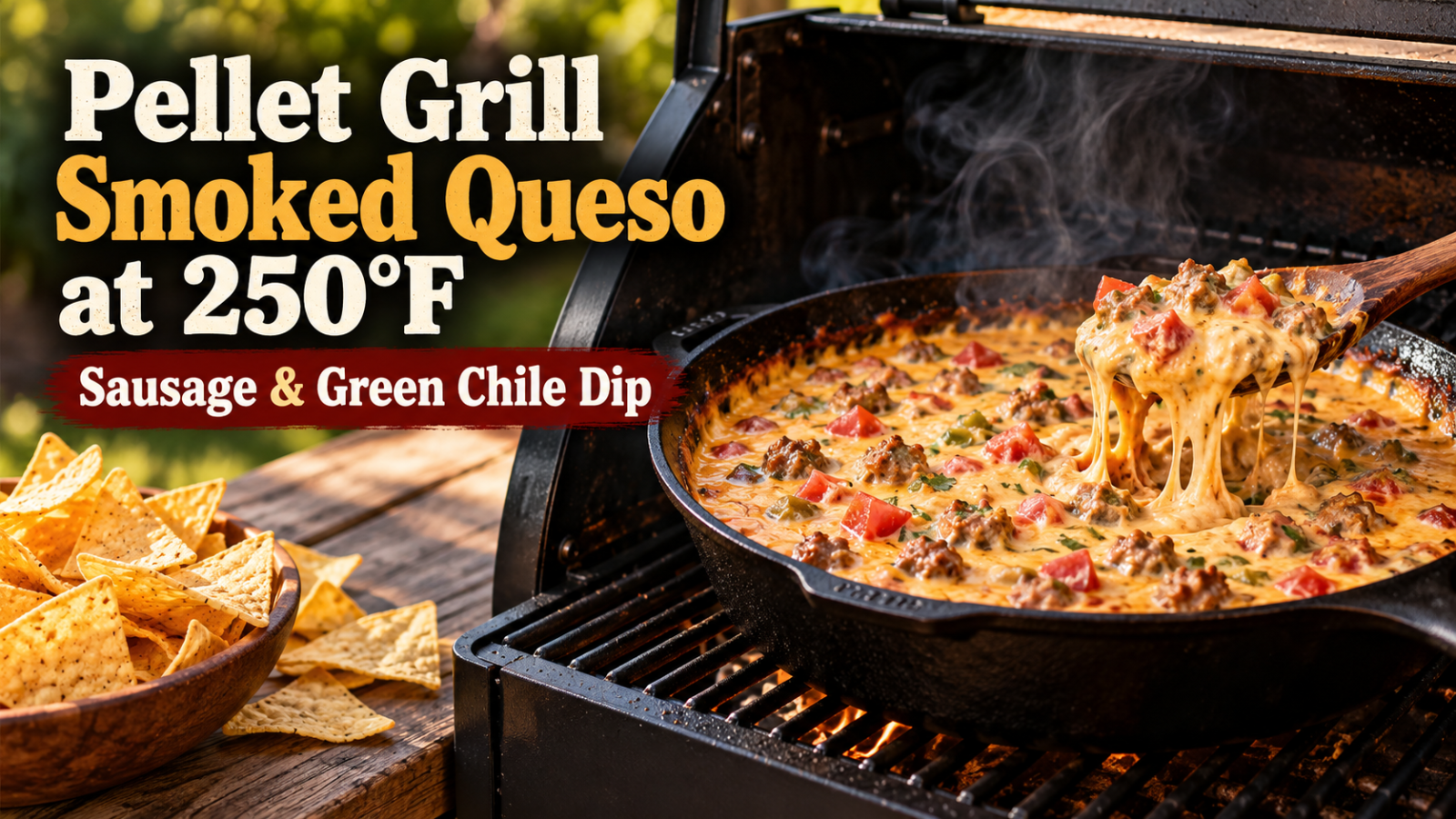
Pellet grill smoked queso at 250°F is a low-stress party dip with browned sausage, green chiles, tomatoes, and enough processed cheese to stay smooth while it picks up light wood smoke. Cook the sausage first, stir the pan every 20 minutes, and stop when the center reaches 165°F and the queso flows slowly from a spoon.
Quick Answer: How Do You Make Pellet Grill Smoked Queso at 250°F?
Brown 1 pound of sausage to 160°F, drain it, then combine it with cubed cheese, tomatoes, chiles, onion, jalapeño, and seasoning. Smoke uncovered at 250°F for 60 to 90 minutes, stirring every 20 minutes, until smooth, bubbling, and 165°F in the center. Thin with warm milk as needed.
Key Points
- Yield: About 12 appetizer servings.
- Prep time: 20 minutes.
- Pellet grill temperature: 250°F.
- Estimated cook time: 60 to 90 minutes after preheating.
- Sausage doneness: 160°F before it goes into the queso.
- Finished dip target: 165°F in the center, fully melted, and smooth.
- Best pellets: Pecan, hickory, mesquite blend, or a balanced competition blend.
- Safe service: Hold at 140°F or hotter; refrigerate within 2 hours, or 1 hour above 90°F.
What Ingredients Do You Need for Smoked Queso?
You need cooked sausage, processed cheese for a stable base, pepper jack for flavor, cream cheese for body, canned tomatoes and chiles, fresh aromatics, milk, and simple spices. These quantities make a large party pan without turning the dip into a solid cheese block.
Ingredients
- 1 pound ground pork breakfast sausage, mild or hot
- 32 ounces processed American cheese loaf, cut into 1-inch cubes
- 8 ounces pepper jack cheese, shredded or cut into small cubes
- 8 ounces cream cheese, cut into 1-inch cubes
- 2 cans diced tomatoes and green chiles, 10 ounces each, not drained
- 1 can diced green chiles, 4 ounces, not drained
- 1 small yellow onion, finely diced, about 1 cup
- 1 jalapeño, seeded and finely diced; leave some seeds for more heat
- 2 garlic cloves, minced
- 1/2 cup whole milk, warmed, plus up to 1/2 cup more as needed
- 1 teaspoon ground cumin
- 1 teaspoon smoked paprika
- 1/2 teaspoon ground black pepper
- 1/4 teaspoon cayenne pepper, optional
- 2 tablespoons chopped cilantro or sliced green onion for garnish, optional
- Tortilla chips, sliced bell peppers, celery, or toasted bread for serving
Equipment
- Pellet grill with enough dry cooking pellets for preheat plus 2 hours
- 12-inch cast-iron skillet, 4- to 5-quart Dutch oven without the lid, or 9-by-13-inch grill-safe pan
- Skillet for browning the sausage
- Heatproof spoon or spatula
- Instant-read food thermometer
- Slow cooker or warming tray for holding, optional
A 12-inch skillet makes a thick but stirrable layer. A wide 9-by-13-inch pan exposes more surface to smoke and usually melts faster. If you use a disposable foil pan, support it with a rigid sheet pan while carrying it and remove that support before cooking unless it is rated for the grill.
How Do You Make Smoked Queso Step by Step?
Cook the sausage and vegetables first, combine them with the cheeses and canned ingredients, then smoke the open pan at 250°F until the center reaches 165°F. Stirring every 20 minutes prevents a thick skin and moves the cooler cubes into the hot sauce.
- Preheat the pellet grill. Set the controller to 250°F, close the lid, and let the grill complete its start-up cycle.
- Brown the sausage. Put the sausage in a skillet over medium heat. Break it into small crumbles and cook until no pink remains and the center of the largest pieces reaches 160°F, about 8 to 10 minutes.
- Cook the aromatics. Add the diced onion and jalapeño to the sausage. Cook for 4 to 5 minutes, then add the garlic for the final 30 seconds.
- Drain excess grease. Spoon off or carefully drain most of the rendered fat. A little adds flavor; a pool of grease makes the queso separate.
- Fill the pan. Add the processed cheese, pepper jack, cream cheese, tomatoes and green chiles, extra green chiles, sausage mixture, cumin, smoked paprika, black pepper, and cayenne.
- Add the first milk. Pour in 1/2 cup warm milk. Do not add the entire optional amount yet.
- Smoke uncovered. Put the pan on the center of the grill grate. Close the lid and cook for 20 minutes.
- Stir thoroughly. Scrape the bottom and fold the softening cheese from the edges toward the middle. Repeat every 20 minutes.
- Adjust the texture. After 60 minutes, stir in warm milk 2 tablespoons at a time if the queso is thicker than you want.
- Finish by temperature. Remove the pan when the dip is smooth, bubbles gently in the center, and reads 165°F in several spots. Most pans take 60 to 90 minutes.
- Rest briefly. Let the queso stand for 5 minutes, stir once more, garnish, and serve.
The clock is a planning range. A deep Dutch oven, cold ingredients, winter weather, or a grill that runs below its setting can add time. A shallow pan on a warm day can finish sooner. Use the thermometer and texture together.
Why Cook Smoked Queso at 250°F?
At 250°F, the cheese melts steadily, the open surface gets time with clean smoke, and the edges are less likely to scorch than they are at high baking temperatures. It is warm enough to bring the mixed dip safely to 165°F without turning the cook into an all-afternoon project.
Published manufacturer methods use a useful range. Camp Chef’s smoked queso guidance uses 250°F for about 1 to 2 hours, while Traeger publishes versions at 225°F and 350°F. The lower methods favor smoke time; the hotter ones favor speed. This recipe uses 250°F as the middle ground.
See Traeger’s smoked queso recipe for a manufacturer example using a lower smoke setting and regular stirring. The ingredient quantities and 250°F method in this article are a separate original recipe.
Why Use Processed Cheese in Smoked Queso?
Processed American cheese melts smoothly because emulsifying salts help fat and water stay together. Pepper jack supplies sharper flavor, while cream cheese adds body. Using only natural shredded cheese makes the dip more likely to become oily or grainy.
This is party queso, not a cheese board. The processed base is doing a job. If you prefer a stronger natural-cheese flavor, replace up to 8 ounces of the processed cheese with cheddar or Monterey Jack. Replacing all 32 ounces changes the recipe and may require a roux or sodium citrate to stay smooth.
Shred block pepper jack yourself when practical. Pre-shredded cheese often carries anti-caking powder that can slightly dull the texture. It will still work; it simply may need more stirring.
How Do You Keep Smoked Queso Smooth Instead of Grainy?
Use a processed-cheese base, keep the cooker near 250°F, stir from the bottom every 20 minutes, drain excess sausage fat, and add only warm milk. Do not let the edges boil hard or the pan sit unstirred over a hot spot.
- Cut cheese evenly: Small, similar cubes melt at the same pace.
- Warm the milk: Cold liquid can tighten the mixture and slow melting.
- Stir before adding more liquid: Partially melted cubes make the pan look thicker than it will be when finished.
- Move the pan if one edge bubbles hard: Pellet grills can have hotter areas near the firepot or grease-tray gaps.
- Keep the heat moderate: High heat can squeeze fat from natural cheese.
- Serve warm: Every queso thickens as it cools.
How Much Smoke Flavor Should Queso Have?
Queso should have a light, clean wood-smoke background, not the bitterness of a dirty fire or an overfilled smoke tube. Cheese and fat absorb smoke readily, so 60 to 90 minutes in an open pan is usually enough.
Pecan and a balanced blend are safe starting points. Hickory gives the sausage a familiar barbecue note. Frank prefers mesquite, and a mesquite blend can work well here, but straight mesquite may become sharp if the grill produces heavy smoke. Use it sparingly the first time.
| Pellet choice | Smoke strength | Best fit |
|---|---|---|
| Pecan | Mild to medium | Balanced with cheese and sausage |
| Hickory | Medium to strong | Bold barbecue flavor |
| Mesquite blend | Strong | Use when the dip needs a definite smoke note |
| Apple or cherry | Mild | Gentler queso for a mixed crowd |
| Competition blend | Medium | Good first batch when the exact wood is unknown |
If your grill normally produces mild food, read how to get more smoke flavor from a pellet grill. Use dry pellets and clean airflow before adding an accessory. Thick white smoke does not improve queso.
How Spicy Is This Sausage and Green Chile Queso?
With mild sausage, one seeded jalapeño, and standard diced green chiles, the dip is mild to medium. Choose hot sausage, keep jalapeño seeds, or add cayenne for more heat; omit the jalapeño and cayenne for a gentler crowd version.
Heat varies between fresh peppers. Taste a tiny piece of jalapeño before adding it, and wear gloves if your skin is sensitive. Keep a small portion mild before turning up the rest of the pan for guests who want more spice.
How Do You Thin Queso Without Making It Watery?
Stir in warm whole milk 2 tablespoons at a time after the cheese is fully melted. Wait until each addition is mixed before deciding whether it needs more.
Queso thickens as it cools, so make it slightly looser than the final texture you want. Milk is the most neutral choice. Evaporated milk makes the dip richer, while a mild lager adds flavor but less creaminess. Water works in an emergency, but too much makes the cheese taste flat.
If the dip becomes too thin, leave it uncovered at 250°F for another 10 to 15 minutes and stir. Do not add flour directly to hot queso; it clumps and can taste raw.
What Substitutions Work in Pellet Grill Smoked Queso?
You can change the meat, heat, cheese, and liquid while keeping the same 250°F method. Preserve a processed-cheese base and keep the total liquid near the recipe so the timing stays useful.
- Ground beef: Replace sausage with 1 pound of 80/20 ground beef cooked to 160°F and drained.
- Chorizo: Use 1 pound fresh chorizo cooked through and drained well. Expect a redder, spicier dip.
- Cooked chicken: Fold in 2 cups chopped fully cooked chicken during the final 30 minutes. The finished dip still needs to reach 165°F.
- Meatless: Omit sausage and add one drained 15-ounce can of black beans, 1 cup sautéed mushrooms, or 1 cup fire-roasted corn.
- Milder: Use Monterey Jack instead of pepper jack and omit the fresh jalapeño and cayenne.
- Smokier: Replace 4 ounces of pepper jack with 4 ounces smoked Gouda. Too much smoked cheese can overpower the pellet smoke.
- No dairy milk: Use unsweetened evaporated milk or a neutral unsweetened plant milk. Texture will vary.
- No cilantro: Use sliced green onion or leave the garnish off.
Can You Add Brisket, Pulled Pork, or Chicken to Smoked Queso?
Yes. Add 2 cups of fully cooked chopped or shredded meat during the final 30 minutes so it heats through without drying out. Reduce the sausage or omit it so the pan does not become greasy or overcrowded.
Cold leftover meat must not simply warm around the edge. Stir thoroughly and confirm 165°F in several spots. If the meat carries a salty rub or sauce, reduce the added seasoning until you taste the finished dip.
How Do You Serve Queso Safely at a Party?
Transfer the finished queso to a preheated slow cooker or approved warmer and keep it at 140°F or hotter. Stir occasionally, check the center with a clean thermometer, and serve smaller portions rather than leaving the entire pan at room temperature.
The USDA says cooked or reheated hot food should be held at 140°F or above. A slow cooker is suitable for holding queso that is already hot, but it should not be used to reheat refrigerated queso from cold. Use a stove, microwave, or oven to reach 165°F first, then move the hot dip to the preheated holder.
Keep a clean serving spoon in the dip and replace it if it falls on the table or ground. Refill a serving bowl with a clean portion rather than pouring fresh queso over a bowl that has sat out for hours.
How Should You Store and Reheat Smoked Queso?
Refrigerate queso in shallow covered containers within 2 hours, or within 1 hour when the air temperature is above 90°F. Eat refrigerated leftovers within 3 to 4 days and reheat them quickly to 165°F.
- Divide the dip into shallow containers so it cools quickly.
- Cover and refrigerate promptly.
- Reheat only the amount you plan to serve.
- Use a saucepan over low-to-medium heat, a microwave with frequent stirring, or a 325°F-or-hotter oven.
- Add warm milk 1 tablespoon at a time as the cheese loosens.
- Check several spots for 165°F before serving.
FoodSafety.gov advises refrigerating perishables within the two-hour limit and reheating leftovers to 165°F. See the current FoodSafety.gov four-step safety guidance for the danger-zone rule.
What Mistakes Ruin Smoked Queso?
The usual problems are adding raw meat to the cheese, using heat that is too high, never stirring, pouring in too much milk, and leaving the finished dip at room temperature.
- Raw sausage in the queso: Brown it separately to 160°F and drain it first.
- Cooker above 300°F: The edges may boil and separate before the center melts.
- No stirring: The bottom can scorch while cold cubes remain on top.
- Too much liquid at the start: Add only 1/2 cup, then adjust after the cheese melts.
- Using only aged natural cheese: It can turn greasy and grainy without an emulsifier.
- Dirty smoke: Damp pellets and restricted airflow add bitterness, not barbecue flavor.
- Serving by the clock: Confirm 165°F in the center before it leaves the grill.
- Room-temperature buffet: Use a warmer at 140°F or hotter.
The site’s guide to using a meat thermometer correctly explains why several readings matter in a thick pan. If this is your first easy party cook, the pellet grill recipes for beginners guide covers the same temperature-first approach.
Frequently Asked Questions
Can I make smoked queso in a foil pan?
Yes. A sturdy 9-by-13-inch foil pan works well and exposes plenty of surface to smoke. Support it while carrying, stir gently to avoid tearing it, and begin checking at 60 minutes.
Can I make smoked queso without Velveeta?
Yes, but the recipe needs a different emulsifying method. Natural cheese alone is more likely to split. Use a tested roux-based queso or sodium-citrate formula rather than simply replacing all 32 ounces one-for-one.
How long does smoked queso take at 225°F?
Plan on roughly 90 minutes to 2 hours, depending on pan depth and starting temperature. Stir every 20 to 30 minutes and cook until smooth and 165°F in the center.
Can I cook smoked queso at 275°F?
Yes. Start checking after 45 minutes and stir every 15 to 20 minutes. The edges will heat faster, so move the pan if one side bubbles hard.
Why did my smoked queso turn oily?
Excess sausage fat, too much natural cheese, or high heat can separate fat from the sauce. Drain the meat, keep the grill near 250°F, and preserve the processed-cheese base.
Can I prepare the queso pan the night before?
Yes. Cook and cool the sausage, assemble the covered pan, and refrigerate it. Start with a cold pan only if the dish is safe for that temperature change, and expect the grill time to increase. The center still must reach 165°F.
Can I freeze leftover smoked queso?
You can freeze it in airtight portions for up to 2 months for best quality, but the texture may become slightly grainy. Thaw in the refrigerator and reheat gently to 165°F while stirring in a little warm milk.
What can I serve with smoked queso besides tortilla chips?
Try sliced bell peppers, celery, toasted baguette, soft pretzel bites, roasted potatoes, or warm flour tortillas. Keep perishable dippers refrigerated until serving.
Final Verdict: Is Pellet Grill Smoked Queso at 250°F Worth Making?
Yes. Pellet grill smoked queso at 250°F gives a party dip enough time to pick up clean smoke while the processed-cheese base stays smooth. Browning the sausage first, stirring every 20 minutes, adding warm milk gradually, and finishing at 165°F remove the usual guesswork. Use pecan or a balanced blend for the first batch; use a small amount of mesquite blend when you want Frank’s preferred stronger smoke.