
Updated: November 1, 2026
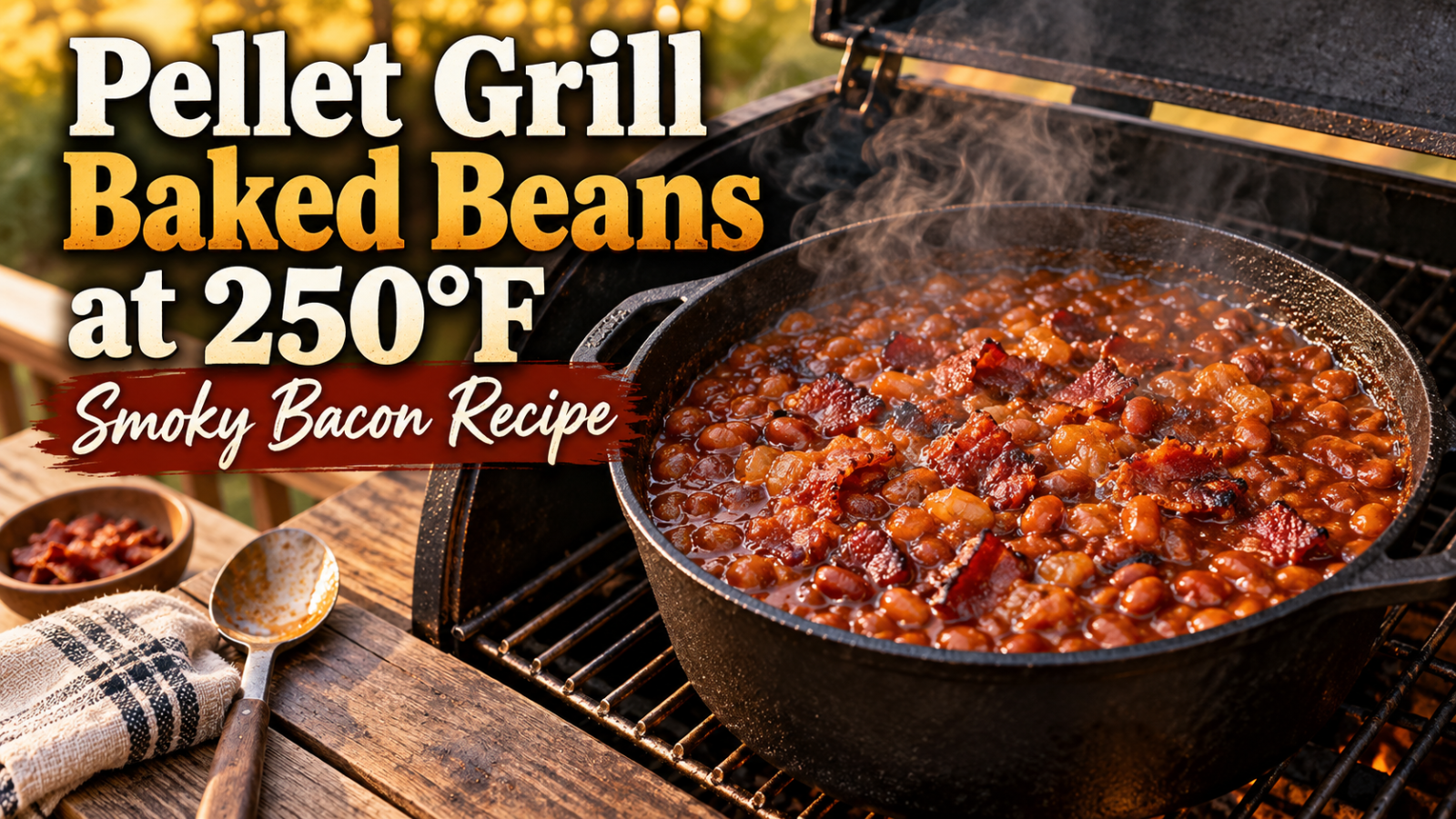
Pellet grill baked beans at 250°F are built for the same slow afternoon as ribs, pork shoulder, or brisket. This recipe starts with canned beans, bacon, onion, and bell pepper, then gives the pan 2 1/2 to 3 1/2 hours of gentle smoke. The result is thick, savory-sweet beans with a soft smoke flavor—not a sugary side dish that tastes like it came straight from the can.
Quick Answer: How Do You Make Pellet Grill Baked Beans at 250°F?
Cook diced bacon until lightly crisp, soften the onion and pepper in the drippings, then stir everything together in a 12-inch cast-iron skillet or 9-by-13-inch pan. Smoke uncovered at 250°F for 2 1/2 to 3 1/2 hours, stirring each hour, until the beans bubble in the center, thicken to your liking, and reach 165°F.
Key Points
- Yield: 10 side-dish servings.
- Prep time: About 20 minutes.
- Pellet grill temperature: 250°F.
- Estimated cook time: 2 1/2 to 3 1/2 hours after preheating.
- Doneness: Bubbling in the center, thickened but still spoonable, and 165°F in the middle.
- Best pellets: Apple, cherry, pecan, or hickory. A balanced blend also works.
- Make-ahead safety: Cool and refrigerate within 2 hours, or within 1 hour when the outdoor temperature is above 90°F.
What Ingredients Do You Need for Smoky Pellet Grill Baked Beans?
You need three large cans of baked beans, bacon, fresh onion and bell pepper, barbecue sauce, and a measured sweet-and-tangy seasoning mixture. The ingredient list is forgiving, but the quantities below keep the sauce balanced and thick enough for a long uncovered cook.
Ingredients
- 6 slices thick-cut bacon, about 8 ounces, cut into 1/2-inch pieces
- 1 medium yellow onion, diced, about 1 1/2 cups
- 1 medium green bell pepper, seeded and diced, about 1 cup
- 3 cans baked beans, 28 ounces each, not drained
- 1/2 cup barbecue sauce
- 1/4 cup packed dark brown sugar
- 2 tablespoons molasses
- 2 tablespoons yellow mustard
- 1 tablespoon apple cider vinegar
- 1 tablespoon Worcestershire sauce
- 1 teaspoon smoked paprika
- 1/2 teaspoon garlic powder
- 1/2 teaspoon ground black pepper
- 1/4 teaspoon cayenne pepper, optional
Equipment
- Pellet grill with enough dry pellets for preheating plus about 4 hours
- 12-inch cast-iron skillet, 5-quart Dutch oven without the lid, or 9-by-13-inch grill-safe pan
- Skillet for the bacon and vegetables if your bean pan cannot be used on the stove
- Long-handled spoon
- Instant-read food thermometer
Choose an uncovered pan with room for stirring. A pan filled to the rim is difficult to move and more likely to spill into the grill. If you use a disposable foil pan, set it on a rimmed sheet pan while carrying it; remove the sheet pan before the beans go on the grill unless the pan is rated for that use.
How Do You Make Pellet Grill Baked Beans Step by Step?
Build the flavor on the stove first, then let the pellet grill reduce the sauce and add smoke. Pre-cooking the bacon and vegetables prevents rubbery bacon and crunchy onion from hiding in otherwise tender beans.
- Preheat the pellet grill. Set it to 250°F with the lid closed. Allow the grill to finish its start-up cycle and settle at the set temperature.
- Cook the bacon. Put the diced bacon in a cool skillet, then cook over medium heat for 7 to 10 minutes, stirring occasionally, until the fat renders and the edges are lightly crisp. Do not cook it brittle; it will continue cooking in the beans.
- Soften the vegetables. Transfer the bacon to a plate with a slotted spoon. Leave about 2 tablespoons of bacon drippings in the skillet. Add the onion and bell pepper and cook for 5 to 7 minutes, until the onion looks translucent and the pepper begins to soften.
- Mix the sauce. In the grill-safe bean pan, combine the barbecue sauce, brown sugar, molasses, mustard, vinegar, Worcestershire sauce, smoked paprika, garlic powder, black pepper, and cayenne if using. Stir until the sugar has no dry pockets.
- Add the beans. Fold in all three cans of baked beans with their sauce, the cooked vegetables, and about three-quarters of the bacon. Scatter the remaining bacon over the top.
- Smoke uncovered. Put the pan on the center of the pellet-grill grate. Close the lid and cook at 250°F for 2 1/2 to 3 1/2 hours.
- Stir and check. Stir after the first hour and once each hour after that, scraping the bottom gently. Begin checking the center temperature and consistency at 2 1/2 hours.
- Finish by temperature and texture. The beans are ready when they reach 165°F in the center, bubble across the middle, and coat a spoon without looking dry. Rest the pan for 10 minutes before serving.
Grill temperatures wander, especially when the lid is opened or the weather is cold. The 2 1/2-to-3 1/2-hour window is a planning range. The center temperature and the thickness of the sauce make the final decision.
Why Cook Baked Beans at 250°F?
At 250°F, the sauce reduces slowly enough to pick up smoke without scorching the sugar around the edge of the pan. It also lets the beans share a cooker with many low-and-slow barbecue meats.
A higher temperature can finish canned baked beans faster, but it shortens the useful smoke window and makes the edges more likely to caramelize before the center is hot. A much lower temperature can leave the pan in the cooker longer than it needs to be. For this canned-bean method, 250°F is a practical middle ground.
Traeger uses 250°F for its dried-bean Boston baked beans method, while its quicker canned-bean recipes often run hotter. Those are different recipes, but the published methods show the tradeoff clearly: lower heat needs more time and builds flavor more gradually. See Traeger’s Boston baked beans method for the manufacturer’s 250°F example.
How Do You Know When Smoked Baked Beans Are Done?
They are done when the center reaches 165°F, the sauce bubbles in the middle, and a spoonful holds together without becoming pasty. Do not judge only by the darkened rim; the center is the slowest part to heat.
The beans in the cans are already cooked, so this is not the same safety problem as raw meat. However, the finished dish is a casserole with bacon and multiple ingredients. FoodSafety.gov lists 165°F for casseroles and leftovers, which is a clear, conservative target for the center of the pan. Check the current FoodSafety.gov safe-temperature chart rather than relying on bubbling at one edge.
Texture is personal. Pull the pan at the early end if you like looser beans. For thicker cookout beans, give the sauce more time uncovered. If the mixture becomes too thick before it reaches 165°F, stir in 1/4 cup of hot water, apple juice, or unsalted chicken broth. Add only enough to restore a spoonable consistency.
Which Pellets Work Best With Baked Beans and Bacon?
Apple, cherry, and pecan add mild smoke that will not bury the molasses and bacon. Hickory gives the beans a stronger barbecue profile, so use it when the pan is sharing the grill with pork shoulder or ribs.
| Pellet | Flavor in the beans | Best use |
|---|---|---|
| Apple | Mild and slightly sweet | Chicken, pork loin, or a family meal |
| Cherry | Mild fruitwood with a little color | Ribs and glazed pork |
| Pecan | Nutty and medium-mild | Beans as the main smoked side |
| Hickory | Strong, traditional barbecue smoke | Brisket or pork shoulder |
| Balanced blend | Moderate and versatile | Use what is already in the hopper |
Use dry, food-grade pellets intended for cooking. Damp pellets swell, burn poorly, and can cause temperature trouble. The site’s complete pellet-grill cleaning guide explains why a clean fire pot and unobstructed grease path matter before a long cook.
Can You Cook These Beans Beside Ribs, Meatloaf, or Pork Shoulder?
Yes, as long as the cooker is near 250°F and the bean pan does not block airflow around the meat. Put the pan where grease from raw meat cannot drip into it, and plan the start time backward from when you want both foods ready.
The beans can share the grill with the site’s pellet grill country-style pork ribs. Their first smoking stage also runs at 250°F. When the ribs move into a covered braise at 275°F, the beans can stay on the cooker; they will simply reduce a little faster.
They also fit beside smoked meatloaf on a pellet grill during its first 225°F stage. Expect the beans to need extra time if they spend the whole cook at 225°F, then let them finish while the meatloaf rests or while the grill climbs.
If you are still learning how your cooker behaves, the easy pellet grill recipes for beginners guide covers simple foods that teach temperature control without risking an expensive brisket.
How Do You Keep Baked Beans From Drying Out or Turning Watery?
Leave the pan uncovered for smoke and evaporation, stir only about once an hour, and adjust with small amounts of hot liquid near the end. A wide, shallow pan reduces faster than a deep Dutch oven, so start checking it sooner.
- If the beans look dry: Stir in 1/4 cup hot water, apple juice, or unsalted broth. Wait 15 minutes before adding more.
- If the beans look watery: Keep the pan uncovered and cook another 20 to 30 minutes. Stir once so the edges do not over-reduce.
- If the top darkens too fast: Loosely tent the pan with foil, leaving one side open so steam can escape.
- If the bottom scorches: Move the pan away from the grill’s known hot spot and stir without scraping burnt bits into the food.
- If the beans taste too sweet: Add 1 tablespoon apple cider vinegar and 1 teaspoon mustard, then taste again after 10 minutes.
What Substitutions Work in This Baked Beans Recipe?
You can make the beans meatless, less sweet, spicier, or more savory without changing the 250°F cooking method. Keep the total amount of liquid close to the original so the timing remains useful.
- Meatless: Omit the bacon, sauté the vegetables in 2 tablespoons of neutral oil, and use a vegetarian Worcestershire sauce.
- Maple: Replace the molasses with 2 tablespoons pure maple syrup. The flavor will be lighter and less bitter.
- Less sweet: Reduce the brown sugar to 2 tablespoons and use a low-sugar barbecue sauce. Do not remove all the sauce without replacing its liquid.
- More heat: Add 1 minced jalapeño with the bell pepper or increase cayenne to 1/2 teaspoon.
- No green pepper: Use red bell pepper for a sweeter flavor, or leave it out.
- No molasses: Use 2 tablespoons maple syrup or 2 additional tablespoons brown sugar plus 1 tablespoon water.
- Turkey bacon: Cook it in 1 tablespoon oil because it renders less fat. Watch it closely so it does not dry out.
How Should You Store and Reheat Pellet Grill Baked Beans?
Refrigerate the beans in shallow covered containers within 2 hours of serving, or within 1 hour when the outdoor temperature is above 90°F. Eat refrigerated leftovers within 3 to 4 days and reheat them to 165°F.
Divide a large batch instead of putting one deep, steaming pot in the refrigerator. Shallow containers cool faster. Reheat on the stovetop over medium-low heat, in a 325°F-or-hotter oven, or in the microwave. Add a splash of water if the sauce has tightened. Stir and check several spots so cold pockets do not hide in the center.
Freeze cooled beans in airtight portions for up to 3 months for best quality. Thaw them in the refrigerator, not on the counter. A slow cooker is useful for holding food that is already hot, but federal guidance does not recommend using one to reheat cold leftovers because the food can warm too slowly.
What Mistakes Ruin Pellet Grill Baked Beans?
The common mistakes are starting with raw bacon, overfilling the pan, cooking strictly by the clock, and letting a sweet sauce dry onto the bottom. All four are easy to avoid.
- Putting raw bacon straight into the beans: It may stay soft and greasy. Render it first.
- Using a tiny pan: The beans cannot reduce evenly, and stirring becomes messy.
- Never stirring: The edge can turn dark while the center stays thin.
- Opening the lid every 15 minutes: The grill loses heat and the cook takes longer. Hourly checks are enough.
- Adding a full cup of liquid at once: You can always add more; removing it takes another hour.
- Serving by appearance alone: Check the center for 165°F.
- Leaving the pan outside all afternoon: The food-safety clock still applies after a correct cook.
Frequently Asked Questions
Can I make pellet grill baked beans in a foil pan?
Yes. Use a sturdy 9-by-13-inch foil pan, support it with a sheet pan while carrying it, and stir gently so you do not tear the bottom. A dark cast-iron pan may cook the edge a little faster, so begin checking either pan after 2 1/2 hours.
Do I need to cover baked beans on a pellet grill?
No. Leave them uncovered so smoke reaches the surface and excess water evaporates. Cover loosely only if the top darkens too quickly or you need to hold the finished beans hot for a short time.
Can I use plain canned beans instead of prepared baked beans?
Yes, but the sauce needs more seasoning and liquid. For this exact recipe, prepared baked beans provide the base sauce. Replacing them with plain navy or pinto beans requires a separate sauce formula, so it is not a one-for-one swap.
Can I make the beans a day ahead?
Yes. Cook, cool, and refrigerate them in shallow containers. Reheat to 165°F in a 325°F oven or on the stovetop, adding a little water if needed. The smoke flavor is often more noticeable the next day.
Can I add leftover brisket or pulled pork?
Yes. Fold in 1 to 2 cups of fully cooked chopped meat during the last hour. Keep the bacon or reduce it to prevent the pan from becoming too salty. The finished mixture still needs to reach 165°F in the center.
How long do baked beans take at 225°F?
Plan on roughly 3 1/2 to 5 hours, depending on pan depth and weather. That is an estimate, not a promise. Cook until the center reaches 165°F and the sauce has the thickness you want.
Can I cook the beans at 275°F instead?
Yes. Start checking after about 2 hours. The sauce will reduce faster, so stir every 45 to 60 minutes and add a small splash of hot liquid if the edges become dry.
Why are my smoked baked beans bitter?
Harsh smoke, scorched sugar, or too much molasses can taste bitter. Use clean-burning pellets, keep the pan away from a hot spot, and measure the molasses. A tablespoon of brown sugar or barbecue sauce can soften mild bitterness, but badly scorched beans cannot be fixed.
Final Verdict: Are Pellet Grill Baked Beans at 250°F Worth the Time?
Yes. Pellet grill baked beans at 250°F are worth making when the cooker is already running for barbecue or when you want a side dish with real smoke instead of a quick oven flavor. Pre-cooking the bacon and vegetables, leaving the pan uncovered, and finishing at 165°F produce beans that are smoky, thick, and safe without becoming dry. Make the recipe once as written, then adjust the sweetness or heat to fit the meat beside it.