
Updated: November 3, 2026
Updated and fact-checked: November 2, 2026
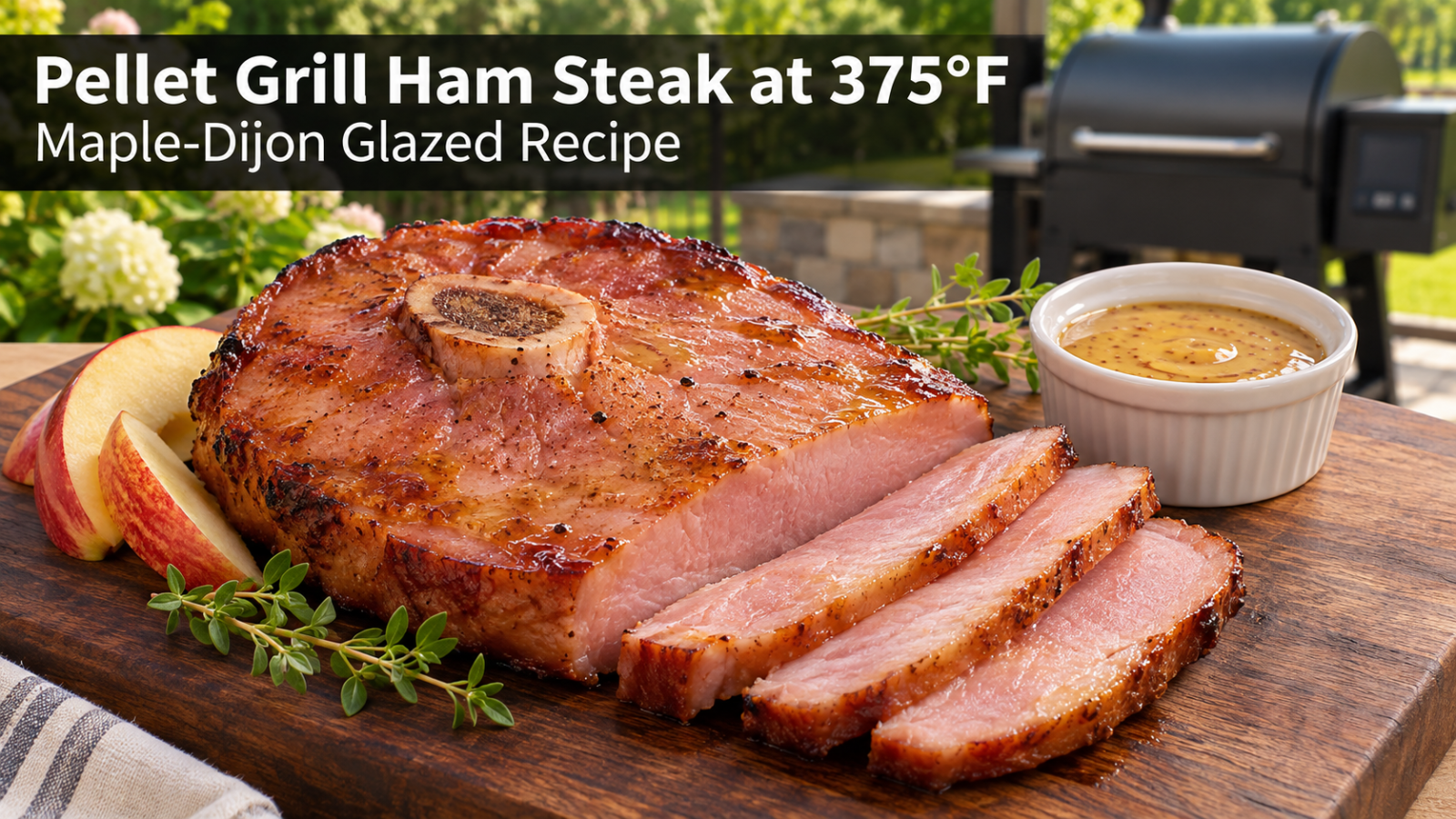
Pellet grill ham steak is a practical dinner when you want smoked flavor without reheating a whole ham. This recipe uses one thick, fully cooked ham steak, a five-ingredient maple-Dijon glaze, and a 375°F grill. The meat goes straight on the grate, so there is no special pan to buy and very little cleanup.
Quick Answer: How Do You Cook Ham Steak on a Pellet Grill?
Preheat the pellet grill to 375°F. Pat a 1¼- to 1½-pound fully cooked ham steak dry and score only the outer fat to limit curling. Grill 8–12 minutes, flip, brush with maple-Dijon glaze, then cook 8–15 minutes more. Glaze once more near the end and remove at the safe temperature printed on the package—normally 140°F for an inspected, fully cooked ham.
Key Points
- Use a fully cooked ham steak. This is a reheating recipe, not a method for raw fresh ham.
- Set the pellet grill to 375°F. The higher roasting temperature warms the steak promptly and sets the glaze before the meat dries out.
- Add sugary glaze late. Maple syrup can darken or burn if it sits over heat for the entire cook.
- Cook by temperature, not the clock. USDA guidance lists 140°F for reheating fully cooked ham packaged in a USDA-inspected plant and 165°F for leftovers or cooked ham repackaged elsewhere.
- Expect 18–30 minutes. Thickness, starting temperature, grill recovery, wind, and the location of the heat source all affect timing.
- Serve four. A 1¼- to 1½-pound steak provides four moderate portions after allowing for a small bone and trimming.
What Kind of Ham Steak Works Best?
Choose a refrigerated, fully cooked ham steak about ¾ to 1 inch thick and weighing 1¼ to 1½ pounds. Bone-in or boneless works; a thick, uniform steak heats more evenly and is less likely to dry out than several thin slices.
Read the label before cooking. It should say fully cooked, ready to eat, or give clear reheating directions. Do not substitute a raw fresh-ham slice and assume the same time or temperature will be safe. A product labeled “cook before eating” needs the package’s cooking instructions and a different plan.
Ham is already salty, so this recipe does not add salt. If the steak has a thick rind, leave it in place for cooking unless the package directs otherwise. Cut shallow notches through the outside fat about every 1½ inches; stop before cutting into the lean meat. Those small cuts help prevent the steak from curling away from the grate.
What Ingredients Do You Need?
You need one fully cooked ham steak plus maple syrup, Dijon mustard, apple cider vinegar, black pepper, and garlic powder. The glaze is deliberately small: enough to coat the meat twice without leaving a pan of sugary sauce to burn below the grate.
Ham Steak
- 1 fully cooked ham steak, 1¼ to 1½ pounds and ¾ to 1 inch thick
- 1 teaspoon neutral oil, for lightly oiling the cleaned grate if needed
Maple-Dijon Glaze
- 2 tablespoons pure maple syrup
- 1 tablespoon Dijon mustard
- 1 tablespoon apple cider vinegar
- ½ teaspoon ground black pepper
- ¼ teaspoon garlic powder
- Pinch of cayenne pepper, optional
Yield: 4 servings
Preparation time: 10 minutes
Grill time: approximately 18–30 minutes
Rest time: 3 minutes
Total time: approximately 31–43 minutes
What Equipment Do You Need?
You need a pellet grill, a finish-safe grate cleaner, long tongs or a wide turner, a small bowl, a brush, and a fast-read food thermometer. A shallow rimmed tray is useful for carrying the raw-from-package steak to the grill, but the steak cooks directly on the grate.
- Pellet grill with dry food-grade pellets
- Grill-safe brush or scraper appropriate for the grate finish
- Long tongs or a wide metal turner
- Small bowl and spoon or whisk
- Silicone basting brush
- Fast-read food thermometer
- Clean platter or cutting board for the cooked ham
You do not need a smoke tube, roasting rack, or disposable foil pan. The ham steak is exposed to the pellet grill’s normal combustion gases for the entire cook, and its broad surface takes glaze well. Start with dry pellets; this guide to storing pellets so they stay dry explains what to look for.
How Do You Prepare the Pellet Grill?
Clean the grate, confirm the grease path is open, fill the hopper with sound dry pellets, and preheat the grill to 375°F with the lid closed. Wait until the grill reaches the set temperature before putting the ham on.
- Check the firepot and grease system according to the grill manual. A fatty or sugary cook should not begin over a neglected grease tray.
- Make sure the hopper contains enough dry pellets for at least one hour of operation.
- Start the grill using its normal ignition procedure.
- Set it to 375°F and close the lid.
- Once preheated, scrape the grate with a tool approved for its finish. If food commonly sticks, wipe the grate very lightly with neutral oil using folded paper towel held in long tongs. Never spray oil toward a flame or hot igniter.
A clean grease route matters because maple syrup can drip. If the cooker is overdue, use the site’s pellet grill cleaning guide before the cook, not while food is waiting.
How Do You Prepare the Ham Steak and Glaze?
Pat the steak dry, make shallow cuts through the outer fat to reduce curling, and whisk the glaze in a clean bowl. Keep the glaze separate from any utensil or surface that touched the ham package until you are ready to brush it on.
- Remove the ham steak from its package over the sink or a tray. Discard the packaging and liquid.
- Pat both sides dry with paper towels. A dry surface browns more readily and keeps the glaze from sliding off.
- If there is a continuous band of fat, cut a shallow notch through that fat every 1½ inches. Do not cut deeply into the lean meat.
- Whisk the maple syrup, Dijon mustard, vinegar, black pepper, garlic powder, and optional cayenne until smooth.
- Reserve the entire glaze for the later stages of cooking. There is no need to marinate a fully cooked, cured ham steak.
How Do You Cook Pellet Grill Ham Steak at 375°F?
Grill the first side without glaze for 8–12 minutes, flip, brush the top, and continue until the center is about 10°F below its required final temperature. Brush again and cook only until the glaze looks glossy and the center reaches the package or USDA reheating target.
- Put the steak on the grate. Place it flat in the center of the cooking area, away from a known hot edge. Close the lid.
- Cook the first side. Leave it undisturbed for 8–12 minutes. The surface should begin to color and release without tearing.
- Flip once. Turn the steak with a wide turner or long tongs. Do not stab it with a fork.
- Apply the first glaze. Brush roughly half the mixture over the cooked side. Close the lid and cook 6–10 minutes.
- Check the temperature. Insert a fast-read thermometer sideways into the thickest lean section, avoiding the bone and large fat pockets.
- Finish the glaze. When the center is about 130°F for a 140°F target, brush the remaining glaze over the top. Cook another 3–5 minutes, watching the color.
- Remove at the correct temperature. For a fully cooked ham steak in its original USDA-inspected package, the federal reheating target is 140°F. Heat leftovers or ham repackaged outside an inspected plant to 165°F. If the product label specifies a higher temperature, follow the label.
- Rest for 3 minutes. Move the steak to a clean board. A short rest lets the glaze settle and makes slicing less messy.
The USDA’s current ham cooking chart distinguishes fully cooked ham in inspected packaging from repackaged ham and leftovers. That distinction is why the package—not appearance alone—must be checked before the grill is lit.
How Do You Know When the Ham Steak Is Done?
The ham steak is done when a thermometer in its thickest lean area reaches the required temperature on the label: typically 140°F for reheating an inspected, factory-packaged fully cooked ham steak, or 165°F for leftovers and ham repackaged elsewhere.
Color is not a reliable doneness test. Cured ham is pink before and after reheating, and a dark glaze can make the outside look finished early. Check at two or three points if the steak has uneven thickness. Keep the probe tip away from bone because bone can distort the reading.
If the glaze is dark enough before the center is hot, move the steak to a cooler part of the grate and lower the set temperature to 325°F. Continue with the lid closed and check every 3–5 minutes. If the center reaches temperature before the glaze sets, remove the ham; safe, moist meat matters more than a darker coating.
What Pellet Flavor Works Best with Ham?
Apple, cherry, maple, pecan, or a mild competition blend works well with cured ham. Hickory is also suitable if you want a stronger smoke note, but the short cook means pellet choice will be a background flavor rather than a dramatic change.
Use a fresh food-grade pellet approved by the grill manufacturer. Do not add extra smoke equipment simply to make this quick recipe seem more complicated. A clean-burning pellet fire and the ham’s own cured flavor are enough.
What Should You Serve with Maple-Dijon Ham Steak?
Serve the ham with a low-salt vegetable and a simple starch. The meat already brings smoke, salt, sweetness, and mustard tang, so mild sides keep the plate balanced.
- Grilled green beans or asparagus
- Roasted sweet potatoes
- Warm apples or unsweetened applesauce
- Simple cabbage slaw
- Potato salad with a vinegar-forward dressing
- Pellet grill baked beans, cooked earlier and reheated while the ham rests
Do not try to cook a 250°F side and this 375°F ham recipe at their original temperatures at the same time. Finish the low-temperature dish first, cover it safely, raise the grill to 375°F, and then cook the ham.
What Substitutions Work?
You can change the sweetener, mustard, vinegar, or pepper without changing the basic cooking method. Keep the total glaze quantity close to four tablespoons so it coats the steak instead of flooding the drip tray.
| Original | Substitute | Adjustment |
|---|---|---|
| Pure maple syrup | Honey | Use 2 tablespoons; watch closely because honey can darken quickly |
| Dijon mustard | Yellow mustard | Use the same amount for a milder, sharper flavor |
| Apple cider vinegar | Orange juice | Use 1 tablespoon; the glaze will be sweeter and less tangy |
| Black pepper | Coarsely ground pepper | Use ¼ teaspoon for a less peppery coating |
| Cayenne | Smoked paprika | Use ¼ teaspoon for color without much heat |
For a reduced-sugar version, omit the maple syrup and whisk 2 tablespoons unsweetened apple juice with 1½ tablespoons Dijon and the remaining seasonings. The coating will be thinner and will not become as glossy. Do not use a raw fresh-ham steak as a direct substitution.
How Do You Prevent Dry or Burned Ham Steak?
Use a thick fully cooked steak, preheat the grill, delay the glaze, and stop cooking as soon as the center reaches its required temperature. Most dry ham steak is simply overheated; most burned glaze was applied too early.
- Ham is dry: Check temperature earlier next time and remove at the label target. Thin steaks cook especially fast.
- Glaze burns: Move the meat away from the hot area, lower the grill to 325°F, and use a thinner final coat.
- Steak curls: Add shallow notches through the outside fat before cooking and use a wide turner for even contact.
- Ham sticks: Start with a clean preheated grate, dry the meat, and give the first side time to release before forcing it.
- Grill makes heavy white smoke: Confirm the grease path and firepot are clean and the pellets are dry. Follow the manufacturer’s shutdown procedure if combustion looks abnormal.
- Center is cool but glaze is done: Lower the grill to 325°F and continue in a cooler area until the thermometer reaches the proper target.
How Should Leftover Ham Steak Be Stored and Reheated?
Refrigerate leftover ham in shallow, covered containers within two hours of cooking—or within one hour when the outdoor temperature is above 90°F. Use refrigerated leftovers within 3–4 days, or freeze portions for longer storage.
- Cut the cooled ham into meal-size portions so it chills quickly and reheats evenly.
- Store it at 40°F or below in a covered container.
- Freeze well-wrapped portions if they will not be eaten within 3–4 days. Label the package with the date.
- Reheat leftovers to 165°F. Add a spoonful of water or apple juice and cover loosely to reduce drying.
- Discard ham left in the temperature danger zone longer than the limits above; do not rely on smell to judge safety.
Frequently Asked Questions
Can you smoke a precooked ham steak?
Yes. A fully cooked ham steak can be reheated on a pellet grill, which adds a mild wood-fired note. Confirm the label, use the correct final temperature, and avoid a long low-temperature cook that dries a thin steak.
How long does ham steak take at 375°F?
A ¾- to 1-inch fully cooked ham steak usually needs about 18–30 minutes at 375°F, but the thermometer decides. Start checking around 16 minutes because grill recovery, meat thickness, outdoor temperature, and bone size vary.
Should ham steak be wrapped in foil?
No. This recipe cooks the steak unwrapped so its surface can brown and the glaze can set. Foil is useful only if the surface is darkening too fast; loosely shield the top while the center finishes.
Do you flip ham steak on a pellet grill?
Yes. Flip once after the first 8–12 minutes. That exposes both sides to the hot grate and gives you a warm surface for the first coat of glaze.
Can you cook the glaze from the beginning?
You can, but it is more likely to burn. Maple syrup darkens quickly at 375°F, so the simpler reliable method is to cook the first side dry and apply the glaze after the flip.
What internal temperature should fully cooked ham steak reach?
USDA guidance says 140°F for fully cooked ham packaged in a USDA-inspected plant. Heat leftovers or cooked ham repackaged elsewhere to 165°F. Follow a higher package instruction if one is printed.
Can this recipe be doubled?
Yes, if two steaks fit in one layer with space around them. Mix a double batch of glaze, allow extra time for the grill to recover after loading, and check each steak separately because they may finish at different times.
Final Verdict: Is Pellet Grill Ham Steak Worth Making?
Pellet grill ham steak is worth making when you want a fast, small-batch ham dinner with more outdoor flavor than a skillet provides. Use a thick fully cooked steak, run the grill at 375°F, and add the maple-Dijon glaze late. The method is simple, the ingredients are ordinary, and a thermometer keeps the meat safe without cooking it dry.
About the Author
Frank W. Roberts has been grilling since 1970 and writes Everything Grill Reviews for backyard cooks who want practical recipes and straightforward equipment guidance. This recipe was developed from established pellet-grill methods and current USDA food-safety guidance; it does not claim a physical cooking test or guaranteed timing on every grill.