
Updated: November 8, 2026
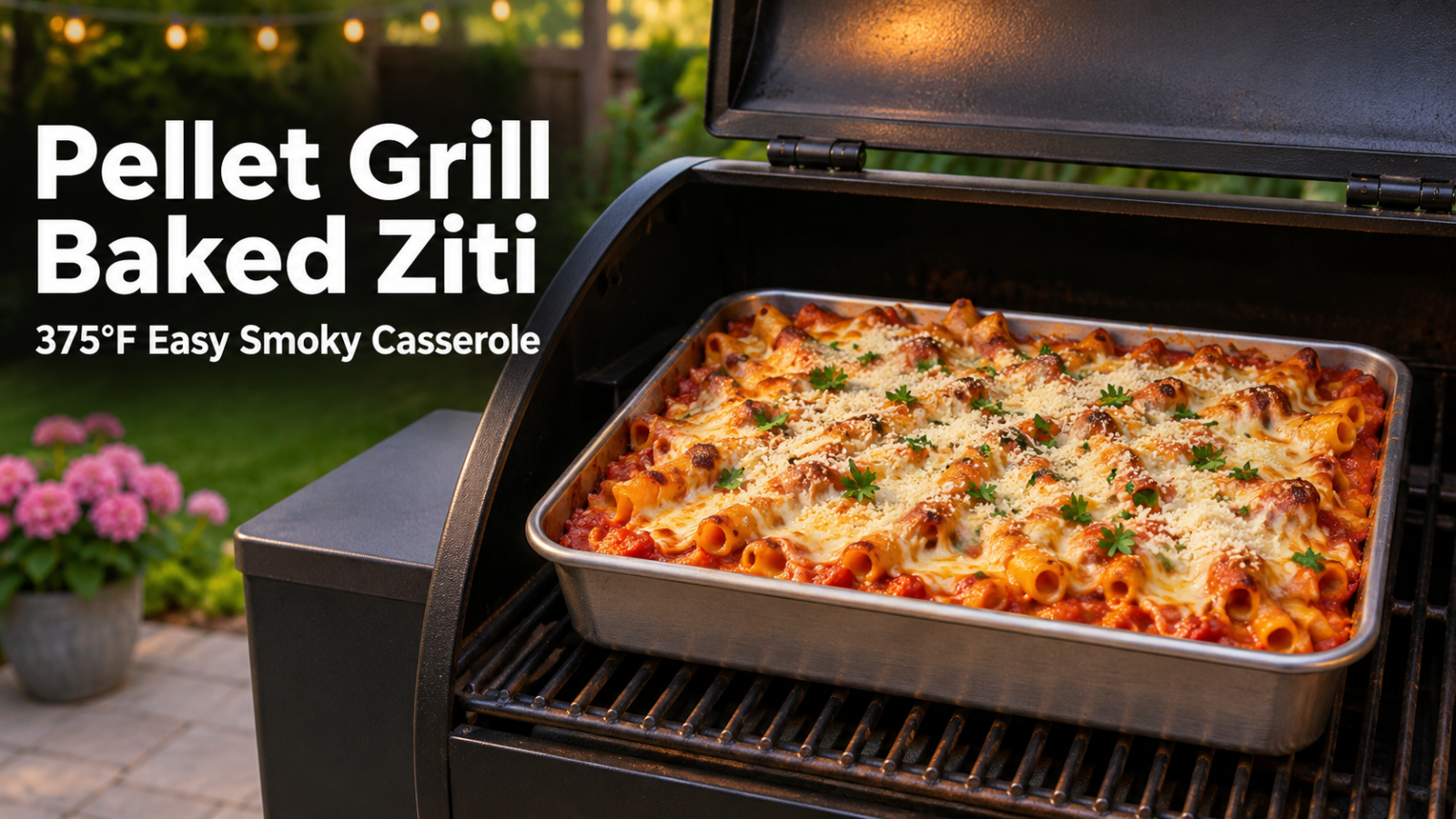
Pellet grill baked ziti turns a pan of pasta, prepared marinara, ricotta, and mozzarella into a practical outdoor casserole with a light wood-fired edge. This version stays simple: boil the pasta just short of tender, assemble everything in one 9-by-13-inch pan, and bake at 375°F until the center reaches 165°F and the cheese is bubbling.
Quick Answer: Cook 12 ounces of ziti 2 minutes less than the package time, mix it with marinara, and layer it with seasoned ricotta, mozzarella, and Parmesan in a greased 9-by-13-inch grill-safe pan. Bake on a preheated pellet grill at 375°F for 30–40 minutes, uncovering after 20 minutes. Pull it when the center reaches 165°F, then rest 10 minutes.
Key Points
- Servings: 8 main-dish portions.
- Grill setting: 375°F after a full lid-closed preheat.
- Pan: one greased 9-by-13-inch grill-safe metal or disposable aluminum pan.
- Pasta: boil 2 minutes less than the package’s al dente time so it does not turn soft on the grill.
- Estimated grill time: 30–40 minutes after preheating.
- Doneness: bubbling edges, melted cheese, and at least 165°F in the center.
- Rest: 10 minutes before serving so the layers hold together.
What Do You Need for Pellet Grill Baked Ziti?
You need ordinary grocery-store ingredients, a pot for the pasta, a mixing bowl, and one 9-by-13-inch grill-safe pan. Prepared marinara keeps the method focused on the casserole instead of turning it into a separate sauce project.
Ingredients
- 12 ounces dry ziti or penne
- 1 tablespoon kosher salt for the pasta water
- 1 jar (28 ounces) prepared marinara sauce
- 1 container (15 ounces) whole-milk or part-skim ricotta
- 3 cups (12 ounces) shredded low-moisture mozzarella, divided
- 1/2 cup (2 ounces) finely grated Parmesan, divided
- 1 teaspoon Italian seasoning
- 1/2 teaspoon garlic powder
- 1/4 teaspoon crushed red pepper flakes, optional
- 2 tablespoons chopped fresh parsley or basil, optional
- Nonstick cooking spray or 1 teaspoon olive oil for the pan
Equipment
- Pellet grill with enough grate room for a 9-by-13-inch pan
- 9-by-13-inch metal, cast-iron, or disposable aluminum pan
- Large pot and colander
- Medium mixing bowl and large spoon
- Aluminum foil
- Instant-read thermometer
- Dry heat-resistant gloves
What Is the Recipe at a Glance?
Plan on about 25 minutes of preparation, 30–40 minutes on the preheated grill, and a 10-minute rest. The full job usually takes about 1 hour 15 minutes, depending on how quickly the pasta water boils and the grill recovers.
| Recipe detail | Target |
|---|---|
| Yield | 8 main-dish servings |
| Prep time | About 25 minutes |
| Pellet grill temperature | 375°F |
| Covered bake | 20 minutes |
| Uncovered finish | 10–20 minutes |
| Center temperature | 165°F |
| Rest | 10 minutes |
| Pellet choice | Oak, maple, cherry, pecan, or a mild competition blend |
How Do You Make Pellet Grill Baked Ziti?
Undercook the pasta slightly, preheat the pellet grill to 375°F, layer the sauced pasta and cheese in a greased pan, bake covered for 20 minutes, then uncover and finish until the center reaches 165°F.
- Start the pasta water. Bring a large pot of water to a boil. Add 1 tablespoon kosher salt.
- Preheat the grill. Set the pellet grill to 375°F and preheat with the lid closed according to its manual. Make sure the grease path is clear before placing a pan inside.
- Undercook the ziti. Add 12 ounces of pasta and cook it 2 minutes less than the package’s al dente time. Drain well. Do not rinse; the surface starch helps the sauce cling.
- Mix the cheese filling. In a bowl, combine 15 ounces ricotta, 1 cup mozzarella, 1/4 cup Parmesan, 1 teaspoon Italian seasoning, 1/2 teaspoon garlic powder, and the optional red pepper flakes.
- Sauce the pasta. Reserve 1/2 cup marinara. Toss the drained pasta with the remaining sauce.
- Prepare the pan. Coat a 9-by-13-inch grill-safe pan with cooking spray or 1 teaspoon olive oil. Spread the reserved 1/2 cup sauce across the bottom.
- Build the first layer. Add half of the sauced pasta. Spoon the ricotta mixture over it in small, evenly spaced dollops.
- Finish the layers. Add the remaining pasta. Top evenly with the remaining 2 cups mozzarella and 1/4 cup Parmesan.
- Cover and bake. Cover the pan with foil and place it in the center of the preheated grill. Close the lid and bake for 20 minutes.
- Brown the top. Wearing dry heat-resistant gloves, remove the foil. Close the lid and cook another 10–20 minutes.
- Check doneness. Probe the center without touching the pan. The ziti is ready when the middle reaches at least 165°F, the edges bubble, and the cheese is fully melted.
- Rest before serving. Move the pan to a stable heatproof surface and rest 10 minutes. Sprinkle with the optional parsley or basil, then cut into 8 portions.
Traeger’s published baked-ziti methods support baking a pasta-and-cheese casserole in a pellet grill, including a 375°F version. The method here uses prepared marinara and no raw meat so the assembly stays shorter and the timing is easier to repeat. See the Traeger baked-ziti method for the manufacturer’s more involved bacon-and-sausage variation.
Why Should You Undercook the Pasta?
The pasta continues absorbing liquid while the casserole bakes. Stopping 2 minutes before the package’s al dente time leaves enough firmness to prevent soft, swollen ziti.
Drain it well but do not rinse it. Water trapped in the tubes can thin the sauce, while rinsing removes starch that helps sauce coat the pasta. If the pasta sits more than a few minutes before assembly, toss it promptly with the sauce so the pieces do not stick together.
Should You Cover Baked Ziti on a Pellet Grill?
Cover it for the first 20 minutes to heat the dense center without drying the top, then uncover it for the final 10–20 minutes so the cheese can brown and pick up a light smoke note.
Leaving the pan uncovered for the entire cook can toughen the top layer before the center is hot. Keeping it covered from start to finish prevents browning and blocks most smoke contact. The split method gives the casserole both moisture control and a little wood-fired character.
What Pellets Work Best for Baked Ziti?
Oak, maple, cherry, pecan, or a mild competition blend works well. Use clean, dry pellets and skip a strong mesquite load unless everyone at the table already likes heavy smoke on cheese and tomato sauce.
This is a 30–40 minute casserole at 375°F, so the smoke will be lighter than a low-and-slow meat cook. That is useful here. The goal is a gentle wood-fired background, not a pasta dish that tastes like an ashtray. A smoke tube is unnecessary and may overpower the cheese.
For a second pellet-grill baking example, see the site’s pellet grill apple crisp.
How Do You Keep Baked Ziti From Drying Out?
Use the full 28-ounce jar of marinara, undercook the pasta, cover the pan during the first stage, and stop cooking as soon as the center is hot and the cheese has melted.
Low-moisture mozzarella is useful because it melts without flooding the pan, but the pasta still needs enough sauce. If the marinara is unusually thick, stir 2 tablespoons of water into the sauced pasta before assembling. Do not add a cup of water “just in case”; excess liquid collects at the bottom and prevents clean portions.
How Do You Know When Baked Ziti Is Done?
The casserole is done when the center reaches at least 165°F, the sauce bubbles around the edges and near the center, and the top cheese is completely melted with a few browned spots.
Check temperature in two central locations because a disposable pan can heat unevenly. Keep the probe tip in the pasta and cheese, not against the hot metal bottom. The site’s guide to using a food thermometer correctly explains why probe placement matters.
Can You Add Sausage or Ground Beef?
Yes, but cook and drain the meat before assembling the casserole. Add up to 12 ounces of cooked crumbled Italian sausage or ground beef to the sauced pasta.
Do not rely on the casserole bake to safely brown raw meat. Ground beef and pork need to reach 160°F during their initial cooking, and poultry sausage needs 165°F. Once the cooked meat is mixed into the casserole, keep the same 165°F center target for the finished pan.
What Ingredient Substitutions Work?
Penne can replace ziti, cottage cheese can replace ricotta, and an Italian cheese blend can replace some mozzarella. Keep the total pasta, sauce, and cheese amounts close to the original so the casserole still heats evenly.
| Original | Substitution | Adjustment |
|---|---|---|
| 12 oz ziti | 12 oz penne or rigatoni | Cook 2 minutes short of package al dente |
| 15 oz ricotta | 15 oz small-curd cottage cheese | Drain visible liquid first |
| 3 cups mozzarella | 3 cups Italian cheese blend | Choose a blend that melts well |
| Parmesan | Pecorino Romano | Use slightly less if it tastes saltier |
| Marinara | Tomato-basil or roasted-garlic pasta sauce | Keep the jar near 28 ounces |
| Vegetarian version | 12 oz cooked sausage or beef | Cook, drain, and cool slightly before mixing |
Can You Assemble Baked Ziti Ahead of Time?
Yes. Assemble it, cover it, and refrigerate for up to 24 hours before grilling. Add extra cooking time and verify 165°F in the center because a refrigerator-cold pan heats more slowly.
Do not put a cold glass baking dish into a hot pellet grill; thermal shock can break it. Use metal, cast iron, or a disposable aluminum pan. If the casserole is refrigerated in another container, transfer it to a greased grill-safe pan before preheating the grill.
Why Is the Bottom Burning Before the Center Is Hot?
The pan is probably over a concentrated hot spot, the grill is running hotter than its display, or the pan is too dark and thin for that location. Move it to a more indirect area and verify the grate-level temperature.
- Rotate the pan once after uncovering if one side browns faster.
- Set a thin disposable pan on a second empty sheet pan for more insulation.
- Keep the pan away from a direct-flame opening unless the grill maker specifically approves that placement.
- Do not raise the grill above 375°F simply to hurry a cold center.
Why Is the Baked Ziti Watery?
The usual causes are pasta that was not drained, wet cottage cheese, fresh mozzarella with high moisture, or cutting immediately after the pan leaves the grill.
Use low-moisture shredded mozzarella, drain substitutions, and let the casserole rest the full 10 minutes. The rest allows bubbling sauce to settle and cheese to firm enough for serving. A little sauce in the bottom is normal; a pool of clear water means excess moisture entered during assembly.
How Should You Store and Reheat Leftovers?
Refrigerate leftovers within 2 hours in shallow covered containers, use them within 3–4 days, and reheat portions to 165°F. If the outdoor temperature is above 90°F, refrigerate within 1 hour.
For the grill or oven, place leftovers in a covered pan with a spoonful of sauce and reheat at 325°F or higher until the center reaches 165°F. For the microwave, cover, rotate or stir when practical, allow standing time, and check more than one spot. Freeze meal-size portions promptly for longer storage and thaw them in the refrigerator before reheating.
Frequently Asked Questions
Can you bake pasta in a pellet grill?
Yes. A pellet grill works like an outdoor convection oven when it holds a steady temperature. Use a grill-safe pan and keep it away from direct flame unless the grill manual permits it.
Can you put a disposable aluminum pan in a pellet grill?
Yes. Support the bottom with two gloved hands because a full disposable pan bends easily. A rimmed sheet pan underneath can add stability and protect against a concentrated hot spot.
Can you make baked ziti without ricotta?
Yes. Use drained small-curd cottage cheese or replace the ricotta layer with an additional 1 1/2 cups mozzarella for a firmer, less creamy casserole.
Do you need a smoke tube for baked ziti?
No. The uncovered final stage supplies enough light pellet smoke for this dish. A separate smoke tube can make tomato sauce and cheese taste harsh.
Can you use glass bakeware in a pellet grill?
Only when the bakeware manufacturer explicitly approves grill use and thermal conditions. Metal or cast iron is safer because temperature swings can shatter glass.
Why is my ziti still firm?
The pasta may have been underboiled by more than 2 minutes, the sauce may be unusually thick, or the pan may not have reached temperature. Cover it, add a few spoonfuls of warm sauce around the edges, and continue until tender and 165°F in the center.
Can you double this recipe?
Use two separate 9-by-13-inch pans rather than one extra-deep pan. Leave airflow around both, rotate them if the grill has hot spots, and verify 165°F in each center.
What should you serve with pellet grill baked ziti?
A green salad, grilled vegetables, or garlic bread balances the rich pasta. Keep the sides simple because the casserole already supplies pasta, sauce, and cheese.
Can you freeze baked ziti?
Yes. Cool it promptly, divide it into meal-size freezer containers, label the date, and freeze. Thaw in the refrigerator and reheat to 165°F.
What if the pellet grill runs out of fuel?
Follow the grill manual before restarting; do not simply refill and assume the fire is healthy. If the casserole has spent more than 2 hours between 40°F and 140°F, discard it rather than guessing.
Verdict: Is Pellet Grill Baked Ziti Worth Making?
Yes. Pellet grill baked ziti is worth making when you want an easy eight-serving casserole and prefer to keep the kitchen oven free. Prepared marinara, pre-shredded low-moisture mozzarella, and one grill-safe pan keep the work reasonable, while the uncovered finish adds a mild smoke note.
The important moves are undercooking the pasta by 2 minutes, covering the first 20 minutes, uncovering only long enough to brown the cheese, checking for 165°F in the center, and resting 10 minutes. Those steps matter more than chasing heavy smoke.
About the author: Frank W. Roberts has grilled since 1970 and writes Everything Grill Reviews to give backyard cooks practical directions without inventing a personal cook test. This recipe was developed from established baked-pasta technique, published pellet-grill methods, and current USDA food-safety guidance. Timing is an estimate; grill design, weather, pan material, and starting temperature can change the cook.