
Updated: November 27, 2026
By Frank W. Roberts
Updated and fact-checked: November 27, 2026
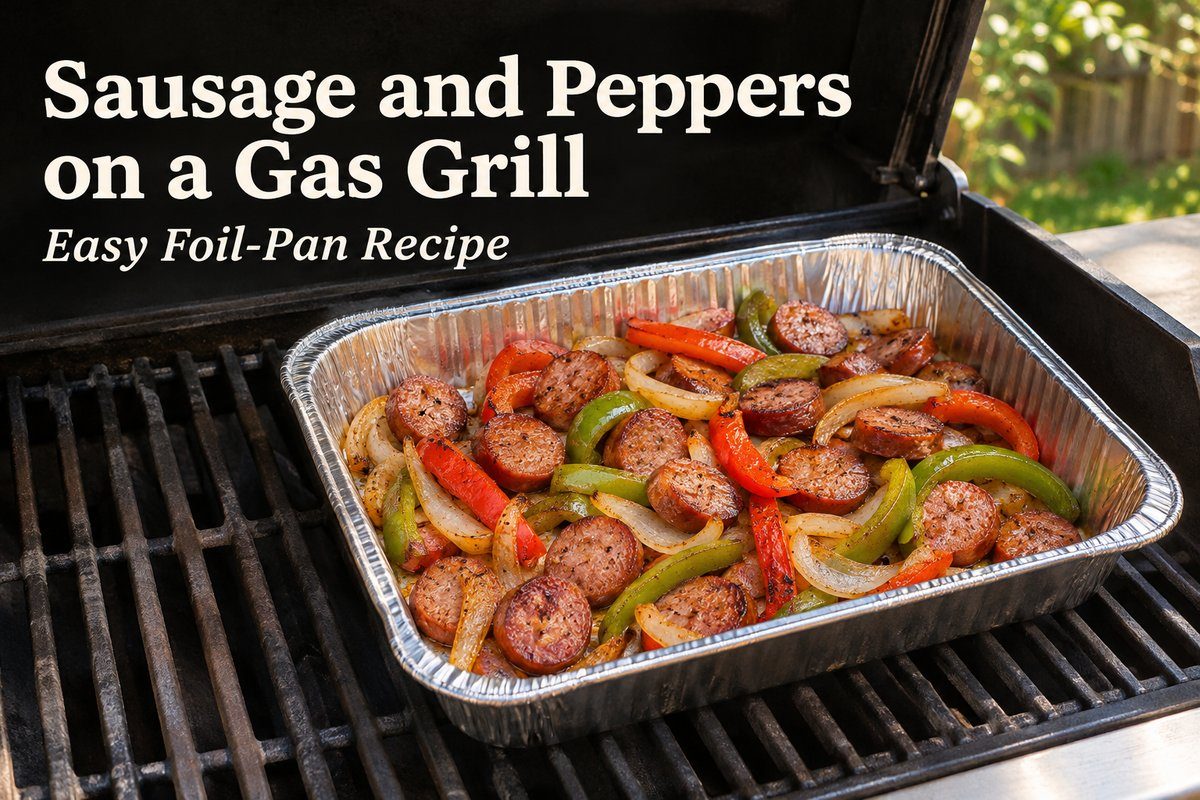
Making sausage and peppers on a gas grill is an easy way to cook dinner without threading skewers or chasing onion slices across the grate. This version uses fully cooked smoked sausage, fresh bell peppers, and one shallow foil pan. A covered first stage softens the vegetables; an uncovered finish lets some moisture escape.
Quick Answer
For sausage and peppers on a gas grill, combine fully cooked smoked sausage, sliced peppers, onion, oil, seasonings, and a little water in a shallow foil pan. Grill over indirect heat at about 400°F, covered for 15–20 minutes, then uncovered for about 10–15 minutes. Finish when the vegetables are tender and the mixture reaches 165°F.
Jump to ingredients | Jump to the recipe steps | Fix a watery or scorching pan
What Do You Need for This Sausage and Peppers Recipe?
You need a package of fully cooked smoked sausage, three bell peppers, one onion, a few pantry seasonings, and a shallow pan that fits entirely over the grill’s indirect area.
Servings: 4 moderate main-dish portions.
Preparation: About 15 minutes.
Estimated cooking: 25–35 minutes, sometimes longer depending on the grill and vegetable thickness.
Grill setting: About 400°F with the grill lid closed, indirect heat.
Ready when: Peppers and onions are tender, sausage is hot throughout, and the mixture reaches 165°F in several places.
- 14 ounces refrigerated fully cooked smoked sausage or kielbasa, cut into ½-inch slices
- 3 medium bell peppers, about 1 pound total, cored and cut into ¼-inch-wide strips
- 1 large yellow onion, about 8 ounces, peeled and cut into ¼-inch slices
- 1 tablespoon olive oil or avocado oil
- 2 tablespoons water
- 1 teaspoon smoked paprika
- ½ teaspoon garlic powder
- ½ teaspoon dried oregano
- ¼ teaspoon ground black pepper
- Optional: up to ¼ teaspoon fine table salt, added to taste after cooking
- Optional for serving: 4 split sandwich rolls and mustard
Equipment: An approximately 13-by-9-inch shallow foil roasting pan suitable for grill use, a sheet of foil for the lid, a bowl, cutting board, knife, long-handled spoon or tongs, thin-tip food thermometer, heat-resistant mitts, and a sturdy metal tray for carrying the disposable pan. A similar-size uncoated metal roasting pan also works.
The sausage already supplies salt, so taste the finished dish before adding more. This recipe has no rice or potatoes in the pan; serve those separately if wanted so they do not change the cooking method.
Key Points
- Use fully cooked sausage. The word “smoked” alone does not establish that a sausage is ready to eat; read the label.
- Keep the burner under the pan off. A thin foil bottom can scorch over direct flame.
- Cut the vegetables evenly. Thick onion wedges take longer than narrow pepper strips.
- Remove the pan cover for the finish. Keep the grill lid closed between checks.
- Support the pan underneath. A disposable foil rim is not a dependable handle for a hot meal.
Which Sausage Works Best for This Method?
A refrigerated smoked sausage or kielbasa clearly labeled fully cooked is the simplest choice. Pork, beef, or fully cooked chicken sausage can work; choose a flavor you like and follow any additional heating instructions on its package.
This method heats the sausage while the vegetables soften. It is not written for raw Italian sausage, fresh bratwurst, frozen sausage, or uncooked smoked links. USDA’s sausage guidance distinguishes uncooked and ready-to-eat products. Do not assume a dark casing means the inside has been cooked.
For this mixed pan meal, 165°F is the finishing target used throughout the recipe, consistent with FoodSafety.gov’s casserole guidance. That is the recipe’s target, not a claim that every packaged ready-to-eat sausage has identical reheating directions.
How Do You Set Up a Gas Grill for a Foil Pan?
Preheat the grill according to its manual, then maintain about 400°F with the burner directly beneath the pan turned off. Heat should circulate around the pan without a flame under its thin bottom.
- Three or more burners: Use the outer burners as needed and place the pan over an unlit center area, if it fits completely there.
- Two burners: Use one burner for heat and place a suitably sized pan over the other, unlit burner.
- A small single-burner grill: If the manufacturer does not provide a suitable indirect setup, use the oven option below.
Check the fit before heating the grill. Leave room around the pan for airflow, close the grill lid normally, and keep vents and grease channels clear. The two-zone grilling guide explains how the lit and unlit areas work together.
Use the sturdy tray only to support the foil pan during transport. Put the pan directly on the cooking grate for this method; an extra sheet pan underneath changes how heat reaches the bottom.
How Do You Make Sausage and Peppers on a Gas Grill?
Toss the ingredients together, cook the pan covered over indirect heat, then uncover it and finish to tenderness and temperature. Keep the food in a shallow, loose layer so you can stir it easily.
- Preheat and prepare. Set up the grill for indirect cooking at about 400°F. Wash the peppers under running water, dry them, and remove the stems and seeds. Slice the peppers, onion, and fully cooked sausage as listed above.
- Mix. Toss the sausage, peppers, and onion in the bowl with the tablespoon of oil, smoked paprika, garlic powder, oregano, and black pepper. Transfer to the pan and spread loosely. Add the 2 tablespoons of water.
- Cover the pan. Crimp a sheet of foil over the rim. Place the pan over the unlit burner area and close the grill lid.
- Cook covered for 15–20 minutes. Check at about 15 minutes, lifting a foil corner away from your face and hands. Stir carefully. The peppers and onion should be beginning to soften. If they remain firm, reseal and cook another 5 minutes before checking.
- Finish uncovered for about 10–15 minutes. Remove the foil cover completely, but close the grill lid. Stir after about 5 minutes and check for hot spots. If one side cooks faster, rotate the pan carefully. Let excess moisture evaporate without cooking the bottom dry and black.
- Check both texture and temperature. A fork should enter the peppers and onion easily. Use a thin-tip thermometer in several thick sausage pieces and different parts of the mixture, keeping the sensing tip in food rather than against aluminum. Finish when the meal reaches 165°F throughout; allow more time if needed.
- Support, season, and serve. Wearing mitts, support the pan underneath on the sturdy metal tray before carrying it. Taste and add optional salt if needed. Divide into four portions and serve as a bowl meal or in the optional rolls with mustard.
Expect tender vegetables and hot sausage with some browned surfaces, not the same crust as food cooked directly on a grate. Do not keep cooking a tender, hot meal indefinitely just to make every piece dark.
Why Is the Pan Watery, Scorching, or Cooking Unevenly?
Standing water calls for an uncovered finish; a blackening bottom calls for less heat underneath. First confirm that the burner directly below the pan is off.
| What you see | Likely reason | What to do |
|---|---|---|
| Tender vegetables in a puddle | The vegetables released water, or the foil stayed on too long. | Remove the pan cover, stir, and continue briefly with the grill lid closed. Serve with a slotted spoon if needed; stop once the food is ready. |
| Dark bottom with firm onions | Direct heat underneath or onion pieces that are too thick. | Move fully over indirect heat. If the bottom is dry, add 1 tablespoon water, cover briefly, and check again in 5 minutes. |
| One end is much darker | A nearby lit burner is heating that end more strongly. | Rotate the pan carefully and adjust the nearby burner. Check the darker end first. |
| A deep pile that heats slowly | Too much food for the pan or a doubled batch. | Divide between two suitable pans and check both independently. |
If you prefer stronger browning on vegetables, a perforated basket is a different method with different moisture behavior. See how to use a grill basket for vegetables before changing cookware halfway through this recipe.
Can You Change the Ingredients or Double the Recipe?
Yes. Keep the same slice thickness, pan space, and fully cooked sausage requirement. Change the seasoning modestly rather than adding ingredients that need a separate cooking process.
- Different peppers: Any mix of red, yellow, orange, and green works in the same total amount. Green peppers give a less sweet flavor.
- A smaller sausage package: A 12- or 13-ounce package works without changing the vegetables. The four portions will simply contain a little less sausage.
- A little heat: Add ⅛ teaspoon crushed red pepper with the dry seasonings.
- Ordinary paprika: Use the same amount if you do not have smoked paprika.
- A double batch: Double the ingredients and divide between two 13-by-9-inch pans. Use only a grill large enough to keep both over indirect heat with airflow around them; otherwise cook separate batches.
For a vegetable side on another day, try grilled Brussels sprouts in a foil pan. Avoid crowding this meal and another large pan into a small cooker just to finish everything together.
How Do You Store and Reheat Leftover Sausage and Peppers?
Transfer leftovers to shallow containers and refrigerate within 2 hours, or within 1 hour above 90°F. Keep them at 40°F or colder, use within 3–4 days, and reheat to 165°F throughout.
These limits follow FoodSafety.gov’s handling guidance and storage chart. Do not leave the full pan on the counter until completely cold. Refrigerate portions promptly, and discard food left out beyond the safe limit.
A covered skillet with a small splash of water is convenient for reheating a portion. Stir to distribute the heat, check several places, and expect the peppers to be softer. Keep leftover rolls separate.
FAQ
Can you use raw Italian sausage in this recipe?
This recipe is written for fully cooked sausage. Raw links need their own cooking instructions and temperature checks; do not substitute them and assume this timing will work.
Can you make the same pan meal in the oven?
Yes. Use a 400°F oven, support the foil pan on a sturdy rimmed baking sheet, and follow the same covered-then-uncovered sequence. Treat the times as estimates and check tenderness and 165°F throughout.
Does a covered foil pan add much smoke flavor?
The covered stage limits contact between smoke and food. This recipe gets its smoky character mainly from the smoked sausage and paprika. A smoke tube is unnecessary.
Can you prepare the vegetables ahead?
Yes. Slice the peppers and onion earlier the same day and refrigerate them in a covered container. Keep the sausage refrigerated according to its label and combine everything when you are ready to cook.
Final Verdict
Sausage and peppers on a gas grill makes sense when you want a simple pan meal and easy serving. Use fully cooked sausage, keep direct flame away from the foil bottom, and finish by checking both the vegetables and the temperature. The pan does the carrying and keeps the small pieces together.
About Frank W. Roberts
Frank W. Roberts has grilled since 1970 and writes Everything Grill Reviews. This is a research-based recipe developed from published grilling methods and current USDA and FoodSafety.gov guidance. Frank has not physically tested this recipe; cooking times are estimates.