
Updated: August 19, 2026
Everything Grill Reviews may earn a commission from qualifying purchases made through links on this page, at no extra cost to you.
This dual fuel gas and charcoal grill review is for cooks who like the speed of propane but do not want to give up charcoal flavor. A combination grill can replace two separate cookers, but the tradeoff is a wider, heavier appliance with two smaller cooking zones and more parts to clean.
Quick Answer: Yes, a dual fuel grill is worth buying if you regularly cook with both gas and charcoal and have room for a wide, heavy grill. It gives you fast weeknight cooking and real charcoal flavor in one frame, but each side is usually smaller than a dedicated grill and cleanup takes more work.
Bottom line at a glance
- Best for: households that genuinely use both fuel types, cooks who entertain, and buyers trying to avoid owning two full-size grills.
- Skip it if: you mainly use one fuel, need a compact grill, or want the strongest possible smoking performance for your money.
- Biggest advantage: two different heat sources and cooking zones can be available during the same meal.
- Biggest compromise: you maintain a gas grill and a charcoal grill even when one side gets little use.
Are dual fuel gas and charcoal grills worth it?
They are worth it for the right cook, not automatically for every backyard. The value comes from using both sides often enough to justify the extra size, assembly, and maintenance. If you cook quick burgers or chicken on gas during the week and want charcoal for steaks or weekend barbecue, the format makes sense.

A combo grill is less convincing when one side becomes permanent storage. A good dedicated gas grill plus a kettle-style charcoal grill may give you more total flexibility, easier replacement, and better performance from each fuel. That two-grill setup, however, takes more floor space and may be less convenient when you want both fuels ready at once.
Do not buy a combination grill merely because it promises the “best of both worlds.” Buy one when its two cooking chambers, footprint, cleanup system, and replacement-parts support fit the way you actually cook.
How does a dual fuel gas and charcoal grill work?
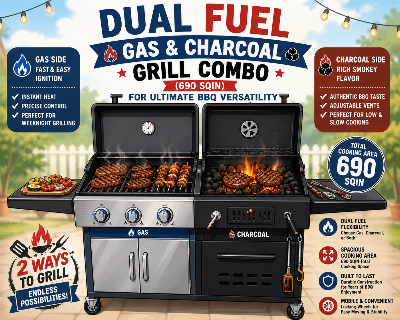
Most dual fuel grills place a propane cooking chamber beside a separate charcoal chamber on one cart. The gas side uses burners and heat tents like a conventional gas grill. The charcoal side uses a charcoal grate or tray, air vents, and an ash-management system. Separate lids allow the two sides to run at different temperatures.
Some models add an offset firebox for charcoal and wood, while others offer an optional side firebox. That distinction matters. A side-by-side charcoal grill can cook indirectly and add smoke, but it is not automatically a true offset smoker.
Many separate-chamber models can operate both sides during the same meal, but follow the owner’s manual for the exact grill. Never put charcoal or wood in the gas firebox, and never improvise a natural-gas conversion unless the manufacturer specifically approves the grill and conversion kit.
How was this dual fuel grill comparison evaluated?
This is a researched category review based on documented design, specifications, cleaning features, fuel layout, and likely ownership tradeoffs. It does not claim that every model below was personally tested. Manufacturer specifications can change, so confirm the current manual, dimensions, fuel type, warranty, and parts availability before ordering.
The most useful questions are not “Which grill has the largest BTU number?” or “Which one has the biggest total area?” They are:
- How much primary cooking space is available on each side?
- Can the charcoal heat and airflow be controlled without lifting the lid?
- Are the grease tray and ash pan easy to remove?
- Will the grill fit with safe clearance around it?
- Can you still obtain grates, burners, igniters, and other parts?
- Does the charcoal side match the way you grill, or do you really need an offset smoker?
Which dual fuel gas and charcoal grills should you compare?
Start by comparing three different layouts: a smoke-first offset combo, a large traditional side-by-side combo, and a cabinet-style combo. The examples below are not ranked as universal winners. They show how design differences affect the buyer.
| Model | Documented layout | Useful features | Best fit | Main caution |
|---|---|---|---|---|
| Oklahoma Joe’s Canyon Combo | Three-burner propane grill with a charcoal-and-wood offset smoker/grill | 750 sq. in. listed primary area, 281 sq. in. firebox grate, adjustable dampers, dual lid gauges, removable ash pan | Buyer who puts smoking ahead of cabinet storage | Large footprint and more fire management than a simple charcoal tray |
| Char-Griller Double Play 5650 | Side-by-side gas and charcoal chambers, three main gas burners, and a side burner | 875 sq. in. listed primary area, 1,260 sq. in. total area, ash pan, dual gauges, optional side-firebox compatibility | Families and frequent entertainers wanting a traditional combo layout | At about 64 inches wide and more than 150 pounds as listed, it is not compact |
| Royal Gourmet ZH3003S | Three-burner gas and charcoal combo with cabinet storage | 843.56 sq. in. listed total area, removable grease tray and cup, enclosed storage, locking casters | Buyer who values storage and a finished cabinet-style cart | Confirm the cooking area assigned to each fuel side, not just the total |
Specifications above were checked against the manufacturers’ published pages in August 2026. Availability and specifications may change.
Is the Oklahoma Joe’s Canyon Combo best for smoking?
It is the most smoke-oriented design in this comparison because it includes an offset charcoal-and-wood chamber rather than only a charcoal tray beside the gas grill. Oklahoma Joe’s lists a 36,000-BTU three-burner propane side, 750 square inches of primary cooking space, a 281-square-inch firebox grate, adjustable dampers, and a removable ash pan. See the official Canyon Combo specifications.
The tradeoff is involvement. Offset-style cooking asks the user to manage fuel, airflow, and heat movement. If you want push-button convenience on both sides, this is not that. If you enjoy tending a fire and also want a propane grill for faster meals, its layout is more purposeful than a basic two-chamber combo.
Is the Char-Griller Double Play best for large meals?
It is a strong comparison for entertaining because Char-Griller lists 875 square inches of primary cooking space and 1,260 square inches overall. The gas section has three main burners plus a side burner, while the charcoal section has its own temperature gauge and ash pan. An optional side firebox can be added for offset-style smoking. See the official Double Play specifications.
Remember that total area can include warming racks. Compare the usable primary grate on each side with the foods you normally cook. A large combined number does not help if your preferred fuel side is too narrow for your usual ribs, brisket, or batch of burgers.
Is the Royal Gourmet ZH3003S best for storage?
It is the cabinet-style option in this comparison, with enclosed storage plus a removable grease tray and cup. Royal Gourmet lists 843.56 square inches of total cooking area, 33,000 BTU of total output, a net weight of 143.3 pounds, and four locking casters. See the official ZH3003S specifications.
The cabinet may keep tools organized, but it does not remove the need to check each cooking chamber’s dimensions, vent arrangement, ash access, and replacement-part support. Those details matter more than polished doors once the grill has spent several seasons outdoors.
How well does a gas and charcoal combo grill cook?
A good combo grill can cook very well, but expect each chamber to behave like its own smaller grill. The gas side should be judged as a gas grill, and the charcoal side should be judged as a charcoal grill or smoker. One fuel does not correct weaknesses on the other side.
How fast is the gas side?
The gas side is the convenience half: it should light quickly, preheat predictably, and allow separate heat zones. Burner placement, grate material, firebox depth, lid fit, and wind protection affect performance as much as the total BTU number. A large BTU figure alone does not guarantee even heating or strong searing.
Look for independent burner controls so you can keep one zone hot and another cooler. That lets you brown food over direct heat and move it to a gentler gas zone to finish. Use a grate-level thermometer when accuracy matters; a lid thermometer measures the air near the lid, not the exact temperature at the food.
Does the charcoal side give real charcoal flavor?
Yes. Food cooked over charcoal can develop the aroma and flavor associated with charcoal combustion and drippings hitting hot coals. The amount of smoke character depends on the fire, airflow, food, and whether you add suitable wood chunks—not simply on the word “charcoal” in the product name.
An adjustable charcoal tray is useful because changing the coal-to-food distance changes cooking intensity. It is not essential on an offset-style chamber, where heat is managed with fire size, fuel placement, and dampers. Match the mechanism to the cooking you plan to do.
Can a dual fuel grill smoke low and slow?
It can, but smoking ability varies sharply by design. A dedicated offset chamber such as the Canyon’s is built around indirect heat and smoke flow. A standard charcoal chamber may still smoke with a small fire on one side and food on the other, provided the manual permits that setup and the vents allow control.
If smoking is your main goal, compare the combo against a dedicated smoker before buying. Our best smokers guide and outdoor grill and smoker barrel guide cover alternatives that may offer more smoking room or simpler airflow control.
Can you sear on a combination grill?
Yes, either side may sear when it can deliver enough grate-level heat, but the method differs. On charcoal, concentrate a fully lit coal bed beneath the searing zone. On gas, preheat as directed and use the grill’s high-heat zone. Do not assume you can literally “slide” food between separate chambers; transfer it safely with clean utensils and a tray.
What are the pros and cons of a dual fuel grill?
The main benefit is flexibility; the main cost is compromise and upkeep. The following list is more useful than treating “two fuels” as an automatic upgrade.
Advantages
- Fast propane cooking and charcoal cooking in one frame
- Separate heat environments for different foods
- Potential to operate both chambers during a large meal when the manual allows it
- Less patio clutter than two full-size cart grills
- A practical compromise for households divided between gas and charcoal
Disadvantages
- Wider, heavier, and harder to move than many single-fuel grills
- Each fuel side may have less usable room than a dedicated grill
- Two cleanup systems: grease on one side and ash on the other
- More burners, vents, trays, gauges, seams, and finishes to maintain
- Replacing the entire unit may be wasteful if only one side wears out
What should you check before buying a dual fuel grill?
Check the space assigned to each fuel, the cleaning access, construction, parts support, and full assembled dimensions. These factors predict day-to-day satisfaction better than a long accessory list.
1. How much cooking space is on each side?
Ignore the combined number until you know the primary grate area for both chambers. Warming racks often count toward the advertised total. Measure your largest common foods—such as a rib rack, cast-iron pan, or whole chicken—and compare those dimensions with the actual grate layout.
2. Is the charcoal fire easy to control?
Look for usable intake and exhaust vents, safe fuel access, and either an adjustable charcoal tray or a well-designed offset firebox. You should be able to add or rearrange fuel with minimal disruption. A lid thermometer is helpful for trends but does not replace a probe near the food.
3. Is ash and grease removal straightforward?
A removable ash pan and pull-out grease tray reduce the chance that cleanup will be postponed. Check whether each can be removed without spilling into the cabinet or across a propane hose. Also look at access around burners and heat tents, where grease and debris collect.
4. Does the grill feel durable where it matters?
Inspect the fireboxes, lid alignment, hinges, cart bracing, wheels, handles, grates, and finish rather than relying on an unsupported minimum steel-gauge rule. Thin sheet metal is not the only durability issue; trapped water, loose hardware, damaged coatings, and unavailable parts can shorten a grill’s useful life.
5. Will it fit after the lids and shelves are opened?
Use assembled width and depth, then add the safe clearance required by the manual. Include room to stand, open both lids, access the offset firebox or ash pan, move the propane cylinder, and roll the grill out for cleaning. A 64-inch-wide grill can overwhelm a small deck even when it technically fits.
6. Can you get the correct fuel setup and replacement parts?
Assume a gas side is propane-only unless the manufacturer says otherwise. Confirm the regulator, approved cylinder size, any natural-gas compatibility, burner availability, igniter parts, grates, ash pans, and a fitted cover. Read the warranty terms instead of judging quality by warranty length alone.
7. How difficult is assembly?
Large combo grills can be heavy and awkward to assemble alone. Review the manual before delivery, count the boxes, prepare a level work area, and arrange help for lifting fireboxes or attaching the cart. Tighten hardware as directed and check lid, hose, and wheel alignment before the first burn.
Who should buy a dual fuel grill—and who should skip it?
Buy one when both fuel types are part of your real cooking routine; skip it when “maybe someday” is the only reason you want the second chamber.
A dual fuel grill is a good fit if:
- You use gas for quick meals and charcoal for flavor at least several times per season.
- You want two independent heat zones for family meals or entertaining.
- You have enough level outdoor space for a wide, heavy cart.
- You accept separate ash and grease cleanup routines.
- You prefer one assembled unit over two freestanding grills.
You should probably skip it if:
- You cook almost exclusively with gas or almost exclusively with charcoal.
- You need a light grill that can be moved often.
- You have a narrow patio, balcony, or limited storage clearance.
- Your main goal is serious low-and-slow smoking; a dedicated smoker may serve you better.
- You want the easiest possible cleaning and fewest replacement parts.
If open-fire charcoal cooking is the real attraction, compare a dedicated option such as our Oklahoma Joe’s Firecraft Series review before committing to a combo.
How do you clean and maintain a dual fuel grill?
Maintain each half according to its fuel system: control grease on the gas side, remove cold ash from the charcoal side, and keep water out of both. A few minutes after each cook is more effective than a major cleanup after corrosion or blocked burners appear.
After each cook
- Follow the manual’s procedure for brushing or scraping the cooking grates.
- Turn off the gas at the controls and cylinder in the order specified by the manufacturer.
- Let charcoal and ash become completely cold before disposal.
- Empty grease or ash containers before they overflow.
- Wipe spills from shelves and painted surfaces with a suitable cleaner.
Every few cooks
- Inspect burner ports and venturi openings for grease, debris, or insect blockage.
- Check the propane hose, regulator connection, and cylinder area.
- Remove accumulated grease from the firebox and grease tray.
- Clear ash that can hold moisture against steel.
- Check fasteners, wheels, handles, vents, and lid alignment.
At the start and end of the season
- Perform the leak check described in the owner’s manual.
- Touch up only with coatings approved for the grill and location.
- Replace worn parts with manufacturer-approved components.
- Use a fitted, vented cover after the grill has cooled and dried.
- Store propane cylinders exactly as local rules and the manual require.
Safety reminder: Use gas and charcoal grills outdoors only in a well-ventilated area. Never use one in a garage, breezeway, carport, enclosed porch, or beneath a surface that can burn. The U.S. Consumer Product Safety Commission also recommends checking for propane leaks and keeping grease traps clean. Read the CPSC grill-safety guidance.
Use a food thermometer rather than color alone. The USDA safe minimum temperature chart lists current temperatures and rest times.
Frequently Asked Questions
Can you use gas and charcoal at the same time on a dual fuel grill?
Many models with separate fireboxes are designed to operate both sides, but the owner’s manual is the deciding authority. Keep the required clearances, monitor both fires, and never leave the grill unattended.
Can you put charcoal in the gas side?
No, not unless the manufacturer explicitly designed that chamber for charcoal. Loose coals can damage burners, block ports, overload the grease system, and create unsafe heat. Use each fuel only in its approved chamber.
Can you add wood chips or chunks to a combo grill?
Use wood only in a manner allowed by the manual. Wood chunks may be suitable with charcoal or in an offset firebox. On the gas side, use only an approved smoker box or method; do not place loose wood on burners or heat tents.
Is a dual fuel grill better than buying two separate grills?
It is better for a buyer who values one frame and coordinated cooking more than maximum performance from each fuel. Two dedicated grills may offer more total grate space, easier replacement, and more specialized cooking, but they take more patio room.
Are dual fuel grills harder to clean?
Usually, yes, because they combine grease management with charcoal-ash removal. A pull-out grease tray and removable ash pan make the work easier. Neglecting either side can increase corrosion, flare-ups, or unreliable heating.
Can a gas and charcoal combo grill be converted to natural gas?
Only if the exact model is approved for conversion and the manufacturer supplies or specifies the correct kit. Do not use a universal conversion kit or drill burner orifices. If the manual does not authorize conversion, treat the grill as propane-only.
How long should a dual fuel grill last?
There is no honest one-number answer. Climate, steel and coating quality, drainage, grease and ash removal, cover use, replacement-parts availability, and cooking frequency all matter. Regular cleaning and keeping cold ash and standing water away from steel can extend useful life.
Final Verdict: Is a dual fuel gas and charcoal grill a smart buy?
Yes—for a cook who will use both fuels often and accepts the extra size and maintenance. Gas handles quick meals and controlled heat zones. Charcoal supplies live-fire cooking and smoke potential. Together they can make a flexible entertaining station without placing two separate cart grills on the patio.
The format is not automatically cheaper, smaller, or better than two dedicated grills. Compare the usable area on each side, confirm the charcoal design matches your cooking style, inspect the cleaning access, and verify parts support. If one fuel will handle nearly every meal, buy the best single-fuel grill you can instead.
Our recommendation: Choose a smoke-first offset combo if barbecue is the priority, a large side-by-side model for entertaining, or a cabinet model when storage and a finished appearance matter most. Do not choose by total BTU, total square inches, or sale price alone.
About the author
Frank W. Roberts has been grilling since 1970 and has participated in cookoffs. Everything Grill Reviews separates documented product facts from opinion and does not claim hands-on testing when a grill was evaluated through manufacturer information and careful comparison.