
Updated: November 11, 2026
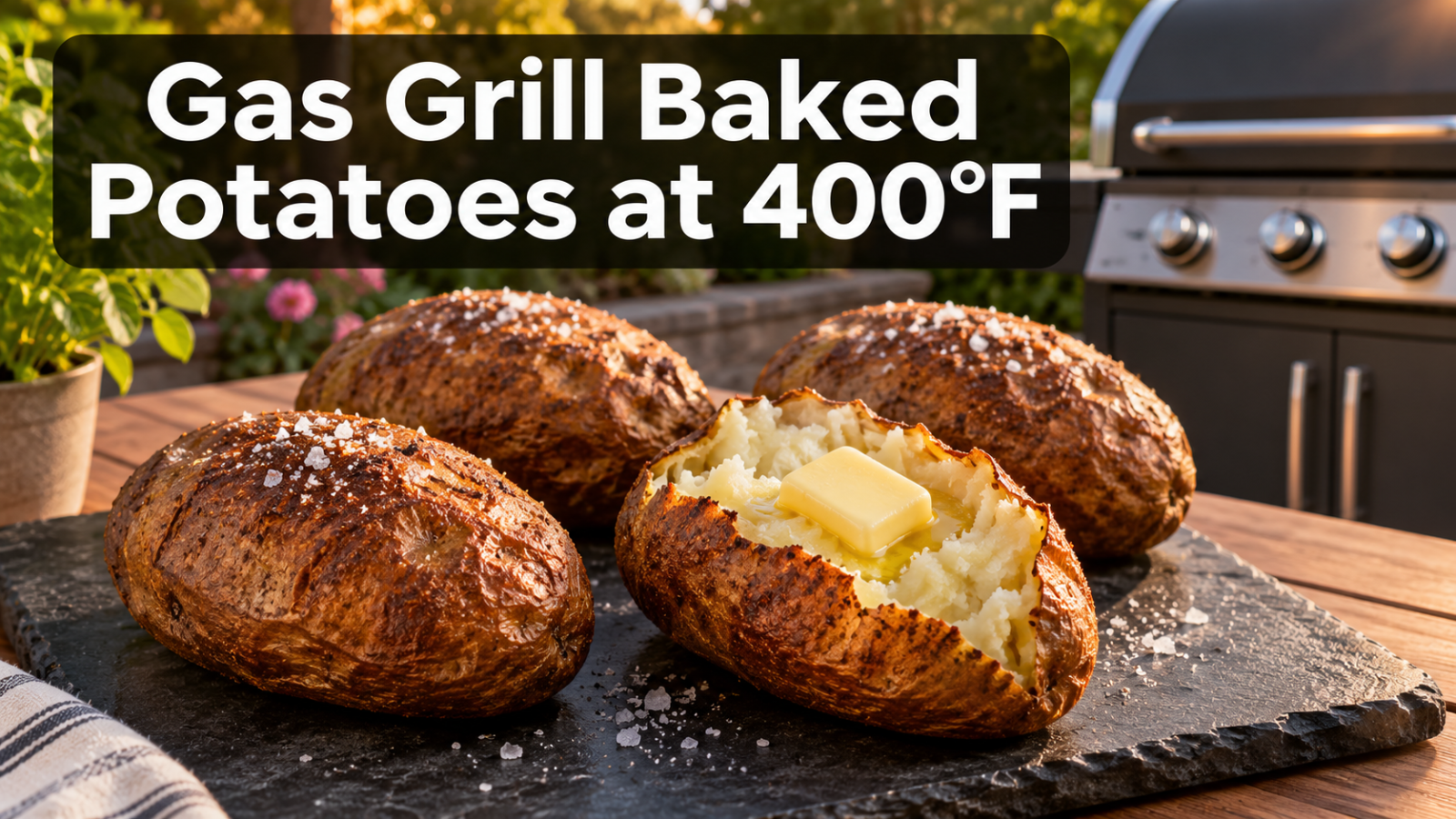
Gas grill baked potatoes at 400°F come out with crisp, salty skins and fluffy centers when you cook them over indirect heat without foil. The method is simple: use similarly sized russets, dry them well, coat them lightly with oil and salt, then cook with the lid closed until the center reaches about 205°F and a skewer slides in easily.
Quick Answer: Preheat a gas grill for indirect cooking at 400°F. Scrub and completely dry four 8- to 10-ounce russet potatoes, pierce each one several times, then rub all four with 1 tablespoon of high-heat oil and 2 teaspoons of kosher salt. Put them on the unlit side, close the lid, and cook for 50 to 70 minutes. Rotate once for even browning. They are ready when the centers are about 205°F and a thin skewer meets almost no resistance.
Key Points
- Grill setup: 400°F with at least one burner off; potatoes sit over the unlit area.
- Best potato: Medium russets, 8 to 10 ounces each, matched as closely as possible.
- Prep: Scrub, dry, pierce, then coat lightly with oil and kosher salt.
- Cooking time: Usually 50 to 70 minutes, depending on potato size and the grill’s true indirect-zone temperature.
- Doneness: About 205°F in the center plus a skewer that slides in easily.
- Foil: Skip it for crisp skin. Foil traps steam and gives you a softer skin.
What Do You Need for Gas Grill Baked Potatoes at 400°F?
You need four medium russet potatoes, a small amount of oil, kosher salt, and an instant-read thermometer or thin skewer. This recipe makes four side-dish servings and uses ordinary kitchen tools.
Ingredients
- 4 medium russet potatoes, 8 to 10 ounces each
- 1 tablespoon avocado, canola, or other high-heat neutral oil
- 2 teaspoons kosher salt
Optional toppings
- 2 tablespoons butter
- 1/2 cup shredded cheddar
- 1/2 cup sour cream or plain Greek yogurt
- 2 tablespoons sliced chives or green onions
- Freshly ground black pepper
Equipment
- Gas grill with a lid and at least two independently controlled burners
- Grill brush or the grate-cleaning tool recommended for your grill
- Fork
- Tongs
- Instant-read thermometer or thin metal skewer
Prep time: 10 minutes
Cook time: 50 to 70 minutes
Total time: About 60 to 80 minutes
Yield: 4 baked potatoes; 4 side-dish servings
How Do You Set Up a Gas Grill for Baked Potatoes?
Set up an indirect zone by lighting one side of the grill and leaving the burner directly under the potatoes off. Preheat with the lid closed, then adjust the lit burner or burners until the lid thermometer settles near 400°F.
- Clean the cooking grate while the grill is cold or according to the grill maker’s directions.
- On a two-burner grill, light one burner and leave the other off. On a three- or four-burner grill, light the outer burners and leave a center burner off if the layout creates a safe, stable indirect zone.
- Close the lid and preheat for 10 to 15 minutes.
- Adjust the lit burners to hold roughly 400°F. Keep required vents and gaps open.
The lid thermometer is a useful reference, not a map of the grate. If one side of your grill always runs hot, put the largest potato in the cooler part of the indirect zone and rotate positions halfway through. Our guide to finding hot and cold spots on a gas grill explains how to map that pattern.
How Do You Prepare the Potatoes?
Scrub the russets under running water, dry them completely, pierce each one several times, and coat them lightly with oil and salt. Drying matters because surface water delays browning and softens the skin.
- Choose potatoes that are close in weight. A 14-ounce potato will not finish with an 8-ounce potato just because they went on together.
- Scrub away soil under cool running water. Do not use soap.
- Dry every potato thoroughly with a clean towel.
- Pierce each potato 5 or 6 times with a fork, spacing the holes around the surface.
- Rub the four potatoes with 1 tablespoon of oil total. You want a thin sheen, not dripping oil.
- Sprinkle all sides evenly with 2 teaspoons of kosher salt.
Do not wrap the potatoes in foil if crisp skin is the goal. Foil holds steam against the skin. It can be useful when you specifically want a soft, steamed exterior, but it changes the result.
How Do You Grill Baked Potatoes at 400°F Without Foil?
Place the prepared potatoes over the unlit burner, close the lid, and cook for 50 to 70 minutes. Turn each potato and swap positions after about 30 minutes, then start checking the smaller potatoes at 50 minutes.
- Arrange the potatoes on the indirect side with at least 1 inch between them.
- Close the lid and keep the grill near 400°F. Avoid opening it repeatedly; every long look releases heat.
- At 30 minutes, turn the potatoes with tongs. If the grill has a known hot side, swap their positions as well.
- At 50 minutes, insert an instant-read thermometer through the side into the center of the smallest potato. You can also test with a thin skewer.
- Remove each potato separately when its center is about 205°F and the skewer slides through with almost no resistance.
- Cut a lengthwise slit right away, gently press the ends to open the potato, and fluff the center with a fork. Opening lets excess steam escape instead of making the interior heavy.
The 205°F number is a quality target, not a food-safety minimum. Potato Goodness, the site of the U.S. potato industry, also recommends about 205°F for a baked potato. Use texture as the final check because potato size, starch, and thermometer placement all vary.
How Long Do Baked Potatoes Take on a Gas Grill?
Medium 8- to 10-ounce russets usually need 50 to 70 minutes at a steady 400°F over indirect heat. Smaller potatoes may finish sooner, while large potatoes can take 75 minutes or more.
| Potato size | When to start checking | Likely range at 400°F |
|---|---|---|
| 6 to 8 ounces | 45 minutes | 45 to 60 minutes |
| 8 to 10 ounces | 50 minutes | 50 to 70 minutes |
| 12 to 14 ounces | 60 minutes | 60 to 85 minutes |
These are planning ranges, not promises. Wind, outside temperature, burner output, potato moisture, and lid openings all change the cook. A thermometer tells you where you are; a skewer tells you whether the center is actually tender. For probe technique, see how to use an instant-read thermometer correctly.
Why Are the Skins Soft, Burned, or Tough?
Soft skin usually comes from foil or a wet potato; burned skin usually means the potato sat over direct flame; and a hard center means the potato needs more time. The fix depends on the failure point.
| Problem | Likely cause | Better move |
|---|---|---|
| Skin is soft | Foil, wet surface, or crowded potatoes trapping steam | Dry well, skip foil, and leave space between potatoes |
| One side is black | Potato is over a lit burner or a strong hot spot | Move fully into the indirect zone and rotate positions |
| Center is firm | Potato is large or the grill is running below 400°F | Keep cooking and check again in 10-minute intervals |
| Center is dense instead of fluffy | Potato was cut late and steam stayed trapped | Split and fluff promptly after it comes off the grill |
| Salt falls off | Too little oil or uneven coating | Use a thin, complete oil film before salting |
What Substitutions Work?
Yukon Gold and sweet potatoes can use the same indirect setup, but they will not have the same dry, fluffy center as a russet and may finish on a different schedule.
- Oil: Use avocado, canola, grapeseed, or another neutral oil suited to grill heat. Melted butter can burn on the skin, so save it for serving.
- Salt: Fine salt works, but reduce the volume because it packs more densely than kosher salt. Start with 1 teaspoon for four potatoes.
- Sweet potatoes: Cook indirectly and begin checking medium sweet potatoes around 40 minutes. They are done when a skewer passes through easily.
- Yukon Golds: Use potatoes of equal size and expect a creamier, less fluffy center.
- No thermometer: Use a thin skewer through the thickest part. It should meet almost no resistance. Avoid squeezing a hot potato in your hand.
How Should You Store and Reheat Leftover Baked Potatoes?
Refrigerate leftover potatoes within 2 hours, use them within 3 to 4 days, and reheat them to 165°F. Store them unwrapped in a shallow covered container once they have stopped steaming heavily.
The USDA advises refrigerating leftovers promptly, keeping them no longer than 3 to 4 days, and reheating leftovers to 165°F. Its guidance also notes a documented botulism outbreak involving foil-wrapped baked potatoes left at room temperature. See the USDA’s leftover safety guidance and baked-potato botulism explanation.
For the best skin, reheat an unwrapped potato on a 375°F grill or in a 375°F oven until the center reaches 165°F. A microwave is faster, but the skin will soften. Do not leave cooked potatoes sitting in a closed grill after the heat is off.
Frequently Asked Questions
Do you have to boil or microwave potatoes before grilling?
No. Whole 8- to 10-ounce russets will cook through over indirect 400°F heat in about 50 to 70 minutes. Par-cooking is only a shortcut, and it adds another timing variable.
Should you poke holes in potatoes before grilling?
Yes. Pierce each potato 5 or 6 times with a fork. The holes give steam a controlled way to escape while the potato cooks.
Can you put baked potatoes directly on gas-grill grates?
Yes, as long as the grate is clean and the potatoes sit over an unlit burner. Directly over flame, the skins can burn long before the centers soften.
Do you close the grill lid for baked potatoes?
Yes. A closed lid lets the indirect side act like an outdoor oven. Opening it often lengthens the cook and makes the temperature less stable.
When should you use foil?
Use foil only when you prefer soft, steamed skin or when another recipe specifically calls for it. For crisp, salted skin, cook the potatoes unwrapped and refrigerate leftovers promptly.
Conclusion: Is 400°F the Best Gas-Grill Temperature for Baked Potatoes?
Yes. For medium russets, 400°F balances a crisp exterior with a practical 50- to 70-minute cook. The important part is not the number alone: keep the potatoes over indirect heat, match their sizes, dry the skins, and judge doneness by both center temperature and tenderness.
About the author: Frank W. Roberts writes Everything Grill Reviews for cooks who want clear, practical answers without invented test results. This research-based recipe was checked against current food-safety guidance and established baked-potato doneness guidance on November 11, 2026; it is not presented as a physical cooking test.