
Updated: November 11, 2026
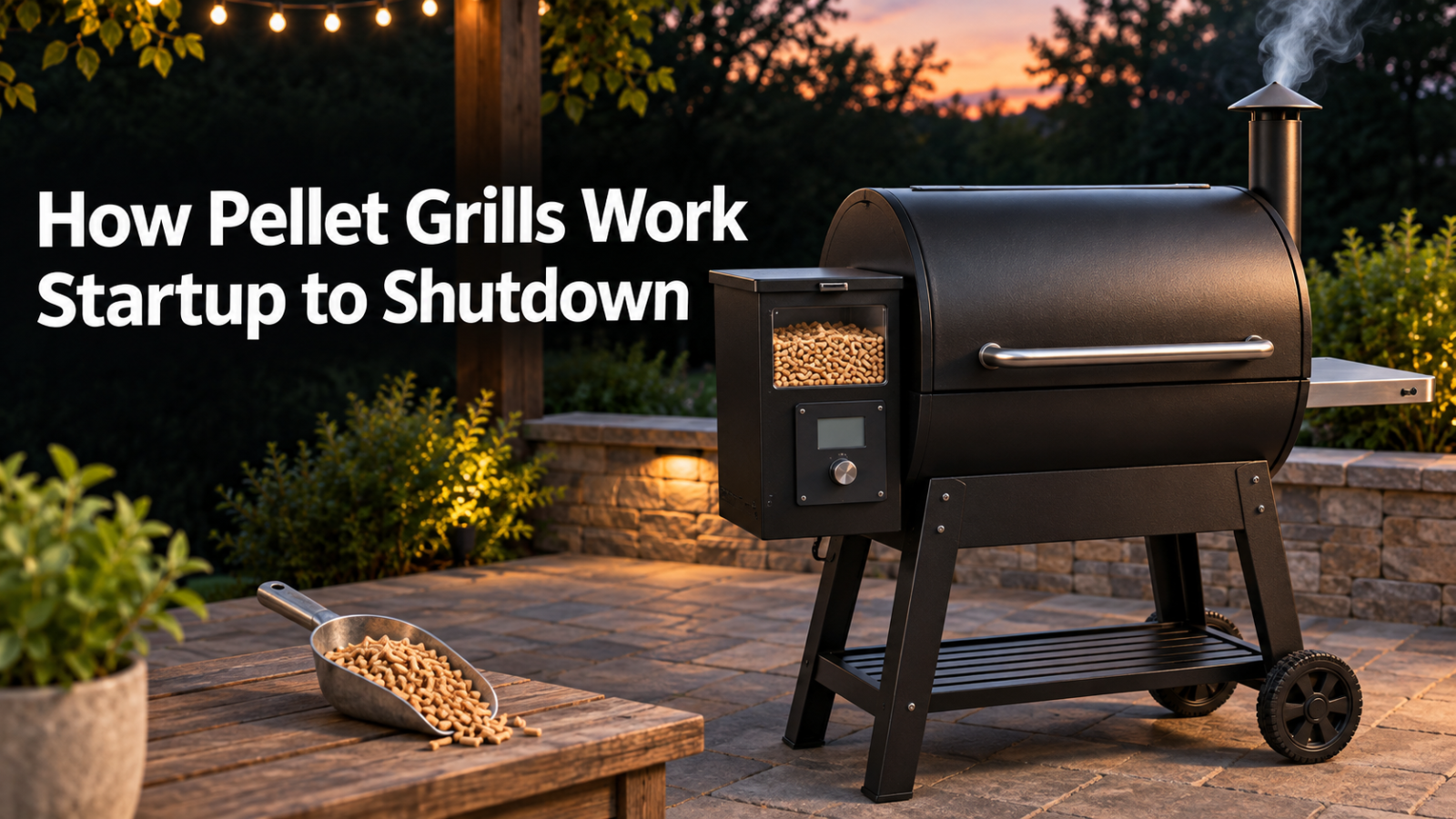
If you want to know how pellet grills work, picture a small wood fire managed by a thermostat. Food-grade wood pellets supply the fuel, while household electricity runs the controller, auger motor, igniter, and fan. Those systems cooperate to light the fire, move heat and smoke around the food, and adjust the burn as conditions change.
Quick Answer: Pellets fall from a hopper onto a motor-driven auger, which carries them into a firepot. An electric hot rod ignites the first pellets, and a fan supplies combustion air. A temperature sensor reports the cooking-chamber temperature to the controller. The controller then changes pellet delivery—and, on some models, fan speed—to keep the grill near the selected setting. Heat shields and a drip tray turn the concentrated fire into mostly indirect heat, while smoke and hot air pass around the food and leave through a chimney or rear vents.

Table of Contents
- Key Points
- What Fuels a Pellet Grill?
- What Does Each Part Do?
- How Do Pellets, Air, Heat, Smoke, and Grease Move?
- What Happens From Inspection to Ignition?
- How Does the Controller Hold Temperature?
- What Changes During a Cook?
- What Happens During Shutdown?
- Why Do Pellet Grills Fail?
- What Maintenance Keeps One Reliable?
- How Is This Different From Tending a Firebox?
- Frequently Asked Questions
- Conclusion
Key Points
- Two inputs are essential: cooking pellets provide heat and smoke; electricity powers the feed, ignition, airflow, and controls.
- The controller reacts—it does not predict everything: weather, wind, cold food, pellet condition, and lid openings can temporarily pull the grill away from its set temperature.
- Most cooking is indirect: a diffuser and drip tray separate food from the firepot, spread heat, and route grease away from the flame.
- Startup procedures are model-specific: first use, an empty auger, a normal start, and a restart after a flameout are not the same job.
- Shutdown is part of fire safety: let the programmed cycle finish before switching off or unplugging unless the manufacturer directs otherwise for an emergency.
- A cold firepot and grease path need regular inspection: ash, excess pellets, and accumulated grease can cause ignition trouble or fire.
What Fuels a Pellet Grill?
A pellet grill uses food-grade cooking pellets for combustion and electric power for operation. Losing either input stops normal cooking.
What are cooking pellets?
Cooking pellets are small cylinders made from compressed wood material intended for food preparation. The exact wood blend and any permitted processing ingredients vary by manufacturer, so the safest rule is to use dry pellets approved by the grill maker. Never substitute home-heating pellets; their composition and intended use are different.
Good pellets are firm and dry. Pellets that crumble readily, feel damp, or have swollen into soft material can feed unevenly and may form a hard auger jam. Store sealed bags off concrete and away from rain and humidity. If the hopper will sit unused in damp weather, follow the manual’s instructions for emptying it rather than assuming a lid makes it moistureproof. Our guide to storing pellets so they stay dry covers the practical details.
Why does a wood-burning grill need electricity?
Electricity does not provide the cooking heat; it powers the machine that manages the wood fire. The controller, display, auger motor, igniter, combustion fan, sensors, and connected features all depend on power.
That distinction matters outdoors. A bag of pellets cannot make the grill work during an outage. A generator, inverter, or power station must meet the grill maker’s voltage, grounding, waveform, and power requirements. Do not guess from average running watts alone, because an igniter usually creates a larger startup load than the controller and fan need later.
What Does Each Pellet-Grill Part Do?
Every pellet grill combines a fuel-delivery path, a controlled fire, forced airflow, heat and grease management, and feedback controls. The layout changes by model, but the jobs remain recognizable.
| Part | Job | Important variation or caution |
|---|---|---|
| Hopper | Stores the working supply of pellets. | Capacity and emptying method vary. A lid is not a guarantee against humidity. |
| Hopper guard | Helps keep hands and large objects away from the auger opening. | Do not remove or defeat it to push pellets toward a moving auger. |
| Pellet chute or throat | Guides pellets from the hopper to the auger. | Some designs place the hopper beside the chamber; compact models may put it inside the cabinet. |
| Auger and motor | A screw conveyor moves measured amounts of fuel toward the firepot. | Controllers may pulse the motor or vary its operation. Never put fingers near an energized auger. |
| Feed tube | Contains the auger and delivers pellets to the firepot. | Wet fuel can swell inside it; heat traveling backward into the tube is a burn-back hazard. |
| Firepot or burn pot | Holds the small, concentrated pellet fire. | Blocked air holes, ash, or leftover pellets can interfere with ignition. |
| Igniter or hot rod | Heats the first pellets during startup. | Normally it is not the continuous heat source. Ignition logic differs by controller. |
| Combustion fan | Supplies oxygen and helps circulate hot air and smoke. | Some fans run at a fixed speed; others vary. A failed or obstructed fan changes combustion. |
| Controller | Compares the selected temperature with sensor data and commands the auger, fan, and ignition sequence. | PID, timed-cycle, smoke-mode, and proprietary systems behave differently. |
| Internal temperature sensor | Measures air temperature at one point in the chamber. | It is not a grate-wide average. Grease buildup, damage, or nearby cold food can distort what it reports. |
| Meat probe | Measures food temperature for display, alerts, or optional control features. | It does not replace an instant-read check in more than one spot. |
| Heat diffuser | Spreads concentrated firepot heat and reduces direct exposure. | Shape, material, and placement create model-specific hot spots. |
| Drip tray | Shields the fire and slopes grease toward a drain. | Some models combine it with the diffuser; some have a sliding direct-flame opening. |
| Grease drain and cup or bucket | Carry and collect grease outside the chamber. | A blocked, missing, or overflowing collector is a fire and spill risk. |
| Cooking grates and chamber | Support food in the controlled stream of hot air and smoke. | Upper and lower racks may cook differently because of distance from the diffuser and airflow. |
| Gaskets and seals | Limit unintended leakage where fitted. | Not every pellet grill is tightly sealed. Do not add seals unless the manufacturer approves them. |
| Chimney or rear vents | Provide the designed exhaust path for smoke, moisture, and combustion gases. | Neither style automatically creates more smoke flavor. Never block, extend, or modify an exhaust without approval. |
Traeger’s official pellet-grill explanation confirms the core hopper–auger–firepot–fan–controller loop. Other manufacturers add their own airflow paths, direct-flame gates, sensor arrays, and control features, so the owner’s manual remains the operating authority for a specific grill.
How Do Pellets, Air, Heat, Smoke, and Grease Move?
Pellets travel mechanically to the firepot; the fan pushes combustion air toward the fire and circulates hot gases through the chamber; grease moves by gravity down the drip tray and out to a collector. All four paths must remain open.
How does the grill turn a small fire into even cooking heat?
The firepot makes an intense local heat source. The diffuser absorbs and redirects some of that energy, while the fan moves hot air around the chamber. Food therefore cooks through a mix of convection from moving air, radiation from hot metal surfaces, and conduction where it touches a grate or griddle.
“Indirect” does not mean perfectly uniform. The area above the firepot, the edges of a diffuser, a direct-flame gate, the exhaust side, and spaces beside a large pan can all behave differently. Learn the pattern with inexpensive food or temperature probes before loading an expensive brisket. A large pan or tightly packed grate can also redirect airflow and slow recovery.
What should pellet-grill smoke look like?
After ignition settles, clean combustion often produces thin, pale smoke that can be hard to see. Heavy white smoke during the first minutes can be normal while pellets ignite, but persistent thick smoke, a rising pile of unburned pellets, or a failed temperature rise can signal incomplete ignition. Do not keep feeding a questionable fire just because “more smoke” sounds desirable.
Does a smokestack work better than rear vents?
Both are engineered exhaust systems. A stack creates a defined outlet; rear louvers can spread exhaust across the back. Performance depends on the complete chamber, fan, controller, and exhaust design—not the visible outlet alone. Our comparison of pellet grills with and without smokestacks explains the tradeoffs.
What Happens From Cold Inspection to a Stable Fire?
A safe start is a sequence: inspect the cold grill, verify the fuel and grease paths, prime only when the manual calls for it, run the approved ignition cycle, confirm the fire, then preheat. Skipping the inspection is how an old pile of pellets or a full grease cup becomes today’s problem.
What should you inspect before switching on?
With the grill cold and unplugged, check that the firepot is not buried in ash or unburned pellets, the diffuser and drip tray are seated correctly, the grease drain and collector are clear, the sensor is intact, and the hopper contains dry cooking pellets. Confirm the grill is stable, outdoors, and separated from combustibles by the clearance in its manual. Check the cord and outlet, then open any rain cover completely.
When does the auger need priming?
Prime an auger only when the manufacturer’s procedure calls for filling an empty feed tube—usually at first use, after deliberately running the hopper empty, or after approved fuel-system service. A normal start with pellets already in the tube usually does not need another prime.
Priming moves fuel without assuming a normal fire is already established. Over-priming can dump too many pellets into the firepot. Some grills provide a dedicated prime command; others specify a timed control sequence. Stop at the manual’s endpoint instead of filling the pot by eye.
What happens during the ignition cycle?
The controller energizes the hot rod, runs the fan according to its startup program, and commands the auger to deliver an initial charge of pellets. The pellets heat, smoke, and ignite. As the chamber temperature rises, the controller recognizes that a fire has formed and transitions toward normal temperature control.
Lid position is brand- and model-specific. Some older procedures call for an open-lid smoke stage; many newer grills specify closed-lid ignition. Follow the current manual for the exact model instead of copying a different owner’s ritual.
How is first use different from a normal start?
First use can require assembly checks, an empty-auger prime, and a manufacturer-prescribed burn-in or seasoning cycle. A normal start assumes the feed path is already charged and the grill is clean enough to operate. These steps are not interchangeable, and “seasoning” may mean burning off manufacturing residue rather than coating every internal surface with oil.
How should you restart after a flameout or ignition fault?
Do not simply press Start again. Shut down as directed, let the grill become fully cold, and inspect the firepot. Remove accumulated pellets and ash by the manufacturer-approved method before a restart. Repeated ignition attempts can build a large fuel pile that later ignites all at once.
How Does a Pellet-Grill Controller Hold Temperature?
The controller reads one or more sensors, compares the measured temperature with the setpoint, and changes fuel and sometimes airflow. It can reduce error, but it cannot make the entire grate equal to a single displayed number.
What is the difference between PID and timed-cycle control?
A PID controller uses the size and history of the temperature error to make continuing corrections. A simpler cycle-based controller uses preset feed-and-pause patterns, sometimes adjusted for a temperature setting. Both can cook food well; PID control generally aims for tighter recovery and smaller swings, while deliberate cycling can create more visible smoke on certain designs.
Manufacturers protect their exact algorithms, and not every “PID” implementation controls the fan or auger the same way. Treat the label as a control approach, not a guarantee of a particular accuracy band.
What are smoke modes and P-settings?
They are model-specific ways to alter low-temperature fuel cycling. On supported legacy controllers, a P-setting changes the pause between pellet-feed events in Smoke mode. A higher number commonly means a longer pause and a cooler, smokier, but less stable fire. It is not a universal temperature knob, and changing it in wind or cold can cause a flameout. Use only the documented range and default for that controller.
Why does the display differ from a grate probe?
The built-in sensor measures its own location, while a grate probe measures another point and has a different response time. Heat from the diffuser, cold food, radiant energy, sensor shielding, airflow, and probe placement all create legitimate differences. Compare over time after the grill stabilizes; do not chase every momentary mismatch by constantly changing the setting.
Are temperature swings normal?
Yes. The grill must add batches or a changing flow of solid fuel, and each change takes time to affect the sensor. Small rises and falls are part of control. A lid opening, cold load, gust of wind, or new setting can create a larger temporary deviation. Persistent runaway heat, repeated flameouts, or an error code is different and deserves troubleshooting.
What Changes Pellet-Grill Performance During a Cook?
Setting, weather, wind, pellet condition, food load, pan placement, and lid openings all change how much heat the grill loses and how hard the controller must work to replace it.
- Higher settings: usually require a faster fuel burn and often make lighter smoke because combustion is hotter and cleaner.
- Cold or windy weather: strips heat from the body and can increase pellet use. Use only a manufacturer-approved insulation blanket.
- Damp or crumbly pellets: can feed inconsistently, make excess ash, or jam the auger.
- A full cold grate: absorbs heat, so the displayed temperature can fall before recovering.
- Large pans and tightly packed food: block circulation and can create a cooler zone behind the obstruction.
- Opening the lid: releases hot air immediately; the controller may add fuel, which can contribute to overshoot after the lid closes.
How much fuel does a pellet grill use?
There is no honest universal number. Consumption depends on grill size and insulation, set temperature, ambient conditions, wind, pellet energy and condition, food load, and lid use. Manufacturer estimates are best treated as planning ranges for a named model under stated conditions. For a long cook, begin with enough dry fuel and check the hopper periodically rather than trusting a cost-per-hour claim copied from another grill.
Do Wi-Fi, pellet sensors, and multiple probes change how the fire works?
They mostly change monitoring and control convenience. Wi-Fi can expose temperatures, alerts, recipes, or firmware updates; a pellet sensor warns about fuel level; extra food probes monitor more items. Some advanced grills use multiple chamber sensors or variable-speed fans. These features do not remove the need to inspect the firepot, keep grease moving, and respond to faults.
How do direct-flame and searing systems differ?
A standard diffuser keeps food away from the fire. A verified direct-flame system opens part of that barrier so radiant heat can reach a small zone. Other grills use a removable griddle or a high-temperature indirect mode. Follow the approved configuration: sliding or removing the wrong metal part can expose grease to flame and alter airflow.
What Happens From the End of Cooking to Cold Cleanup?
Use the grill’s programmed shutdown. The controller stops normal fuel delivery and usually keeps the fan running so remaining pellets burn down and the firepot cools in a controlled way. Wait until the cycle ends before switching off or unplugging.
- Remove the food and confirm that grease is not actively burning.
- Start the documented shutdown cycle; do not improvise by closing exhausts or cutting power.
- Keep the lid in the position specified by the manual and let the fan finish.
- After the controller reports completion, switch off and unplug if the manual calls for it.
- Let every internal part become fully cold before vacuuming ash, handling the grease system, covering, or transporting the grill.
Weber’s official Searwood shutdown and cleaning guidance and Traeger’s model manuals both stress completing the shutdown cycle. The exact fan time and display messages vary, so use the grill’s own procedure rather than timing it with a generic stopwatch.
Why Do Pellet Grills Fail, and What Should You Do?
Most operational failures come from an interrupted fuel path, failed ignition, restricted airflow, bad sensor information, power loss, excess ash, or grease. The safe first response is to stop feeding an uncertain fire and follow the model’s fault procedure.
| Symptom | Likely causes | Safe owner response |
|---|---|---|
| No ignition or temperature rise | Empty hopper, empty auger, wet pellets, ash-covered hot rod, failed igniter, fan or power fault | End the cycle, cool completely, inspect the cold pot and fuel, then follow the manual’s ignition troubleshooting. Do not keep restarting into a growing pellet pile. |
| Firepot overflowing with pellets | Failed ignition, repeated restarts, sensor/control fault, blocked combustion air | Shut down as directed, allow full cooling, remove excess fuel and ash by the approved method, and find the cause before relighting. |
| Flameout during cooking | Empty or bridged hopper, wind, wet fuel, excess ash, too-long smoke-mode pause, fan or feed failure | Move food to a safe cooking appliance if necessary. Cool and clean the firepot before the approved restart. |
| Auger does not turn | Swollen pellets, foreign object, motor or gearbox failure, wiring fault | Disconnect power before owner-approved inspection. Never reach through a guard or force a powered auger. Use manufacturer service for electrical or mechanical repairs outside the manual. |
| Smoke or heat moving toward the hopper | Burn-back caused by disrupted airflow, excess fuel, improper shutdown, or a feed-path problem | Keep people away and follow the manufacturer’s emergency procedure. Do not open the hopper casually or pour water into it. |
| Temperature runs away or reads impossibly | Dirty, damaged, or disconnected chamber sensor; controller problem; fire outside the pot | End cooking safely and use the displayed error and manufacturer diagnostics. Replace only approved parts. |
| Power loss | Outlet, cord, breaker, generator, or utility failure | Treat it as an interrupted shutdown. Once cold, inspect for unburned pellets before using the exact power-loss restart procedure. |
| Grease fire | Loaded tray, blocked drain, overflowing collector, grease exposed to flame | Keep the lid closed where the manual directs, shut down controls if safe, and never use water on burning grease. Call emergency services if the fire is not controlled. |
Traeger’s official grill-fire guidance warns against unplugging an active grill fire or using water or flour. Emergency instructions can differ by model, so keep the manual accessible and do not defeat guards, sensors, electrical protection, combustion-air openings, or exhaust parts.
What Maintenance Keeps a Pellet Grill Reliable?
Maintain three paths: combustion air through a clean firepot, grease through a clear drain and collector, and dry pellets through an unobstructed feed system. Clean only after the complete shutdown and full cooling.
What should be cleaned after each cook?
Follow the manual, but common tasks include brushing or scraping the cooking grates with a suitable tool, checking the drip tray and liner, and confirming the grease collector is not approaching full. High-fat cooks can require grease service sooner than a calendar schedule suggests.
How often should ash be removed?
Use the manufacturer’s interval and shorten it after long cooks or when ash is visibly crowding the firepot. With the grill cold and unplugged, remove grates, drip tray, and diffuser as directed. Vacuum only cold ash with equipment suitable for fine ash, keeping water away from the hopper, firepot, motor, controller, and wiring.
Should you clean the temperature sensor?
Yes, if the manual permits it. A film of grease and soot can slow the sensor’s response. Wipe gently with the approved method; do not bend, sand, or strike it. A damaged or persistently inaccurate sensor is a service part, not a candidate for improvised repair.
What should you inspect in the fuel system?
Look for swollen pellets, excessive sawdust, corrosion, unusual motor noise, and slow or irregular feed. Empty the hopper using the approved dump or burn-off method before long, damp storage. Auger removal, electrical diagnosis, firmware repair, and internal wiring generally belong to the manufacturer’s documented service process.
How Is a Pellet Grill Different From Tending Frank’s Charcoal Grill and Firebox?
The pellet grill automates the repetitive fuel-and-air corrections, but it does not eliminate the owner’s responsibility for fuel, airflow, grease, food temperature, and fire safety.
Frank has described his favorite cook as brisket on a charcoal grill with an external firebox, burning mesquite. He remembers sitting beside it, checking the fire, tending the logs, and adjusting vents while trying to hold about 200°F or lower. Keeping the fire alive without letting the temperature climb was the difficult part.
A pellet grill assigns much of that continuous work to a sensor, controller, auger, and fan. Instead of manually adding a log and changing a vent, the controller meters small amounts of pellet fuel and adjusts the powered system. What it cannot do is verify that the pellets stayed dry, clear a blocked burn pot, prevent a grease cup from overflowing, check food doneness, or safely interpret an abnormal fire. Automation reduces tending; it does not turn live-fire cooking into an unattended indoor appliance.
Frequently Asked Questions
Do pellet grills create their own heat, or are they electric grills?
The burning wood pellets create the cooking heat. Electricity powers the mechanisms that deliver fuel, ignite it, move air, and control temperature.
Can you leave a pellet grill unattended overnight?
No grill should be treated as risk-free or left contrary to its manual and local fire rules. Long cooks need enough dry fuel, a clear grease path, safe placement, working alarms or probes, and periodic checks. Connected alerts are useful but do not replace supervision.
Why does a pellet grill make less visible smoke at high heat?
Hotter, well-supplied combustion tends to burn fuel more completely, producing less visible smoke. At lower settings, pellet cycling and cooler combustion can create more smoke. Visible smoke is not a direct measure of good flavor.
Can you add a smoke tube?
Often, but only if the grill maker permits it and it can sit safely without blocking airflow or exposing grease to flame. See our guide to using a smoke tube in a pellet grill.
Does the controller temperature prove the food is done?
No. The controller measures the cooking chamber, not every part of the food. Use a properly placed probe and verify doneness with an instant-read thermometer. Our guide to using a meat thermometer correctly explains placement and cross-checking.
Can you use any brand of cooking pellets?
Only if the grill warranty and manual allow it. Always use dry pellets made for pellet grills and food cooking; never use home-heating fuel. Some manufacturers require or strongly recommend their own pellets.
Conclusion: What Is the Best Way to Understand a Pellet Grill?
The clearest answer is to follow the five connected systems: dry pellets move through the hopper and auger; the hot rod and fan establish combustion; the diffuser, drip tray, and exhaust manage heat, smoke, and grease; the sensor and controller correct temperature; and the shutdown cycle burns down fuel before cold cleanup. Once you understand those paths, startup mistakes, temperature swings, flameouts, and maintenance needs become much easier to diagnose.
A pellet grill is easier to tend than a separate wood firebox, but it is still a live-fire appliance with moving parts, hot grease, and electrical controls. Read the exact manual, preserve the designed airflow, let shutdown finish, and inspect the cold firepot before every questionable restart. That is how pellet grills work reliably from startup to shutdown.
About the author: Frank W. Roberts writes Everything Grill Reviews to help everyday cooks understand outdoor equipment before they spend money or light a fire. This guide combines Frank’s shared live-fire experience with current manufacturer documentation. It does not claim that Frank physically tested every pellet-grill design described here.