
Updated: September 23, 2026
Updated and fact-checked: September 22, 2026
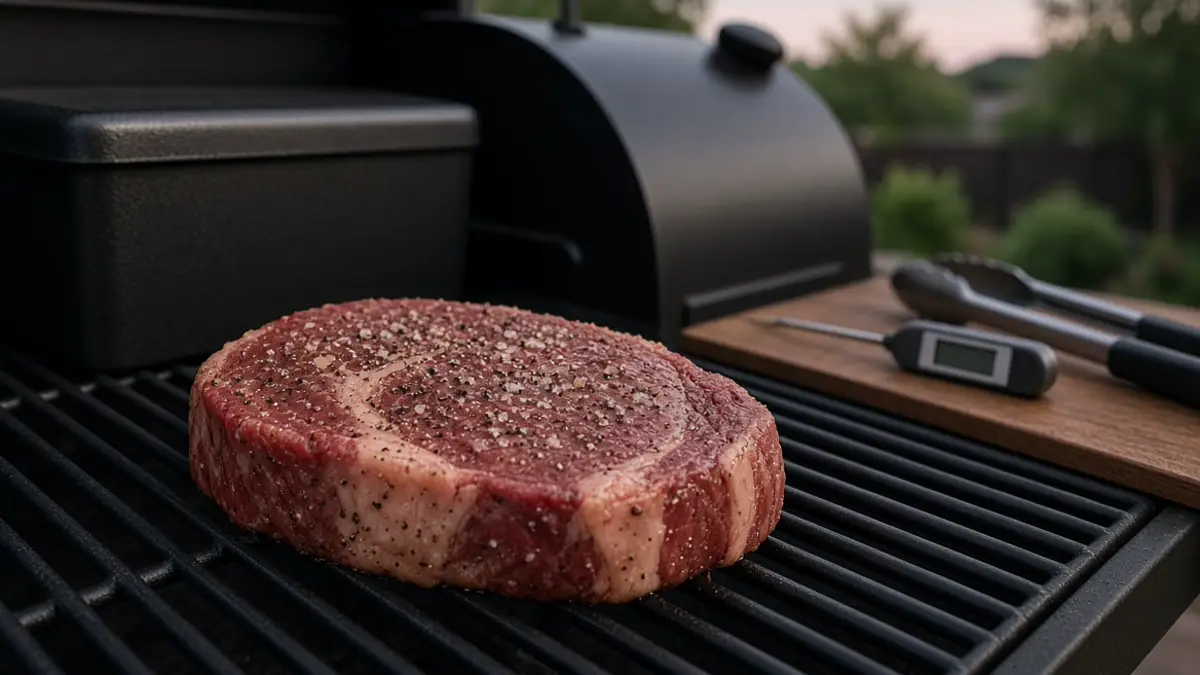
Reverse sear steak on a pellet grill is a two-stage cook: hold a thick steak at 225°F until the center is close, then sear it for a short time on the hottest surface you can get. The low stage evens the interior. The sear is only for crust. The USDA safe minimum for whole beef steaks is 145°F plus at least 3 minutes of rest. Color on the outside is not proof the center is safe.
Quick Answer: How Do You Reverse Sear a Steak on a Pellet Grill?
Cook a 1½- to 2-inch steak at 225°F until the center is close, then sear it briefly on the hottest grate or in a hot pan. USDA safety for whole beef steaks is 145°F plus a 3-minute rest. Time after preheat is an estimate; thickness, starting temperature, and the cooker change it.
Key Points
- Use reverse sear on steaks about 1½ inches thick or more. A thin steak finishes during the sear and does not need the low stage.
- A pellet grill is built for the 225°F first stage. Many models will not put a charcoal-style crust on the steak.
- USDA safety for whole beef, pork, lamb, and veal steaks is 145°F in the food plus at least 3 minutes of rest. Preference temps below that are not the safety chart.
- Pull the steak 10–15°F below the finish you want so the sear does not overshoot the center.
- Pat the surface dry before the sear. Wet steak steams instead of browning.
- If the pellet grate stays pale after a short high-heat try, finish in a screaming-hot cast-iron pan. Do not bake the steak at 450°F for another 10 minutes.
What Cut Works for a Pellet-Grill Reverse Sear?
Buy a whole steak about 1½ to 2 inches thick: ribeye, strip, sirloin, or a similar solid muscle. That thickness gives the 225°F stage time to even the center before the outside is done. A ¾-inch supermarket steak is the wrong cut for this method. Cook that one hot and fast.
Ground beef is a different food. USDA lists 160°F for ground meat, and a burger does not get a reverse-sear rest chart. Mechanically tenderized steaks still follow the whole-cut rule of 145°F plus 3 minutes; check the label if you are not sure what you bought.
What Temperature Should You Set on the Pellet Grill?
Set the pellet grill to 225°F for the first stage after a full preheat. That set point is low enough to move the center slowly and high enough that the cook does not drag for hours. Some cooks use 200–250°F. Stay in that band. A 350°F “low stage” is just roasting, and it rebuilds the gray band reverse sear is meant to avoid.
The sear stage is a separate job. Raise the grill to its highest set point, or move the steak to a hotter pan or a charcoal or gas sear zone. Last verified September 22, 2026.
| Stage | Set point | What you are doing |
|---|---|---|
| Preheat | 225°F | Heat the grates and diffuser, not just the air near the lid probe |
| Low stage | 225°F | Bring the steak center close to the finish temperature |
| Sear | Highest grill setting, or a hot pan | Brown the dry surface for 1–3 minutes per side |
| USDA finish | 145°F in the steak, then rest 3 minutes | Safety minimum for whole beef steaks, chops, and roasts |
Which Pellets Work for Steak?
Oak, hickory, or a competition blend are practical choices for a short steak cook. The steak is not on the grill long enough to take a heavy smoke load. Strong mesquite can taste harsh on a thick, well-marbled cut. If you want more pellet smoke in general, that is a separate setup question covered in how to get more smoke flavor from a pellet grill.
What Ingredients and Gear Do You Need?
Food
- One 1½- to 2-inch whole beef steak, about 12–20 ounces depending on the cut
- Kosher salt
- Black pepper, optional
- A light film of high-heat oil only if the surface looks dry before the sear
Gear
- Pellet grill that can hold 225°F
- Instant-read thermometer; a leave-in probe helps on the low stage
- Tongs, not a fork
- Paper towels
- Cast-iron skillet if the pellet grate will not sear
A thermometer is not optional. Grill browning is not a doneness test. Placement is covered in how to use a meat thermometer correctly on a grill or smoker.
How Do You Set Up the Pellet Grill?
Fill the hopper with dry pellets, start the grill, and preheat to 225°F with the lid closed until the grates are hot. Give the firepot and heat diffuser time to catch up. A lid reading of 225°F on a cold grate still cooks the first side of the steak on a lukewarm surface.
Clean heavy old grease off the grates before a steak cook. Old drippings smoke dirty and can flare when you later jump the set point. Keep the grease tray manageable so a high-heat finish does not turn into a grease fire.
How Do You Reverse Sear a Steak on a Pellet Grill Step by Step?
Salt the steak, cook it at 225°F until the center is close, dry it, then sear it hard and briefly. Times below are estimates for a refrigerator-cold 1½- to 2-inch steak after the grill is fully preheated. Weather, cooker, and thickness move them.
- Salt the steak on all sides. You can salt it just before the cook or earlier in the day and keep it refrigerated. Pepper can wait until after the sear if you do not want it scorched.
- Preheat the pellet grill to 225°F with the lid closed.
- Place the steak on the grate. Close the lid. Do not flip on a timer.
- Start checking internal temperature earlier than you think. Insert the probe from the side into the center of the thickest muscle. Stay off bone and the hard fat cap.
- For a USDA 145°F finish, pull the steak around 130–135°F. For a lower preference temperature, pull 10–15°F below that target. The sear still adds heat.
- Pat the surface completely dry. Oil the steak lightly only if it looks dry. Do not pour oil on a hot grate.
- Raise the pellet grill to its highest setting and move the steak over the hottest part of the grate, or put a preheated cast-iron pan on the grate and sear in the pan. Sear 1–3 minutes per side.
- Confirm the center with the thermometer. For the USDA minimum, the steak itself must reach 145°F before it comes off the heat.
- Rest at least 3 minutes before slicing. That rest is the USDA safety rest for whole steaks, not a juice-sponge trick. Longer rest guidance for other cuts is in how to rest meat after grilling.
A 1½-inch steak often needs about 35–50 minutes on the 225°F stage. A full 2-inch steak can run closer to 45–70 minutes. Treat those as estimates.
What Internal Temperature Is Safe for Reverse-Seared Steak?
USDA FSIS lists 145°F plus at least 3 minutes of rest as the safe minimum for beef steaks, chops, and roasts. Measure the food, not the grill air. The current chart is the USDA safe minimum internal temperature chart, last verified September 22, 2026.
Many steak cooks still pull lower for a redder center. That is a personal preference, not a substitute for the chart. USDA also notes that cooks may choose a higher temperature. Ground beef stays at 160°F. Poultry is 165°F and does not belong in this method unless you are cooking a thick turkey steak under its own 165°F rule.
| Food | USDA minimum | Rest |
|---|---|---|
| Whole beef steak | 145°F | At least 3 minutes |
| Pork chop, if you use this method | 145°F | At least 3 minutes |
| Ground beef | 160°F | None on the USDA chart |
| Leftover steak | 165°F | None on the USDA chart |
Can a Pellet Grill Sear the Steak at the End?
Sometimes. Often not well. A pellet grill holds 225°F cleanly because that is the job it was designed for. The firepot is small. Drippings usually miss a live coal bed. Many models will brown a steak if you jump to the highest set point and use the hottest patch of grate. Plenty will not make a hard crust before the center climbs past the finish you wanted.
If the crust is still pale after a short try, stop. Finish in a hot pan. Leaving the steak on a 450°F pellet setting for another 10 minutes is roasting, not searing. That limitation is a cooker fact, not a failure of reverse sear. The broader method on charcoal and gas is in how to reverse sear a steak on a grill.
What Are the Common Mistakes?
The usual failure is using the wrong steak, or treating the sear like a second roast.
- Thin steak. Below about 1 inch, the low stage costs more than it helps. The center is done when the crust forms.
- Wet surface. Marinade, purge, or condensation on the meat turns the sear into steam.
- Late thermometer. If you wait until the steak “looks ready,” the sear will push the center past the number you wanted.
- Long high-heat bake on the pellet grill. High air temperature is not the same as a hot radiating surface.
- Color as proof. USDA grilling guidance is to use a food thermometer. Brown crust is not a safety reading.
- Partial cook now, finish later. USDA says not to partially grill meat and complete the cook later.
How Should You Store Leftover Steak?
Refrigerate leftover steak within 2 hours, or within 1 hour if the air is above 90°F. Use it in 3 to 4 days or freeze it. Reheat leftovers to 165°F. That leftover number is separate from the original 145°F steak minimum. USDA grilling guidance also tells you to refrigerate leftovers promptly in shallow containers.
Final Verdict: Should You Reverse Sear Steak on a Pellet Grill?
Yes, if the steak is thick and you will measure the center. The pellet grill is a reliable 225°F oven for the first stage. Plan the sear as a short, actually hot finish, even if that finish happens in a pan. Skip the method on a thin steak. Do not confuse a preference temperature under 145°F with the USDA minimum.
Frequently Asked Questions
How long does reverse sear take on a pellet grill?
A 1½- to 2-inch steak often needs about 35–70 minutes at 225°F after preheat, plus a 1–3 minute sear per side. That is an estimate. Starting temperature, thickness, weather, and how hard the grill holds 225°F change the clock. The thermometer decides, not the timer.
Do you flip the steak during the 225°F stage?
You can, but you do not have to on a schedule. A pellet grill heats the chamber more like an oven than a banked charcoal fire. Flip once if one side is clearly drier or closer to the heat source. Checking temperature matters more than flip count.
Should you rest reverse-seared steak?
Yes. USDA asks for at least 3 minutes after a whole steak reaches 145°F. That rest is for safety and a more even center. A long rest will not pull lost juice back into a thin slice. Slice after the required rest, not after a 20-minute cooldown that drops the steak through the temperature you just earned.
Can you reverse sear a frozen steak on a pellet grill?
Not well. A frozen center and a thawed rim cook at two speeds. Thaw in the refrigerator first. USDA also warns against partial grilling with a plan to finish later.
Can you reverse sear a thick pork chop the same way?
Yes, if the chop is thick. USDA’s 145°F plus 3-minute rest applies to pork chops as well as beef steaks. Pull a little early so the sear does not run the chop past the texture you want. Ground pork is still 160°F.
Why is the steak gray at the edge after a reverse sear?
The low stage ran too hot, the sear lasted too long, or the steak was too thin. Keep the first stage near 225°F. Get the finishing surface hotter so the crust forms faster. Save this method for a thick cut.
Related Reading
- How to Reverse Sear a Steak on a Grill
- How to Use a Meat Thermometer Correctly on a Grill or Smoker
- How to Rest Meat After Grilling
- How to Get More Smoke Flavor From a Pellet Grill
- How to Reheat Leftover Pulled Pork on a Pellet Grill
About Frank W. Roberts
Frank W. Roberts is the author of Everything Grill Reviews. He has grilled since 1970 and brings more than 50 years of backyard cooking and cookoff experience to fire management, fuel behavior, smoke, and practical cooker use. This article is based on USDA temperature and grilling guidance plus standard reverse-sear practice on a pellet grill. It is not a product test and does not claim a measured result from one named grill. Last verified September 22, 2026.