
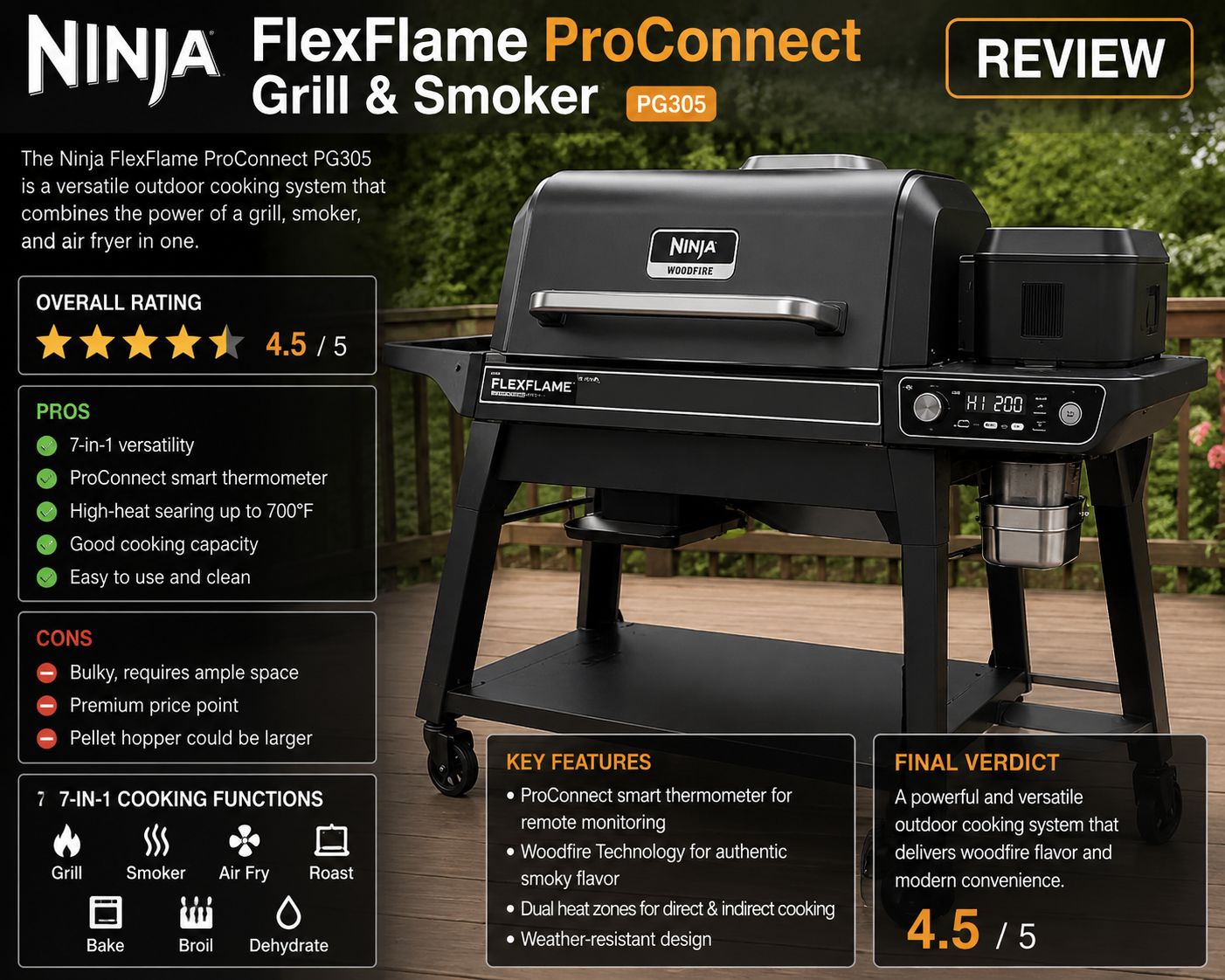
Updated: August 27, 2026 The Ninja FlexFlame ProConnect PG305 is a connected propane grill with digital temperature control, a convection fan, and a small pellet box for adding wood-smoke flavor. It is an unusual combination: more automated than a conventional gas grill, but not designed to replace a dedicated pellet or charcoal smoker.
Ninja FlexFlame ProConnect Grill & Smoker Review (PG305)
Best for: Backyard smoking
Ninja FlexFlame ProConnect Grill & Smoker Review (PG305) is worth comparing on cooking space, temperature range, cleanup, owner feedback, and current price before you buy.
Check Price on AmazonAs an Amazon Associate I earn from qualifying purchases.
Quick Answer: The Ninja FlexFlame ProConnect PG305 is best for cooks who want propane speed, set-temperature control, app monitoring, and occasional pellet smoke. Skip it if deep low-and-slow smoke, a large grate, or simple knob control matters more.
This review does not claim personal testing of the PG305. It compares Ninja’s published specifications and support documents with independent tests from established grilling and food publications. That distinction matters because the strongest praise and the most important smoking limitation come from published cook tests, not marketing copy.
Bottom line: Buy the PG305 primarily as a premium connected gas grill that can roast and add light pellet smoke. Do not buy it primarily for all-day 225°F barbecue. Prices and bundles change, so compare the exact model number and included accessories before ordering.
What is the Ninja FlexFlame ProConnect PG305?
The PG305 is a three-burner liquid-propane grill that uses electronic controls and a fan to manage heat with the lid closed. The ProConnect version adds phone monitoring and an included connected food probe, while its removable Woodfire pellet box adds smoke flavor without using pellets as the heat source.
| PG305 detail | Published specification |
|---|---|
| Fuel and power | Liquid propane plus 120V electricity; Ninja lists 670 watts |
| Main cooking area | 424 square inches |
| Upper rack | 180 square inches; approximately 604 square inches total |
| Burners | Three horizontal burners; major listings report approximately 36,000 to 37,000 BTU |
| Temperature range | Mode-dependent; marketed for cooking from about 200°F to 600°F |
| Dimensions | Approximately 61.69 inches wide, 25.08 inches deep, and 48.31 inches high with the lid closed |
| Weight | Approximately 135.8 pounds |
| Connected feature | ProConnect app support and a connected food probe |
| Warranty | 10-year limited warranty; read the current terms for coverage and exclusions |
The basic connected package includes the grill, two porcelain-enameled cast-iron grates, an upper roast/smoke rack, the pellet box, a grease tray, and the connected probe. A griddle, pizza stone, cover, pellets, propane tank, and outdoor extension cord may be separate unless a retailer bundle specifically includes them.
Who should buy the PG305, and who should skip it?
The PG305 makes the most sense for someone who grills more often than they smoke and will genuinely use its fan, digital controls, probe, and app. Buyers wanting a simple gas grill or a dedicated low-and-slow smoker can get a better fit without paying for features they will not use.
Buy the PG305 if you:
- Cook burgers, steaks, chicken, vegetables, and roasts more often than overnight barbecue.
- Prefer choosing a cooking mode and temperature instead of managing three individual burner knobs.
- Want phone alerts and remote temperature adjustments from an included probe.
- Like the idea of adding a lighter pellet-smoke layer to weeknight cooks.
- Have a safe outdoor outlet arrangement and room for a grill roughly 62 inches wide.
- Will buy the griddle or pizza accessory only if those modes are useful to you.
Skip the PG305 if you:
- Primarily want long brisket, pork shoulder, or other steady 225°F smoking sessions.
- Need a larger main grate for frequent parties or big batch cooking.
- Want natural gas; Ninja does not list a natural-gas PG305 or conversion kit.
- Prefer a grill that works normally without a power cord, display, app, or convection fan.
- Want independent burner knobs for traditional direct and indirect gas-grill control.
- Do not want to purchase accessories separately to unlock griddling or pizza cooking.
How does the Ninja FlexFlame ProConnect PG305 work?
You select a cooking function and target temperature, and the grill chooses a burner pattern while its convection fan circulates heat under the closed lid. Propane supplies the cooking heat; electricity powers the control system, display, fan, ignition electronics, and connected features.
Digital burner modes
Ninja’s published PG305 guidance assigns different burners and temperature ranges to each function:
| Function | Burner pattern | Listed range |
|---|---|---|
| Grill/Pizza | Front, middle, and back | 450°F to 600°F |
| 2-Zone | Front and middle; back off | 350°F to 500°F |
| Roast/Bake | Front and back; middle off | 300°F to 450°F |
| Low & Slow | Middle only | Advertised at 200°F to 300°F |
This is different from a conventional gas grill. You are asking the PG305 to manage a closed cooking chamber rather than creating every heat zone manually. That can simplify roasting and batch cooking, but cooks who enjoy direct knob-by-knob control may find it restrictive.
Woodfire pellet-smoke system
The removable side box holds about two cups of food-grade barbecue pellets. Pressing the Woodfire Flavor button ignites them while propane continues to provide the cooking heat. Ninja’s support FAQ says one fill produces roughly 45 minutes of visible smoke, while hot embers can remain much longer. Longer cooks require careful refilling by hand. The box becomes extremely hot, so follow the official instructions rather than touching or removing it during a cook. This system is best understood as a smoke-flavor attachment, not an automatic hopper-fed pellet system.
ProConnect app and probe
The connected probe lets the app report food and grill temperatures, send doneness alerts, and allow some temperature adjustments. According to Ninja’s official PG305 support FAQ, the app cannot ignite the grill, power it off, or change the active cooking function. You still perform those steps at the control panel.
How well does the PG305 grill and roast?
Independent reviewers generally describe the FlexFlame as a capable, fast-heating gas grill when used with the lid closed. Its convection fan is the feature most responsible for quick preheating, even browning, and roast-like cooking, but that same fan adds noticeable noise. Serious Eats’ hands-on FlexFlame review recorded roughly 500°F in a little over six minutes and reported good results on burgers, sausages, vegetables, pizza, and griddle cooking. The reviewer liked the clear digital display and fan-assisted heat but found the ignition control finicky and the fan loud. AmazingRibs’ independent test also credited the fan for even cooking and crisp results. Those findings support the PG305’s strongest use case: quick gas grilling and lid-closed roasting with less burner management than a traditional grill.
Where it performs best
- Fast weeknight grilling: The closed-lid system preheats quickly and regulates the chamber temperature for burgers, chicken, and vegetables.
- Roasting: The outer-burner pattern and fan can cook chicken or vegetables more like an outdoor convection oven.
- Batch cooking: Circulated heat can reduce the constant food-shuffling sometimes needed over uneven gas burners.
- Optional pizza and griddle cooking: Reviews report useful results, but the stone and griddle are separate purchases in many packages.
Is the Ninja FlexFlame ProConnect PG305 a real smoker?
The PG305 can add genuine pellet smoke to food, but it is not equivalent to a dedicated pellet, charcoal, or offset smoker. It is better suited to smoke-roasted chicken, wings, ribs, and shorter cooks than to long sessions requiring deep smoke and a steady 225°F chamber. The published tests do not all reach the same conclusion, which is useful for buyers. Smoked BBQ Source and Girls Can Grill reported enjoyable smoke-assisted cooks when they accepted shorter pellet cycles and manual refills. Serious Eats experienced a hotter pellet burn that produced an unpleasant smoke result during its test. The most important low-temperature finding came from AmazingRibs. Its tester could not hold the grill below about 250°F even though Low & Slow is advertised down to 200°F. Ninja explained to that publication that reaching 200°F generally requires cold outdoor conditions or additional heat-absorbing measures. AmazingRibs also found lighter smoke character than on a dedicated pellet smoker.
Practical meaning: Treat Woodfire as a convenient way to add smoke flavor to a propane cook. If brisket, pork shoulder, or strong smoke flavor is your main goal, buy a purpose-built smoker instead.
What are the biggest PG305 drawbacks?
The main drawbacks are its premium cost, midsize grate, reliance on electricity, fan noise, limited low-temperature smoking, and accessories that may be sold separately. None automatically makes it a poor grill, but together they narrow the type of buyer who receives good value.
- Power is part of the design: The intended cooking system needs propane and a safe outdoor electrical connection.
- The factory cord is very short: Plan on a properly rated outdoor extension cord unless an outlet is immediately beside the grill.
- The fan is audible: Multiple reviewers noticed substantial fan noise during closed-lid cooking.
- Primary space is midsize: The 424-square-inch main grate is smaller than the main grate on some conventional grills in this price class.
- No side burner: There is no built-in side burner for sauces or side dishes.
- Accessories affect the real cost: Pizza and griddle modes may require separate purchases.
- Smoking needs attention: One pellet fill does not cover an all-day cook, and warm-weather low settings may run above 225°F.
- No natural-gas option: Buyers with a fixed gas line should choose another grill.
- It favors lid-down cooking: Opening the lid interrupts the managed convection environment that makes the design distinctive.
How does the Ninja PG305 compare with a Weber Genesis or pellet grill?
The Ninja is the better match for digitally managed, lid-closed propane cooking with app monitoring and light pellet smoke. A Weber Genesis-class grill is better for conventional burner control and a larger main grate, while a dedicated pellet grill is better for long, smoke-focused cooking.
| Buyer concern | Ninja PG305 | Weber Genesis E-325 | Dedicated pellet grill |
|---|---|---|---|
| Primary role | Connected propane grill with convection and a smoke box | Traditional three-burner gas grill with a sear zone | Automatic wood-pellet smoker and grill |
| Primary / total area | 424 / approximately 604 square inches | 513 / approximately 641 square inches on current E-325 listings | Varies by model |
| Heat control | One digital controller chooses burner patterns | Individual burner knobs and sear-zone control | Digital controller feeds pellets automatically |
| Smoke | Small manual-refill pellet box | No built-in smoke system | Pellets supply heat and smoke from a larger hopper |
| Electricity | Required for the intended digital and fan features | Not required on a standard model | Required |
| Best reason to choose it | Gas speed plus app control and occasional smoke | Simple gas grilling, more main-grate room, and direct burner control | Long low-and-slow cooks with stronger smoke character |
Choose the Ninja if its digital set-temperature approach, probe, app, and smoke box are features you will use weekly. Choose a Genesis-class gas grill if you want more traditional control and no power cord. Choose a pellet grill if long 225°F cooks and smoke flavor are the reason you are spending premium money.
What should you budget beyond the grill?
At minimum, plan for a 20-pound propane tank and a correctly rated outdoor extension cord. A weather cover, barbecue pellets, griddle, and pizza stone can raise the total further, depending on the exact PG305 bundle you buy.
- 20-pound propane tank and fuel
- Outdoor-rated three-prong extension cord
- Cover if the selected bundle does not include one
- Food-grade barbecue pellets for Woodfire cooking
- Griddle plates only if you will regularly use them
- Compatible pizza stone and peel only if pizza is part of your plan
Do not assume that an old promotion, retailer photo, or similarly named PG305 bundle includes every accessory shown. Confirm the exact SKU and written box contents before comparing prices.
How difficult are PG305 setup and ownership?
The PG305 is a large, roughly 136-pound cart grill that requires assembly, an outdoor electrical setup, normal propane inspection, pellet-box cleaning, and protection for its controls. Independent reviewers describe the instructions as manageable, but a second person is sensible for lifting and positioning heavy sections.
- Confirm that the grease tray is correctly seated before cooking and empty it after fatty foods.
- Allow the pellet box and embers to cool completely before handling or cleaning.
- Clean the porcelain-enameled cast-iron grates according to Ninja’s care directions.
- Keep water away from the plug and control area, and use a fitted cover when the grill is stored outdoors.
- Inspect the hose, regulator, and connections before use, following ordinary outdoor propane safety practices.
- Maintain the required clearance from combustible materials and never use the grill indoors or in a garage.
For model-specific assembly, operating, clearance, maintenance, and safety instructions, use SharkNinja’s official Ninja PG305 owner’s guide. The manufacturer’s current instructions should take priority over any summary in a review.
Ninja FlexFlame ProConnect PG305 frequently asked questions
Is the Ninja FlexFlame ProConnect PG305 a good smoker?
It is useful for adding pellet smoke to shorter propane cooks, but it is not the best choice for deep smoke or unattended all-day barbecue. Independent testing shows that the bottom of its advertised Low & Slow range may be difficult to maintain in warm weather.
Does the PG305 include a meat probe?
Yes. Ninja lists a connected food probe with the U.S. PG305. Check the written contents of retailer-specific bundles because accessories and package codes can change.
Does the Ninja PG305 have to be plugged in?
Yes, if you want the digital controls, display, convection fan, and connected features that define this grill. Use only the outdoor power arrangement specified by Ninja.
Can the Ninja PG305 be converted to natural gas?
No. Ninja lists the PG305 as a liquid-propane grill and does not provide a natural-gas conversion kit for it.
Can you use other wood pellets in the FlexFlame?
Use dry, food-grade barbecue pellets that are suitable for the box and follow the current manual. Ninja recommends its Woodfire blends, but pellets provide flavor rather than the grill’s main cooking fuel.
How long does one PG305 pellet load smoke?
Ninja’s support FAQ says a roughly two-cup fill produces about 45 minutes of visible smoke, while embers can remain hot for approximately 90 minutes. Longer cooks require careful refilling according to the instructions.
What is the difference between the PG305 and PG301?
The PG305 is the ProConnect model with app functions and a connected probe. PG301-family versions use the same general FlexFlame cooking idea without the PG305’s connected package.
Can you use the PG305 on a covered patio?
Only if the location satisfies every clearance and overhead-construction rule in Ninja’s current manual. The grill is for outdoor use and should never be operated indoors, in a garage, or beneath unsafe combustible construction.
Can the ProConnect app light or shut down the grill?
No. Ninja’s official PG305 FAQ says the app cannot ignite the grill, power it off, or change cooking functions. Those steps remain at the grill’s control panel.
What is the final verdict on the Ninja FlexFlame ProConnect PG305?
Buy the PG305 if you want a premium gas grill that automates lid-closed heat, monitors food from your phone, and adds occasional pellet smoke. Skip it if your priorities are deep low-and-slow smoke, the largest possible grate, natural gas, or the simplicity of a conventional knob-controlled grill. The connected probe is the clearest reason to choose the PG305 over a non-connected FlexFlame. Its fan-assisted grilling and roasting are the strongest parts of the design. The smoke box is a useful bonus, but published test results make it risky to treat this model as a replacement for a dedicated smoker. Value depends on use, not the length of the feature list. The PG305 earns its space when the fan, app, probe, and at least one accessory mode become part of regular cooking. If you only need to sear burgers or smoke brisket, a simpler gas grill or purpose-built smoker is the more sensible buy.
How this review was prepared: Frank W. Roberts has grilled since 1970. Everything Grill Reviews did not personally test this PG305. The conclusions above compare official Ninja documentation with clearly identified independent reviews so readers can separate verified specifications from tester observations.
Related gas-grill reviews and guides
- Monument 4+2 Burner Gas Grill Review: 72,000 BTU Value
- Weber Genesis S-315 Liquid Propane Gas Grill Review
- Ninja FlexFlame Review: Is the 5-in-1 Grill Worth It?
<!–
Ninja FlexFlame ProConnect Grill & Smoker Review (PG305)
Best for: Backyard smoking
Ninja FlexFlame ProConnect Grill & Smoker Review (PG305) is worth comparing on cooking space, temperature range, cleanup, owner feedback, and current price before you buy.
Check Price on Amazon