
Updated: September 27, 2026
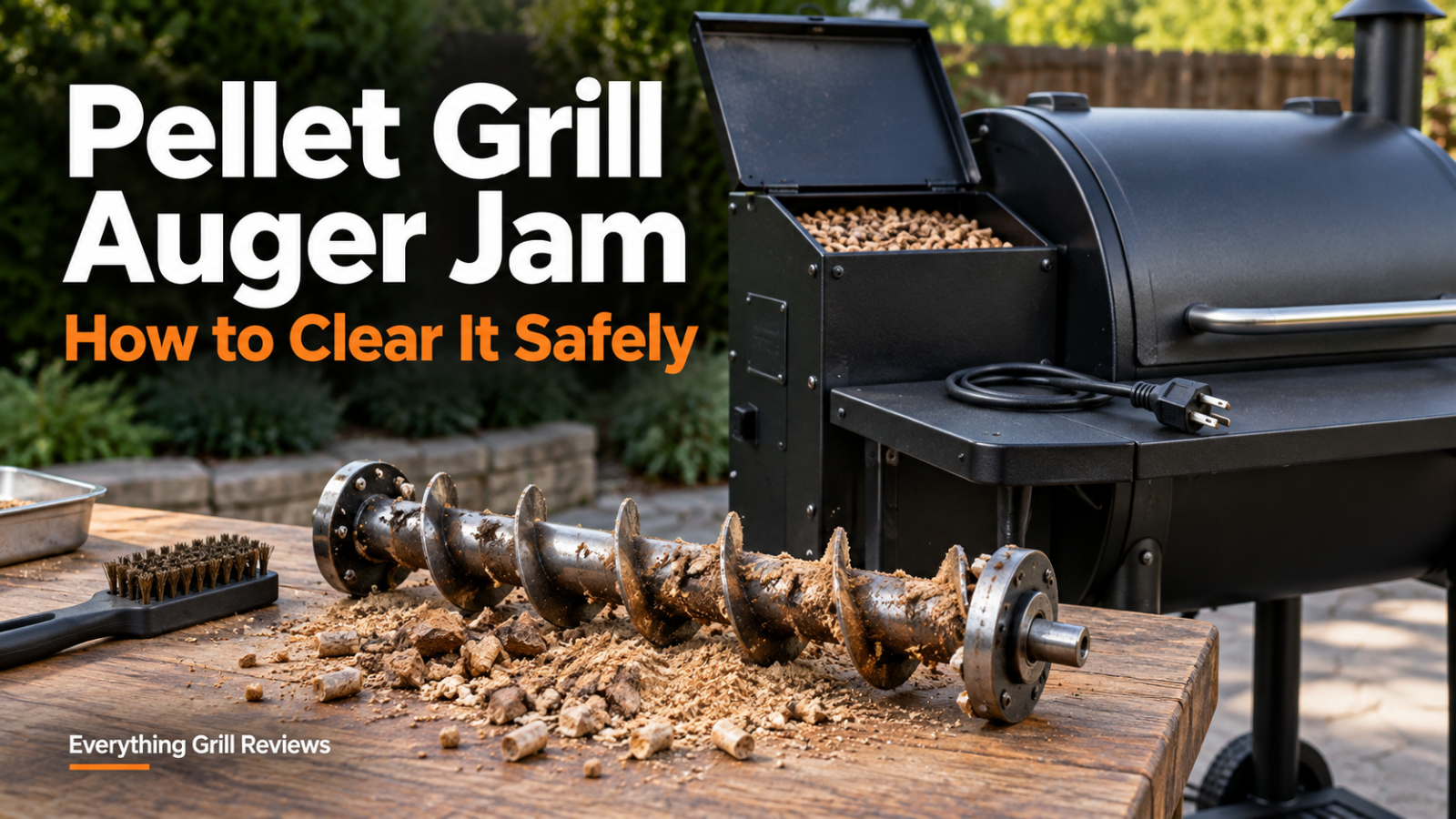
A pellet grill auger jam usually starts when damp pellets swell, break apart, and harden inside the auger tube, but the same “pellets are not feeding” symptom can also come from an empty feed path, bridged pellets, a loose connection, a broken drive pin, or a failed motor. The safest repair begins with a careful diagnosis—not with forcing the auger or ordering parts.
Quick Answer: Shut the grill down normally if it is safe to do so, let it cool, unplug it, empty the hopper, and remove loose pellets and sawdust. Use the grill’s factory “Clear Auger” function only if the manual provides one. If the auger still will not turn, follow the exact model-specific removal instructions or contact the manufacturer; keep fingers and tools out whenever power is connected.
This guide explains the checks that apply to most pellet grills, where procedures begin to differ by brand and model, and when it is smarter to stop. It does not assume that every stalled feed system is truly jammed, and it does not ask you to work around a live auger.
Table of Contents
How Can You Tell If a Pellet Grill Auger Is Jammed?
A likely jam means the drive system tries to move the auger but the auger cannot rotate freely. Pellets stop reaching the firepot, the grill may fail to ignite or lose its fire, and some controllers display an auger-current or motor error. Damp sawdust, swollen pellets, or a solid plug in the hopper throat makes the diagnosis more likely.
One symptom is not enough by itself. Pellet grills normally cycle the auger on and off, so a brief pause does not prove that anything is wrong. Some motors also rock slightly during normal operation. Watch the full startup or prime sequence from a safe distance and compare it with the owner’s manual.
| What you observe | More likely explanation | First safe check |
|---|---|---|
| Motor hums or strains, but the auger does not turn | Physical jam or seized auger | Stop the grill; cool, unplug, and empty the hopper |
| Controller reports auger jam or overcurrent | Resistance caused by a jam | Follow the controller’s model-specific clearing procedure |
| Auger turns, but no pellets fall | Empty tube or pellets bridged above the intake | Turn off; inspect the hopper and prime according to the manual |
| Auger and motor are silent | No power, loose wiring, fuse, controller, or motor fault | Check power and error messages before assuming a jam |
| Motor turns, but the auger shaft does not | Loose or broken drive pin or coupling | Disconnect power and use the exact parts diagram |
| Smoke or heat travels into the hopper | Possible burn-back, not a routine feed jam | Keep the lid closed, move away, and follow emergency guidance |
A true jam should be treated as a mechanical obstruction until proven otherwise. Repeatedly restarting the grill can overload the motor or feed more fuel into an unsafe situation. Do not keep pressing “Prime” if the motor is straining or the controller is reporting overcurrent.
Why Do Pellet-Grill Augers Jam?
Moisture-damaged pellets are the leading practical cause. Pellets are compressed wood. When they absorb enough moisture, they swell, crumble into sawdust, and can dry into a hard mass around the auger flighting. Traeger’s current support guidance identifies wet or compromised pellets as the most common cause of its auger-jam alert, while Pit Boss describes the same swelling-and-hardening failure inside the tube.
Damp pellets and condensation
A covered grill is not necessarily a dry hopper. Humid air, rain entering around a poorly sealed lid, condensation, or wet fuel poured from a damaged bag can all start the problem. The site’s guide to storing wood pellets so they stay dry explains how to inspect fuel before it reaches the grill.
Too much sawdust
Every bag contains some fines, but a large quantity can pack into the feed path. Sawdust also absorbs moisture faster than intact pellets. Avoid dumping the dusty bottom of a damaged bag straight into the hopper.
A foreign object in the hopper
A torn bag fragment, fastener, stone, or other debris can reach the hopper throat. Keep the pellet guard installed during normal use and never use the hopper as a shelf for tools or hardware.
Long storage with pellets left in the grill
Pellets left through a humid season can deteriorate inside a tube where the damage is not visible. If the grill will sit unused, empty it according to the manufacturer’s instructions rather than assuming the hopper and auger are airtight.
Misdiagnosed electrical or drive trouble
A disconnected motor lead, failed motor, controller fault, missing drive pin, or damaged coupling can stop rotation even when the tube is clear. That is why “not feeding” and “jammed” are not interchangeable diagnoses.
What Do You Need Before Clearing a Pellet Grill Auger Jam?
Start with the model number, owner’s manual, a dry collection bucket, and a vacuum rated for cold ash or dry debris. Any further tools should come from the manufacturer’s procedure for the exact grill. Fastener sizes, service-panel locations, motor connections, auger pins, and removal direction vary.
- Owner’s manual or official support page for the exact model
- Phone camera for recording wiring and part positions before disassembly
- Clean, dry bucket for sound pellets
- Wet-dry vacuum or cold-ash vacuum for loose pellets and sawdust
- Work gloves and eye protection
- Screwdrivers, sockets, or hex keys only as specified for the grill
- Replacement cotter pin, shear pin, or fastener only if the parts diagram calls for it
- Fresh, dry cooking pellets for the final test
Safety warning: An auger can cause a severe hand injury. Never put fingers, a screwdriver, pliers, or a vacuum hose into the hopper throat or firepot while the grill is plugged in. Finish the normal shutdown cycle when it is safe, let every part cool, disconnect power, and confirm the plug stays in your view before touching the feed system.
Do not vacuum hot ash or glowing pellets. A household vacuum is not designed for hot debris and can create a fire. The full pellet-grill cleaning guide covers cold-ash removal, firepot access, and reassembly.
How Do You Clear a Pellet Grill Auger Jam Safely?
Use the least invasive fix first: secure the grill, remove compromised fuel, confirm the symptom, and use only a factory clearing routine made for that controller. Manual auger removal is not universal. If the easy checks fail, switch to the exact service document for the model instead of improvising.
Step 1: Stop cooking and protect the food
If the grill has lost heat during a cook, move food to a working cooker or indoor oven before troubleshooting. Do not let meat sit in a cooling grill while you work. Track how long perishable food has been below a safe cooking temperature and follow current food-safety guidance.
If there is smoke coming from the hopper, fire outside the firepot, a burning-wire smell, sparking, or a breaker that repeatedly trips, do not begin an ordinary jam-clearing procedure. Keep people away and follow the grill manual’s emergency instructions. Call emergency services if the fire is spreading or cannot be safely contained.
Step 2: Complete shutdown, cool, and unplug
Use the controller’s normal shutdown cycle if the grill is operating normally enough to do so. The fan may need to run to burn remaining fuel and cool the cooker. When shutdown is complete, unplug the cord and allow the grill, firepot, igniter, drip tray, and heat deflector to cool fully.
If the controller will not operate or the grill is in an unsafe condition, follow the emergency shutdown section of the model’s manual. Do not invent a shutdown sequence based on another brand.
Step 3: Record the exact model and any error code
Photograph the data label and controller message. A manufacturer may publish different procedures for two grills that look almost identical. For example, Traeger separates current WiFIRE, touchscreen, Woodridge, Westwood, and older AC-controller instructions.
Search the manufacturer’s support site by the model number and exact code. “Auger overcurrent,” “auger disconnected,” and “ignition failure” point toward different checks.
Step 4: Empty the hopper and inspect the pellets
Open the factory pellet-release door or slide if the grill has one, with a clean bucket positioned underneath. If it does not, scoop out the pellets as the manual directs. Do not tip the whole grill to dump the hopper.
Discard fuel that is swollen, soft, crumbly, clumped, moldy, or mixed with damp sawdust. Do not blend it with a new bag. Vacuum only cool, loose debris from the hopper after the bulk fuel is removed.
Step 5: Expose and clean the cold firepot
Remove the grates, drip tray, and heat baffle as your manual permits. Vacuum cold pellets and ash from the firepot and the surrounding cook chamber. This matters because a clearing routine may push additional material toward the firepot. Starting with an overloaded pot can create a large startup fire.
Inspect the auger outlet from the firepot side without putting fingers into it. A packed plug of broken pellets supports the jam diagnosis. An empty, clean outlet with no motor action may point toward an electrical or drive problem.
Step 6: Distinguish a bridge from a mechanical jam
Pellets can form a hollow pocket above the hopper intake while the auger itself still turns. Green Mountain Grills advises listening for the motor and observing the auger at the firebox during its startup cycle. If the shaft turns but no pellets feed, turn the grill off before moving pellets in the hopper.
With power disconnected, break up the bridge from above using only the method allowed by the manual. Do not defeat the pellet guard or reach into the intake while the grill is energized.
Step 7: Use the factory clear-auger function only if your grill has one
Some controllers can reverse and advance the auger to loosen a minor obstruction. On supported Traeger WiFIRE grills, the function is found under the Auger menu, and the company tells owners to empty the hopper and clean the firepot before running it. Traeger lists the supported grills and sequence in its official Clear Auger guidance. Other brands and older controllers may not have a reverse routine.
Stand clear, keep all internal parts and tools out of the feed path, and supervise the operation. Cancel the routine if the motor strains, wiring overheats, or the obstruction does not release after the prescribed cycle. Repeating it indefinitely is not a repair.
Step 8: If the jam remains, stop and use the exact manual procedure
A severe jam may require removal of a service panel, controller, hopper housing, motor, bushing screw, drive pin, or the auger itself. The order and hardware are model-specific. Pit Boss support describes disconnecting the motor and removing the auger on affected designs; Traeger publishes separate instructions for its controller families and grill series.
Before disassembly:
- Confirm that the grill is unplugged and cool.
- Save the official instructions for the exact model.
- Photograph every wire connector, fastener, spacer, and bracket.
- Use labels so similar connectors cannot be swapped.
- Keep removed hardware organized in the order it came out.
- Check warranty terms before opening a protected assembly.
Do not substitute a generic video for the parts diagram. If the official procedure requires force that you cannot apply in a controlled way, or if a wire, connector, bushing, motor shaft, or mounting point appears damaged, stop and contact support or a qualified service technician.
Step 9: Clean and inspect the removed feed parts
If the manufacturer’s procedure has you remove the auger, clear every piece of compacted wood from the tube and flighting. Inspect for bent metal, heavy corrosion, a damaged bushing, a worn coupling, or a broken pin. A clean auger that still will not rotate freely can have a mechanical alignment problem rather than a pellet problem.
Do not lubricate the pellet path unless the manufacturer explicitly specifies an approved product and location. Oil or grease can collect sawdust, contaminate fuel, or create an unwanted combustible residue.
Step 10: Reassemble, prime, and perform a supervised test
Reinstall every guard, service panel, heat baffle, drip tray, and grate exactly as designed. Add a small amount of fresh, dry pellets. Prime the auger according to the manual until pellets first reach the firepot, then stop priming. Remove any excess that accumulates.
Run the normal startup outdoors with the lid position specified in the manual. Watch the firepot, controller, motor sound, pellet feed, and smoke. Stay with the grill until the flame is stable and the cooker is holding temperature. If the error returns or the auger feed is irregular, shut it down and call the manufacturer instead of forcing another cycle.
What Problems Look Like an Auger Jam but Are Not?
A clear auger can still stop feeding if the motor is not receiving power or the drive connection has failed. Confirm the symptom before buying an auger motor.
Pellet bridging
The auger rotates, but a cavity forms above its intake. Pellets may cling to damp hopper walls or lock together. The cure is dry fuel and a clean hopper—not auger removal.
An empty auger tube
After the hopper runs dry or the system is emptied for storage, pellets need time to travel the full tube. Use the prime function exactly as directed. Do not mistake the delay for a jam.
A broken or missing drive pin
The motor may run while the auger remains stationary. Replace only with the specified part. A harder improvised bolt can defeat the protective purpose of a shear-style fastener and transfer damage to the motor or gearbox.
A failed motor or controller output
No sound or movement may mean the motor is disconnected, the wiring is damaged, or the controller is not energizing that circuit. Electrical diagnosis should follow the manufacturer’s test procedure. Do not jump wires or bypass safety devices.
A dirty firepot or ignition problem
Pellets can feed normally yet fail to ignite because ash blocks airflow, the igniter has failed, or the combustion fan is not working. The pellet-grill maintenance and troubleshooting hub is a better starting point when pellets reach the pot but no stable fire forms.
How Do You Prevent Another Pellet Grill Auger Jam?
Keep moisture and excess sawdust out of the feed system, and empty the grill before long or humid storage. Prevention is cheaper and easier than pulling a hardened plug from an auger tube.
- Store pellets sealed and dry. Keep opened fuel in a clean container with a tight lid.
- Inspect before pouring. Reject swollen, soft, clumped, moldy, or crumbly pellets.
- Limit bag-bottom dust. Do not pour a heavy layer of fines into the hopper.
- Close the hopper lid promptly. A sudden shower can ruin exposed pellets quickly.
- Empty the system for long storage. Follow the manual’s hopper-emptying and auger-clearing sequence.
- Use a fitted cover after the grill is cool. A cover helps with weather exposure but does not make the hopper airtight.
- Keep guards installed. They reduce the chance that tools, bag fragments, or hands reach the auger intake.
- Respond to unusual motor noise. Grinding, repeated overcurrent errors, or slow feeding deserves attention before the next long cook.
What Mistakes Should You Avoid?
The most dangerous mistake is treating the auger as harmless because it turns slowly. The motor and gearbox create enough force to injure a hand.
- Do not reach into the hopper or firepot with power connected.
- Do not repeatedly restart a motor that hums, strains, or trips an error.
- Do not vacuum warm ash, embers, or hot pellets.
- Do not tip the grill to dump pellets.
- Do not reuse swollen or crumbly pellets after the jam is cleared.
- Do not force an auger with the motor still attached unless the official procedure says to do so.
- Do not replace a drive pin with random hardware.
- Do not lubricate the feed tube with cooking oil or automotive grease.
- Do not test the grill with heat shields or safety guards missing.
- Do not assume smoke from the hopper is a routine jam.
When Should You Call the Manufacturer or a Technician?
Stop when the repair moves beyond a fuel cleanup and the official procedure does not clearly cover your exact grill. Professional help is the right choice when:
- The grill is still under warranty and disassembly could affect coverage.
- The breaker or GFCI trips again after the grill is dry and properly connected.
- Wiring insulation, a connector, controller, or motor looks burned or melted.
- The auger tube, shaft, bushing, or mounting points are bent or corroded.
- The auger is locked after all manufacturer-approved clearing steps.
- The same jam returns with fresh, dry pellets.
- Smoke, heat, or flame has traveled into the hopper.
- You cannot identify the correct disassembly and reassembly sequence.
Have the model number, serial number, controller error, photos, and a short description of what you already checked ready. That information helps support separate a jam from a motor, wiring, pin, controller, or alignment failure.
Frequently Asked Questions
Can I run the pellet grill to clear an auger jam?
Only use a powered clear-auger or reverse routine if the manufacturer provides it for your exact controller. Empty the hopper and firepot first as directed, keep hands and tools away, and supervise the cycle. Do not keep powering a stalled motor.
Can wet pellets dry out and become usable again?
Intact pellets exposed only briefly to humid air may still be sound, but swollen, soft, clumped, or crumbly pellets should be discarded. Drying does not restore their original compressed structure, and damaged fuel can jam the auger again.
Why is the auger turning but no pellets are coming out?
The tube may be empty, or pellets may be bridged above the hopper intake. Turn the grill off before rearranging fuel, then use the model’s prime procedure. If the auger turns but stops under load, inspect the fuel for moisture damage.
How long does it take to clear a pellet-grill auger jam?
A minor obstruction cleared by a factory routine may take only minutes after cooling and cleanup. A hardened wet-pellet plug that requires hopper, motor, or auger removal can take much longer. The model design and severity matter more than a universal time estimate.
Can I use a drill to spin the auger?
Do not attach a drill unless the grill manufacturer publishes that procedure for the exact model. A drill can damage the gearbox, wiring, shaft, bushing, or your hands if the obstruction releases suddenly.
Should I replace the auger motor after a jam?
Not automatically. Clear the feed path and test the existing motor according to the official procedure. Replace a motor only when diagnosis shows it is faulty or damaged; a new motor will not fix compacted pellets inside the tube.
Can I leave pellets in the hopper between cooks?
That depends on weather, storage time, and the manual. In a reliably dry location with frequent use, some owners do. Before a long break or during humid and rainy conditions, emptying the hopper and feed path is safer.
What does smoke coming from the pellet hopper mean?
It can indicate fire or heat traveling backward through the feed system. Treat it as a potential burn-back rather than a routine jam. Keep people away, do not open a smoking hopper casually, and follow the manufacturer’s emergency instructions.
Is a broken auger pin the same as a jam?
No. A jam prevents rotation; a broken pin can let the motor turn without driving the auger. The symptoms can look similar, so inspect the specified coupling or pin only after power is disconnected and the correct parts diagram is available.
Why did the jam come back after I cleared it?
Likely causes include leftover damp sawdust in the tube, damaged pellets added again, a bent or misaligned auger, a worn bushing, water entering the hopper, or a motor or drive part that was never the real problem. Stop repeated clearing attempts and have the feed system inspected.
Final Takeaway
A pellet grill auger jam is usually a fuel-and-moisture problem, but safe troubleshooting must leave room for an empty tube, bridged pellets, a failed drive pin, wiring trouble, or a motor fault. Cool and unplug the grill, remove bad fuel, clean the firepot, and use only the clearing function or disassembly sequence published for the exact model. If the auger stays locked or the electrical system shows damage, support or qualified service is the sensible next step.
About the Author
Frank W. Roberts has cooked over fire since 1970 and brings more than 50 years of backyard grilling and cookoff experience to Everything Grill Reviews. This guide is based on current manufacturer support documentation and established safety practices; it does not claim that Frank personally repaired every grill or controller family mentioned.