
Updated: August 9, 2026
A pellet grill that shuts down in the middle of a cook is frustrating, but the symptom gives you a useful place to start. The most important question is not the brand name or the error code. It is whether the grill lost electrical power or simply lost its fire. That distinction prevents wasted parts, repeated failed starts, and potentially dangerous pellet buildup. This guide walks through nine common causes in a safe order, beginning with checks that do not require tools. Because controls and shutdown procedures differ by model, your owner’s manual always takes priority over general advice.
What Does “Shutting Off” Actually Mean?
It usually means one of two different failures: the controller and display lose power, or the controller remains powered while the flame in the firepot goes out. Watch the display, fan, auger, and error message before touching anything. That observation can divide your search in half. If the screen goes dark: Begin with the outlet, GFCI reset, breaker, plug, cord, and power connection. If those are sound, the grill may have an internal fuse, wiring, controller, motor, or igniter problem that needs model-specific service. If the screen stays on but the temperature falls: Treat it as a flameout or fuel-and-air problem. Check pellet supply and condition, firepot cleanliness, auger feed, combustion airflow, and the grill’s temperature sensor. If the fan keeps running after you turn the grill off: That may be the normal shutdown cycle rather than a failure. Some pellet grills continue running the fan to burn remaining pellets and cool the cooker. Do not interrupt that cycle unless your manual tells you to do so. Write down any error code before cycling the power. A code such as LEr, flame out, failed ignition, or low temperature can make the manufacturer’s support instructions much more specific.
What Does Each Shutdown Symptom Usually Point To?
The table below is a starting point, not a final diagnosis. Check the simplest and safest possibility first, then move to the next cause only if the symptom remains.
| What You See | Likely Area | First Safe Check |
|---|---|---|
| Display and fan both stop | Outlet, breaker, cord, or electrical fault | Confirm the outlet has power and inspect the plug and cord |
| Display stays on, temperature falls | Flameout, fuel feed, or airflow | Check pellet level and look for an error code |
| Firepot is empty after shutdown | Hopper tunnel, empty hopper, auger jam, or lost power | Inspect pellet flow with the grill cool and off |
| Firepot is overflowing with pellets | Failed ignition or failed reignition | Do not restart; cool, unplug, and clean according to the manual |
| Auger makes noise but pellets do not move | Wet-pellet jam or mechanical blockage | Stop the grill and inspect only after it is cold and unplugged |
| Weak fire and little fan sound | Restricted or failed combustion fan | Check air openings and listen during a normal startup |
| Displayed temperature jumps or looks impossible | Dirty or failing internal temperature sensor | Clean the sensor only when the grill is cold |
| Shutdown happens mainly in cold or strong wind | Heat loss, wind, fuel quality, or airflow | Move to a safe, sheltered outdoor position without blocking ventilation |
| Problem began after an app or controller change | Firmware, settings, or controller issue | Check the maker’s current model-specific support page |
Cause 1: Is the Grill Losing Electrical Power?
If the controller goes completely dark, electrical power is the first cause to investigate. Pellet grills need steady electricity for the controller, auger motor, combustion fan, and igniter. A brief interruption can stop fuel delivery or airflow even when the cooker was operating normally a moment earlier. Start without opening the controller box:
- Confirm that the plug is fully seated and the grill’s power switch or dial is in the correct position.
- Check whether the GFCI outlet has tripped. Reset it once only after making sure the cord and area are dry.
- Check the household breaker. A breaker or GFCI that trips again is a warning, not an invitation to keep resetting it.
- Inspect the entire power cord and plug for cuts, crushed insulation, heat damage, loose prongs, or a missing ground pin.
- If you use an extension cord, confirm that your grill’s manual permits it and that the cord is grounded and rated for outdoor use and the required load. When safe and practical, test the grill directly from a known-good outlet to remove the extension cord from the equation.
Traeger’s official mid-cook shutdown guidance, for example, begins with the power source, GFCI or breaker, cord, software, and wiring. Those exact steps are model-specific, but the diagnostic principle applies broadly. Stop if the outlet sparks, smells hot, shows discoloration, or repeatedly trips. Do not bypass a ground pin, GFCI, breaker, or fuse. An electrician should handle a questionable outlet, and the grill manufacturer should guide any internal electrical diagnosis.
Cause 2: Are Damp or Poor Pellets Starving the Fire?
Damp, swollen, crumbly, or sawdust-heavy pellets can feed poorly and produce an unstable fire. The controller may continue running while the temperature falls until it declares a flameout or low-temperature error. Healthy cooking pellets are usually firm, smooth, and easy to pour. Pellets that have absorbed moisture may look swollen, break apart with little pressure, clump in the hopper, or leave excessive sawdust. A hopper can appear full while poor pellets bridge over the auger opening and stop moving. With the grill cool and disconnected from power, remove questionable pellets according to the owner’s manual. Clean out loose sawdust, then refill with dry pellets intended for pellet grills. Store unopened and opened fuel in a dry, sealed container rather than leaving it exposed in the hopper between long periods of use. Do not pour fresh pellets on top of a wet mass and assume the problem is solved. Moist pellets can harden inside the auger tube and create a jam that requires more than a hopper refill. Camp Chef lists pellets and restricted airflow among the common areas to check for a pellet-grill flameout. For fuel choices and storage considerations, see our guide to the best wood pellets for grilling.
Cause 3: Is the Firepot Buried in Ash or Unburned Pellets?
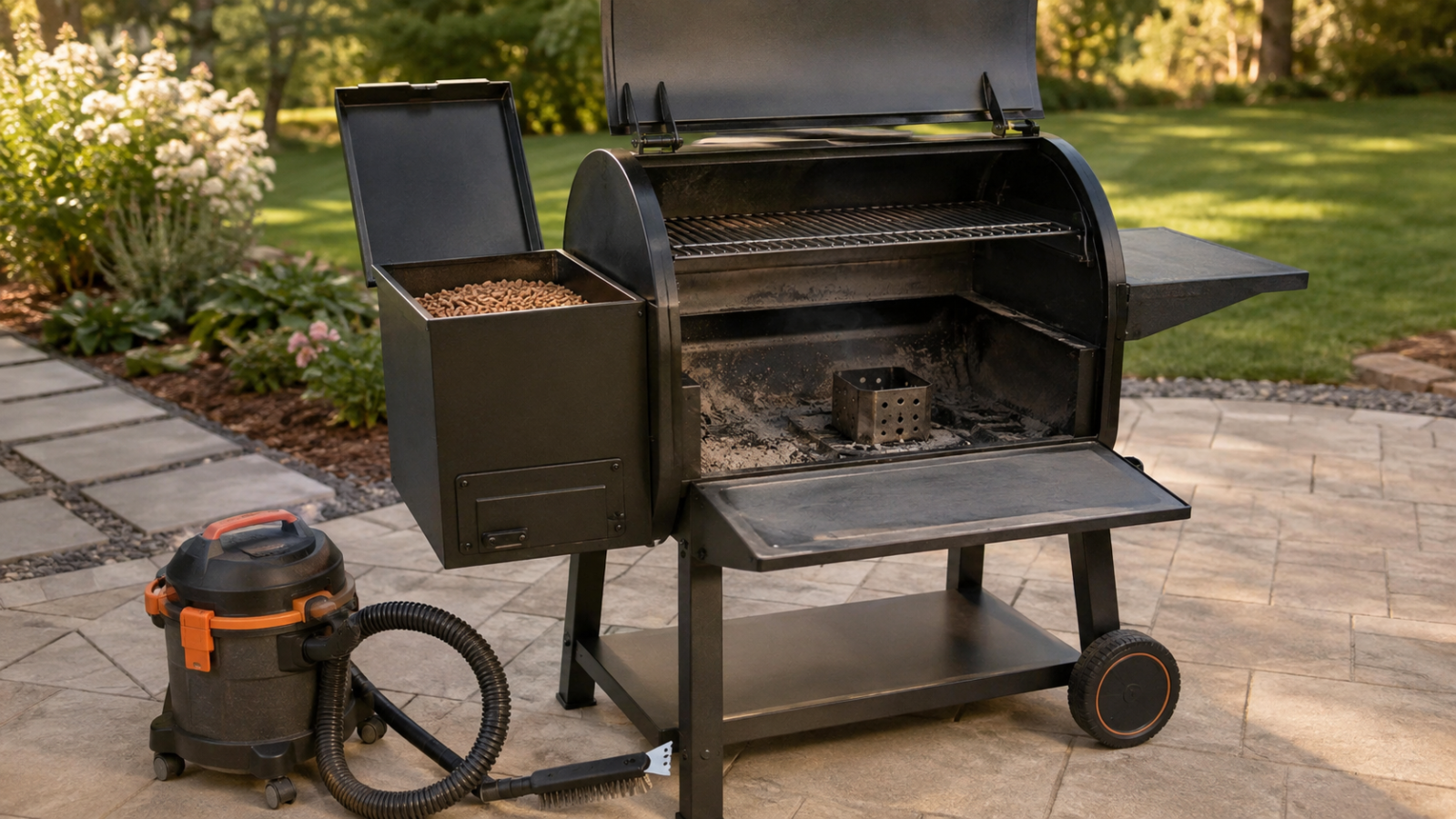
A firepot choked with ash cannot move enough combustion air through the fuel. A pot piled with unburned pellets points to a failed ignition or reignition and must be cleaned before another startup. Ash is normal, but it gradually blocks the holes that supply oxygen to the fire. Grease and debris elsewhere in the grill can also disturb airflow. Follow the cleaning frequency in your manual; cooking time, pellet quality, and weather all affect how quickly ash accumulates. If the flame goes out while the controller continues calling for heat, the auger may keep adding pellets during an attempted recovery. Traeger warns that a failed reignition can cause pellets to build up or overflow the firepot. Restarting on top of that excess fuel can cause a sudden ignition and heavy smoke. Use this safe sequence:
- If there is no active fire emergency, use the model’s proper shutdown procedure.
- Let every part of the grill become completely cold.
- Disconnect electrical power.
- Remove grates, drip tray, and heat diffuser only as the manual directs.
- Vacuum or remove cold ash and unburned pellets with equipment suitable for cold ash. Never vacuum warm material.
- Reassemble the grill correctly before testing it.
If you experience a lid lift, delayed ignition, burn-back toward the hopper, or repeated pellet overflow, stop troubleshooting and contact the manufacturer. Those symptoms deserve model-specific help.
Cause 4: Is the Hopper Empty, Tunneling, or Not Primed?
A grill can run out of fuel even when pellets remain along the hopper walls. Pellets sometimes form a cavity or “tunnel” above the auger opening, and a new or completely emptied grill may need its feed system primed according to the manual. Look through the hopper without placing your hand near the auger. If you see a hollow area over the intake, turn the grill off as directed and let it cool before redistributing pellets safely. Never put fingers, a tool, or clothing near a moving auger. If the hopper ran empty during a cook, refilling it may not deliver pellets to the firepot immediately. The auger tube contains empty space that must be filled. Use only the prime or feed procedure specified for your model. Do not repeatedly start and stop the entire ignition cycle, because each attempt may add fuel without establishing a stable flame. A simple prevention habit is to check pellet quantity before a long cook and look again during the cook. Do not wait for the temperature alarm to tell you the hopper is empty.
Cause 5: Is the Auger Jammed or Merely Cycling Normally?
A pellet auger normally cycles on and off to control heat; it does not necessarily rotate continuously. A true feed problem is more likely when the motor tries to turn but pellets do not move, the firepot remains empty, or the auger never moves during the model’s prescribed test. Common causes include swollen wet pellets, compacted sawdust, a foreign object, a damaged shear pin on models that use one, a failed motor, or loss of power to the motor. Both Traeger and Camp Chef identify pellet jams and motor or power problems in their official auger guidance. Do not judge the auger from a two-second glance, and do not reach into the hopper to feel whether it is moving. If the manual provides a visible feed or prime test, follow it from a safe position. Stop immediately if you hear grinding, repeated clicking, or a stalled motor hum. Clearing an auger can require removing the motor and shaft. That job varies greatly by model and may affect warranty coverage. If the jam is not accessible through the manufacturer’s normal cleaning instructions, contact support instead of forcing the shaft or applying power with guards removed.
Cause 6: Is the Combustion Fan Blocked or Not Running?
The fire cannot remain stable without combustion air. If the controller stays powered but the flame becomes weak and dies, a blocked air path, ash around the firepot, grease or debris near an intake, a loose fan connection, or a failed fan may be responsible. During a normal startup, you can often hear the fan and feel exhaust leaving the cooker without touching moving parts. Compare the sound with the startup description in your manual. Some fans run continuously, while others change speed, so do not assume every pause proves a failure. Once the grill is cold and unplugged, inspect only the accessible air openings and areas the manual tells you to clean. Remove ash and debris without bending fan blades or spraying liquid into electrical parts. Keep the exhaust and grease system clean as well, because the cooker depends on controlled airflow from intake to outlet. If the fan receives power but will not spin, spins only when pushed, scrapes its housing, or repeatedly trips a fuse or breaker, it is time for manufacturer support. Do not operate the grill with a defeated safety device or improvised fan wiring.
Cause 7: Is the Temperature Probe Giving the Controller Bad Information?
A dirty or failing internal temperature sensor can mislead the controller. If the sensor reports a temperature that is too high, the controller may reduce pellet feed until the real fire dies. If it reports too low, the controller may overfeed fuel. The relevant sensor is the grill’s internal cook-chamber probe, sometimes called an RTD or thermocouple, not the removable meat probe. Grease and smoke residue can insulate it and slow its response. With the grill cold, clean the sensor gently using the method approved in your manual. Do not sand it aggressively, bend it, or submerge it. After cleaning, watch for obvious warning signs during the next controlled test: temperatures that jump suddenly, remain fixed despite a heating grill, or differ wildly from a reliable grate-level thermometer placed nearby. A second thermometer is useful for identifying a large discrepancy, but it will not match the built-in sensor degree for degree. The two instruments sit in different locations and respond differently to radiant heat and airflow. Look for a persistent, meaningful pattern rather than one momentary difference. If the display shows impossible readings or a sensor-specific code, use the manufacturer’s test and replacement procedure. Do not buy a controller until the probe and its connections have been ruled out.
Cause 8: Did the Startup or Shutdown Procedure Trigger the Problem?
Yes. An incorrect startup or an interrupted shutdown can leave the fire unstable, load excess pellets into the pot, or leave heat in the auger area even when no major part has failed. Startup procedure: Pellet grills do not all ignite the same way. Some instructions begin with the lid open, others with it closed, and newer controllers may automate steps older models require manually. Use the exact sequence for your model. A failed first ignition should be investigated before a second attempt, especially if pellets have collected in the pot. Shutdown procedure: Use the programmed shutdown cycle after every cook. It burns down remaining fuel and cools the grill in a controlled manner. Switching off a power strip or pulling the plug can leave burning pellets or heat in the auger area. Traeger’s official guidance says its proper shutdown cycle helps reduce back-burn and other adverse events; consult your own brand for the correct procedure and duration. Igniter expectations: On many pellet grills, the hot rod operates mainly during ignition rather than glowing throughout the cook. A hot rod that stops glowing after the fire is established is not automatically defective. Judge it by the model’s ignition test, not by whether it remains on continuously.
Cause 9: Are Weather, Lid Openings, or Software Causing the Shutdown?
They can. Strong wind, low outdoor temperature, extended lid openings, or a controller software problem can make the temperature fall far enough to trigger a warning or shutdown even when the fuel system is mechanically sound. Cold and wind: Low outdoor temperatures and strong wind increase heat loss and can disturb airflow. Move the grill only when it is off and cold. Choose a level, open-air location protected from direct wind while maintaining every clearance and ventilation requirement in the manual. Never move it into a garage, porch enclosure, shed, or other indoor space. Lid opening: Repeatedly opening the lid dumps heat. During low-temperature cooking, a long open-lid period can contribute to a low-temperature warning. Make your checks quickly and let the controller recover. Firmware and settings: Connected grills may receive controller or app updates. If shutdowns began after an update, a power interruption, or a setting change, check the maker’s current support page for your exact controller and model. Avoid random factory resets until you have recorded settings and error history.
How Can You Troubleshoot It in the Safest Order?
Use observation first, cleaning second, and component replacement last. This order handles the common, low-cost causes before electrical or mechanical work and reduces the chance of restarting a grill loaded with excess pellets.
- Record the symptom. Note whether the display went dark, the fan stopped, the temperature fell, and an error code appeared.
- Make the cooker safe. Follow the manual’s shutdown procedure if conditions are normal. If there is an active fire or burn-back, keep clear and follow the emergency directions instead.
- Let it cool fully. Do not remove the heat diffuser, drip tray, firepot contents, hopper guard, or auger parts while hot.
- Check external power. Inspect the outlet, GFCI, breaker, plug, power cord, and permitted extension cord without opening electrical housings.
- Check the fuel. Confirm that there are enough dry, firm pellets and no tunnel above the auger opening.
- Inspect and clean the firepot. Remove cold ash and excess pellets according to the manual.
- Check normal feed and airflow. Use only the manufacturer’s visible startup, prime, or diagnostic test. Keep hands and tools away from moving parts.
- Clean the internal temperature sensor. Look for readings that are fixed, erratic, or clearly unreasonable.
- Use the error code and model number. Search the manufacturer’s support site or call support before replacing a controller, motor, fan, probe, or igniter.
Perform the final test outdoors with the grill clean, correctly assembled, and attended. The U.S. Fire Administration says wood-pellet grills should be used only outdoors, kept away from structures and overhanging branches, surrounded by a three-foot safety zone, and never left unattended while lit.
When Should You Stop Troubleshooting and Call for Help?
Stop when the problem involves repeated electrical trips, damaged wiring, a burn-back toward the hopper, a delayed ignition or lid lift, an inaccessible auger jam, repeated firepot overflow, or a component test that requires exposed live wiring. Those are not good trial-and-error repairs. Have this information ready for support:
- Brand, full model number, and serial number
- Controller type and current software version, if shown
- The exact error code or message
- Whether the screen lost power or the fire alone went out
- Outdoor temperature and wind conditions
- Pellet brand, condition, and age
- What you cleaned or tested and what happened
- Clear photos of the cold firepot and pellets, if requested
This record helps support distinguish a fuel or maintenance problem from a failed probe, fan, auger motor, igniter, controller, or wiring connection. It may also protect your warranty by showing that you followed the approved procedure.
What You Need to Know
- A dark display suggests power loss; a powered display with falling temperature suggests a flameout.
- Damp pellets, hopper tunneling, ash, and interrupted startup or shutdown procedures are worth checking before buying parts.
- An auger that pauses may be operating normally because pellet feed is commonly cycled.
- Never restart over a firepot full of unburned pellets.
- Use the exact model manual for ignition, shutdown, priming, fuse, and component-test instructions.
- Call support for repeat breaker trips, exposed wiring, burn-back, lid lift, or a jam that requires major disassembly.
Bottom Line
If your pellet grill keeps shutting off, do not begin by ordering a new controller. First identify whether the failure is electrical or a flameout. Then check power, dry fuel, pellet flow, firepot cleanliness, airflow, and the temperature sensor in that order. Most importantly, do not keep pressing Start after a failed ignition. A cold inspection and a clean firepot take longer than a quick restart, but they are the safer way to find the cause and protect the grill.
Frequently Asked Questions
Why does my pellet grill shut off after 10 or 15 minutes?
A shutdown shortly after startup often points to failed ignition, slow pellet delivery, a dirty firepot, damp pellets, weak airflow, or a low-temperature safety timeout. If the entire display goes dark, check the electrical supply instead. Let the grill cool and inspect the firepot before trying again.
Why is the firepot full of pellets after a flameout?
The controller may have continued feeding pellets while trying to reach the set temperature or reignite the fire. Do not restart the grill with that pile in place. After the cooker is completely cold and unplugged, remove the excess pellets and ash as directed by the manual, then find the original ignition or airflow problem.
Should a pellet-grill auger run continuously?
Usually not. Many controllers cycle the auger on and off to maintain temperature, so a stationary auger during a brief observation can be normal. Use the model’s prime or diagnostic procedure to confirm a real feed failure, and keep hands away from the mechanism.
Can wet pellets make a pellet grill shut down?
Yes. Moist pellets can crumble, bridge in the hopper, burn poorly, or swell into a hard auger jam. Replace suspect fuel with dry cooking pellets and remove accumulated sawdust or swollen material according to the manufacturer’s cleaning procedure.
Is the hot rod bad if it stops glowing during the cook?
Not necessarily. On many pellet grills, the igniter is used mainly during startup and does not stay energized for the full cook. Suspect it when the model fails its prescribed ignition test, not simply because it is no longer glowing after a stable fire begins.
Can an extension cord make a pellet grill turn off?
Yes. An undersized, damaged, ungrounded, overly long, or poorly connected extension cord can cause voltage drop or intermittent power. Follow the grill manual’s cord requirements. When safe and permitted, a direct test from a known-good grounded outlet can help isolate the cord.
Why does the fan keep running after I shut the grill off?
That is often the normal cooldown cycle. The fan may continue burning remaining fuel and lowering internal temperature before the controller turns everything off. Let the full programmed cycle finish unless the owner’s manual or an active emergency requires a different response.
Can I use my pellet grill in the garage when it is cold or windy?
No. A garage is an indoor or enclosed space, even with the door open. Pellet grills produce heat, smoke, and carbon monoxide. Use the grill only outdoors with the clearances and ventilation required by the manual.