
Updated: July 29, 2026
A pellet grill can make pork shoulder, chicken leg quarters, chuck roast, meatloaf, and other lower-cost meats taste like a special Sunday dinner—without making an older cook stand over a fire all afternoon.
Quick Answer
Older adults can save money with a pellet grill by choosing affordable, forgiving cuts and cooking enough for several meals at once. Chicken thighs and leg quarters are the easiest place to start. Pork shoulder, whole chicken, meatloaf, and sale-priced chuck roast also work well. A digital controller and probe thermometer reduce fire tending, while foil pans, smaller cuts, and a pellet scoop reduce lifting. Cook by internal temperature, refrigerate portions promptly, and freeze what you will not eat within a few days.
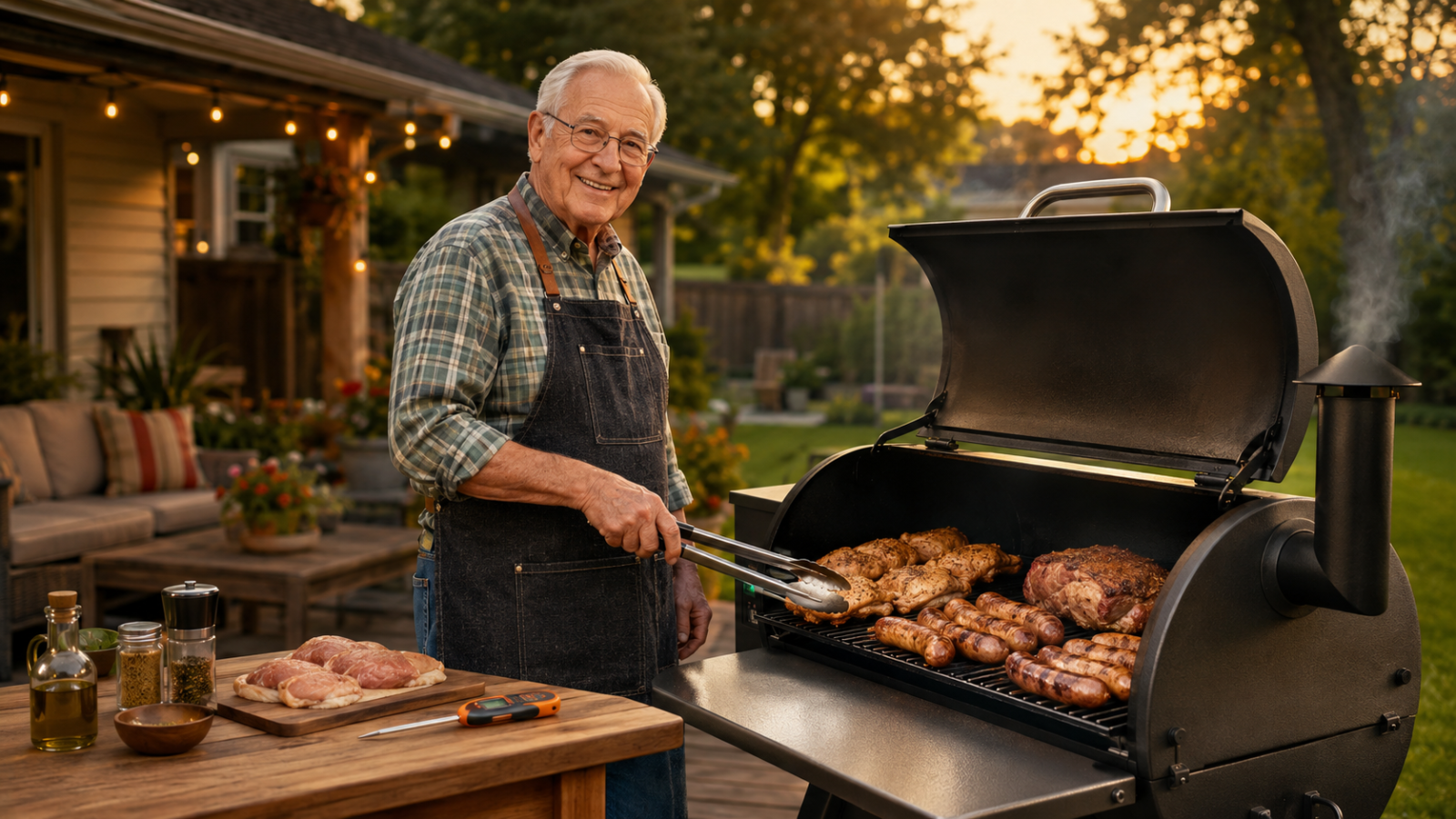
I am in my eighties, and I have been grilling since 1970. At this age, I still want real wood-fired flavor, but I do not want to wrestle with a heavy brisket, bend over a firebox every twenty minutes, or spend half the grocery budget on one piece of meat. That is where a pellet grill can earn its place. You load the hopper, set the cooking temperature, insert a meat probe, and let the controller manage the fire. It is not completely hands-off, and it still needs cleaning and safe operation, but it usually demands less fire management than an offset smoker or charcoal grill. The real money-saving advantage is not that pellets are free or that every cook is cheap. The advantage is that steady heat and light wood smoke can turn economical cuts into tender meat you will actually enjoy eating for several meals.
Why Pellet Grills Work Well for Older Cooks?
A traditional smoker asks you to manage fuel, airflow, and temperature. A pellet grill uses an electric auger to feed compressed wood pellets into a small burn pot. Once the fire is established, the controller adds fuel as needed to hold the temperature you selected. That automatic control can be helpful when standing, bending, carrying fuel, or watching a fire for hours is no longer comfortable. It also makes low-cost cuts more practical because those cuts often need longer cooking to become tender.
The senior-friendly advantages
- Less fire tending: You do not have to add charcoal or split wood throughout the cook.
- Simple temperature control: Most models use a dial or push-button controller.
- Remote checking: A leave-in probe can show meat temperature without repeated trips outside or repeated lid opening.
- Forgiving cooking: Steady indirect heat is well suited to chicken thighs, pork shoulder, meatloaf, and chuck roast.
- Batch capacity: One cooking session can produce several portioned meals.
- No open charcoal handling: There are no hot coals to pour from a chimney starter.
Honest limitation: A pellet grill still requires electricity, dry pellets, occasional ash removal, grease cleanup, and safe outdoor placement. A 20-pound pellet bag can also be awkward. Ask for carryout help, divide pellets into smaller sealed containers, and refill the hopper with a scoop instead of lifting the whole bag.
What Is the Best Affordable Meats for a Pellet Grill?
Meat prices change by store, season, and region, so a fixed dollar figure becomes outdated quickly. The USDA publishes national retail meat-price data monthly, but your best local measure is still the price per pound on the shelf. Look for cuts with enough fat and connective tissue to stay moist during indirect cooking. They are usually easier to cook than lean chicken breast or a costly steak, and they reheat better.
| Meat | Why It Is a Good Value | Pellet-Grill Plan | Best Uses |
|---|---|---|---|
| Chicken leg quarters | Often among the lowest-priced fresh chicken cuts; moist and forgiving | 300–325°F until at least 165°F; thighs are usually more tender around 175–185°F | Dinner plates, sandwiches, soup, chicken salad |
| Bone-in chicken thighs | Smaller and easier to handle than a whole bird; hard to dry out | 300–325°F until at least 165°F; cook longer for softer dark meat | Rice bowls, salads, tacos, casseroles |
| Pork shoulder or pork butt | Usually costs less per pound than ribs, chops, or beef roasts and makes many portions | 250–275°F until probe-tender, commonly 195–205°F for pulled pork | Sandwiches, tacos, beans, baked potatoes |
| Whole chicken | Often costs less per pound than packaged boneless pieces | 325°F until breast and innermost thigh reach at least 165°F | Dinner, sandwiches, soup, pot pie |
| Chuck roast on sale | A practical beef choice when brisket and steaks are too expensive | Smoke at 250°F, then cover with a little broth and cook until shreddable | Open-faced sandwiches, beef and noodles, tacos |
| Homemade meatloaf | Breadcrumbs, egg, and onion stretch the meat; easy to portion | 250–275°F until the center reaches 160°F | Hot dinner, sandwiches, freezer portions |
Best first choice: Start with four to six chicken thighs or leg quarters. They are manageable, cook in a reasonable time, accept almost any seasoning, and do not punish a beginner for being ten minutes late. Best batch-cooking choice: Pork shoulder gives the most meal possibilities. If a large roast is too heavy, ask the meat counter to split it, buy a smaller boneless piece, or cook country-style pork ribs cut from the shoulder. Best beef choice: Buy chuck roast only when the price makes sense. Brisket is heavy, takes a long time, can use a lot of pellets, and is not automatically economical just because barbecue restaurants serve it.
How to Shop for Pellet-Grill Meat on a Fixed Budget?
1. Compare price per pound, not package price
A small package can look cheap while costing more for every pound of meat. Check the shelf label. Then consider how much usable cooked meat the cut will provide. Bone-in chicken may still be the better value, but a roast with an unusually large bone or fat cap may not be.
2. Let the weekly sale choose the menu
Do not decide you must cook beef before seeing the prices. If chicken quarters are the bargain, cook chicken. If pork shoulder is marked down, make pulled pork and freeze part of it. Flexibility saves more money than chasing a particular recipe.
3. Buy manageable pieces
A family pack is not a bargain if it is too heavy to carry, divide, or store safely. Ask the butcher to split a pork shoulder or cut a chuck roast in half. Many stores will repackage meat if you ask. Smaller pieces also cook faster and are easier to move in a shallow pan.
4. Skip expensive rub collections
Salt, pepper, paprika, garlic powder, onion powder, and a small amount of brown sugar can season most pork and chicken. If you have been told to limit sodium, use less salt or a salt-free blend and follow the advice of your healthcare professional.
5. Stretch the meat without making supper feel skimpy
Serve smoked meat with filling, inexpensive foods such as potatoes, beans, rice, cabbage, carrots, or cornbread. Chopped pork mixed into beans or shredded chicken served over a baked potato can make a satisfying meal with a smaller meat portion.
6. Do not fill the grill just because space is available
Batch cooking saves effort only if you can cool, package, refrigerate, and freeze the food promptly. Cook an amount you can safely handle. Four thighs and two baked potatoes may be a smarter cook than a grate packed with food.
Four Easy Pellet-Grill Plans for Affordable Meat
Plan 1: Simple smoked chicken quarters
Why start here: Chicken quarters are inexpensive in many stores, easy to season, and small enough to move without strain.
- Pat the chicken dry. Lightly coat it with oil and season it.
- Preheat the pellet grill to 300–325°F.
- Place the quarters skin-side up and insert a clean probe into the thickest part without touching bone.
- Cook until every piece reaches at least 165°F. Dark meat is usually more tender at 175–185°F.
- Rest for about 5 minutes. Eat one portion and remove the meat from the remaining pieces after they have cooled enough to handle.
Use the extra chicken in sandwiches, soup, rice bowls, or chicken salad. For crispier skin, raise the grill temperature during the final part of the cook, but do not chase perfect skin if simple, tender meat is your main goal.
Plan 2: Smaller-batch pulled pork
Why it works: Pork shoulder is forgiving and reheats well, but a full roast can be heavy. A 3- to 5-pound piece is easier to season, lift, and portion.
- Coat the pork lightly with mustard or oil, then add a simple seasoning.
- Set the pellet grill to 250–275°F. The higher end shortens the cook and still produces good smoke flavor.
- Smoke until the outside has the color you want, usually several hours.
- Move the pork into a foil pan, add a small splash of broth or apple juice, and cover tightly.
- Finish on the pellet grill or in a 275°F kitchen oven until a probe slides in with little resistance, commonly around 195–205°F.
- Rest it covered, then pull only the amount you can comfortably handle at one time.
Once the pork is tightly covered, finishing in the oven can save pellets because smoke can no longer reach the meat. That is not cheating; it is sensible cooking.
Plan 3: Smoked-then-braised chuck roast
Why it works: Chuck has beef flavor and connective tissue that becomes tender with time. Covering it partway through the cook makes the result more dependable.
- Season a small chuck roast with salt, pepper, garlic, and onion powder.
- Smoke at 250°F for 2 to 3 hours.
- Place it in a shallow foil pan with sliced onion and about a cup of low-sodium broth.
- Cover tightly and continue cooking until fork-tender or easy to shred.
- Skim excess fat after the liquid cools and use the juices to keep reheated portions moist.
This approach gives you smoky beef without buying a full brisket. Serve it over noodles or potatoes, on toast, or in a small tortilla.
Plan 4: Pellet-grill meatloaf
Why it works: Meatloaf is familiar, easy to slice, and allows breadcrumbs, onion, and egg to stretch the meat.
- Mix ground beef, turkey, pork, or a blend with breadcrumbs, one egg, chopped onion, and seasoning.
- Form a low, wide loaf in a grill-safe pan so it cooks evenly and is easy to carry.
- Cook at 250–275°F until the center reaches 160°F for ground beef or pork. A loaf containing ground poultry must reach 165°F.
- Add sauce only during the final 15 to 20 minutes so it does not burn.
- Rest for 10 minutes before slicing.
If you want more beginner ideas, see our easy pellet grill recipes for beginners.
How One Pellet-Grill Cook Can Become Several Meals?
The most affordable cook is not always the cheapest piece of raw meat. It is the cook that gives you food you will use instead of leftovers you eventually throw away.
| Main Cook | First Meal | Second Meal | Freezer Portion |
|---|---|---|---|
| Chicken thighs | Chicken, potato, and vegetable | Chopped chicken salad or rice bowl | Diced chicken for soup |
| Pulled pork | Sandwich with slaw | Pork and beans or loaded potato | Flat meal-size bags for later |
| Chuck roast | Beef with potatoes | Open-faced beef sandwich | Beef and cooking juices |
| Meatloaf | Hot slices with vegetables | Meatloaf sandwich | Individually wrapped slices |
Before the meat goes on the grill, set out shallow storage containers, labels, and freezer bags. When the cooked food is cool enough to handle, divide it into one- or two-meal portions. Shallow containers cool faster than one deep tub. The USDA advises refrigerating perishable leftovers within two hours, or within one hour when the outdoor temperature is above 90°F. Most cooked leftovers keep three to four days in the refrigerator; freeze portions you will not use in that period. Reheat leftovers to 165°F. See the USDA’s complete leftover safety guidance.
A Safer, Easier Pellet-Grill Setup for Seniors
A good setup prevents more problems than a fancy recipe. Arrange the work so you are not carrying raw meat, opening doors, stepping over a cord, and searching for a thermometer at the same time.
Put the grill where every step is level
Use the pellet grill outdoors on a stable surface with the clearances required by its manual. Keep the route from the kitchen dry, well lit, and free of hoses, extension cords, and loose mats. Never operate a pellet grill inside a home, garage, shed, or other enclosed space.
Use a tray or shallow pan for every trip
A rimmed sheet pan catches drips and gives both hands a stable place to hold. Use one clean tray for cooked food and a separate tray for raw meat. Do not return cooked meat to a surface that held it raw.
Choose smaller tools, not heavier tools
A lightweight foil pan is often easier to manage than a cast-iron skillet. Long tongs should open easily in your hand. Heat-resistant gloves must fit well enough that a pan cannot slide out of your grip. If arthritis or shaking makes a job unsafe, ask for help with that step.
Let a probe thermometer make the extra trips
Insert the probe before closing the lid and set a high-temperature alarm. A simple receiver can be easier than a phone app, but either one can reduce walking and lid lifting. Always verify the final temperature in a second spot with an instant-read thermometer.
Cook during daylight
Start long cooks in the morning instead of running the grill unattended overnight. Cooking pork shoulder at 250–275°F instead of the lowest smoke setting can shorten the day. Good barbecue does not require losing sleep.
Wait for a full cool-down before cleaning
Shut the grill down according to its manual. Do not move a hot grill, empty hot grease, or vacuum warm ash. Clean in short jobs: grates one day, grease tray after the next cook, and fire-pot ash when the grill is completely cold and unplugged.
My simple setup
I would rather have a modest pellet grill at a comfortable working height, a front shelf, a reliable probe, a pellet scoop, and a clear walking path than a giant cooker loaded with features. Ease of use matters more when the grill is supposed to help you cook, not wear you out.
Food Safety Matters More After Age 65
Older adults are more likely to have a serious outcome from foodborne illness, so this is not the place to guess by color, cooking time, or whether the juices look clear. Use a thermometer every time. The USDA recommends keeping the smoker or grill between 225°F and 300°F while smoking meat and poultry. Its smoking safety guidance explains why both grill temperature and meat temperature should be monitored.
| Food | USDA Minimum Internal Temperature | Important Note |
|---|---|---|
| Whole cuts of beef and pork | 145°F plus a 3-minute rest | Pork shoulder and chuck need a much higher finishing temperature for pulled or shreddable texture. |
| Ground beef or pork | 160°F | Measure in the center of meatloaf or patties. |
| All poultry, including ground poultry | 165°F | Check the thickest part without touching bone. Dark meat may be cooked higher for tenderness. |
| Leftovers | 165°F when reheating | Reheat only the portion you intend to eat. |
Those figures come from the USDA’s safe minimum internal temperature chart.
What if the pellet grill goes out?
If the hopper runs empty, the power fails, or the fire goes out, check both the meat temperature and how long the grill has been down. Do not simply restart a long cook and hope for the best. When the time and temperature history are uncertain—especially for an older adult or anyone with a weakened immune system—discarding the meat is safer than taking a chance. Keep raw meat refrigerated until the grill is ready. Wash your hands after handling it, use separate utensils for raw and cooked food, and never partially cook meat one day with plans to finish it later.
How to Spend Less on Pellets and Supplies?
- Use one all-purpose pellet: Oak, hickory, or a competition blend works with pork, chicken, and beef. You do not need a different bag for every recipe.
- Keep pellets completely dry: Damp pellets swell, crumble, jam the auger, and turn a bargain bag into waste. Store smaller amounts in sealed containers.
- Finish covered meat indoors: Once pork or beef is tightly wrapped, the kitchen oven can finish the cook without sacrificing additional smoke flavor.
- Cook sides at the same time: Add potatoes, onions, or a pan of beans when the grill temperature suits them and there is safe space around the meat.
- Keep the lid closed: Every unnecessary peek releases heat and can lengthen the cook.
- Protect the grill from wind: Use a safe open-air location and only a grill blanket approved for your model. Never trade ventilation for fuel savings.
For help choosing a versatile fuel, read our guide to the best wood pellets for grilling.
Is a Pellet Grill Worth It for Seniors on a Fixed Income?
If you already own one, yes—a pellet grill can be a practical way to make affordable meats more enjoyable and prepare several meals with one cooking session. It is especially useful if you enjoy outdoor cooking but no longer want to manage charcoal or an offset-smoker fire. If you would have to buy a new grill solely to reduce the grocery bill, the answer is less certain. The cooker, cover, pellets, thermometer, and maintenance cost money. A kitchen oven or slow cooker can cook the same cuts for less initial expense. The pellet grill earns its value through easier outdoor cooking and wood-smoked flavor, not through instant payback. For one or two people, a reliable compact or mid-size grill is usually more sensible than the largest model on the showroom floor. Look for a comfortable grate height, stable legs, simple controls, easy grease access, a useful shelf, and local availability of pellets and replacement parts. Our pellet grills by budget guide can help you compare sizes and price levels.
Bottom Line
The smartest affordable pellet-grill meal for an older cook is not an enormous brisket. It is a manageable cut that is easy to carry, forgiving to cook, safe to portion, and useful in more than one meal. Start with chicken thighs or leg quarters. Move up to a smaller pork shoulder when you are comfortable. Use a probe thermometer, let the controller do the fire tending, and stop before the job becomes tiring.
Frequently Asked Questions
Are pellet grills easy for seniors to use?
Pellet grills are often easier for older adults than charcoal grills or offset smokers because an electronic controller feeds the fire automatically. The cook still needs to fill the hopper, handle food safely, clean grease and ash, and use the grill outdoors. A waist-high cooking surface, simple controller, front shelf, and probe thermometer can make operation easier.
What is the cheapest meat to cook on a pellet grill?
Chicken leg quarters are often one of the least expensive and easiest options. Pork shoulder, bone-in chicken thighs, whole chicken, homemade meatloaf, and chuck roast bought on sale are also good values. Local price per pound matters more than a national list.
What is the easiest meat for an older beginner to smoke?
Chicken thighs are the easiest starting point because they are small, moist, forgiving, and faster than a pork shoulder or brisket. Cook them at 300–325°F and verify that they reach at least 165°F internally.
How can one person use a whole pork shoulder?
Ask the butcher to divide it, or cook the whole shoulder and freeze the pulled pork in small, flat portions with a spoonful of cooking juice. Use it for sandwiches, tacos, beans, soup, omelets, or baked potatoes. Freeze anything you will not eat within three to four refrigerated days.
Can I finish smoked meat in the oven to save pellets?
Yes. After meat has taken on smoke and is tightly wrapped or covered, finishing it in the oven is practical and can reduce pellet use. Continue monitoring internal temperature and tenderness just as you would on the grill.
Do pellet grills use a lot of electricity?
A pellet grill needs electricity for the controller, auger, fan, and ignition system, but the main cooking fuel is wood pellets. Actual electricity and pellet use vary by grill size, temperature, weather, insulation, and cooking time.
Should an older adult cook overnight on a pellet grill?
Daytime cooking is the safer and easier choice. Start early, use a probe alarm, and cook at 250–275°F when the recipe permits. A pellet grill can still lose power, run out of fuel, or experience a flameout, so it should not be treated as risk-free while everyone sleeps.
What tools make pellet grilling easier for seniors?
A reliable leave-in probe, instant-read thermometer, lightweight rimmed tray, easy-opening tongs, fitted heat-resistant gloves, pellet scoop, small sealed pellet containers, and a front or side shelf provide more value than a cabinet full of gadgets.
Affiliate disclosure: Everything Grill Reviews may earn a commission from qualifying purchases made through links on this site. This does not change the price you pay. Product prices and availability can change, so verify current details before buying.