
Updated: October 25, 2026
Updated and fact-checked: October 24, 2026
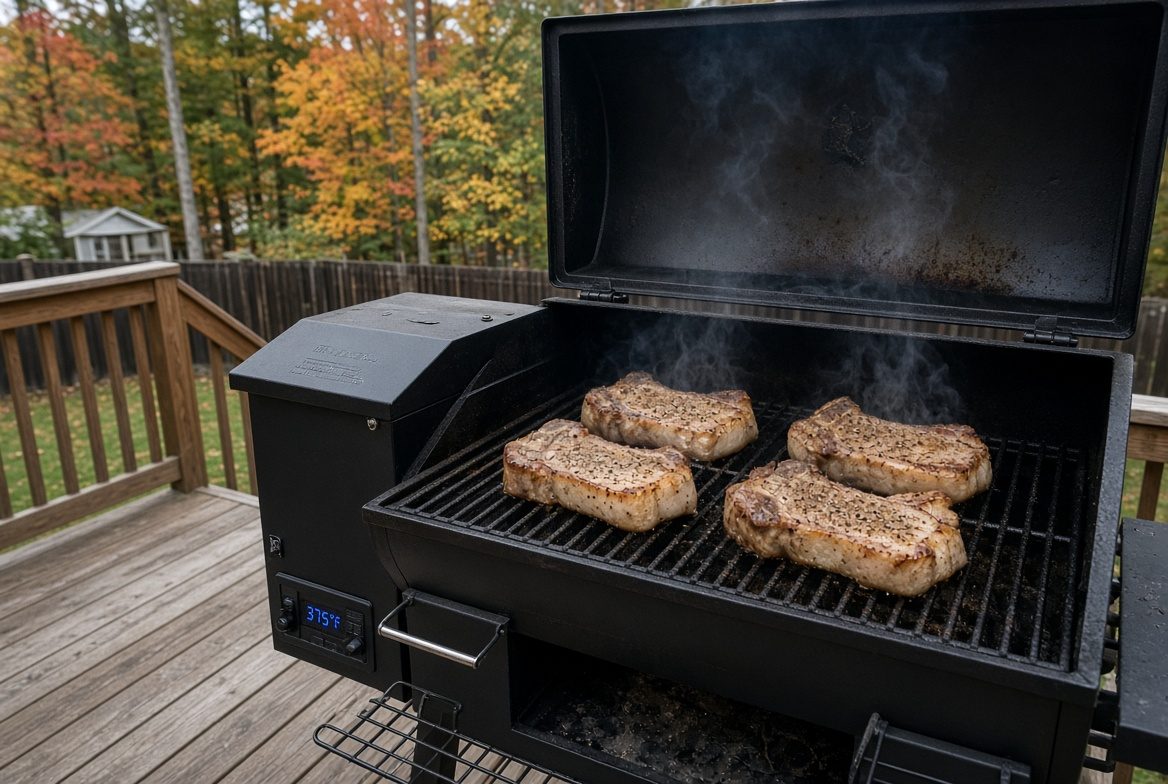
Thick pork chops on a pellet grill cook at 375°F until the center reaches 145°F, then rest at least 3 minutes. The set point is high enough for a weeknight roast and low enough that thick chops stay juicy when you watch the thermometer instead of the clock. Thin chops dry out while the lid is closed.
Quick Answer: How Do You Cook Thick Pork Chops on a Pellet Grill?
Preheat the pellet grill to 375°F, season thick chops, and cook until 145°F in the center, then rest at least 3 minutes. Buy chops at least 1 inch thick. Salt ahead if you have time and pat dry. A blush of pink at 145°F is normal. Time after preheat is an estimate of 25 to 40 minutes.
Key Points
- Set the pellet grill to 375°F for thick pork chops.
- USDA FSIS lists 145°F plus a 3-minute rest as the safe minimum for whole pork chops and roasts.
- Measure in the thickest part, away from bone and large fat pockets.
- Buy chops at least 1 inch thick. Thin chops overcook while the lid stays closed.
- Pink color at 145°F does not mean the chop is undercooked. Do not chase gray meat.
- Time is an estimate. Thickness, starting temperature, wind, and your specific grill move the clock.
What Ingredients and Equipment Do You Need?
You need thick pork chops, salt, a pellet grill, dry food-grade pellets, and a reliable instant-read thermometer. A leave-in probe helps on thicker cuts, but confirm the final reading with an instant-read probe in the center.
- 4 bone-in or boneless pork chops, at least 1 inch thick
- Kosher salt and black pepper
- Optional: garlic powder, paprika, or a simple dry rub
- Pellet grill with a working hopper and grease path
- Food-grade hardwood pellets (oak, apple, or cherry work well)
- Instant-read thermometer
Store pellets dry so they do not swell or crumble in the auger. The site’s guide on how to store wood pellets and charcoal covers the practical steps.
How Should You Prepare the Chops?
Pat the chops dry and salt them ahead of time if the schedule allows. Salt 45 minutes ahead in the refrigerator draws out a little moisture and helps it reabsorb. Pat dry again before they hit the grate so the surface browns instead of steaming. Thin chops do not need the advance salt as much because they cook so fast, but they also dry out faster.
Bone-in chops take a little longer and can shield one edge. Place the probe away from the bone. Boneless chops are simpler to check but can overcook if you rely only on color.
How Do You Set Up the Pellet Grill?
Preheat to 375°F with the lid closed and use only dry pellets. Confirm the grill is outdoors on a stable surface with the clearance listed in its manual. Empty the grease bucket if it is more than half full. Brush the grates. Load the hopper, set the temperature, and wait until the grill holds 375°F and startup smoke has settled into a clean exhaust. Thick white smoke at ignition is startup, not flavor.
Oak is the everyday pellet. Apple or cherry is milder and fits pork chops well. Hickory is stronger if you want more smoke on a short cook. The 30-day pellet plan on this site lists the same 375°F set point and 145°F target for thick chops.
How Do You Cook Thick Pork Chops Step by Step?
Place the chops on the grate, close the lid, and cook until the center reaches 145°F. Time after preheat is an estimate of 25 to 40 minutes for 1-inch chops. Check earlier if the chops are thinner or the grill runs hot.
- Pat the chops dry and season both sides.
- Preheat the pellet grill to 375°F with the lid closed.
- Place the chops on the grate with space between them. Insert a leave-in probe in the thickest part if you use one, away from bone.
- Close the lid. Cook until an instant-read thermometer reads 145°F in the center of the thickest part.
- Remove the chops and rest them at least 3 minutes before slicing or serving.
Flip once if the top is browning unevenly. Do not open the lid just to look. The thermometer is the finish line, not the clock. See the site’s guide on how to use a meat thermometer correctly for probe placement on chops.
What Internal Temperature Makes Pork Chops Safe?
USDA FSIS lists 145°F plus at least 3 minutes of rest as the safe minimum for whole pork chops and roasts. Measure before you take the chops off the heat. The rest lets the temperature hold or continue rising briefly. Color is not proof of safety. Pork cooked to 145°F can still show a blush of pink in the center and is safe. Do not chase gray meat. Ground pork and fresh sausage need 160°F.
Last verified against the USDA FSIS safe-temperature chart on October 24, 2026. The chart is at fsis.usda.gov.
| Food | USDA minimum | Rest or note |
|---|---|---|
| Whole pork chops and roasts | 145°F | Rest at least 3 minutes |
| Ground pork and fresh sausage | 160°F | No extra rest listed |
| Leftovers | 165°F | Reheat thoroughly |
Barbecue tenderness on a pork shoulder is a separate target past the safety minimum. A chop at 145°F is done. A shoulder at the same number is usually still too tight to pull. The site’s guide on smoking pork shoulder on a pellet grill explains the difference.
How Should You Rest and Serve the Chops?
Rest the chops at least 3 minutes off the heat before you slice or serve them. Tent loosely with foil if the air is cool. Slice against the grain if the chop is thick enough. Serve with simple sides. Leftovers belong in the refrigerator within 2 hours and should be eaten within 3 to 4 days or frozen. Reheat leftovers to 165°F.
What Are Common Mistakes with Pellet Grill Pork Chops?
The most common mistake is using thin chops and expecting them to stay juicy at 375°F. Thin chops overcook while you close the lid and check the temperature. Other common problems:
- Relying on color instead of a thermometer. Pink at 145°F is normal and safe for whole chops.
- Opening the lid every few minutes. Each opening drops the chamber temperature.
- Loading damp or dusty pellets. They cause temperature swings and dirty smoke.
- Pulling the chops early and counting on carryover to finish them. Measure 145°F before you remove them from the heat.
If your pellet grill will not build a hard crust at 375°F, that is normal on many models. The reverse-sear guide on this site notes that thick chops can take a low first stage then a short sear, but the 375°F roast works for most weeknight chops without the extra step.
Final Verdict: Should You Cook Pork Chops on a Pellet Grill at 375°F?
Yes for thick chops when you want a reliable weeknight cook that holds temperature without constant fire management. Set 375°F, use a thermometer, pull at 145°F, and rest 3 minutes. The method is simple because the pellet grill holds the set point. It will not match the hard radiant sear of a charcoal bed, but it delivers even heat and clean smoke for chops that stay juicy when you buy them thick enough.
Frequently Asked Questions
Can pork chops be pink at 145°F?
Yes. USDA FSIS notes that pork cooked to 145°F may still show a blush of pink and is safe. Color is not proof of doneness. Use a thermometer in the thickest part.
How long do thick pork chops take on a pellet grill at 375°F?
Plan on 25 to 40 minutes after preheat for 1-inch chops, but treat the time as an estimate. Thickness, starting temperature, wind, and your specific grill change the clock. Check the center with a thermometer.
Do I need to reverse sear pork chops on a pellet grill?
Not for most weeknight chops. The 375°F roast works when the chops are at least 1 inch thick. Reverse sear is useful for very thick chops if your grill can raise the temperature or if you finish in a hot skillet. The site’s reverse-sear guide covers the limits on many pellet models.
What pellets work best for pork chops?
Oak is the everyday choice. Apple or cherry is milder. Hickory adds more smoke on a short cook. Keep pellets dry. Damp pellets cause temperature problems.
Related Reading
- 30-Day Pellet Grill Recipe Plan
- How to Use a Meat Thermometer Correctly
- Smoke Pork Shoulder on a Pellet Grill at 250°F
- How to Reverse Sear a Steak on a Grill
- How to Store Wood Pellets and Charcoal
About Frank W. Roberts
Frank W. Roberts is the author of Everything Grill Reviews. He has grilled since 1970 and brings more than 50 years of backyard cooking and cookoff experience to fire management, fuel behavior, smoke, and practical cooker use. This article is based on USDA FSIS guidance, verified pellet-grill technique, and the site’s existing cooking guides. It does not claim hands-on testing of a specific pellet grill model. Last verified October 24, 2026.