
Traeger Woodridge Pro
Best for: Pellet grill buyers
Traeger Woodridge Pro is worth comparing on cooking space, temperature range, cleanup, owner feedback, and current price before you buy.
Check Price on AmazonAs an Amazon Associate I earn from qualifying purchases.
Updated: August 23, 2026
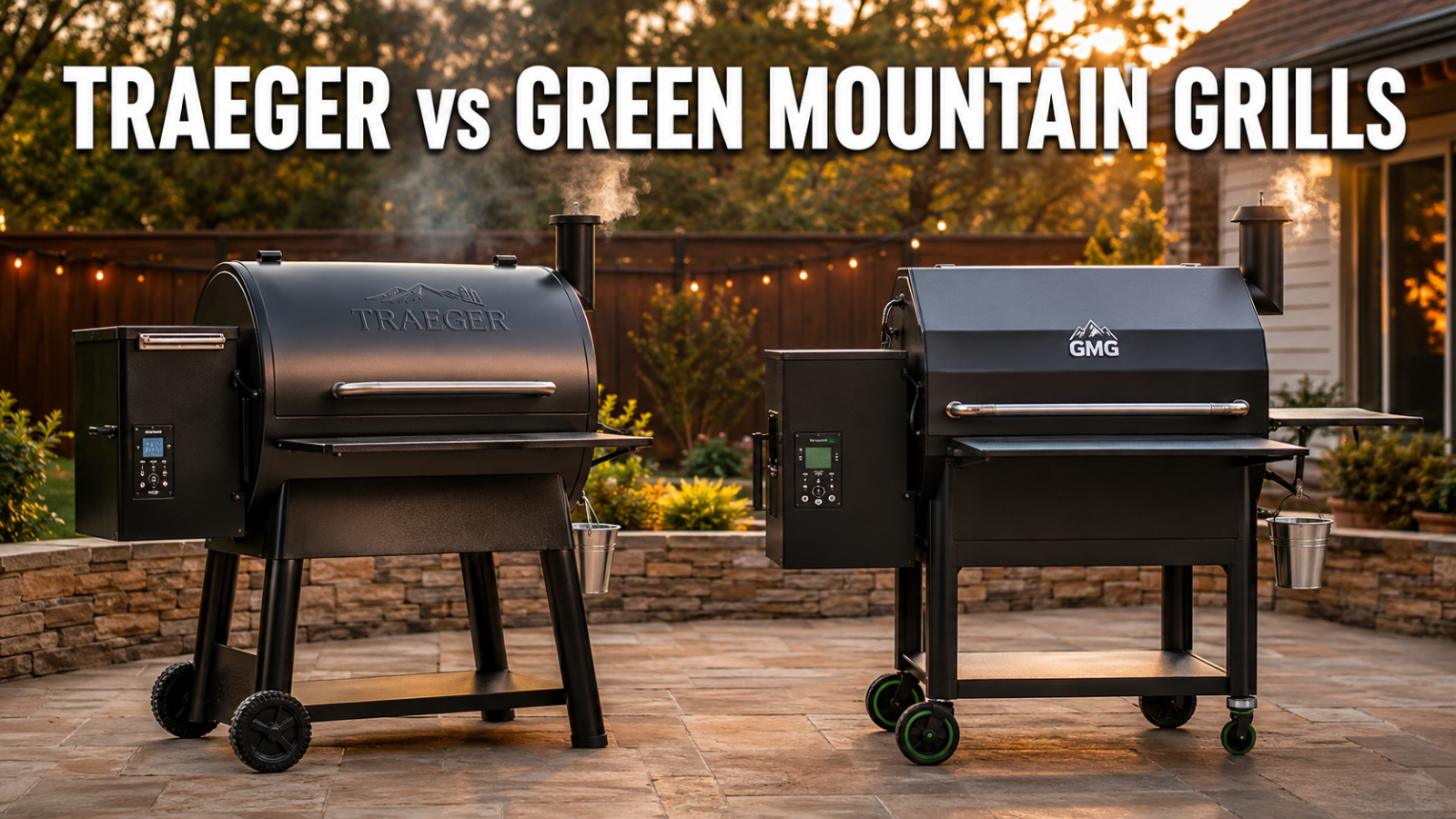
The Traeger vs Green Mountain Grills decision is less about finding one brand that beats the other at everything and more about choosing the ownership experience you want. Traeger makes sense for shoppers drawn to its WiFIRE ecosystem, current Woodridge cleanup design, and broad range of step-up models. Green Mountain Grills (GMG) stands out for its 150°F to 550°F Prime 2.0 controls, dealer-focused support, and add-ons such as RACKT, SideBURN, pizza, and rotisserie accessories.
Affiliate disclosure: As an Amazon Associate I earn from qualifying purchases. This does not change the price you pay.

Table of Contents
- Verdict at a glance
- Current and older model names
- Current lineup comparison
- Temperature control and Wi-Fi
- Smoke flavor and low-and-slow cooking
- Searing and high-heat cooking
- Cleanup and maintenance
- Price and long-term value
- Warranty and support
- Who should buy each brand
- Final verdict
- Frequently asked questions
Which Is Better: Traeger or Green Mountain Grills?
Traeger is the better fit for buyers who specifically want Traeger’s connected ecosystem and the easy-access cleanup features of the Woodridge family. GMG is the stronger fit for buyers who want a higher published controller ceiling, extensive add-on flexibility, or help from a nearby authorized dealer.
There is no honest brand-wide winner because the result changes with the models being compared. A Traeger Pro 575, a base Woodridge, and a Woodridge Elite do not have the same features. The same is true of the portable GMG Trek Prime 2.0, mid-size Ledge Prime 2.0, and larger Peak Prime 2.0.
| Buying factor | Traeger | Green Mountain Grills | Practical winner |
|---|---|---|---|
| Remote control | WiFIRE on connected models | GMG WiFi Smart Control on Prime 2.0 models | Tie on core functions; compare the exact app features you will use |
| Published heat range | Current Woodridge and Pro pages list a 500°F maximum | Prime 2.0 is listed at 150°F–550°F in 5-degree steps | GMG on controller range |
| Cleanup approach | Woodridge combines grease and ash in an accessible EZ-Clean keg | Prime 2.0 provides an AshVac access door for use with a vacuum after the grill is cold | Traeger Woodridge for the simpler routine |
| Accessory strategy | P.A.L. rail and ModiFIRE accessories on Woodridge models | RACKT, SideBURN, pizza, and rotisserie options on compatible Prime 2.0 models | GMG for cooking-system customization |
| Portable option | Portable choices exist, but they are separate from the full-size models discussed here | Trek Prime 2.0 is built around portable 12-volt use; cart and some power accessories cost extra | GMG Trek for this specific use |
| Buying experience | Direct online sales plus dealers and retailers | GMG emphasizes authorized local dealers; inventory varies by location | Depends on whether you prefer online convenience or local help |
Bottom line: Start with the model, cooking space, and local support you need. Then compare what is included in the box. A brand name alone does not tell you whether a shelf, cover, high-heat burner, extra rack, or smoke mode is included.
GMG buying note: Amazon commonly shows Green Mountain Grills covers, replacement parts, and accessories rather than reliable listings for current full-size Prime 2.0 grills. GMG recommends checking an authorized local dealer for grill availability, current price, and warranty-backed support.
What Happened to the Daniel Boone and Jim Bowie Model Names?
GMG’s current Prime 2.0 lineup uses Trek, Ledge, and Peak. The company’s parts and support pages identify Ledge as the successor name associated with the older Daniel Boone Prime/Prime Plus size class and Peak with the older Jim Bowie Prime/Prime Plus class.
This matters because many older comparisons still place a Traeger Pro 575 against a GMG Daniel Boone Prime Plus. That comparison can help a used-grill shopper, but it is not the best way to judge the current new-grill market. For a new purchase, compare Traeger’s current Pro or Woodridge options with the current GMG Ledge or Peak Prime 2.0 that matches your needed capacity.

Traeger also sells multiple generations at the same time. The Traeger Pro 575 remains a familiar connected model, while the newer Woodridge family changes the cleanup system, cooking capacity, accessory rail, and warranty proposition. Always read the page for the exact model number instead of applying one Traeger specification to the whole brand.
How Do the Current Traeger and GMG Lineups Compare?
Traeger offers more distinct step-up families, while GMG keeps its main Prime 2.0 choices easy to understand: portable Trek, mid-size Ledge, and larger Peak. The simpler lineup can make GMG easier to narrow down, but Traeger gives buyers more ways to pay for specific upgrades.
Which Traeger Models Should Buyers Compare?
Look at the Pro series if you want a familiar WiFIRE pellet grill, and look at Woodridge if cleanup and the newer accessory system matter more. Move to upgraded Woodridge, Ironwood, or Timberline models only when their extra features solve a real need.
The current base Woodridge lists 860 square inches of total cooking space, a 24-pound hopper, WiFIRE control, a 500°F maximum setting, P.A.L. accessory compatibility, and an EZ-Clean Grease & Ash Keg. Woodridge Pro adds more cooking space, a side shelf, and Super Smoke mode. Higher Woodridge trims add storage or a dedicated side sear station, depending on the version.
Those differences are important. A shopper who buys the base model expecting Super Smoke or an included sear station could be disappointed. Confirm the feature list on the exact product page before ordering.

Which Green Mountain Grill Models Should Buyers Compare?
Choose the Trek Prime 2.0 for travel or tight spaces, the Ledge Prime 2.0 for ordinary family cooking, and the Peak Prime 2.0 when you routinely need more grate and rack capacity.
All three current Prime 2.0 models are presented as Wi-Fi smart-controlled grills. The full-size Ledge and Peak are designed to accept several optional cooking systems, including the RACKT internal rack setup, SideBURN infrared attachment, pizza oven, and rotisserie. These are not all included, so build a complete price before deciding that one model is a bargain.
GMG also emphasizes 12-volt direct power. Its product pages note that some DC cords, carts, and accessories are sold separately. That flexibility is valuable for the right buyer, but it is another reason to compare complete packages rather than headline prices.
Which Brand Has Better Temperature Control and Wi-Fi?
GMG has the wider published controller range on its Prime 2.0 models, while both brands provide remote temperature control and food monitoring on their connected grills. Neither app should decide the purchase until you confirm phone compatibility, Wi-Fi requirements, and the functions included with the exact model.

Traeger’s WiFIRE system lets owners change grill temperature and monitor a cook through the Traeger app on compatible models. GMG’s Prime app supports remote grill and probe monitoring, temperature changes, timers, and programmable cooking profiles on compatible Prime 2.0 models.
The GMG Prime 2.0 line is officially listed for 150°F to 550°F control in 5-degree increments. Traeger lists a 500°F maximum for the Pro 575/780 and current Woodridge. That published difference is real, but it does not prove one grill is more accurate in wind, cold, or with a full cooking chamber. Pellet quality, a clean firepot, lid opening, weather, and probe placement all influence what happens during a cook.
Both brands can cook from the onboard controller without making Wi-Fi the center of every meal. Wi-Fi is most useful when you want to check a long cook from inside the house. It should not replace a properly placed food thermometer or safe food-handling judgment.
Which Pellet Grill Produces Better Smoke Flavor?
Neither brand guarantees stronger smoke flavor across every model. Smoke intensity depends heavily on cooking temperature, pellet condition and wood blend, airflow, food placement, and whether the exact grill has a dedicated smoke setting.
Pellet grills generally make more visible smoke during lower-temperature operation than they do at roasting or high grilling temperatures. Traeger specifically notes that the Woodridge produces more smoke in its lower cooking range, and the Woodridge Pro adds Super Smoke mode. The base Woodridge does not list that mode. GMG promotes low-and-slow use across the Prime 2.0 line, but the buyer should not assume that a higher maximum temperature also means heavier smoke.
For either brand, dry pellets and a clean firepot matter. Damp or crumbling pellets can feed poorly, and excess ash can interfere with a clean burn. If pellet choice is part of your decision, see our guide to the best wood pellets for grilling.
Is Traeger or Green Mountain Better for Searing?
GMG’s 550°F controller ceiling gives it an on-paper advantage over standard 500°F Traeger models, but a 50-degree setting difference does not automatically produce a better steak crust. Direct, concentrated heat matters more than the number on the controller.
A standard pellet grill cooks mostly with circulating indirect heat. It can brown food and finish steaks, but it will not behave exactly like a charcoal grate directly above coals or a powerful gas infrared burner. If steak searing is a top priority, compare the actual high-heat system:
- GMG: Compatible Ledge and Peak Prime 2.0 grills can accept the optional SideBURN infrared side-burner attachment.
- Traeger: The Woodridge Elite includes a side sear station; lower Woodridge trims do not list that same built-in feature.
- Either brand: A separate gas or charcoal grill may be the better partner if most of your meals are quick burgers and steaks rather than smoked food.
Do not pay for a premium pellet grill merely because the brochure uses the word “sear.” Decide whether you are getting a true direct-heat tool, an optional attachment, or simply a higher indirect cooking setting.
Which Pellet Grill Is Easier to Clean?
The Traeger Woodridge has the cleaner everyday design on paper because its EZ-Clean keg collects both grease and ash in an accessible container. GMG’s AshVac port improves access to the firepot, but it still requires a suitable vacuum and a completely cooled grill.
That does not make either grill maintenance-free. Grease can still collect on trays and inside the cooking chamber. Grates still need brushing, and every pellet grill needs periodic ash removal. The safest routine is to follow the exact manual, complete the shutdown cycle, disconnect power when directed, and wait until the fire and ash are fully cold before vacuuming.
GMG’s Ledge Prime 2.0 owner guidance says the AshVac door must remain closed while the grill is operating and instructs owners to wait at least one hour after shutdown before using a vacuum. Traeger owners should likewise follow the Woodridge manual rather than treating the keg as permission to ignore grease buildup elsewhere.
Which Brand Gives You Better Value for the Money?
GMG can offer excellent feature value when a nearby dealer has the right package, while Traeger can justify a higher total with Woodridge cleanup, its accessory ecosystem, or a model-specific warranty advantage. The only fair comparison is the complete out-the-door package.
Prices and promotions change too often to hard-code a winner. Instead, write down the cost of everything you would buy during the first year:
- The exact grill and required power equipment
- A weather cover
- Front or side shelf space
- Extra racks or grates
- Meat probes
- A searing, pizza, or rotisserie attachment
- Delivery and assembly, if needed
- Pellets and routine grease-bucket or liner supplies
GMG’s RACKT, SideBURN, pizza, and rotisserie systems create useful upgrade paths, but several pieces are optional. Traeger also separates important features by trim: for example, base Woodridge, Woodridge Pro, Pro Plus, and Elite do not include the same storage, smoke, or searing equipment.
If you are comparing alternatives, our Weber Smoque XL pellet smoker guide and Z GRILLS 8-in-1 pellet grill review can help you judge whether either brand earns its place on your shortlist.
How Do Traeger and GMG Compare for Warranty and Support?
Current Traeger Woodridge models advertise a 10-year limited warranty, while GMG’s published limited warranty states three years. Do not apply those terms to every older Traeger or used GMG model; coverage, exclusions, proof-of-purchase rules, and transferability must be checked for the exact grill.
Traeger provides model-specific manuals, troubleshooting pages, app help, and direct support. GMG also maintains manuals and support resources, but its buying model places more emphasis on authorized local dealers. GMG says dealer inventory varies, so call before driving to see a specific model.
Warranty length is only one part of ownership. Before buying, ask these questions:
- Who handles the first diagnosis: the manufacturer, store, or local dealer?
- Will a failed part be shipped to you, and are you expected to install it?
- Does the warranty cover labor, shipping, finishes, and normal wear?
- How easy is it to obtain igniters, probes, controllers, fans, and auger parts locally?
- What documentation is required if the grill was a gift or bought used?
Read the current Traeger service and warranty terms and Green Mountain Grills warranty before treating any warranty period as a deciding fact.
Who Should Buy Traeger, and Who Should Buy Green Mountain Grills?
Buy Traeger when its specific connected, cleanup, or trim-level features fit your routine. Buy GMG when its Prime 2.0 controller range, local dealer relationship, portable power, or accessory system solves a need you know you have.
Who Should Choose Traeger?
Traeger is the better fit for a buyer who wants WiFIRE, likes the Woodridge cleanup approach, and wants several model tiers within one accessory and app ecosystem.
- You want the EZ-Clean Grease & Ash Keg on a current Woodridge.
- You specifically want Super Smoke and are willing to choose a model that includes it.
- You want a current Woodridge model with its published limited 10-year warranty.
- You prefer buying directly online or comparing several Traeger trims.
- You already own compatible Traeger accessories or use the Traeger app.
Who Should Choose Green Mountain Grills?
GMG is the better fit for a buyer who wants 150°F–550°F control, values an authorized local dealer, or plans to build a more customized cooking station around Prime 2.0 accessories.
- You want the Trek Prime 2.0 for camping, tailgating, or a small patio.
- You want compatible RACKT shelves, pizza, rotisserie, or SideBURN options.
- You like the idea of AC and optional DC power flexibility.
- A respected GMG dealer nearby can help with setup, parts, and support.
- The complete GMG package costs less for the features you will actually use.
Who Should Skip Both Brands?
Skip both if you do not want an outdoor cooker that depends on electricity, a controller, an auger, a fan, and dry pellet fuel. Also look elsewhere if direct-flame searing is far more important to you than low-and-slow convenience.
A simple charcoal kettle, gas grill, or non-connected smoker may be easier to own if your cooking area has unreliable power or Wi-Fi, you dislike app-based features, or you want fewer electronic parts. Pellet grills are convenient, but they still require grease control, ash removal, weather protection, and safe pellet storage.
Final Verdict: Traeger or Green Mountain?
For most first-time buyers who want a current full-size grill and simple cleanup, I would start by comparing the Traeger Woodridge with the GMG Ledge Prime 2.0. Choose the Woodridge for its grease-and-ash keg and Traeger ecosystem; choose the Ledge for its wider controller range and accessory flexibility.
Move up to a larger or more expensive model only after naming the feature you are paying for. If that answer is “more room every weekend,” a larger grate may be worthwhile. If it is “maybe I will use it someday,” the money may be better spent on a cover, reliable thermometer, pellets, and the accessories you will use immediately.
My final recommendation is conditional, not a brand popularity contest:
- Best for Woodridge cleanup and Traeger’s connected ecosystem: Traeger
- Best for published temperature range and modular add-ons: Green Mountain Grills
- Best for portable 12-volt-focused cooking in this comparison: GMG Trek Prime 2.0
- Best local support: whichever brand has the more capable authorized dealer near you
- Best overall purchase: the exact model that includes the capacity and features you need without forcing you to buy unused upgrades
Frequently Asked Questions About Traeger vs Green Mountain Grills
These answers cover the questions that most often change the buying decision: old model names, smoke, Wi-Fi, searing, pellets, and current warranty terms.
Is Green Mountain Grills Better Than Traeger?
GMG is better for buyers who prioritize its 150°F–550°F Prime 2.0 control range, local dealer model, and optional RACKT, SideBURN, pizza, or rotisserie equipment. Traeger is better for buyers who prioritize WiFIRE, Woodridge cleanup, and Traeger-specific trim choices.
Is the GMG Ledge the Same as the Daniel Boone?
The names are not identical models, but GMG’s own parts navigation associates Ledge with the older Daniel Boone Prime/Prime Plus category. Treat Ledge Prime 2.0 as the current model family to compare, while checking serial and model numbers when buying used parts.
Can Traeger and Green Mountain Grills Work Without Wi-Fi?
Yes. Current connected grills from both brands can be controlled at the grill for basic cooking. Wi-Fi adds remote monitoring, temperature changes, notifications, and other app functions; it is not required to create heat.
Which Brand Is Better for Smoking Brisket?
Either can smoke brisket successfully when the grill is clean, the pellets are dry, and the cook uses reliable food-temperature checks. A dedicated smoke mode can be useful, but cooking space, weather performance, and the owner’s process matter more than the logo.
Which Brand Is Better for Steak?
GMG lists a 550°F maximum versus 500°F on the Traeger models discussed, but dedicated direct heat is more important for hard searing. Compare GMG’s optional SideBURN or Traeger’s Woodridge Elite sear station if steak is a priority.
Can You Use Any Brand of Pellets in Traeger or GMG Grills?
Use food-grade hardwood grilling pellets that meet the instructions for your exact grill. Never use heating pellets, pellets exposed to moisture, or fuel containing unknown binders or additives. Manufacturer-branded pellets are not the only buying factor; dryness, quality, and safe storage matter.
Which Brand Has the Better Warranty?
Current Traeger Woodridge pages advertise a limited 10-year warranty, while GMG publishes a three-year limited warranty. Older Traeger models can have different coverage, and every warranty has exclusions, so verify the exact model and current terms before buying.
Why Trust This Comparison?
This guide separates verified manufacturer specifications from buying judgment and does not claim a side-by-side hands-on test that did not occur.
Frank W. Roberts has been grilling since 1970 and writes Everything Grill Reviews to help ordinary buyers understand practical tradeoffs. For this update, current Traeger product and warranty pages, current GMG Prime 2.0 product pages, GMG owner guidance, and both companies’ support information were checked. Prices were deliberately left out of the verdict because promotions and dealer inventory change.
Manufacturer references: Traeger Woodridge specifications, Traeger Pro specifications, GMG Prime 2.0 lineup, and GMG authorized dealer information.