
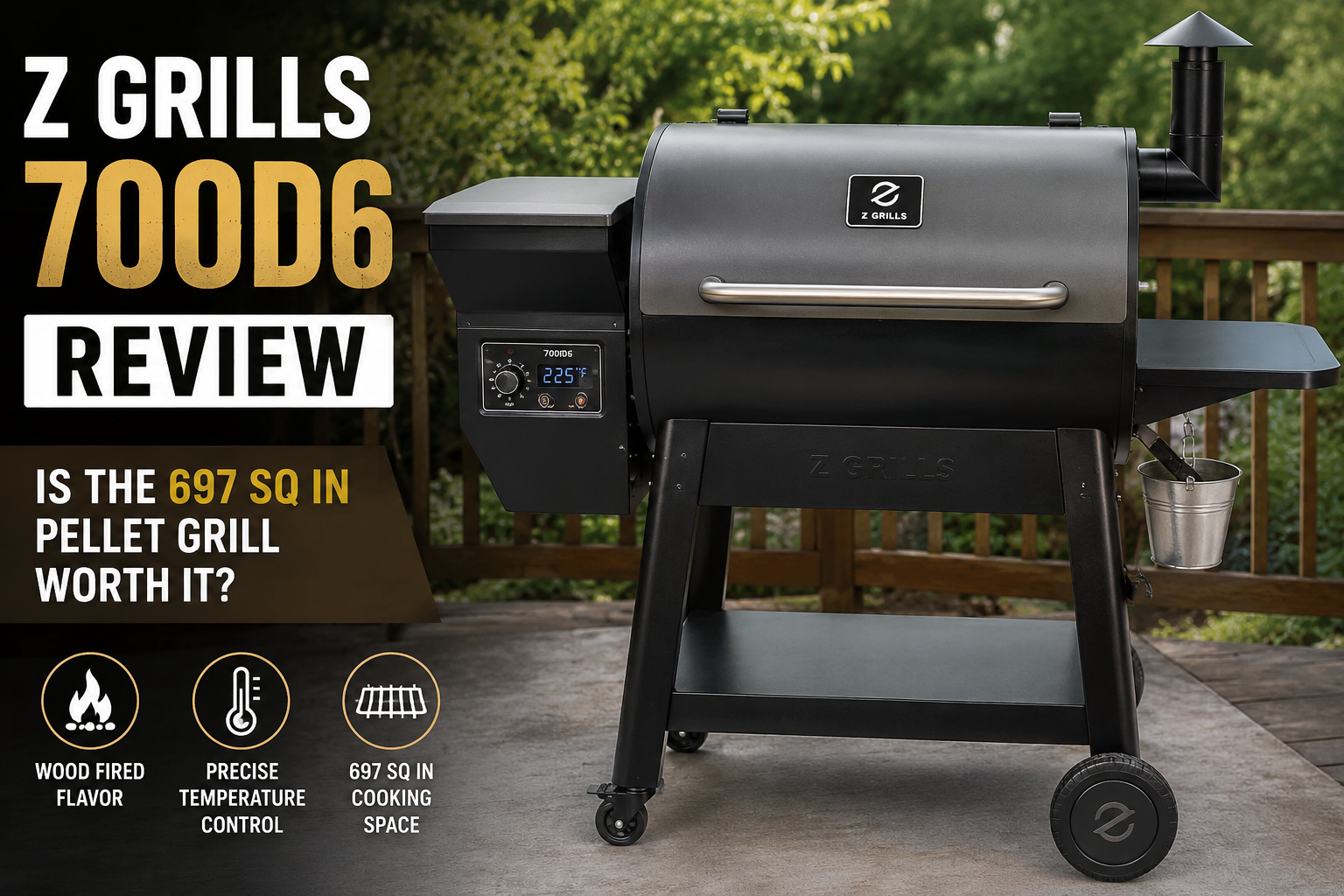
Z Grills 700D6 review: Worth Buying?
Best for: Backyard grill buyers
Z Grills 700D6 review: Worth Buying? is worth comparing on cooking space, temperature range, cleanup, owner feedback, and current price before you buy.
Check Price on AmazonAs an Amazon Associate I earn from qualifying purchases.
Updated: July 30, 2026
Affiliate disclosure: This article may contain affiliate links. If you buy through one of those links, Everything Grill Reviews may earn a commission at no extra cost to you. That does not change what we recommend. How this review was prepared: I have cooked with charcoal, wood, gas, and pellet equipment for more than fifty years, but I did not run a controlled hands-on test of this exact 700D6 review unit. This assessment is based on the current Z Grills product listing, the official 700D3/700D6 owner’s manual, the grill’s documented design, and practical cooking experience. My son owns a Z Grills pellet grill that has continued to serve him well, but that family experience is not a substitute for model-specific test data.
Is the Z Grills 700D6 worth it?
Yes, for a smoker-first buyer who wants useful capacity, simple controls, and sheltered storage in one pellet grill. The 700D6 is designed to make ribs, pork shoulder, chicken, brisket, and other indirect cooks easier than they would be on a manually managed charcoal or wood fire. Fill the hopper, set the temperature, insert a probe, and let the controller manage pellet delivery and airflow. That convenience does not make it an all-purpose outdoor cooker. The published 450°F maximum is enough for roasting, baking, crisping chicken skin, and cooking burgers, but it is not the kind of direct, concentrated heat many cooks want for a steakhouse crust. The official materials do not advertise direct-flame access or Wi-Fi control. If those two features are high on your list, keep shopping. The value question also depends on the seller’s current price and the exact version in the box. Pellet-grill prices and bundles move too often to build an honest recommendation around one temporary sale. Compare the delivered price, return policy, and controller description on the day you buy.
What are the verified Z Grills 700D6 specifications?
The official specification table describes a 697-square-inch pellet grill with a 28-pound hopper, two cooking tiers, and a 160–450°F set-temperature range. Here are the details that matter most to a buyer:
| Specification | Official listing | Why it matters |
|---|---|---|
| Total cooking area | 697 sq. in. | Useful family and small-gathering capacity across two racks |
| Main cooking rack | 504 sq. in. | The most useful number when checking whether pans or large cuts will fit |
| Upper rack | 193 sq. in. | Adds room for smaller food, warming, or overflow |
| Set-temperature range | 160–450°F | Covers smoking through roasting, but not extreme high-heat searing |
| Hopper | 28 lb. in the specification table | Large enough on paper for long sessions, although pellet use varies |
| Dimensions | 48 × 22 × 51 in. | Check the complete footprint before ordering |
| Lid clearance | 9 in. | Worth checking for tall food and cookware |
| Weight | 132 lb. | Two-person handling is the sensible approach |
| Meat probes | Two included | Lets you follow two foods or two areas of a large cut |
| Warranty | 3 years | Read the current terms and exclusions before buying |
One caution: Z Grills’ current page is internally inconsistent. The specification table lists a 28-pound hopper, while a repeated feature block mentions 20 pounds. The page also uses both “PID V2.1” and “Gen 3.0 PID” language for the controller. Those conflicts come from the manufacturer page—not from independent testing. If hopper size or controller generation affects your decision, ask the seller to confirm the exact unit before you order.
How should the 700D6 cook?
Expect the 700D6 to work best as an indirect smoker and outdoor convection cooker. Pellets feed into a firepot, and a fan circulates heated, smoky air around the food. A heat baffle and grease drain pan sit between the fire and cooking grate. That layout is well suited to steady low-and-slow cooking because you do not have to manage a charcoal bed or split-wood fire throughout the cook.
Is it a good fit for ribs, pork shoulder, and brisket?
Yes. Those foods match the strengths of a pellet grill: long indirect cooks, repeatable set temperatures, and easy probe monitoring. The two-tier rack gives you flexibility, but the 504-square-inch main grate is the number to use when planning around a large brisket, roasting pan, or multiple rib racks. Total-area numbers can look generous while part of that space sits on a shallower upper shelf. The controller can reduce the work of maintaining the fire, but it cannot remove all variation. The official manual says wind, outdoor temperature, humidity, pellet quality, and other conditions can affect performance. I did not measure the 700D6’s temperature swing, warm-up time, smoke output, or pellet consumption, so I will not give you made-up precision numbers.
Can the Z Grills 700D6 sear steaks?
It can cook a steak, but it is not built around intense direct-flame searing. The 450°F maximum can brown food, especially with a thoroughly preheated grate or a cast-iron surface, but that is different from placing meat close to open flame or an extremely hot gas burner. Buyers who expect one cooker to deliver both low-and-slow smoke and aggressive steakhouse searing should treat this as the 700D6’s biggest limitation.
Does the dual-wall chamber help?
The dual-wall cooking chamber is a sensible feature because an extra wall can reduce direct heat loss compared with a similar single-wall body. That should be helpful in cooler or breezy conditions. However, it does not turn the grill into a fully insulated commercial cabinet, and the manufacturer does not publish a guaranteed fuel-savings percentage. A windbreak that preserves safe clearances, dry pellets, and keeping the lid closed still matter.
How much food and fuel will it hold?
The 697-square-inch total should suit normal family cooking and modest gatherings, while the listed 28-pound hopper reduces the need to refill during many long cooks. Z Grills markets the cooking area with food-count examples, but shapes and spacing vary. Measuring the food and cookware you actually use is more reliable than treating a burger count as a guarantee. Z Grills also promotes up to 28 hours of non-stop cooking. Read that as a manufacturer estimate, not a promise. Pellet consumption changes with the set temperature, weather, lid openings, pellet condition, and the grill’s workload. A nearly full hopper on a mild day at smoking temperature will behave differently from the same hopper during a cold-weather roast. The pellet cleanout door is genuinely useful for changing wood flavors or emptying pellets before storage. The manual instructs the owner to place a bucket beneath the rear cleanout door, release the fastener, and let the pellets drain. It also warns that pellets must be kept dry because moisture can make them swell and cause feed problems.
What should buyers know about the controller and probes?
The important confirmed features are automatic pellet-and-air management, a display, and two probe connections; the exact controller-generation label is not clear. The current product page calls it PID V2.1 in one place and Gen 3.0 PID in another. That makes it unreasonable to promise a particular controller revision without checking the box or seller listing. The included probes are convenient, but they should still be checked against a thermometer you trust. A built-in probe helps you follow a cook without opening the lid repeatedly; it does not replace judgment about food placement, carryover cooking, or food-safe doneness. Insert probes into the thickest appropriate part of the food and keep the cable away from pinch points and direct contact with hot metal. This is also a straightforward choice for someone who does not want an app. There is no advertised Wi-Fi feature on the product materials reviewed for this article. Some owners see that as a missing convenience; others would rather use a dial and a separate wireless thermometer they can replace independently.
What are assembly, cleanup, and everyday ownership like?
Plan on two people for assembly, regular ash removal, and routine grease management. Z Grills estimates about 45 minutes for assembly, while the manual recommends two people. Actual time depends on experience and whether every part arrives organized and undamaged. At 132 pounds, getting help is the safer decision.
Useful everyday features
- Enclosed lower cabinet: It keeps tools and supplies out of sight, although it is not a weatherproof pantry.
- Four casters, including two locking casters: Helpful on a firm, level surface when you need to reposition the grill.
- Manual pellet-feed control: Useful during startup or feed-system procedures when used exactly as the manual directs.
- Automatic startup and shutdown: Reduces routine fire management, but you still need to follow the full shutdown cycle.
- Hopper cleanout: Makes it easier to remove pellets instead of leaving them exposed to humidity.
Maintenance that should not be skipped
The manual recommends lining the grease drain pan with heavy-duty foil and changing it frequently. It also warns that grease buildup can lead to a grease fire. Keep the drain path and bucket clean, brush the grates, wipe the temperature sensor carefully, and vacuum loose ash only after the grill is completely cool, switched off, and unplugged. A fitted cover is a sensible purchase, but a cover does not excuse putting a hot grill away or leaving damp pellets in the hopper. Store the cooker outdoors in a safe, ventilated location, keep pellets dry, and follow the manual’s clearance rules. The hopper lid is not a shelf; the manual warns that placing heavy items there can create a tipping hazard.
What are the real pros and cons?
Pros
- 697 square inches of documented two-tier cooking area
- 504-square-inch main grate is useful for large cuts and pans
- Dual-wall chamber is a practical cold- and windy-weather feature
- Two meat probes are included
- Pellet cleanout door simplifies flavor changes and storage
- Enclosed cabinet provides neater storage than an open cart
- Simple operation for buyers who do not want app dependence
Cons and tradeoffs
- 450°F maximum and indirect design are not ideal for hard searing
- No advertised Wi-Fi or app control
- Manufacturer copy conflicts over hopper size and controller version
- Total cooking area includes the smaller upper rack
- Large and heavy enough that assembly and movement deserve planning
- Like every pellet grill, it needs electricity, dry pellets, and periodic ash cleanup
Who should buy the Z Grills 700D6—and who should skip it?
Buy it if you want a roomy, straightforward pellet smoker and you accept that its best work happens at smoking and roasting temperatures.
The 700D6 makes sense for:
- A beginner who wants easier fire management than an offset smoker
- A family cooking ribs, pork shoulder, chicken, brisket, casseroles, or baked dishes
- A charcoal-grill owner who wants a second cooker for unattended stretches of a long cook
- Someone who values an enclosed cabinet, two probes, and a pellet cleanout door
- A buyer who prefers simple onboard controls over a phone app
Skip it if:
- High-heat, direct-flame steak searing is a primary job
- You require Wi-Fi monitoring and remote temperature changes
- You cannot provide a safe outdoor location near electrical power
- You do not want to protect pellets from moisture or vacuum ash periodically
- The seller cannot clearly identify the controller and hopper configuration you expect
Final verdict: a capable smoker-first pellet grill with limits you should understand
The Z Grills 700D6 earns a research-based rating of 4.0 out of 5. Its combination of 697 square inches, two probes, dual-wall construction, pellet cleanout, and cabinet storage covers the practical needs of many backyard smoking families. It is easier to understand when you stop asking it to be a substitute for every kind of grill. If ribs, pork, brisket, chicken, and hands-off indirect cooking are the goal, put the 700D6 on your shortlist and compare its current delivered price with similarly sized pellet smokers. If steak searing or remote app control is essential, choose a model designed around those priorities. Before paying, verify the controller revision and hopper description because Z Grills’ current page contains conflicting language. Check the manufacturer’s current 700D6 specifications and availability
Frequently asked questions
How much cooking space does the Z Grills 700D6 have?
Z Grills lists 697 square inches total: 504 square inches on the main rack and 193 square inches on the upper rack. Use the main-rack measurement when checking fit for a large cut or pan.
What temperature range does the 700D6 offer?
The official specification table lists 160–450°F. That range suits smoking, roasting, and baking. It is less convincing for cooks who want very high direct heat.
Does the Z Grills 700D6 have Wi-Fi?
No Wi-Fi or app-control feature is advertised in the official product materials reviewed for this article. The grill uses onboard controls and includes two wired meat probes.
How large is the 700D6 pellet hopper?
The current Z Grills specification table says 28 pounds, but another block of copy on the same product page says 20 pounds. Because the manufacturer page conflicts with itself, confirm the exact capacity with the seller if it matters to your purchase.
Which PID controller comes with the 700D6?
Z Grills’ page uses both PID V2.1 and Gen 3.0 PID wording. The honest answer is that the page does not make the revision clear. Ask the seller to verify the controller on the unit being shipped instead of relying on a copied product description.
Can you empty unused pellets from the hopper?
Yes. The 700D6 has a rear pellet cleanout door. The manual says to hold a bucket beneath the door, release its fastener, and drain the pellets. Store removed pellets in a dry, sealed container.
How long is the Z Grills 700D6 warranty?
The current official specifications list a three-year warranty. Warranty coverage has conditions and exclusions, so read the terms that accompany the unit and retain your purchase record.
Sources checked for this review
Z Grills 700D6 review: Worth Buying?
Best for: Backyard grill buyers
Z Grills 700D6 review: Worth Buying? is worth comparing on cooking space, temperature range, cleanup, owner feedback, and current price before you buy.
Check Price on Amazon