
Updated: August 16, 2026
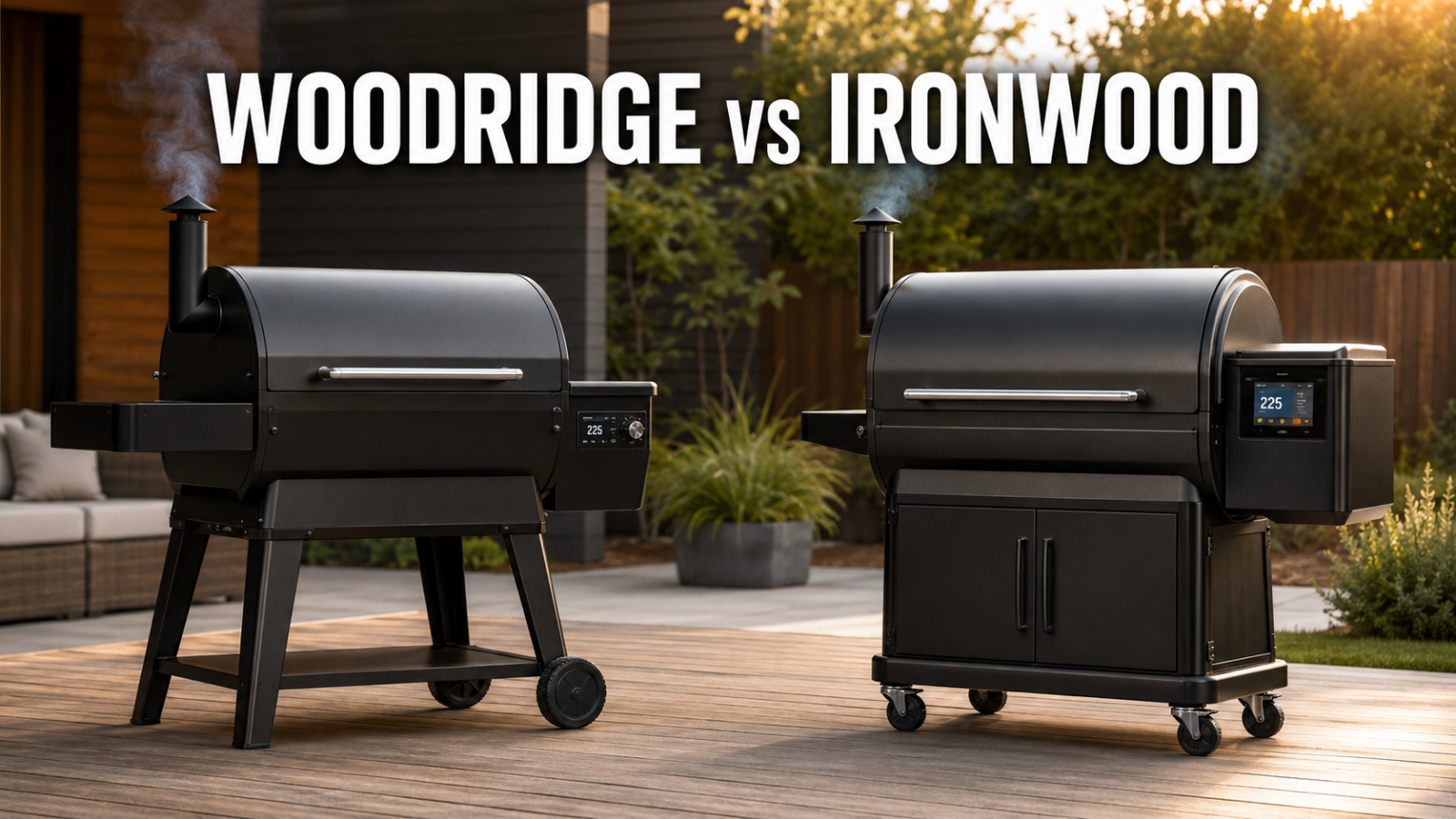
Quick Answer: In the Traeger Woodridge vs Pro vs Ironwood comparison, the Woodridge Pro offers the best balance of cooking space, Super Smoke, pellet monitoring, and convenience for most buyers. Choose Ironwood for dual-wall insulation and a touchscreen, or Woodridge Elite for insulation plus an electric side burner.
By Frank W. Roberts — Grilling since 1970 Traeger Woodridge vs Pro vs Ironwood sounds like a simple three-grill comparison, but the names hide several different models. The Woodridge family now has four trims, Ironwood comes in two sizes, and the older Pro line includes connected and non-connected grills. The right choice depends less on the badge and more on whether you value cooking capacity, added smoke control, cold-weather construction, storage, or searing help. How this guide was prepared: This is a research-based buying comparison using current manufacturer specifications, support documents, warranty terms, and practical design analysis. It does not claim side-by-side cooking tests on models that have not been personally used. Source note: Model details were checked against Traeger’s official Woodridge series information, Ironwood specifications, and warranty documentation on August 16, 2026. Prices and retailer stock can change.
In This Guide
What Is the Difference Between Traeger Woodridge, Pro, and Ironwood?
The short answer: Woodridge is Traeger’s current value-focused WiFIRE family, Ironwood adds premium controls and dual-wall construction, and the Pro 575/780 use an older D2-based design that remains available through some retailers. The Woodridge Pro is usually the strongest all-around choice, while the best upgrade depends on what you need.
- Woodridge: The current high-capacity family with WiFIRE, EZ-Clean grease-and-ash collection, accessory rails, and a 24-pound hopper.
- Woodridge Pro: Adds Super Smoke, a pellet sensor, Keep Warm mode, more cooking space, and a folding side shelf.
- Woodridge Pro Plus: Keeps the Pro’s core cooking features and adds enclosed storage.
- Woodridge Elite: Adds body and lid insulation plus a 1,100-watt infrared electric side burner.
- Ironwood: Uses fully insulated dual-wall construction, a touchscreen, two included wired probes, Super Smoke, and a 22-pound hopper.
- Pro 575 and Pro 780: Older WiFIRE models with the D2 controller, no standard Super Smoke, and conventional grease and ash cleanup.
Important naming note: “Pro” can mean the Woodridge Pro, Woodridge Pro Plus, or the older Traeger Pro Series. Check the complete model name before comparing features or prices.
How Do the Traeger Woodridge, Pro, and Ironwood Specifications Compare?
The Woodridge family offers the most cooking space for its tier, while Ironwood puts more of its cost into insulation, controls, and included probes. The Pro 575 and 780 still provide WiFIRE control, but their smaller hoppers and older cleanup system show their age beside the current designs.
| Model | Cooking Area | Hopper | Temperature Range | Super Smoke | Pellet Sensor | Standout Feature |
|---|---|---|---|---|---|---|
| Woodridge | 860 sq. in. | 24 lb. | 180–500°F | No | No | Lowest-cost current Woodridge |
| Woodridge Pro | 970 sq. in. | 24 lb. | 180–500°F | Yes | Yes | Best overall feature balance |
| Woodridge Pro Plus | 970 sq. in. | 24 lb. | 180–500°F | Yes | Yes | Enclosed storage cabinet |
| Woodridge Elite | 970 sq. in. | 24 lb. | 180–500°F | Yes | Yes | Insulation and electric side burner |
| Ironwood | 616 sq. in. | 22 lb. | 165–500°F | Yes | Yes | Dual-wall body and touchscreen |
| Ironwood XL | 924 sq. in. | 22 lb. | 165–500°F | Yes | Yes | Ironwood features with more capacity |
| Pro 575 | 572 sq. in. | 18 lb. | 165–500°F | No | Optional upgrade | Compact older-generation WiFIRE model |
| Pro 780 | 780 sq. in. | 19 lb. | 165–500°F | No | Optional upgrade | Larger older-generation WiFIRE model |
Manufacturer specifications can change by market or model revision. The Pro 575 name is commonly associated with 575 square inches, while Traeger’s current support guide lists 572 square inches of total grilling area. This table uses the current support figure.
Is the Traeger Woodridge Pro the Best Choice for Most Buyers?
Yes, the Woodridge Pro is the most sensible choice for many buyers because it adds the features that affect everyday use without forcing you into the highest trim. Its 970 square inches of cooking area exceed both the standard Ironwood and Ironwood XL, while Super Smoke and the pellet sensor address two common reasons buyers upgrade from an entry model.
Who should buy the Woodridge Base?
Buy the base Woodridge if you want current WiFIRE controls, a large hopper, generous capacity, and easier cleanup at the lowest Woodridge tier. It still includes a wired meat probe, compatibility with Traeger’s Bluetooth thermometer system, accessory rails, hopper cleanout, and the combined grease-and-ash keg. The compromise is straightforward: the base model does not include Super Smoke or an integrated pellet sensor. If you mainly cook at moderate grilling temperatures and check the hopper before every cook, those omissions may not matter. If smoke control is a major reason you are buying a pellet grill, the Pro is the safer long-term choice.
What does the Woodridge Pro add?
The Woodridge Pro adds Super Smoke, a digital pellet sensor, Keep Warm mode, a folding side shelf, and 110 additional square inches of cooking space. Those upgrades improve low-temperature smoking, fuel monitoring, prep space, and big-cook flexibility without changing the basic Woodridge controls. This is the point in the lineup where the important conveniences come together. You are not paying primarily for cosmetic trim, and you are not giving up capacity to obtain a premium screen.
Is the Woodridge Pro Plus worth buying?
The Pro Plus is worth considering only if enclosed storage is important on your patio. It carries over the Pro’s 970-square-inch capacity, Super Smoke, pellet sensor, 24-pound hopper, and folding shelf, then adds a cabinet for tools and nonflammable accessories. That cabinet makes the grill look tidier, but it does not add smoke capability, insulation, or a hotter main chamber. If you already have weather-protected outdoor storage, the regular Pro is usually the better value.
Who should step up to the Woodridge Elite?
Choose the Woodridge Elite when you specifically want insulation and a powered side cooking surface. Traeger lists grill-body insulation, an insulated lid, cabinet storage, Super Smoke, and a 1,100-watt infrared electric side burner among its distinguishing features. The burner is useful for searing in a pan, sautéing vegetables, warming sauce, or simmering while the pellet chamber handles the main cook. Traeger’s support documentation says the burner can bring a pan to about 500°F in approximately five minutes. It is not a 20,000-BTU gas burner, and the main pellet chamber still tops out at 500°F.
Is the Traeger Ironwood Worth the Extra Money?
The Ironwood is worth the added cost for buyers who prioritize fully insulated dual-wall construction, a touchscreen, two included wired probes, and a more premium control experience. It is harder to justify if maximum cooking area per dollar is the main goal.
Where does Ironwood beat Woodridge?
Ironwood’s clearest advantages are its dual-wall body, touchscreen interface, and two-probe package. The insulated construction is valuable in cold or windy conditions because it reduces heat loss and helps the controller manage temperature without fighting the weather as aggressively. The touchscreen also exposes settings and status information more directly than the Woodridge dial-and-button layout. That is a genuine convenience, although it does not automatically make the food taste better.
Where does Woodridge beat Ironwood?
Woodridge wins on usable capacity and usually on value. The 860-square-inch base Woodridge is larger than the 616-square-inch standard Ironwood. The 970-square-inch Woodridge Pro, Pro Plus, and Elite are also slightly larger than the 924-square-inch Ironwood XL. If you cook for groups or want room for several racks of ribs, the capacity difference matters. If you cook for two to four people and regularly face cold weather, the standard Ironwood’s smaller footprint and insulation may be the smarter trade.
Should You Buy a Traeger Pro 575 or Pro 780 in 2026?
A Pro 575 or Pro 780 can still be a reasonable buy when the retailer price is meaningfully below a comparable Woodridge and the warranty terms are clear. Do not buy one solely because a salesperson calls it a current Pro model. Traeger still maintains a Pro 575 product page that directs buyers to local retailers, and its January 2026 Pro 780 support guide lists several U.S. and Canadian model variations as active. That evidence does not support claiming that every Pro 575 and Pro 780 was universally discontinued in January 2025.
What is still good about the Pro 575 and 780?
Both models provide WiFIRE remote monitoring, a 500°F maximum setting, a wired probe, TurboTemp recovery, and a familiar D2 controller. Parts and support documentation remain available, and many owners already understand the design.
- The Pro 575 is easier to fit on a smaller patio.
- The Pro 780 provides substantially more grate space.
- Both can accept Traeger’s compatible add-on pellet sensor.
- Both use the same Traeger app for basic remote temperature monitoring and adjustment.
What do you give up compared with Woodridge?
You give up the Woodridge’s larger hopper, EZ-Clean grease-and-ash keg, current accessory system, and standard Super Smoke option. The Pro 575 and 780 use a separate grease bucket and require conventional firepot vacuuming. Their pellet sensor is an optional accessory rather than standard equipment. A discounted Pro can make sense as a straightforward WiFi pellet grill. At a price close to a Woodridge, the current Woodridge design is the more complete purchase.
What about the Traeger Pro 34?
The Pro 34 remains an active model in at least some U.S. configurations, but it belongs to an older non-WiFIRE branch of the Pro family. It offers a large 884-square-inch cooking area and a 450°F maximum temperature, but it does not provide app control. Buyers wanting remote monitoring should compare the Pro 575, Woodridge, or newer connected models instead. For a closer look at the older connected models, read our Traeger Pro 575 review and Traeger Pro 780 review.
Which Traeger Is Best for Smoke Flavor and Searing?
For added smoke control, start with any model that includes Super Smoke; for a separate high-heat cooking surface, choose the Woodridge Elite. No honest specification sheet can prove that one grill will always produce the best-tasting food because pellets, temperature, food placement, weather, and technique all influence the result.
Which models have Super Smoke?
Woodridge Pro, Woodridge Pro Plus, Woodridge Elite, Ironwood, and Ironwood XL include Super Smoke. Traeger allows the mode at low smoking temperatures; its support guidance lists 185–225°F for Woodridge models and 165–225°F for touchscreen and D2 grills that support the feature. The base Woodridge and Pro 575/780 do not include Super Smoke. They still produce wood-fired flavor, but they do not provide the same selectable smoke mode.
Can these pellet grills sear a steak?
They can brown and finish steaks at their 500°F maximum, but none of these pellet chambers behaves like an exposed-flame charcoal grill or a powerful gas sear burner. A preheated cast-iron pan or compatible griddle improves crust formation by concentrating heat at the food’s surface. The Woodridge Elite is the exception only in the sense that it adds a separate infrared electric side burner. That burner accepts ordinary electric-stovetop cookware and is useful for pan searing. It does not raise the pellet chamber above 500°F.
How Do WiFIRE, Controllers, and Meat Probes Compare?
Woodridge, Ironwood, Pro 575, and Pro 780 all connect to the Traeger app, but they do not use the same controller hardware. The older Pro 575 and 780 use D2 WiFIRE controllers, current Woodridge models use their own digital controller platform, and current Ironwood models use a full-color touchscreen system.
- Woodridge family: Digital dial-and-button controls, one wired probe, and compatibility with Traeger’s Bluetooth wireless thermometer system.
- Ironwood family: Touchscreen controls, two included wired probes, integrated pellet monitoring, and wireless thermometer compatibility.
- Pro 575/780: D2 dial controls, one included wired probe, WiFIRE app support, and an optional add-on pellet sensor.
- Pro 34: No WiFIRE or app control.
WiFIRE is useful for checking grill and probe temperatures, changing the set point, receiving alerts, and following compatible recipes. It cannot replace safe startup checks, pellet inspection, grease management, or being close enough to respond if something goes wrong.
Which Traeger Is Easiest to Clean?
Woodridge and current Ironwood models are easier to clean because their EZ-Clean Grease & Ash Keg combines routine grease and ash collection in one accessible container. The Pro 575 and Pro 780 use the older grease-bucket and internal firepot-cleaning arrangement. The EZ-Clean system reduces routine mess, but it does not make any pellet grill maintenance-free. Check grease buildup regularly, brush or scrape the grates safely, inspect the drip system, and clean accumulated ash according to the owner’s manual. Cleaning frequency depends on cook length, food fat, pellet quality, and how often the grill is used.
What Warranty Comes With Each Traeger Series?
Current Woodridge models and current touchscreen Ironwood models fall under Traeger’s 10-year limited warranty schedule, while older Pro coverage depends on the model and manufacturing date. The number in the warranty name is not a promise that every component has identical full coverage for that entire period.
- Woodridge and touchscreen Ironwood: Traeger’s component-specific 10-year limited warranty schedule.
- Pro Gen 2 made after October 2021: Traeger’s component-specific 7-year limited warranty schedule.
- Grills manufactured before October 2021: Traeger’s older 3-year warranty may apply.
Before buying retailer stock or a clearance grill, record the exact model number, confirm that the seller is authorized, keep the dated receipt, and read the coverage table for that grill. Registration can make service easier, but the official terms and proof of purchase control the claim.
Which Traeger Should You Actually Buy?
The Woodridge Pro is the best overall recommendation, but the right answer changes when storage, winter performance, patio size, or a separate cooking surface matters more than raw value.
| Buyer | Best Choice | Why |
|---|---|---|
| Most backyard cooks | Woodridge Pro | Large capacity, Super Smoke, pellet sensor, useful shelf, and current cleanup system |
| Lowest current Woodridge tier | Woodridge | Keeps WiFIRE, a 24-pound hopper, 860 square inches, and EZ-Clean |
| Buyer wanting enclosed storage | Woodridge Pro Plus | Pro cooking features with a built-in cabinet |
| Cold-weather cook or touchscreen fan | Ironwood | Fully insulated dual-wall construction and premium controls |
| Large cooks plus Ironwood construction | Ironwood XL | Expands Ironwood capacity from 616 to 924 square inches |
| One-station smoking and pan searing | Woodridge Elite | Insulation plus the 1,100-watt infrared electric side burner |
| Clearance shopper | Pro 575 or Pro 780 | Worth considering only with a meaningful discount and confirmed warranty |
Bottom Line: Buy the Woodridge Pro if you want the safest all-around decision. Buy the standard Ironwood when insulation and premium controls matter more than maximum grate space. Buy the Woodridge Elite only when you will use its insulation and side burner. Treat the Pro 575 and 780 as discount opportunities, not automatic bargains.
Frequently Asked Questions
Did the Woodridge replace the Traeger Pro 575?
The Woodridge occupies the current value-focused WiFIRE position that many shoppers previously associated with the Pro 575, but Traeger still maintains a Pro 575 product page for local-retailer availability. It is safer to describe Woodridge as the newer alternative rather than claim every Pro 575 was discontinued on one date.
Is the Woodridge Pro better than the Ironwood?
The Woodridge Pro is better for capacity and value, while the Ironwood is better for dual-wall insulation, touchscreen controls, and two included wired probes. Neither is universally better; climate and cooking volume should decide.
What is the difference between Woodridge Pro and Pro Plus?
The Pro Plus adds enclosed cabinet storage to the Woodridge Pro package. Both have 970 square inches of cooking space, Super Smoke, a pellet sensor, a 24-pound hopper, WiFIRE, Keep Warm mode, and a folding side shelf.
Which Traeger in this comparison produces the most smoke?
Choose a Woodridge Pro or higher, or either current Ironwood, if selectable Super Smoke is important. Specifications alone do not establish a guaranteed flavor winner because pellets, cooking temperature, airflow, food placement, and technique all affect smoke flavor.
Can the Woodridge Elite side burner sear a steak?
Yes, the 1,100-watt infrared electric side burner can heat a suitable pan for searing. Traeger says it can bring a pan to approximately 500°F in about five minutes. It is separate from the pellet chamber, which also has a 500°F maximum.
Do the Pro 575 and Pro 780 have Super Smoke?
No, the Pro 575 and Pro 780 do not include Super Smoke. They still burn hardwood pellets and provide WiFIRE control, but buyers wanting the selectable smoke mode should consider Woodridge Pro, Pro Plus, Elite, or a current Ironwood.
Does every Traeger in this comparison have WiFi?
Woodridge, Woodridge Pro, Pro Plus, Elite, Ironwood, Ironwood XL, Pro 575, and Pro 780 have WiFIRE connectivity. The older Pro 34 does not have WiFIRE or app control.
What warranty does the Woodridge have?
Woodridge models use Traeger’s 10-year limited warranty schedule. Coverage is component-specific, exclusions apply, and proof of purchase from Traeger or an authorized dealer is important. Read the current written warranty rather than relying only on a retailer’s summary.
Can these grills use non-Traeger pellets?
Use clean, dry, food-grade hardwood pellets made for pellet grills and follow the owner’s manual. Avoid heating pellets or fuel pellets intended for stoves because their composition and binders may not be food-safe.
Related Reading
Traeger Pro 575 Review
Traeger Pro 780 Review
Traeger vs. Green Mountain
More Grill Comparisons