
Updated: September 8, 2026
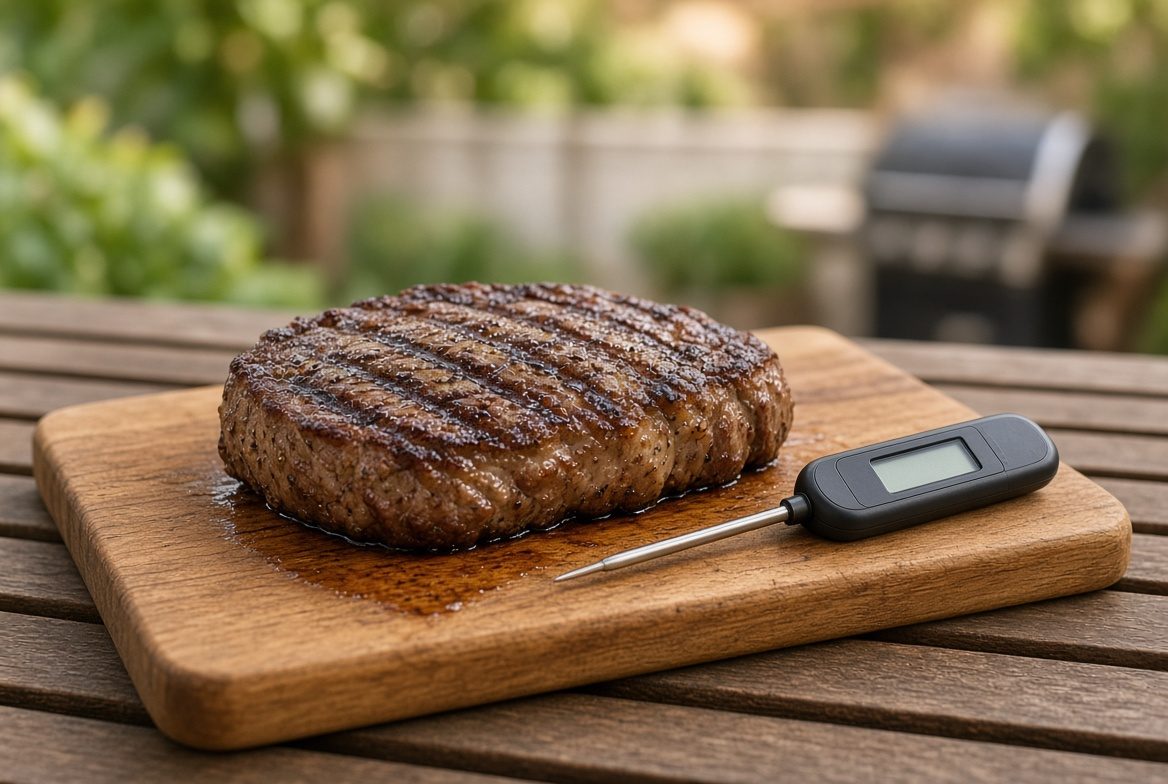
Updated and fact-checked: September 8, 2026 How to rest meat after grilling is a short hold off the fire so the center finishes safely and the temperature evens out. For whole beef, pork, lamb, and veal steaks, chops, and roasts, the USDA asks for at least three minutes after the food itself hits 145°F. A longer sit can help a thick roast or brisket slice cleaner. It is not a sponge trick that pulls lost juice back into a thin steak.
Quick Answer: How Long Should Meat Rest After Grilling?
Give whole steaks, chops, and roasts at least 3 minutes after they reach 145°F on the grill. That rest is part of the USDA safety instruction, measured before the food leaves the heat. A thick roast or smoked shoulder can sit longer so carryover heat finishes the center and slicing stays tidy. Thin steaks, smash burgers, and food you want crusty and hot now do not need a long foil tent.
Key Points
- USDA safety rest: whole beef, pork, lamb, and veal steaks, chops, and roasts need 145°F plus at least 3 minutes.
- Measure the food on the grill. Do not pull under the minimum and hope carryover heat will rescue it.
- Ground meat needs 160°F and poultry needs 165°F. The USDA chart does not attach a required rest to those two groups.
- Carryover heat is real. Thick cuts with a hot crust rise more than thin ones.
- Resting is mainly temperature control and cleaner slicing. Juice “redistribution” is oversold.
- A tight foil wrap steams the crust or bark. Use a loose tent only when you need to hold heat.
- Do not park leftovers in the 40–140°F danger zone for more than 2 hours, or 1 hour above 90°F.
What Does Resting Meat After Grilling Actually Do?
It lets the hottest outer layers share heat with the cooler center and gives you a short window before you slice. That is carryover cooking plus a pause for carving. The USDA also uses a 3-minute rest as part of the safety instruction for whole steaks, chops, and roasts cooked to 145°F. FoodSafety.gov describes that rest as time for the innermost parts of those meats to become fully and safely cooked. FSIS is equally plain on the measurement rule: cook to the minimum internal temperature with a thermometer before removing the food from the heat source. A rest is not a substitute for a missed number. What resting does not reliably do is pull a puddle of juice back into the muscle like a sponge. Older cooking tests showed less liquid on the board after a wait. Later comparisons that held final center temperature constant found little difference in how much juice left the meat. Professional testing and barbecue-science writing now treat rest mainly as temperature management, not a juiciness miracle. Last verified September 8, 2026.
Is the USDA 3-Minute Rest the Same as a Quality Rest?
No. One is a food-safety hold. The other is a cooking choice about doneness, crust, and slicing. Keep them separate so you do not undercook a chop or steam a good sear into leather.
| Kind of rest | What it is for | How long |
|---|---|---|
| Safety rest | USDA hold for whole beef, pork, lamb, and veal steaks, chops, and roasts after 145°F | At least 3 minutes |
| Carryover rest | Let a thick cut coast a few degrees toward the eating temperature you want | Often 5–15 minutes on a thick steak or small roast; longer on a large roast |
| Slicing rest | Let a brisket, pork shoulder, or prime rib firm up so slices hold together | Often 20–60 minutes if the meat stays hot |
| No useful rest | Thin steaks, smash burgers, hot dogs, and food served for crust and heat | Move it to the plate. Do not foil-tent it cold. |
The carryover and slicing times above are practical ranges, not USDA clock settings. Thickness, starting temperature, crust heat, wind, and whether you wrap the meat all change the result. Last verified September 8, 2026.
What Internal Temperature Should Meat Hit Before It Rests?
Hit the USDA minimum in the food before it leaves the grill, then rest only the cuts that the chart says need it. Preference temperatures for medium-rare steak sit below that whole-cut safety number. That is a personal choice, not a substitute for the chart if you are cooking to the USDA minimum.
| Food | USDA minimum internal temperature | USDA rest |
|---|---|---|
| Beef, pork, lamb, and veal steaks, chops, and roasts | 145°F | At least 3 minutes |
| Fresh or uncooked smoked ham | 145°F | At least 3 minutes |
| Ground beef, pork, lamb, and veal | 160°F | None on the USDA chart |
| All poultry, including ground poultry and stuffing | 165°F | None on the USDA chart |
| Fish and shellfish | 145°F | None on the USDA chart |
| Leftovers and casseroles | 165°F | None on the USDA chart |
Color, grill marks, and clear juices are not proof the meat is safe. FSIS says a food thermometer is the only reliable check. Insert it in the thickest edible part, away from bone, fat, and gristle. On a thin burger or chop, come in from the side. The site’s guide to using a meat thermometer on a grill or smoker covers probe placement. Last verified September 8, 2026, against the FSIS safe-temperature chart.
How Do You Rest Meat After Grilling Step by Step?
Confirm the internal temperature on the grill, move the meat to a warm plate or board, wait the right amount of time, then slice. Keep the rest short enough that the crust stays useful and the food stays out of the danger zone.
- Check temperature in the thickest part before the food leaves the heat. If it is under the USDA minimum for that food, put it back on the cool side of a two-zone fire rather than wrapping it and hoping.
- Lift the meat with tongs or a spatula onto a warm cutting board or platter. Do not drop a seared steak onto a wet, cold plate if you can avoid it.
- Leave it uncovered, or tent foil loosely if wind or a cold night is dumping heat too fast. Do not wrap it tight unless you are holding a large roast and accept a softer crust.
- Time the USDA 3-minute rest on whole steaks, chops, and roasts cooked to 145°F. Add more time only when the cut is thick enough to need it for carryover or slicing.
- Slice across the grain. Spoon any board juices over the meat or a side dish. Those juices are not wasted just because they left the steak.
- Get leftovers into the refrigerator within 2 hours, or within 1 hour if the air is above 90°F. Reheat leftovers to 165°F.
A two-zone setup gives you a landing spot if the center is still short. See how to set up two-zone grilling on charcoal or gas.
How Long Should Different Cuts Rest?
Match the rest to thickness and the job you need, not to a single kitchen-myth timer. A ½-inch skirt steak and a packer brisket are not the same problem.
| Cut | Practical rest after a safe cook | Why |
|---|---|---|
| Thin steak, skirt, flank, smash burger | Little or none beyond any required 3-minute safety hold on whole steaks | Almost no carryover. Crust fades fast. |
| 1 to 1½-inch steak or pork chop | 3 to 10 minutes | Covers the USDA 3-minute hold and a little equalization |
| Thick steak, 2 inches or more | 8 to 15 minutes | More mass, more leftover heat in the crust |
| Chicken pieces cooked to 165°F | 3 to 10 minutes if you want cleaner carving | No USDA rest required. Do not let it go lukewarm. |
| Small roast, pork loin, tri-tip | 10 to 20 minutes | Easier slicing and a more even center |
| Brisket, pork shoulder, large prime rib | 20 to 60 minutes while it stays hot | Slicing rest. Keep it out of the danger zone. |
These ranges are estimates based on how heat moves through thick versus thin meat. They are not laboratory measurements from a single test cook on this site. Last verified September 8, 2026.
How Much Does Carryover Cooking Raise the Temperature?
A thick cut with a hard, hot crust can climb several degrees after it leaves the fire. A thin cut barely moves. The rise is leftover heat traveling inward, not a timer you can set on every grill. What changes the climb:
- Thickness. A 2-inch roast has more hot exterior relative to a thin skirt steak.
- How hard you seared it. A screaming-hot finish stores more heat in the crust than a gentle indirect cook.
- How you rest it. A tight foil wrap and a towel hold heat and can push the center farther. An open board in a breeze dumps heat.
- Starting point. Pulling a thick steak 5–10°F under your eating target before a hard sear is a common way to leave room for the rise. That is a quality tactic. It does not replace hitting 145°F before the USDA rest if you are cooking to that safety minimum.
The reverse-sear method is built around this idea: cook thick steak gently first, then sear, then give it a short rest so the center does not blow past the target. Details are in how to reverse sear a steak on a grill.
Should You Tent Meat With Foil While It Rests?
Only if you need to slow heat loss. A tight wrap will steam the crust. Foil does not lock juices inside. It traps moisture against the bark or grill marks you just spent time building. Use a loose tent when:
- The night is cold or windy and the roast is cooling faster than you can slice.
- You are holding a large cut for guests and still keeping it hot.
Skip the foil when:
- You just seared a steak and want the crust to stay dry and crisp.
- The bark on a brisket or pork shoulder is the point of the cook.
- The piece is thin and will go cold under a wrap before anyone eats it.
If you wrap barbecue for a hold, you are trading crust for temperature stability. That can be the right trade for a packer brisket. It is the wrong trade for a 1-inch ribeye.
When Does Resting Meat After Grilling Not Help?
Skip a long rest when the cut is thin, the crust is the prize, or the USDA chart does not require a hold. Resting is a tool. It is not a moral rule.
- Smash burgers and thin patties. Ground beef is safe at 160°F with no USDA rest. A long sit turns a crisp edge soggy.
- Hot dogs, sausages already cooked through, and thin kebabs. Serve them hot.
- Skirt, flank, and other thin steaks if you already met any required 3-minute safety hold. They cool fast and do not carry much leftover heat.
- Food you overcooked on purpose. Extra time will not put moisture back into a dry chicken breast.
- A steak you pulled far below the temperature you wanted. Resting will not finish an underdone center the way returning it to indirect heat will.
If juice on the board bothers you more than a softening crust, rest a little longer. If you would rather eat a hot steak with a little board juice spooned over the top, serve it. Both are honest choices once safety is handled.
How Should You Rest Brisket, Pork Shoulder, or Ribs?
Hold big barbecue cuts so they stay hot enough to slice or pull, not so they sit out for hours at picnic temperature. Collagen-rich meat can be past the 145°F whole-cut safety minimum and still be tough. Tenderness is a separate finish, covered in the site’s guide to cooking tough, cheap cuts until tender. A practical backyard hold:
- Cook until a probe slides in with little resistance in the thickest part, not merely until a clock runs out.
- Move the meat to a clean cutting board or pan. Wrap it only if you need to keep heat in and you accept a softer bark.
- Rest 20–60 minutes for most backyard briskets and shoulders if the meat stays hot. That window is for slicing and evening out the temperature, not for inventing extra tenderness.
- Keep hot food at or above 140°F if the hold is going to last. FSIS calls 40–140°F the danger zone. Do not treat a closed cooler as a magic safe for meat that has already cooled into that range.
- Slice brisket across the grain. Pull pork when it separates cleanly. Refrigerate leftovers within the 2-hour rule.
Competition-style overnight cooler holds are a different project. They only stay in food-safety territory if the meat remains hot. If you cannot keep it at a safe hot holding temperature, slice sooner and chill the leftovers.
Does Chicken Need to Rest After Grilling?
The USDA chart does not require a rest for poultry. A short pause can still make carving neater. Cook chicken, turkey, and other poultry to 165°F in the thickest part. Then you may wait a few minutes so juices on the board are easier to manage and a whole bird slices cleaner. Do not use a long rest to finish undercooked poultry. If the breast or thigh is short of 165°F, it goes back over indirect heat. A foil coffin will not fix a raw joint, and it will soften the skin you browned on the grill.
What Are the Common Resting Mistakes?
The usual failures are pulling too early, wrapping too tight, and leaving food out too long.
- Trusting carryover to hit the safety number. FSIS says measure before the food leaves the heat.
- Using color as doneness. Cooked meat can stay pink. Undercooked meat can brown.
- Tight foil on a seared steak. You traded crust for a steamed surface.
- Resting a thin cut until it is lukewarm. The guest eats cold meat with a faded sear.
- Slicing with the grain after a perfect rest. The hold cannot fix a bad slice on flank, skirt, or brisket.
- Leaving the platter on a hot deck for the afternoon. The 2-hour rule still applies after a correct cook.
Frank’s Take
I rest thick meat because it slices better and finishes more evenly. I do not hide a thin steak under foil until it is tepid. After more than fifty years of backyard cooks and cookoff trays, the rest that matters is the one that matches the cut in front of you. On a 1-inch steak, I want the USDA 3 minutes when I am cooking to 145°F, then I slice. On a brisket, I want the meat to stop jiggling long enough that the knife does not shove it apart. On a smash burger, I want it on the bun while the edges are still crisp. Board juice is not a failure. Spoon it over the meat and eat it while it is hot.
Final Verdict: Should You Rest Meat After Grilling?
Yes for whole steaks, chops, and roasts that need the USDA 3-minute hold, and yes for thick barbecue you still have to slice. No for a long, tight wrap on thin, crust-first food. Rest is a short control step after a correct temperature reading, not a way to repair an undercooked or overcooked piece of meat.
Frequently Asked Questions
Can I rest meat until it reaches a safe temperature?
No. Take the reading before the food leaves the heat. The USDA minimums are measured on the grill or in the cooker. Carryover heat may raise a thick cut a few more degrees, but it is not a planned rescue for meat that is still under 145°F, 160°F, or 165°F.
Does resting meat make it juicier?
Not in the way most grill advice claims. A short rest can mean a little less liquid running onto the board while the temperature evens out. Tests that compared slices at the same final center temperature have found little extra juice staying in the meat. Overcooking dries meat. A thermometer prevents that better than a long rest.
How long can rested meat sit out before it is unsafe?
No more than 2 hours at room temperature, or 1 hour if the air is above 90°F. FSIS calls 40–140°F the danger zone. Keep hot food at 140°F or above if you are holding it for guests. Refrigerate leftovers in shallow containers and reheat them to 165°F.
Should ground beef burgers rest?
The USDA chart does not require a rest for ground meat cooked to 160°F. A minute on the bun is fine. A long foil rest on a smash burger mostly cools it and softens the crust. Check thin patties from the side with a thermometer so you are not guessing by color.
Why did my steak keep climbing after I pulled it?
Heat stored in the hot exterior kept moving toward the cooler center. That climb is larger on thick meat and after a hard sear. Pull a thick steak a little shy of your eating temperature if you want room for that rise, then confirm the final number before you serve it.
Do I need to rest ribs?
A brief pause makes them easier to cut. A long wrap can soften bark you wanted to keep. Ribs are done by tenderness and a safe cook, not by a fixed rest clock. If they are probe-tender and the pork has passed the whole-cut minimum, you can sauce, slice, and serve.
Related Reading
- How to Use a Meat Thermometer Correctly on a Grill or Smoker
- How to Reverse Sear a Steak on a Grill
- How to Set Up Two-Zone Grilling on Charcoal or Gas
- How to Cook Tough, Cheap Cuts of Meat Until Tender
- How to Keep a Charcoal Grill at 225°F
Authority sources used for safety temperatures and holding rules: the USDA FSIS safe minimum internal temperature chart and the FSIS Danger Zone (40°F–140°F) page. Last verified September 8, 2026.
About Frank W. Roberts
Frank W. Roberts is the author of Everything Grill Reviews. He has grilled since 1970 and brings more than 50 years of backyard cooking and cookoff experience to fire management, fuel behavior, smoke, and practical cooker use. This article is based on USDA and FoodSafety.gov rest and temperature rules, published cooking-science debate about juice retention, and long backyard practice with steaks, poultry, and large smoked cuts. It is not a product test and does not report laboratory measurements from a single controlled rest trial on this site. Last verified September 8, 2026.