
Updated: September 1, 2026
Updated and fact-checked: September 1, 2026 Keep a charcoal grill at 225 by lighting only a small corner of the fuel and letting that fire crawl through unlit charcoal. Air is the throttle. A full chimney dumped across the grate will run hot. A snake or Minion setup, a lid-on two-zone fire, and a thermometer at grate level will hold the 225–275°F window used for low-and-slow barbecue.
Quick Answer: How Do You Keep a Charcoal Grill at 225°F?
Build a two-zone fire, light only one end of the charcoal, leave the top vent mostly open, and pinch the bottom vent once the grate hits about 200°F. Use briquettes in a snake on a kettle. Use a Minion pile in a deep firebox. Read temperature at the grate, not only on the lid. USDA smoking pages list cooker air at 225–300°F or 250–300°F; cook the meat to a safe internal temperature either way.
Key Points
- 225°F is cooker air temperature next to the food, not the number on a lid thermometer bolted to the dome.
- Light a few coals and let them ignite the rest. Lighting the whole load is how the grill jumps to 400°F.
- The snake method fits a kettle. The Minion method fits a Weber Smokey Mountain, drum, or kamado firebox.
- Bottom vent feeds oxygen. Top vent exhausts smoke. Closing both vents kills the fire and can make dirty smoke.
- Briquettes burn more evenly in a snake than lump. Lump is fine for two-zone grilling, harder to meter at 225°F.
- Wind, wet fuel, and a clogged ash bowl swing temperature more than brand-name charcoal.
Is 225°F Safe for Smoking on a Charcoal Grill?
Yes, if the cooker air stays in the smoking range and the food reaches a USDA-safe internal temperature. USDA pages do not all print the same air-temperature window. A 2024 USDA food-safety briefing and one FSIS grilling page tell cooks to keep smoker or grill air between 225°F and 300°F. Another FSIS smoking section lists 250°F to 300°F. Use a grate-level thermometer, stay inside that band, and do not treat the lid dial as proof. That air number is not doneness. Poultry still needs 165°F inside. Ground meat needs 160°F. Steaks, chops, and roasts of beef, pork, lamb, or veal need 145°F plus a 3-minute rest. Color and smoke time are not proof the meat is safe. Do not start a long smoke with frozen meat. USDA notes that low heat takes too long to push frozen food through the temperature range where bacteria grow. Thaw first. Keep raw and cooked tools separate. Refrigerate leftovers within 2 hours, or within 1 hour if the air is above 90°F.
Why Does a Charcoal Grill Run Hotter Than 225°F?
Too much lit fuel and too much air raise the temperature. Ash and a closed exhaust drop it, then make the fire dirty. Charcoal needs oxygen. Open vents feed the fire. A pile of fully lit coals under the whole grate is a direct-heat grill, not a smoker. A lid thermometer reads the hot air at the top of the dome, which is often 25–75°F different from the grate. Chase the grate reading.
| What you see | Likely cause | First fix |
|---|---|---|
| Grill jumps past 300°F | Too many lit coals, vents wide open, lid off too long | Close the bottom vent partway. Do not dump water on the fire. |
| Temperature will not climb to 225°F | Wet charcoal, ash blocking the bottom vent, too few lit coals | Open vents, dump cold ash, add 8–12 fully lit briquettes to the lit end |
| Temp swings 50°F every time you open the lid | Heat and smoke escaping; fire then surges | Leave the lid on. Use a probe. Open only to baste or move food. |
| Thick white or acrid smoke | Smoldering fuel, wet wood, choked exhaust | Open the top vent. Wait for thin, clean smoke before adding food. |
| Fire dies after an hour | Bottom vent buried in ash, snake not touching, wet briquettes | Clear the ash path. Rebuild so each briquette touches the next. |
What Equipment Do You Need to Hold 225°F?
A lid, two working vents, a chimney starter, and a thermometer at grate level are the real tools. A 22-inch kettle is the usual backyard example. The same airflow rules apply to a kamado, drum, or Weber Smokey Mountain, but the fuel layout changes. A water pan is optional. It can blunt temperature spikes and add humidity. It is not magic. A cover over the grill during the cook is not a substitute for vent control.
- Charcoal chimney and a clean fire starter. Skip lighter fluid if you care about flavor.
- Briquettes for a snake. Lump charcoal for a kamado or a short two-zone cook.
- A leave-in probe at grate height on the cool side, plus an instant-read thermometer for the meat.
- Two or three dry wood chunks if you want smoke. Chips burn off too fast for a long hold.
- Heat-resistant gloves. You will move a hot grate and a water pan.
Should You Use the Snake Method or the Minion Method?
Use a snake on a shallow kettle grate. Use a Minion pile in a deep charcoal chamber. Both ideas come from the same place: Jim Minion popularized lighting a small amount of charcoal on top of a larger unlit load so the fire spreads slowly. The snake is that idea stretched into a C-shaped fuse around a kettle. Weber’s own kettle instruction from Head Grill Master Dustin Green covers both a mini Minion crater and a 2-by-2 or 3-by-2 snake.
| Setup | Best cooker | How the fire moves | Typical use |
|---|---|---|---|
| Snake (2 wide, 1 or 2 high) | 22- or 26-inch kettle | Fire crawls along the ring | Ribs, chicken, pork shoulder on a kettle |
| Minion pile | Weber Smokey Mountain, drum, kamado | Lit coals ignite the pile from the top down | Longer unattended burns in a deep firebox |
| Two-zone bank | Any charcoal grill | All coals on one side, food on the other | Shorter indirect cooks, not a 10-hour set-it-and-forget-it fire |
Community estimates for a half-ring snake on a 22-inch kettle often land around 6 to 8 hours at smoking temperature. A full ring on a larger kettle can run longer. Weather, briquette brand, and vent setting change that. Treat those hours as a planning range, not a guarantee.
How Do You Build a Charcoal Snake That Holds 225°F?
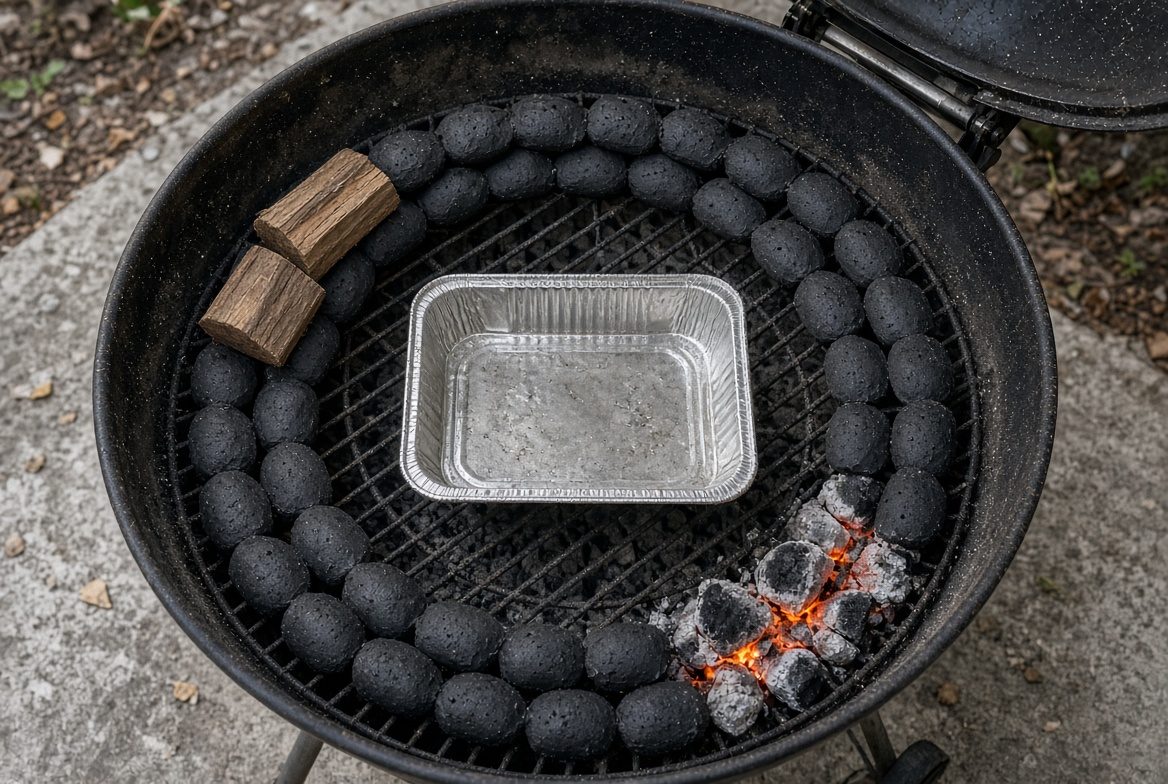
Lay unlit briquettes in a touching C around the rim, light one end, and put the food on the empty side. Uniform briquettes stack. Odd-shaped lump leaves gaps, and gaps make the fuse skip or surge.
- Clean the ash out of the bowl so the bottom vent can breathe.
- On the charcoal grate, build two rows of unlit briquettes around the inner wall, about halfway to two-thirds of the circle. Keep a clear gap on one side. That gap is your cool zone.
- Stack a second layer on top if you need more than a short rib cook. A common kettle layout is two briquettes wide and two high. A thinner 2-by-1 snake burns cooler and shorter.
- Make sure each briquette touches the next. A break in the line is a fire that dies at the gap.
- Set two or three dry wood chunks on the first half of the snake, not a heap of chips on the lit end.
- Optional: set a disposable pan of water in the open center. It occupies space, steadies the air a little, and catches drips.
- Light 8 to 12 briquettes in a chimney until they are ashed over. Dump them only on one end of the snake.
- Put the cooking grate on. Place a thermometer probe at grate level on the cool side, away from the lit end.
- Set the lid so the top vent sits over the cool side, opposite the fire. That draw pulls smoke across the food.
How Do You Set the Vents for 225°F?
Start with both vents open, then restrict intake once the grate climbs through 200°F. Do not pinch the exhaust shut. Meathead Goldwyn’s long-standing vent advice is to treat the bottom damper as the main heat control and leave the top mostly open unless you cannot hit temperature with the intake alone. Closing the exhaust chokes the burn and can turn the smoke dirty. Weber’s Dustin Green has said he makes small changes at the top damper first on a kettle. Both approaches work if you change one vent at a time and wait 10 to 15 minutes before touching anything else.
- Light the snake or Minion with both vents open so the fire can establish.
- When the grate probe reads about 200°F, close the bottom vent to roughly one-quarter open.
- Leave the top vent fully open or no more than a quarter closed.
- If the cooker is still climbing through 275°F, close the bottom vent a little more. If it stalls under 215°F, open the bottom vent a little.
- Never close both vents to “save charcoal.” The fire starves, smoke turns thick, and the next time you open the lid the coals can surge.
Wind on the bottom vent acts like a bellows. Turn the grill so the intake is not aimed into a gust, or shield that side. Cold air and a wet bowl pull heat. Expect a longer climb in winter and a faster climb on a hot, still day.
How Do You Run a Minion Fire at 225°F?
Fill the chamber with unlit briquettes, make a small well, and add a chimney of lit coals to that well. This is the classic Weber Smokey Mountain approach described on The Virtual Weber Bullet: unlit fuel in the ring, a modest lit charge on top, bottom vents started open, then pinched as the cooker reaches about 200°F, with the top vent left open. Put meat and wood on as the temperature rises. Cold meat in a rising cooker is easier to hold than a roaring empty cooker you then try to cool. On a kettle, a “mini Minion” is a pile of unlit briquettes on one side with a crater in the middle. Dump a partial chimney into the crater. It is less precise than a snake but faster to build. Expect a warmer cool zone than a well-built snake.
Can You Hold 225°F With Lump Charcoal?
Yes on a kamado or in a deep firebox. It is a poor first choice for a kettle snake. Lump pieces vary in size, so a snake has gaps and hot spots. In a ceramic cooker the thick walls hold heat, so a smaller Minion-style load of lump can sit at low temperature with the vents nearly closed. On a thin-metal kettle, briquettes give a more even fuse. If lump is all you have, bank it tightly on one side, light a small corner, and accept more vent babysitting.
How Do You Recover When the Temperature Spikes or Falls?
Change air first, fuel second. Wait before you change anything else.
- Too hot: Close the bottom vent partway. Keep the lid on. Do not spray the fire. A water pan already in place helps more than a panic splash.
- Too cool: Open the bottom vent. Confirm the ash is not blocking it. Add a few fully lit briquettes to the burning end. Unlit briquettes tossed on a dying fire make white smoke before they help.
- Fire reached a gap in the snake: Close the gap with fresh briquettes so the fuse can continue.
- Long cook running out of fuel: Add unlit briquettes to the unburned end of the snake, or add a small lit charge to a Minion pile. Do not dump a full chimney onto the cool-zone grate.
If fat is dripping onto the lit end and the cooker is jumping, move the meat farther from the fire and keep the lid closed. That is the same two-zone habit that limits flare-ups on hotter cooks.
What Mistakes Keep People From Holding 225°F?
Lighting too much charcoal is the first mistake. Trusting the lid thermometer is the second.
- Using lighter fluid, then wondering why the first hour smells like a gas can.
- Building a snake with gaps, or mixing tiny lump shards into the line.
- Putting wood chunks on the already-raging end so they flame instead of smolder.
- Closing the top vent to “trap smoke.” That traps bad combustion, not flavor.
- Opening the lid every 10 minutes to peek. The recovery spike is what you feel later as 300°F.
- Leaving last weekend’s ash in the bowl so the bottom vent is a slot of dust.
Final Verdict: Can a Basic Charcoal Grill Hold 225°F?
Yes. A kettle with a snake, or a deep charcoal cooker with a Minion pile, will hold smoking temperature if you light a small fire and meter the air. 225°F is a grate-level target inside a 225–300°F smoking window, not a promise from the lid dial. Briquettes and a two-zone layout do more work than gadgets. If the cooker still will not settle after you clean the ash, fix the vents, and light only one end of the fuel, the charcoal is wet or the thermometer is lying. Fix those before you buy another grill.
Frequently Asked Questions
How long will a charcoal snake stay at 225°F?
Plan on about 6 to 8 hours from a half-ring snake on a 22-inch kettle in mild weather. A taller snake or a larger kettle lasts longer. Wind, cold air, and a thin 2-by-1 layout shorten it. Check the remaining unburned briquettes at the four-hour mark instead of trusting a clock.
Should the top vent be open or closed at 225°F?
Keep the top vent mostly open. Use the bottom vent as the main heat control. Pinching the exhaust to force the temperature down usually makes thick smoke and an unstable fire.
Do I need a water pan to hold 225°F?
No, but a pan can take the edge off spikes and catch grease. The fire layout and vents do the real work. An empty space in the center of a snake is still a cool zone without water in it.
Is 225°F or 250°F better on a charcoal grill?
Both sit inside the common smoking window. USDA pages list either 225–300°F or 250–300°F for smoker air. 250°F is often easier to hold on a leaky kettle. Safety still depends on the meat’s internal temperature, not on hitting 225°F on the lid.
Can I add charcoal in the middle of the cook?
Yes. Add unlit briquettes to the unburned end of a snake, or a few lit coals to a dying Minion pile. Open the lid only long enough to refuel. A full chimney dumped under the meat will blow past 225°F.
Why is my lid thermometer at 225°F when the meat is cooking too fast?
The dome sensor is in hotter air than the grate. Put a probe at grate level on the cool side. Cook by that number and by the meat’s internal temperature.
Related Reading
- Thin Blue Smoke vs White Smoke for Barbecue Cooking
- Pellet Grill Smoke vs Charcoal Smoke: Which Tastes Better?
About Frank W. Roberts
Frank W. Roberts is the author of Everything Grill Reviews. He has grilled since 1970 and brings more than 50 years of backyard cooking and cookoff experience to fire management, fuel behavior, smoke, and practical cooker use. This article explains charcoal airflow and common fuel layouts. It is not a timed test of one kettle or one charcoal brand. Last verified September 1, 2026.