
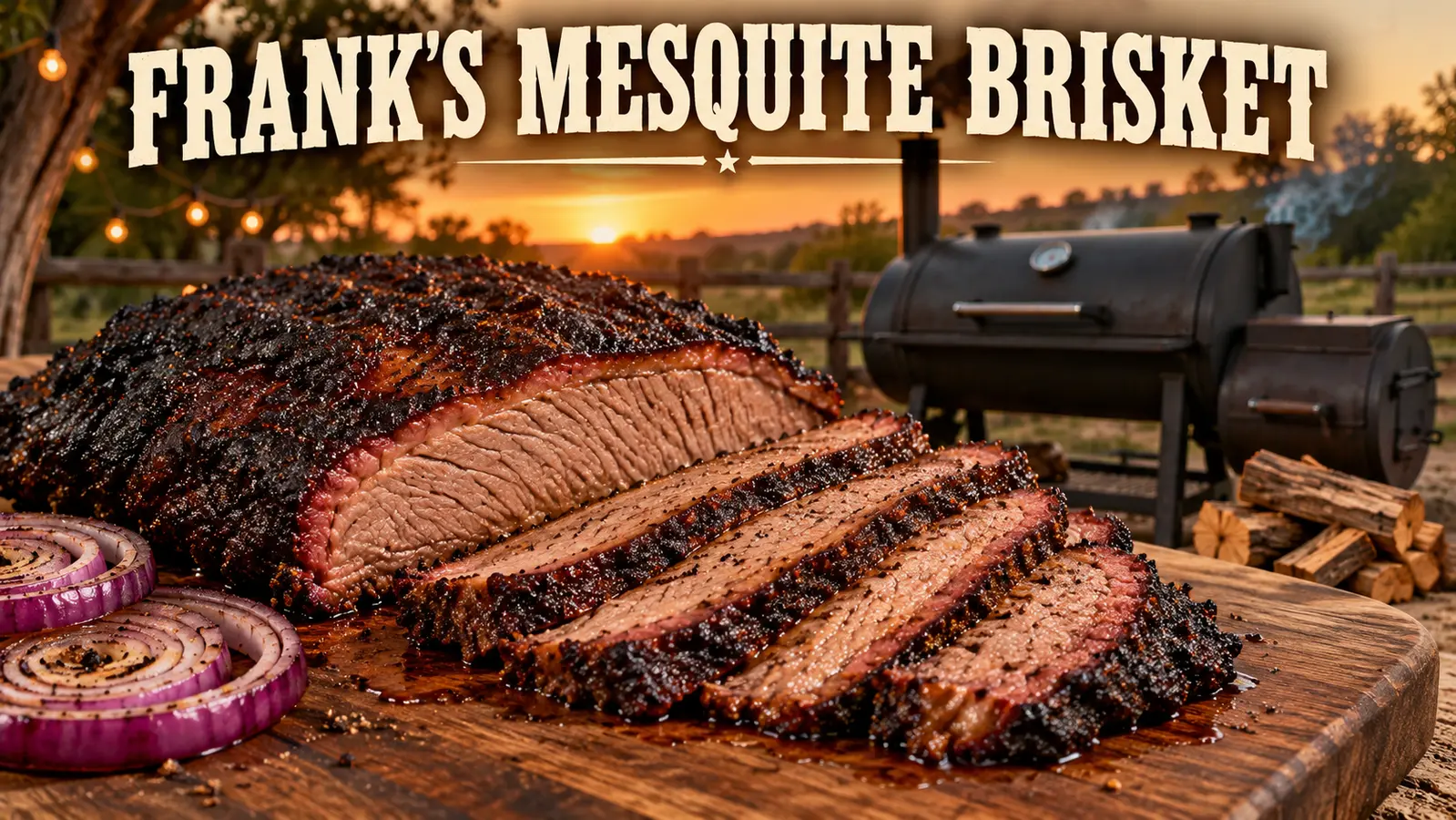
Last updated: September 8, 2026. Food-safety information verified the same day. I have been grilling since 1970, and this mesquite brisket recipe is the method I keep coming back to. It does not require the most expensive smoker or the most expensive brisket in the store. It requires steady heat, clean smoke, patience, and enough experience to know when the meat is truly tender. I learned the foundation of this method from my brother-in-law after he served me a brisket I thought was excellent. I adapted it to the old offset smoker I called the Black Dog, and every brisket I cooked with it came out well. My object here is simple: get you cooking with the equipment and ingredients you already have.
How Do You Make Frank’s Mesquite Brisket?
The 8-hour and 4-hour stages are good planning numbers, but brisket does not wear a watch. Its size, thickness, starting temperature, weather, fuel, and smoker airflow can all change the cooking time. If it is still tight when you probe it after 12 hours, keep cooking it until it becomes tender.
What Makes This Brisket Method Different?
This method builds flavor in layers: meat tenderizer, a thin mustard binder, beef rub, Worcestershire sauce, plenty of red onion, and mesquite smoke. I do not depend on salt and pepper alone. I tried brisket at a lot of places around Austin over three or four years, and the salt-and-pepper-only brisket was the one I enjoyed least. That style may suit somebody else, but I wanted more flavor. You do not need to chase a particular brisket brand, either. I buy the cheapest whole brisket I can find at the grocery store. Low, steady heat gives a tough cut time to soften, and the seasoning method gives it the flavor I want. A more expensive brisket may have heavier marbling, but price alone does not cook it for you. I prefer mesquite because its strong smoke stands up to the mustard, beef rub, Worcestershire sauce, and onion. My son once used this recipe with pecan in a barbecue contest. This is only my opinion, but I still believe they would have won if he had used mesquite. You can use another smoking wood; just expect a different flavor.
What Are the Key Points and Cooking Times?
Allow at least 24 hours for refrigerated seasoning, about 12 hours for cooking, and 2 hours for resting. That makes this roughly a 38-hour project from the first preparation to slicing, although only part of that time is hands-on.
| Stage | Temperature | Planning Time | What Matters Most |
|---|---|---|---|
| Tenderize | 40°F or colder | 24 hours | Keep refrigerated and follow the tenderizer label. |
| Smoke unwrapped | 225°F | 8 hours | Maintain steady heat and clean smoke. |
| Cook wrapped | 225°F | About 4 hours | Begin checking tenderness near 195°F. |
| Rest covered | Keep above 140°F | 2 hours | Use an empty insulated cooler with no ice. |
What Ingredients Do You Need?
The exact amount of seasoning depends on the size and shape of your brisket. The goal is light, even coverage rather than a heavy crust of salt and seasoning.
- 1 whole beef brisket
- Meat tenderizer, enough for a light coat and used according to its label
- Prepared mustard, enough for a thin coat over the entire brisket
- H-E-B store-brand Beef Rub, or any beef rub you already like
- Worcestershire sauce, enough for a light sprinkle on both sides
- 1 large red onion, or more if you like plenty of onion
- Salt and black pepper, optional and used lightly
- Seasoned mesquite wood, or another smoking wood of your choice
- A small amount of charcoal, only if needed to start the wood fire
Check the sodium in your tenderizer and beef rub before adding extra salt. Both products may already contain plenty, so taste is usually better when the optional salt stays light.
What Equipment Do You Need?
You need a smoker that can cook indirectly at a stable 225°F, plus a shallow metal pan and reliable thermometers. An offset smoker is the setup I used, but the method can work in another type of smoker if you can control the heat and produce clean smoke.
- Offset smoker or another smoker capable of indirect cooking
- Shallow metal pan large enough to hold the brisket
- Grate-level thermometer for the smoker temperature
- Instant-read thermometer or leave-in meat probe
- Heavy-duty aluminum foil or unwaxed food-grade butcher paper
- Heat-resistant gloves and sturdy tongs
- Insulated ice chest or cooler, completely empty and with no ice
How Do You Prepare the Brisket the Day Before?
Trim the hard and excessive surface fat, leaving about a 1/2-inch layer over the brisket. That is enough fat to protect the meat during the long cook without leaving an unnecessarily thick layer on the finished slices.
- Trim the brisket. Remove loose pieces and very hard fat, then even the fat cap to roughly 1/2 inch.
- Add the tenderizer. Coat the brisket lightly and evenly, following the amount and handling directions on the product label.
- Refrigerate it. Put the brisket in a covered food-safe container and refrigerate it for about 24 hours. I have let it sit longer, but follow your tenderizer’s label because some formulas can make the outside too soft if left too long.
Keep the brisket at 40°F or colder during this step. Do not leave raw meat on the counter overnight.
How Do You Season the Brisket Before Smoking?
Use thin layers. The mustard is there mainly to help the rub stay on the meat, while the beef rub, Worcestershire sauce, onion, and smoke build the flavor.
- Take the refrigerated brisket out while you prepare and preheat the smoker. Do not leave it at room temperature longer than necessary.
- Spread a thin coat of mustard over every side of the brisket.
- Apply a thin, even layer of H-E-B Beef Rub to both sides. Any beef rub will work if that is what you have.
- Place the seasoned brisket in a shallow metal pan.
- Sprinkle Worcestershire sauce lightly over both sides, turning the brisket carefully as needed.
- Cut a large red onion crosswise several times to make thick slices or rounds. Arrange them over the top of the brisket. In my opinion, more onion is better.
- Add a small amount of salt and pepper only if the tenderizer and rub have not already supplied enough.
How Do You Hold an Offset Smoker at 225°F?
Build a small, clean-burning fire and make gradual changes to the intake vent or fuel load until the cooking chamber settles near 225°F. Measure the temperature at grate level near the brisket instead of trusting a lid thermometer without checking it. The Black Dog was designed for charcoal, but I never cared for cooking with charcoal. I used only enough charcoal to get the wood burning, then cooked with wood. Small pieces of seasoned mesquite added as needed were easier to manage than a firebox packed with too much fuel at once. Keep enough airflow for the wood to burn cleanly. Thick white smoke can make the brisket bitter, especially with strong mesquite. Avoid closing the exhaust just to trap more smoke; control the heat with the size of the fire and careful intake adjustments. Once the smoker is stable, give each small adjustment time to work before changing something again. The USDA recommends keeping a smoker between 225°F and 300°F and using thermometers to monitor both the cooking chamber and the meat. My target for this recipe is the low end of that range: 225°F.
How Do You Smoke the Brisket?
Smoke the prepared brisket in its shallow pan for 8 hours at 225°F, then wrap it tightly and continue cooking for about 4 hours. Keep checking the smoker during both stages so a fuel or airflow problem does not turn into a long temperature swing.
- Preheat the smoker to 225°F. Wait until the fire is stable and the heavy startup smoke has cleared.
- Place the pan in the cooking chamber. Keep the brisket over indirect heat, with the red onion still covering the top.
- Smoke uncovered for 8 hours. Maintain a low, steady 225°F and a clean stream of smoke. Add mesquite in modest amounts as the fire needs it.
- Wrap the brisket. After 8 hours, wrap it securely in heavy-duty aluminum foil or heavy food-grade butcher paper. Take care around the hot pan and juices.
- Return it to the smoker. Continue cooking at 225°F for about 4 more hours.
- Start checking near 195°F. Test the thickest parts of both the flat and point. Keep cooking if the probe still meets firm resistance.
- Remove it when tender. Temperature guides you to the checking range, but the easy feel of the probe tells you when the brisket is ready.
Is Brisket Done at 195°F?
Use 195°F as the point to begin checking, not as an automatic finish line. Many briskets become tender somewhere around 195°F to 205°F, but the correct finishing point is when a thermometer probe or skewer slides into the thickest parts with very little resistance. Check more than one spot because the flat and point do not always soften at exactly the same time. Avoid judging doneness by appearance, elapsed time, or a single temperature reading. If the meat is still tight at 195°F, rewrap it and continue cooking, checking again periodically. Food safety and barbecue tenderness are two different questions. The safe minimum for whole cuts of beef is 145°F followed by a 3-minute rest, but brisket cooked only to that minimum will usually remain tough. The higher finishing range in this recipe is for breaking down the connective tissue and producing tender slices.
How Do You Rest and Slice the Brisket?
Keep the finished brisket wrapped, cover it well, and rest it for 2 hours in an empty insulated ice chest with no ice. Close the lid and leave it alone so the meat can settle before slicing. Use a thermometer during the hold and keep the brisket above 140°F. FoodSafety.gov advises holding hot food at 140°F or warmer. If the temperature falls below that level, end the hold and serve or refrigerate it promptly. Do not leave it below 140°F for more than 2 hours. After the rest, unwrap the brisket carefully and save any hot juices you want to serve with it. Slice across the grain. Because the grain changes direction between the flat and point, rotate the brisket or separate the muscles when necessary so every slice stays across the grain. Then eat it while it is warm.
What Common Brisket Mistakes Should You Avoid?
The most common problems come from too much seasoning, dirty smoke, unstable heat, or treating the clock as the final judge. Each one has a practical fix.
| Problem | Likely Cause | What to Do |
|---|---|---|
| Brisket tastes too salty | Tenderizer and rub already contained salt | Use thin coats and add little or no extra salt. |
| Bitter or harsh flavor | Heavy, dirty smoke or too much mesquite at once | Build a smaller fire, use seasoned wood, and maintain airflow. |
| Large temperature swings | Large fuel additions or constant vent changes | Add fuel in small amounts and make one gradual airflow change at a time. |
| Brisket is tough after 12 hours | The connective tissue has not softened yet | Keep it wrapped and cooking until it probes tender. |
| Slices seem dry or stringy | Too much fat was trimmed, the rest was skipped, or the meat was cut with the grain | Leave about 1/2 inch of fat, rest for 2 hours, and slice against the grain. |
| Unsafe preparation or holding | Raw meat was left warm, or the rested brisket fell below 140°F | Tenderize in the refrigerator and monitor the cooler hold with a thermometer. |
Why Does Experience Matter More Than Smoker Price?
My wife bought me the old Black Dog in the early 2000s, as I remember it, because I wanted a smoker with a separate firebox. My son later had an expensive smoker, while I still had the Black Dog. During one cook, his smoker temperature wandered all over the place. My grill held 225°F through the full 12-hour cook. The difference was not the price tag. I knew how much fuel the Black Dog needed and exactly how to set its air so the fire stayed stable. That is what a little experience will do. Learn how your own cooker reacts when you add fuel, open the intake, close it slightly, or lift the lid. A simple smoker you understand can give you better results than an expensive smoker you have not learned yet.
What Else Should You Know About This Mesquite Brisket?
Can I Use Any Beef Rub?
Yes. I use H-E-B store-brand Beef Rub, but the object is to get you cooking, not make you hunt for one product. Use another beef rub you like, apply it in a thin coat, and check its salt level before adding extra salt.
Do I Have to Use Mesquite Wood?
No. You can use pecan, oak, hickory, or another wood you enjoy. Mesquite is my choice because its bold flavor fits this seasoning method. If mesquite tastes strong to you, use less of it or blend it with a milder wood.
Is the 12-Hour Cook Time Exact?
No. Eight hours unwrapped and about 4 hours wrapped is my normal schedule at 225°F, but a large or thick brisket may need longer. Cook until the meat probes tender, even when that means going past 12 hours.
What Does the Mustard Do?
The thin mustard coat acts as a binder so the beef rub stays evenly attached. It joins the other seasonings during the long cook instead of leaving the finished brisket tasting like a mustard sandwich.
Why Put the Brisket in a Shallow Pan?
The pan keeps the brisket and red onion together, catches drippings, and makes the loaded brisket easier to move. Use a thin, shallow metal pan that fits your cooking chamber without blocking the airflow around the food.
Can I Cook This on a Pellet, Electric, or Charcoal Smoker?
Yes, if the smoker can maintain indirect heat near 225°F. Follow the manufacturer’s fuel and airflow instructions, use the smoke wood or pellets made for that cooker, and rely on tenderness rather than assuming the same brisket will finish at exactly 12 hours.
What Is the Bottom Line?
Buy a brisket you can afford, leave about a 1/2-inch fat cap, season it in light layers, and give it steady 225°F heat. Smoke it for 8 hours, wrap it for roughly 4 more, and start checking near 195°F. When it probes tender, rest it covered for 2 hours and slice it against the grain. Do not let a costly smoker, a hard-to-find rub, or somebody else’s rules stop you from cooking. Use what you have, learn how its airflow works, and pay attention to the meat. That is how I cooked brisket on the Black Dog, and it is the reason I am sharing the method with you.