
Updated: September 3, 2026
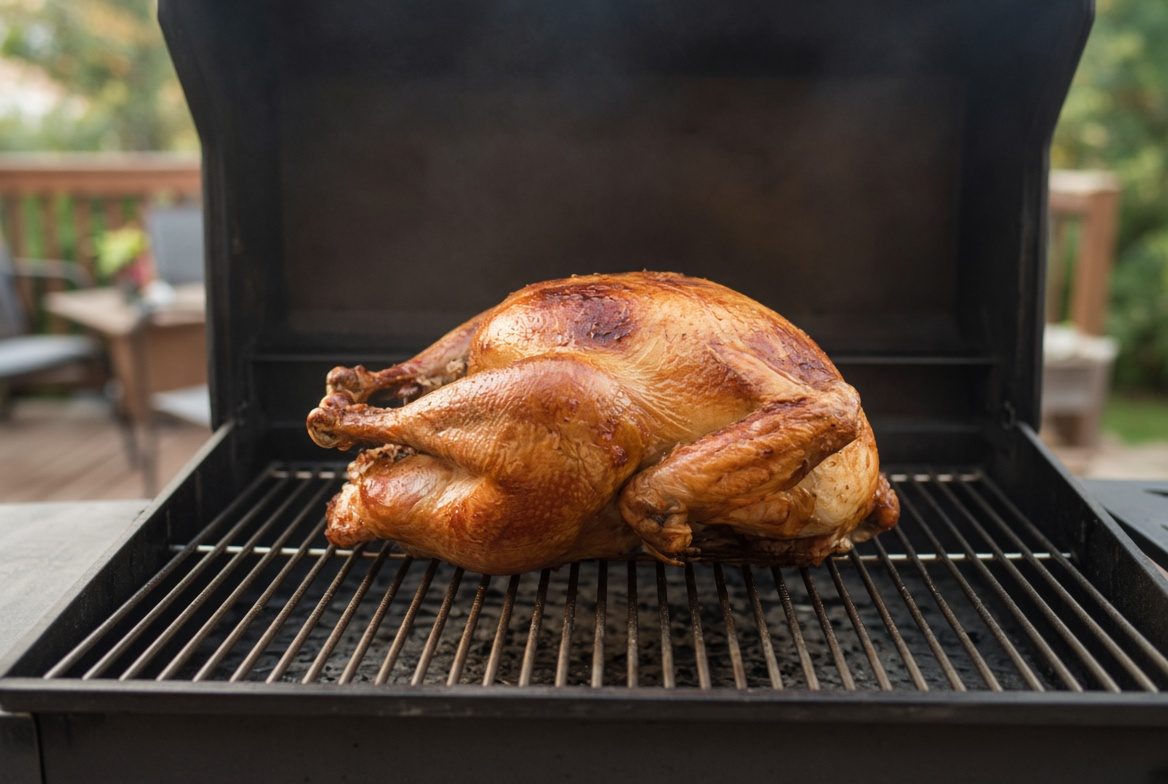
Updated and fact-checked: September 2, 2026 How to smoke a turkey that a family will actually eat is not an all-day 225°F cook with bitter smoke and rubbery skin. Use a fully thawed, unstuffed 12- to 14-pound bird, hold the cooker between 275°F and 300°F, and pull it when a thermometer reads 165°F in the breast, innermost thigh, and innermost wing.
Quick Answer: How Do You Smoke a Turkey the Family Will Love?
Smoke an unstuffed 12- to 14-pound turkey at 275–300°F until the breast, innermost thigh, and innermost wing all reach 165°F. Dry-brine overnight, use mild wood, skip stuffing, and rest 20 minutes. Time is only an estimate. A thermometer decides when dinner is ready.
Key Points
- USDA safe minimum for turkey is 165°F in the thickest breast, innermost thigh, and innermost wing. Color is not proof of doneness.
- Keep the smoker or covered grill between 225°F and 300°F. For family dinner, 275–300°F is the more reliable window for moisture and usable skin.
- Do not stuff a turkey that will be smoked, grilled, fried, or microwaved.
- Thaw completely in the refrigerator before the cook. A frozen or half-frozen bird spends too long in the 40–140°F danger zone.
- A 12- to 14-pound unstuffed bird at 275–300°F often takes about 3 to 4½ hours, but cooker, weather, and bird shape change that range.
- Mild woods (apple, cherry, pecan, or a mild blend) suit a whole family turkey better than heavy mesquite.
What Makes a Smoked Turkey Taste Like Thanksgiving Instead of a Science Project?
Families usually want juicy breast meat, cooked dark meat, clean wood flavor, and dinner on time. An 8-hour 225°F cook can add smoke, but it often dries the breast, leaves the skin soft, and puts the meal late. A smaller unstuffed bird at 275–300°F still takes smoke, finishes sooner, and is easier to carve for a mixed table of kids and adults. That cooker range also matches USDA guidance for smoking meat and poultry: keep the air temperature in the smoker or covered grill between 225°F and 300°F, and use one thermometer for the cooker and another for the food.
What Size Turkey Should You Smoke?
A 12- to 14-pound unstuffed turkey is the better family size for most backyard cookers. Plan about 1 to 1¼ pounds of raw turkey per person if you want leftovers. A 20-pound bird is harder to cook evenly on a mid-size pellet grill or a 22-inch kettle, and the breast is usually overdone by the time the thighs are safe. If you need more meat, smoke two smaller birds rather than one giant one. They cook more evenly and give you a backup if one side of the cooker runs hotter.
| Bird size | Better for | Watch-out |
|---|---|---|
| 10–12 lb, unstuffed | Smaller pellet grills, kettles, first-time cooks | Less leftover meat |
| 12–14 lb, unstuffed | Most family tables | Still needs grate space and a stable cooker |
| 16 lb and up | Large cookers only | Breast and thigh finish farther apart |
How Do You Thaw a Turkey Safely Before Smoking?
Thaw the turkey completely in the refrigerator before it goes on the smoker. USDA guidance is about one refrigerator day for every 4 to 5 pounds. A 12- to 14-pound bird usually needs 3 to 4 days in a 40°F or colder fridge, still in its wrapper, on a tray to catch drips. Cold-water thawing works if the bird is in leak-proof packaging, fully submerged, and the water is changed every 30 minutes. Cook it as soon as it thaws. Never thaw a turkey on the counter. USDA smoking guidance is blunt on this point: a frozen bird takes too long to climb through the 40–140°F danger zone in a low-temperature smoker.
Should You Stuff a Smoked Turkey?
No. Do not stuff a turkey that will be smoked. The USDA says not to stuff turkeys that will be grilled, smoked, fried, or microwaved. Stuffing cooked inside a smoked bird lags behind the meat. The turkey can read 165°F while the center of the stuffing is still in a risky range. Bake dressing in a separate dish to 165°F. If you want aroma in the cavity, a halved onion, a citrus half, or a few herb sprigs are enough. They are not stuffing, and they should not pack the cavity.
What Ingredients and Equipment Do You Need?
You need a fully thawed turkey, salt, a reliable thermometer, and a cooker that can hold 275–300°F with the lid closed. The ingredient list below is a practical starting point for one 12- to 14-pound bird, not a branded rub formula.
Turkey and seasoning
- 1 whole turkey, 12 to 14 pounds, fully thawed, giblets and neck removed
- 12 to 14 teaspoons kosher salt (about 1 teaspoon per pound)
- 1 teaspoon baking powder (helps the skin dry and brown; optional)
- 2 teaspoons coarse black pepper
- 1 teaspoon paprika or smoked paprika (optional)
- 2 tablespoons oil or melted butter, for a light coat before the cook
- 1 onion or 1 orange, halved, for the cavity if you want aroma only
Equipment
- Pellet grill, charcoal kettle or smoker, or a covered grill that can hold a steady indirect fire
- A cooker thermometer plus a leave-in or instant-read food thermometer
- Wire rack and sheet pan for overnight dry-brining in the fridge
- Heat-resistant gloves and a sheet pan or roasting rack for moving the bird
- Foil for a loose breast tent if the skin darkens early
- Mild hardwood pellets or a couple of dry wood chunks (apple, cherry, pecan, or a mild blend)
Do not rinse the raw turkey in the sink. Water spreads raw juices around the kitchen. Pat it dry with paper towels instead.
How Do You Dry-Brine a Turkey for the Smoker?
Salt the turkey 12 to 24 hours ahead and leave it uncovered in the refrigerator. Mix the kosher salt with the baking powder and pepper. Pat the skin dry, then season the bird on the breast, legs, thighs, and lightly inside the cavity. Set it on a rack over a pan and refrigerate uncovered. The uncovered rest dries the skin, which is the main reason smoked turkey skin often turns out flabby. If you only have 4 to 6 hours, salt it anyway. That is better than going on the cooker wet and unsalted. Do not wet-brine and dry-brine the same bird.
How Should You Set Up the Cooker?
Set the cooker for indirect heat at 275–300°F and wait for clean smoke before the turkey goes on. Thick white startup smoke is normal for a few minutes. The bird should not sit in it. For the difference between clean thin smoke and dirty white smoke, see the site’s guide to thin blue smoke vs white smoke.
| Cooker | Family setup | Notes |
|---|---|---|
| Pellet grill | Preheat to 275–300°F. Use apple, cherry, pecan, or a mild blend. | Easiest temperature control. Smoke is milder than charcoal. A Super Smoke-style setting is only useful at the low end of the range, not for the whole cook. See Traeger Super Smoke mode. |
| Charcoal kettle or covered grill | Bank coals on one side, or split them into two piles with a water pan in the middle. Turkey sits over the pan, not over live coals. | This matches the USDA covered-grill smoking method. Add a dry wood chunk or two after the coals are ashed over. Light the charcoal without lighter fluid; see how to light a charcoal grill without lighter fluid. |
| Gas grill | Burners on one side only. Turkey on the unlit side. Add a smoker tube or box if you want wood flavor. | Works in a pinch. Watch for hot spots and do not put the bird over a lit burner. |
Pellet smoke is cleaner and milder than charcoal smoke. That is often what a mixed family table prefers. If you want a deeper pit flavor, charcoal with a clean fire is the more direct path. The site’s comparison of pellet grill smoke vs charcoal smoke explains that tradeoff.
How Do You Smoke the Turkey, Step by Step?
Cook by temperature, not by a printed hour-per-pound rule. The steps below assume a thawed, dry-brined, unstuffed 12- to 14-pound turkey and a cooker holding 275–300°F.
- Take the turkey out of the fridge while the cooker preheats. Pat the skin dry again. Lightly coat with oil or melted butter.
- Confirm the cooker is stable in the 275–300°F range and the exhaust smoke is thin and clean, not thick and sharp.
- Place the turkey breast-side up on the grate, away from direct fire. On a kettle, that means over the water pan or on the cool side.
- Insert a probe into the thickest part of the breast without touching bone. Plan to spot-check the innermost thigh and innermost wing later.
- Close the lid. Stop peeking. Every lid opening dumps heat and extends the cook.
- If the breast skin is getting too dark before the thigh is close to 165°F, tent the breast loosely with foil.
- Start checking all three USDA spots when the breast probe is around 155–160°F: thickest breast, innermost thigh, innermost wing.
- Remove the turkey when all three spots read at least 165°F.
- Rest the turkey 20 minutes before carving. USDA roasting guidance uses a 20-minute stand before carving.
How Long Does a Smoked Turkey Take?
A 12- to 14-pound unstuffed turkey at 275–300°F often lands in the 3 to 4½ hour range, but that is only a planning window. Wind, lid openings, a cold grate, a water-logged bird, and a cooker that swings 40°F will move the time. USDA oven charts at 325°F are useful for planning, not for copying minute-for-minute onto a smoker.
| Unstuffed weight | Planning window at 275–300°F | Done when |
|---|---|---|
| 10–12 lb | About 2½ to 4 hours | 165°F in breast, innermost thigh, and innermost wing |
| 12–14 lb | About 3 to 4½ hours | Same three-spot check |
| 14–16 lb | About 3½ to 5½ hours | Same three-spot check; watch the breast |
Start earlier than you think you need, then hold the carved meat or the rested bird rather than serving undercooked poultry. Keep cooked turkey hot above 140°F if dinner slips, or refrigerate it and reheat leftovers to 165°F.
What Internal Temperature Is Safe, and What About Juicy Breast Meat?
165°F in the breast, innermost thigh, and innermost wing is the USDA safe minimum for the whole bird. Check all three spots and keep the probe off bone, fat, and gristle. A pop-up timer is not a substitute. Some barbecue cooks pull turkey breast a little lower and rely on carryover heat. That is a texture preference, not the safety standard. For a family meal, especially with guests, cook to the USDA minimum and rest 20 minutes. Dark meat can be a bit higher than 165°F and still eat well. Do not chase thigh temperatures so high that the breast turns to sawdust. Juice color and meat color are not safety tests. USDA and university extension guidance both say a thermometer is the only reliable check.
How Do You Rest, Carve, and Serve It?
Rest 20 minutes, then carve on a board with a channel so the juices stay off the tablecloth. Remove the legs and thighs first, then the wings, then the breast halves. Slice the breast across the grain. Serve the crispest skin with the white meat so the people who care about skin get some. If the skin is still softer than oven-roasted skin, that is common on smoked turkey. 275–300°F helps more than 225°F, but a smoker is still a moist chamber. Do not torch the skin at the table. A few minutes of higher heat at the end is optional only if you can still keep the breast from shooting past 165°F.
What Mistakes Ruin a Family Smoked Turkey?
The usual failures are a half-frozen bird, dirty smoke, stuffing, and trusting the clock.
- Starting frozen or partly frozen. The surface sits in the danger zone too long. Thaw first.
- Heavy white smoke for hours. That tastes like an ashtray. Wait for a clean fire. Dry pellets or dry chunks matter.
- Mesquite on a whole bird. Fine in small doses on beef. Easy to overdo on turkey breast.
- Stuffing the cavity. Not for smoked or grilled turkey.
- A 22-pound bird on a small cooker. The breast dries out while the thighs lag.
- Opening the lid to “check the color.” Use the probe. Color lies.
- No second thermometer. Lid gauges on kettles and cheap dome thermometers are often wrong. USDA smoking guidance calls for a cooker thermometer and a food thermometer.
- Leaving leftovers out. Refrigerate within 2 hours. Slice the meat, use shallow containers, eat within 3 to 4 days, or freeze.
Can You Spatchcock the Turkey Instead?
Yes. Removing the backbone and flattening the bird is a good family option when you want more even cooking and better skin. The turkey finishes faster and exposes more skin to heat. You need shears, a little extra fridge space, and enough grate width. Food-safety rules do not change: still 165°F in the thickest breast and in the thigh meat. Leave a whole bird whole if you want the classic platter. Spatchcock if even cooking matters more than the photo.
Final Verdict: What Turkey Should You Smoke for the Family?
Smoke a fully thawed, unstuffed 12- to 14-pound turkey at 275–300°F, with mild wood, until 165°F in the breast, innermost thigh, and innermost wing, then rest 20 minutes. That is the method that gets dinner on the table with clean smoke and meat people will eat the next day. Save the all-night 225°F cook for pork shoulder, not for the one bird the whole table is waiting on.
Frequently Asked Questions
Can I smoke a turkey at 225°F?
You can, but it is usually the wrong family method. 225°F is inside the USDA smoker range, yet the cook runs long, the skin stays soft, and the breast has more time to dry. Use 225°F only for a short opening smoke stage, then raise the cooker to 275–300°F.
Do I need to brine a smoked turkey?
A simple overnight dry brine is enough for most birds. Salt, time, and dry skin do more for a family turkey than a five-gallon wet-brine bucket. If the turkey is labeled “enhanced” or already injected with a salt solution, cut the added salt or skip the long brine so the meat does not taste cured.
What wood is best for smoked turkey?
Apple, cherry, pecan, or a mild hardwood blend are the safer family choices. They add wood flavor without burying the turkey. Hickory works in small amounts. Mesquite is easy to overdo on white meat.
Is pink turkey meat safe if it hits 165°F?
Yes. Smoke and myoglobin can leave a pink tint even after the meat is safely cooked. Trust the thermometer in the breast, innermost thigh, and innermost wing, not the color. If any of those spots are under 165°F, keep cooking.
Can I finish a smoked turkey in the oven?
Yes, if the smoker is struggling or weather is working against you. Move the bird to a 325°F oven and still cook to 165°F in the same three spots. Partial cooking ahead of time, then a long wait before finishing, is the unsafe version. USDA warns against partial cooking that lets bacteria multiply before the final heat.
How long do smoked turkey leftovers keep?
Refrigerate within 2 hours, use within 3 to 4 days, and reheat leftovers to 165°F. Slice the meat into shallow containers. USDA does not recommend reheating a whole leftover turkey. Frozen cooked turkey keeps quality for about 4 months.
Related Reading
- Thin Blue Smoke vs White Smoke for Barbecue Cooking
- Pellet Grill Smoke vs Charcoal Smoke: Which Tastes Better?
- What Is Traeger Super Smoke Mode? How to Use It
- How to Light a Charcoal Grill Without Lighter Fluid
- How to Keep a Charcoal Grill at 225°F for Hours
- USDA: Turkey Basics — Safe Cooking
- USDA: Smoking Meat and Poultry
- USDA: Turkey Basics — Stuffing
About Frank W. Roberts
Frank W. Roberts is the author of Everything Grill Reviews. He has grilled since 1970 and brings more than 50 years of backyard cooking and cookoff experience to fire management, fuel behavior, smoke, and practical cooker use. This article is a cooking-method guide based on that fire experience and current USDA food-safety rules. It is not a claim that Frank cooked this exact bird on a named grill last weekend. Last verified September 2, 2026.