
Updated: September 13, 2026
Updated and fact-checked: September 12, 2026
How to grill chicken without drying it out starts with two-zone heat and a thermometer, not a clock or the color of the juices. Chicken dries when lean breast meat sits over a full fire until the outside is dark enough to look “done.” Cook most of the way beside the fire, finish for color, and take the food off only after the thickest edible part hits 165°F.
Quick Answer: How Do You Grill Chicken Without Drying It Out?
Build a two-zone fire, cook chicken mostly on the cool side with the lid closed, and pull it at 165°F in the thickest part, away from bone. Color, clear juices, and a timer are not proof of safety or juiciness. Bone-in thighs can take extra heat for texture. Boneless breasts cannot. Sauce late so sugar does not burn before the center is ready. Times below are estimates; thickness, starting temperature, wind, and the cooker change them.
Key Points
- USDA’s safe minimum for all poultry, including ground poultry and stuffing, is 165°F measured with a food thermometer before the food leaves the heat.
- Two-zone grilling is the practical fix: a hot side for color and a cool side that acts like an oven.
- Boneless breasts dry first because they are lean and cook fast. Bone-in thighs and drumsticks are more forgiving.
- Pink meat near the bone is not a doneness test. Only the thermometer reading is.
- Never put cooked chicken back on the platter that held raw chicken. Refrigerate leftovers within 2 hours, or within 1 hour if the air is above 90°F.
- Sauce in the last few minutes. Sugar burns long before a bone-in piece is cooked through.
Why Does Grilled Chicken Dry Out?
Most dry grilled chicken is overcooked lean meat, not a missing marinade. Breast meat has little intramuscular fat and a narrow window between safe and chalky. A full bed of coals or every burner on high cooks the surface much faster than the center. By the time the thickest part reaches 165°F, the outer layer has already given up moisture.
Three other common causes sit next to that:
- No cool zone. Food that starts to burn has nowhere to go except farther into the fire or off the grill half-raw.
- Lid open the whole cook. Heat escapes, the fire surges when you close it, and you keep peeking. That lengthens the cook and dries the surface.
- Sauce too early. Tomato and sugar glazes blacken while the bone side is still under 165°F. People then keep cooking to “fix” the look and finish with dry meat under burnt glaze.
A brine or a fat cap helps. It does not replace heat control. Fifty years of backyard chicken cooks taught me the same lesson every summer: the fire layout matters more than the bottle of marinade.
What Internal Temperature Is Safe for Grilled Chicken?
All poultry must reach 165°F in the thickest part before it leaves the heat, according to the USDA Food Safety and Inspection Service safe-temperature chart. That number covers whole birds, breasts, legs, thighs, wings, ground poultry, giblets, and stuffing. Ground chicken and turkey are 165°F, not the 160°F used for other ground meats.
FSIS tells cooks to measure before removing food from the heat source. Do not pull chicken at 155°F or 160°F and count on a rest to finish the safety job. Carryover heat is real on a thick piece, but it is not a substitute for the chart.
| Food | USDA minimum | What that means on a grill |
|---|---|---|
| Chicken or turkey, any cut | 165°F | Check the thickest edible part. Recheck a second piece. |
| Ground chicken or turkey | 165°F | Check the center of the patty. Color is not proof. |
| Stuffing cooked inside a bird | 165°F in the stuffing | The bird and the stuffing both have to hit 165°F. |
| Leftovers | Reheat to 165°F | Do not “warm” leftover chicken on a dying fire and call it done. |
| Beef, pork, lamb, veal steaks and roasts | 145°F plus a 3-minute rest | Listed here so the poultry number is not mixed up with steak doneness. |
Last verified September 12, 2026, against the FSIS safe-temperature chart and the FSIS grilling-and-food-safety page.
Dark meat can stay pleasant past 165°F because thighs and drumsticks have more connective tissue. Many cooks take bone-in dark meat into the 175–185°F range for a softer bite. That is a texture choice after the safety minimum, not a reason to treat 165°F as optional. Breast meat does not get better as it climbs through that range. It gets drier.
Which Chicken Cut Is Hardest to Keep Juicy on the Grill?
Boneless, skinless breast is the hardest cut to keep juicy because it is lean, uneven in thickness, and easy to overshoot. A supermarket pack often holds one thick end and one thin tail. The thin end hits 165°F while the thick end is still in the 140s if you cook the pack as if every piece were the same.
| Cut | Forgiveness | Best grill approach | Notes |
|---|---|---|---|
| Boneless, skinless breast | Low | Short direct color, then indirect to 165°F | Pound or butterfly thick ends so pieces cook at the same pace. |
| Bone-in, skin-on breast | Medium | Mostly indirect, brief direct finish | Bone slows the center. Skin protects the surface if you do not scorch it. |
| Boneless thighs | High | Direct or two-zone | Fat helps, but sugar sauce still burns over a hot fire. |
| Bone-in thighs and drumsticks | Highest | Indirect first, direct to crisp skin | Best weeknight choice if you want less stress. |
| Wings | Medium | Indirect until nearly done, then hotter finish | Check more than one wing. Small pieces finish at different times. |
| Whole or spatchcocked chicken | Medium | Indirect the whole way, lid closed | Check breast and innermost thigh. Do not stuff the bird on the grill. |
| Ground chicken patties | Low to medium | Direct medium heat to 165°F | Pressing the patty dry on a screaming grate squeezes out moisture. |
If your household fights over dry white meat, cook thighs. If you need breasts, buy even pieces or spend two minutes with a mallet so the pack cooks as one job instead of three.
How Do You Set Up the Grill for Juicy Chicken?
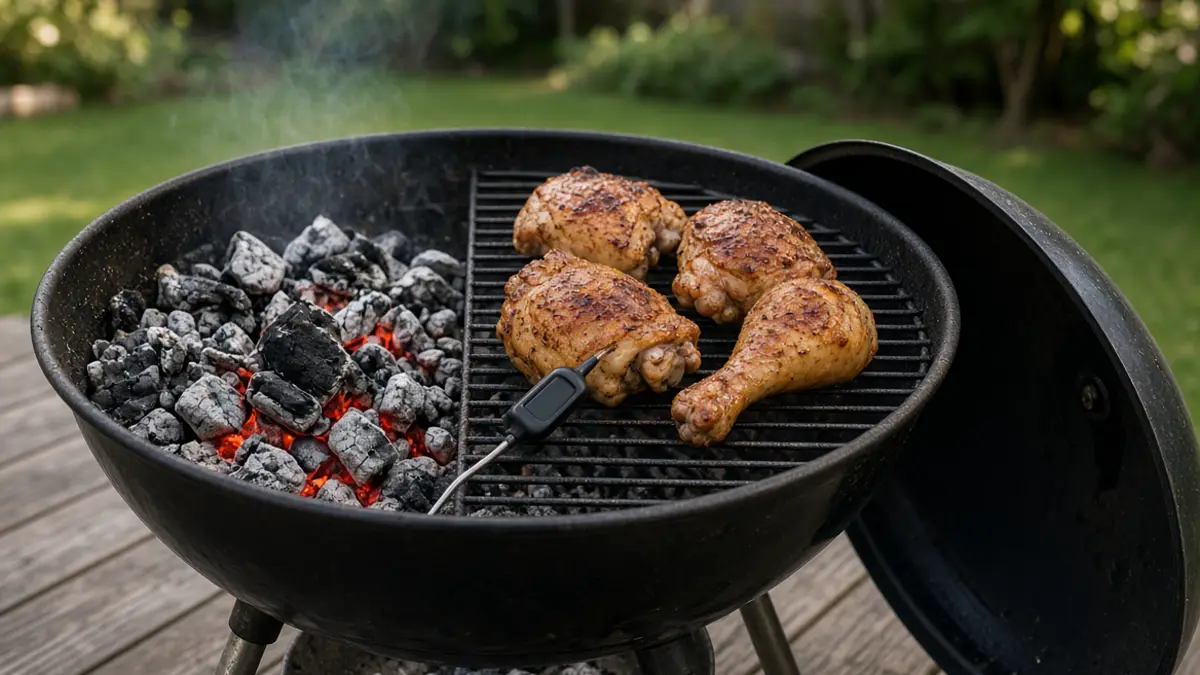
Set a two-zone fire so one side can brown and the other side can finish the center without scorching the skin. Direct heat is fire under the food. Indirect heat is fire beside the food. Chicken pieces belong on that split more than almost any other weeknight protein.
On charcoal, light a chimney, pour the ashed coals onto one half to two-thirds of the charcoal grate, and leave a clear empty zone. Replace the cooking grate and preheat with the lid on. Point the top vent over the cool side so heat and smoke pull across the food. The site’s two-zone setup and charcoal-lighting guides cover the layout in more detail.
On gas, light one side and leave the other side off. A two-burner grill gets one burner on. A three- or four-burner grill should leave a real unlit section, not every other burner half-lit. Preheat 10 to 15 minutes with the lid closed. If both sides read the same high number, you do not have a cool zone yet.
On a pellet grill, treat the cook like an oven. Set 350–375°F for pieces and keep the lid closed. Use a hot cast-iron pan, a sear grate, or a short trip over a separate high-heat burner if you want grill marks at the end. Chasing steakhouse crust on a mild pellet fire while the breast is still climbing through 140°F is how those cooks dry out.
Keep a grate-level thermometer on the cool side when you can. A lid dial on a kettle or gas box reads air at the dome, not the air next to the chicken.
Should You Grill Chicken With the Lid Open or Closed?
Close the lid for the indirect stretch and for almost every bone-in piece. A closed lid turns the cookbox into an oven. Heat reaches the top of the food instead of only blasting the skin from below. That is the difference between cooked-through chicken and black skin over a raw bone.
Open-lid cooking has a place on a brief sear when you need to watch fat drip and move a piece off a flare-up. It is a poor plan for a pack of bone-in thighs. Every peek dumps heat. The fire then runs hotter when you close the lid again. Check with a thermometer on a schedule, not every two minutes “just to see.”
How Do You Grill Chicken Step by Step?
Thaw completely, pat the surface dry, season, preheat a two-zone grill, cook mostly indirect, finish for color, and confirm 165°F in more than one piece. The order matters more than any single seasoning trick.
- Thaw chicken in the refrigerator, not on the counter. FSIS does not treat room-temperature thawing as a safe shortcut.
- Pat the surface dry. Wet skin steams and sticks. Wet boneless breasts brown poorly and pick up more grate junk.
- Season shortly before the cook, or brine in the refrigerator ahead of time. Do not leave raw chicken sitting out “to take the chill off” for a long stretch.
- Set the grill outdoors on a stable surface. For gas, open the lid before lighting. Unburned propane can collect in a closed box. Follow the lighting sequence in your manual.
- Build two zones and preheat. Clean the hot grate with a tool that matches the grate finish, then oil the grate lightly if food has been sticking.
- Place chicken on the cool side, skin-side up if it has skin. Close the lid.
- Leave it alone long enough for the center to climb. Move pieces that are racing ahead. Swap positions if one edge of the cool zone runs hotter.
- When the thickest part is near 160–165°F, shift pieces to the hot side only as long as you need color or crisp skin. Sauce now, not at the start.
- Confirm 165°F in the thickest edible part of more than one piece, away from bone. If one piece is short, it goes back to the cool side. Do not stack finished and unfinished chicken on the same plate.
- Rest briefly for carving and juice control, then serve. Get leftovers into the refrigerator on the FSIS timetable below.
Boneless, skinless breasts
Pound or butterfly the thick end so the pack is closer to even thickness. Give each side a short stay on the hot zone for color, then move to indirect and close the lid. Check early. A ¾-inch breast can finish in roughly 8–12 minutes of total grill time on a hot grate; a thick restaurant-style breast takes longer. Those minutes are planning numbers, not doneness.
Bone-in breasts, thighs, and drumsticks
Start skin-side up on the cool side so fat can render without dumping straight onto the fire. Weber’s published grilling charts have long listed bone-in breasts around 30–40 minutes over indirect medium heat and bone-in leg pieces in a similar window. Use those only as a planning range. Confirm 165°F. If you want darker-meat texture past that number, keep the piece on the cool side instead of parking it over a flare.
Wings
Cook indirect until the meat near the joint is close to 165°F, then move to hotter heat to crisp the skin. Check several wings. The drumette and flat on the same rack can finish minutes apart. FSIS guidance for chicken wings is the same 165°F minimum, measured away from bone.
Whole or spatchcocked chicken
Spatchcocking (removing the backbone and flattening the bird) evens the cook so the breasts are not still climbing while the thighs are already past pleasant. Keep the whole bird on the cool side with the lid closed. Point the legs toward the hotter edge if one side of the grill runs warmer; dark meat tolerates that extra heat better than the breast. FSIS says to check the innermost thigh, innermost wing, and thickest part of the breast on a whole bird. Do not grill a stuffed chicken and guess about the center of the stuffing. If you stuff, the stuffing itself must hit 165°F.
Approximate oven-style ranges from food-safety roasting charts put a 3- to 4-pound whole chicken in the neighborhood of an hour or more at moderate heat. A grill is not a calibrated oven. Trust the probe.
Does Brining or Marinating Keep Grilled Chicken Juicy?
A refrigerator brine can help lean breast meat hold more moisture, but it will not rescue a breast cooked to 180°F over a full fire. Salt changes how muscle proteins hold water. That is useful. It is not magic.
Keep raw chicken in the refrigerator the entire time it sits in brine or marinade. FSIS is direct about this: do not marinate poultry on the counter. Discard used marinade, or boil it thoroughly if you want to turn that liquid into a sauce. Do not brush raw-marinade leftovers onto cooked chicken.
A dry brine (salt on the surface, uncovered on a rack in the refrigerator) helps skin dry so it can crisp later. A wet brine helps boneless breasts more than it helps already-fatty thighs. If the chicken already tastes salty from a store enhancement solution, skip a long wet brine or you will overshoot the seasoning.
Oil on the surface can reduce sticking. A heavy coat of sugary sauce at the start is still a bad trade.
When Should You Sauce Grilled Chicken?
Sauce in the last few minutes, after the meat is close to 165°F. Most bottled barbecue sauces are built on tomato, sugar, or both. Over direct fire they darken fast. People then keep cooking to hide the scorch and drive the center well past the useful range.
A practical sequence:
- Season with salt and a sugar-light rub at the start.
- Cook indirect until the thermometer says you are close.
- Move to the hot side or raise the heat only as needed.
- Brush a thin layer of sauce. Close the lid briefly so it sets. Repeat once if you want a second coat.
- Confirm 165°F again after the sauce step. A glaze can hide a piece that is still short.
If you want smoke on a gas grill, add a small load of dry hardwood in a smoker box or foil packet on the lit side and keep the chicken on the cool side. Clean, thin smoke is enough. Heavy white smoke makes chicken taste bitter, not “more barbecued.”
How Long Does Chicken Take on the Grill?
Time is only a planning estimate; thickness, bone, starting temperature, cooker heat, and lid discipline change it. FSIS says a food thermometer is the only reliable doneness test for chicken. The ranges below assume a preheated two-zone grill, chicken that started refrigerator-cold, and a closed lid on the indirect stretch.
| Cut | Typical planning window | Stop when |
|---|---|---|
| Boneless breast, about ¾ inch | About 8–14 minutes total | 165°F in the center |
| Thick boneless breast | About 14–20 minutes | 165°F in the thickest part |
| Bone-in breast | About 30–40 minutes | 165°F away from bone |
| Bone-in thighs or drumsticks | About 25–40 minutes | 165°F minimum; many cooks continue toward 175°F+ for texture |
| Wings | About 18–30 minutes | 165°F in several pieces |
| Spatchcocked 3–4 lb chicken | About 45–70 minutes | 165°F in breast and innermost thigh |
| Whole 3½–4½ lb chicken, indirect | About 1–1½ hours | 165°F in breast, innermost thigh, and innermost wing |
Weber’s older published charts put boneless skinless breasts on direct medium heat for roughly 8–12 minutes and bone-in pieces on indirect medium heat for roughly 30–50 minutes depending on the chart edition. Those numbers match backyard experience well enough to plan supper. They do not replace a probe. Wind, a cold grate, and a crowded cookbox all stretch the window.
Is Pink Chicken Near the Bone Still Safe?
Pink color near the bone is not proof that chicken is undercooked, and white meat is not proof that it is safe. FSIS states that the color of cooked chicken is not a sign of safety. Hemoglobin in bone marrow can leak into nearby meat, especially in younger birds, and leave a pink ring after the food has already reached 165°F. Freezing can make that color change more noticeable.
Clear juices are a weak signal for the same reason. Measure. If the thickest part is 165°F and the thermometer did not rest on bone, the piece is at the USDA minimum even if a joint still looks pink.
What Are the Most Common Grilled-Chicken Mistakes?
The usual failures are a single hot zone, a missing thermometer, early sauce, and treating time as doneness.
| What you see | Likely cause | Fix |
|---|---|---|
| Black skin, raw near the bone | All direct heat, lid open, or sugar sauce too early | Move to the cool side and finish with the lid closed |
| Dry, chalky breast | Cooked well past 165°F, or a thin tail overcooked while the thick end caught up | Even out thickness and pull at 165°F |
| Bitter, acrid taste | Heavy white smoke, lighter fluid, or burnt drippings | Wait for clean smoke; keep chicken off a grease fire |
| Flare-ups under skin-on pieces | Fat dripping on a full fire | Use the cool zone. Do not spray water on a grease fire |
| Chicken welded to the grate | Cold or dirty grate, wet skin, or flipping too soon | Preheat, dry the surface, and wait for release |
| Some pieces done, others not | Mixed sizes cooked as one pile | Group like pieces and check more than one |
FSIS also warns cooks not to partially grill chicken and finish it later. That method leaves the food in a temperature range where bacteria can survive and grow. Cook it through in one pass.
How Should You Handle Raw Chicken Around the Grill?
Keep raw chicken and cooked chicken on separate tools and platters, and wash hands and surfaces after you touch the raw pack. FSIS grilling guidance is blunt: do not return cooked food to the plate that held raw meat or poultry. Juice from the raw pack can put bacteria back on food you just cooked to 165°F.
Use one set of tongs for raw pieces and a clean set for turning cooked food, or wash the tool in hot soapy water between jobs. Do not rinse raw chicken in the sink. That spreads juices around the kitchen without making the meat safer. The thermometer probe needs the same washing. A dirty probe dragged from a raw thigh into a finished breast is a cross-contamination tool.
For gas lighting, keep the lid open and follow the manual. The U.S. Consumer Product Safety Commission has long warned that unburned gas can collect under the grates in a closed box and ignite all at once.
How Do You Store Leftover Grilled Chicken?
Refrigerate leftover grilled chicken within 2 hours of cooking, or within 1 hour if the air is above 90°F. FSIS calls the range between 40°F and 140°F the danger zone because bacteria can multiply quickly there. Keeping finished chicken on a warm grill that has already dropped below a true hold temperature is not the same as keeping it safely hot at 140°F or above.
Carve large pieces so they cool faster in shallow containers. FSIS leftover guidance says refrigerated leftovers are for 3 to 4 days. Reheat to 165°F. Do not taste-test your way through a container that sat out through a long backyard party.
Final Verdict: What Actually Keeps Grilled Chicken Juicy?
Two-zone heat and a thermometer keep grilled chicken juicy; a longer marinade does not. Cook lean breasts to 165°F and stop. Give dark meat more time if you want a softer texture after it is already safe. Keep sugar off the grate until the end. Close the lid on the indirect stretch. That is the whole method, and it works on charcoal, gas, and pellet cookers.
If you only change one habit this weekend, stop cooking a full pack of chicken over a wall-to-wall fire. Give the pieces a cool side. The rest of the advice is easier once that layout is in place.
Frequently Asked Questions
Can I pull chicken at 160°F and let it rest to 165°F?
Do not treat a rest as the USDA safety step for poultry. FSIS tells cooks to reach the minimum internal temperature before removing food from the heat source. The 3-minute rest on the USDA chart belongs to whole cuts of beef, pork, lamb, and veal, not to chicken. A short rest still helps a breast slice cleaner. It is not a license to leave the fire early.
Should I grill chicken on high heat the whole time?
No. High heat the whole time is how skin burns and breasts dry out. Use high heat only to color the surface. Finish on the cool side with the lid closed so the center can catch up.
Is it better to grill chicken thighs or breasts?
Thighs are the easier juicy result; breasts need tighter temperature control. Choose breasts when you want lean slices. Choose bone-in thighs when you want less risk and better leftover texture.
Do I need to brine chicken before grilling?
No. Brining helps some lean breasts, but it is optional. Even thickness, two-zone heat, and a 165°F stop matter more. If you brine, keep the chicken refrigerated the entire time.
Why is my grilled chicken rubbery instead of dry?
Rubbery skin usually means the surface never got dry and hot enough to render, or the piece was crowded and steamed. Pat the skin dry, give pieces space, and use a short direct finish after the center is nearly done. Rubbery breast meat can also mean the opposite problem: the protein tightened from a long stay past 165°F.
Can I grill chicken from frozen?
Thaw it in the refrigerator first when you can. Frozen pieces brown on the outside while the center lags, which pushes you toward the burnt-and-raw pattern this article is trying to avoid. If you must start from frozen, use only indirect heat and plan on a much longer cook, still ending at 165°F in the center. FSIS notes that cooking from frozen can take substantially longer.
Should I use lighter fluid on charcoal chicken?
Skip it. Fluid taste clings to chicken skin. A chimney starter and a dry fire starter light charcoal without that flavor. Wait until the fire is burning cleanly before the food goes on.
Related Reading
- How to Set Up Two-Zone Grilling on Charcoal or Gas
- How to Use a Meat Thermometer Correctly on a Grill or Smoker
- How to Rest Meat After Grilling
- How to Prevent Grill Flare-Ups (and Stop a Grease Fire)
- How to Light a Charcoal Grill Without Lighter Fluid
Authoritative references used for temperatures and handling: the USDA FSIS safe minimum internal temperature chart, FSIS grilling and food safety, and Chicken from Farm to Table. Last verified September 12, 2026.
About Frank W. Roberts
Frank W. Roberts is the author of Everything Grill Reviews. He has grilled since 1970 and brings more than 50 years of backyard cooking and cookoff experience to fire management, fuel behavior, smoke, and practical cooker use. This article is based on that long practice with two-zone fires plus current USDA/FSIS temperature and handling rules. It is not a hands-on test of a named grill model. Last verified September 12, 2026.