
Updated: September 13, 2026
Updated and fact-checked: September 13, 2026 Smoker temperature control is oxygen, fuel, and measurement—not a lucky lid number. Air has to enter the fire, pass through the chamber, and leave through an exhaust. You change heat by changing how much fuel is burning and how much air that fire gets. A pellet controller does the same job with an auger and a fan. USDA and FSIS smoking guidance still tells cooks to keep smoker air between 225°F and 300°F and to finish food with a thermometer in the meat.
Quick Answer: How Do You Control Temperature on a Smoker?
Measure air next to the food, build a fire that can last, then throttle intake air instead of choking the exhaust. On charcoal and wood, leave the top vent mostly open and pinch the bottom vent after the grate climbs through about 200°F. On a pellet grill, set the controller and keep the lid closed. Do not chase every 5°F swing.
Key Points
- Cooker air and meat temperature are two different jobs. You need a grate-level air reading and a food thermometer.
- USDA and FSIS tell cooks to keep smoker or grill air between 225°F and 300°F while the food reaches a safe internal temperature.
- On most charcoal and wood smokers, the intake vent is the heat dial. The exhaust is the draft.
- Closing the exhaust to “make more smoke” often makes dirty smoke and an unstable fire.
- A water pan buffers spikes. It does not replace vent control or a correctly sized fire.
- Weather, leaks, ash, wet fuel, and lid openings move temperature more than most vent tricks.
What Temperature Should a Smoker Run?
Keep hot-smoking air in the 225°F to 300°F band and cook the food to a safe internal temperature. A 2024 USDA food-safety briefing and FSIS smoking guidance tell cooks to monitor smoker air in that window with one thermometer and to check the meat with another. Some FSIS smoking pages print 250°F to 300°F instead of 225°F to 300°F. Stay inside the band. Do not treat one lid number as a law. That air number is not doneness. USDA’s current chart still lists:
- 145°F plus a 3-minute rest for whole beef, pork, veal, and lamb steaks, chops, and roasts
- 160°F for ground meat
- 165°F for poultry
- 145°F for fish
Barbecue texture on brisket and pork shoulder is a later target. Those cuts are usually taken well past the safety floor so collagen breaks down. Safety first. Tenderness second. Time on a clock is an estimate. A practical backyard window inside the USDA band is 225°F to 275°F at the grate. 250°F is often easier to hold on a leaky cooker than a perfect 225°F.
Where Should You Measure Smoker Temperature?
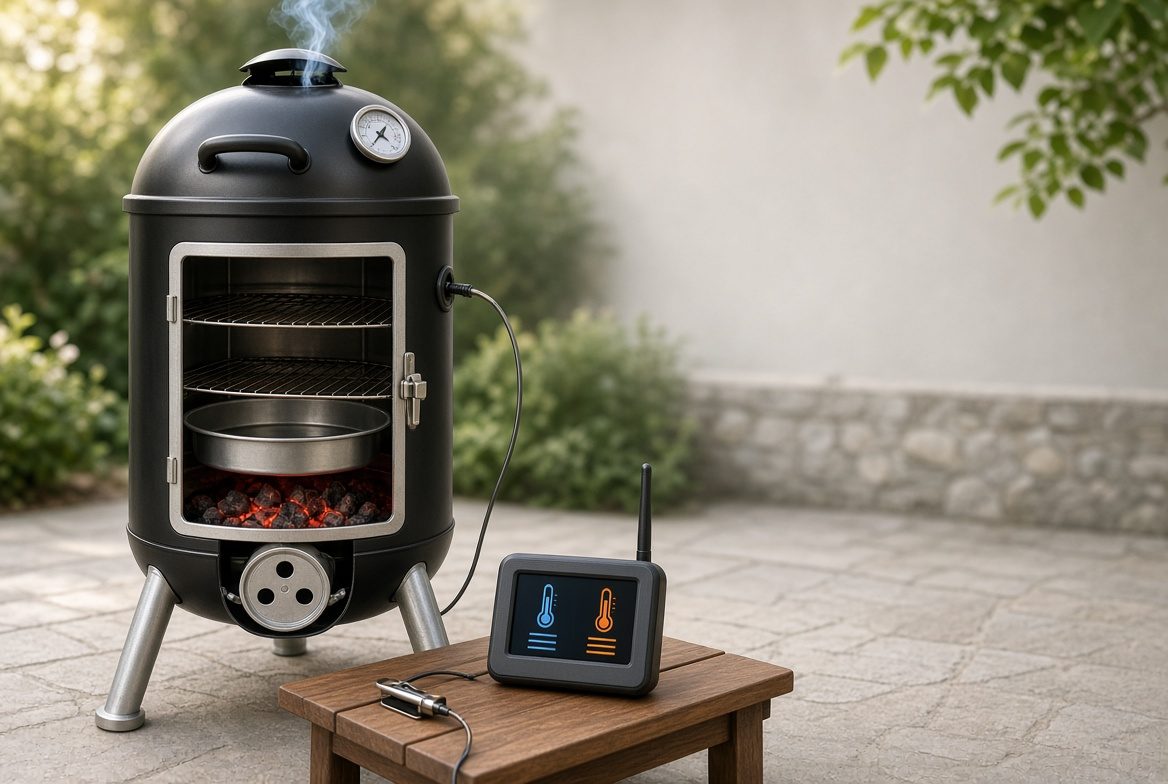
Measure air at grate level, near the food, and measure the food in the thickest muscle away from bone. A lid thermometer sits in the hottest rising air. AmazingRibs and a long owner record on water smokers both warn that the dome can read far hotter than the grate. FSIS tells cooks to use two thermometers for that reason: one for cooker air, one for food. Place the air probe on the same grate as the meat, not touching metal and not hanging in the lid. Place the food probe in the center of the thickest part. Confirm the finish with an instant-read thermometer. Probe placement is covered in how to use a meat thermometer on a grill or smoker. One grate reading is a trend, not a map. Offsets and tall bullets often have a hot side and a cool side. If you can run two air probes, do it once so you know where the heat lives in your cooker.
How Does Airflow Control Heat?
More oxygen makes a bigger fire. Less oxygen makes a smaller fire. Exhaust has to stay open enough for the fire to breathe. Meathead Goldwyn’s long-standing vent rule is the one that still holds on most charcoal and wood cookers: control temperature mainly with the intake damper and leave the exhaust mostly open unless you cannot hit the target with intake alone. The exhaust creates draft. Draft pulls fresh air in through the intake. Close the chimney and you slow that pull, trap combustion gases, and often get thick white smoke. The same idea is already on this site for smoke quality: do not choke vents just to make a thicker plume. That path is in thin blue smoke versus white smoke.
| Control | What it does | Usual smoking setting |
|---|---|---|
| Fuel amount and layout | Sets how much heat is available for hours | Small lit charge, larger unlit reserve |
| Intake / bottom vent | Feeds oxygen to the fire; main heat dial | Open to start, then pinched as the grate hits about 200°F |
| Exhaust / top vent or chimney | Lets heat and smoke out; creates draft | Mostly open |
| Water pan or ceramic mass | Absorbs spikes; slows changes | Helpful, not a substitute for the fire plan |
| Lid openings | Dump heat and pull extra air across the fire | Open only when you have a reason |
Wait after each change. Ten to fifteen minutes is a normal delay before the grate tells you what you did. Moving two vents at once hides the cause.
How Do You Control Temperature on Each Kind of Smoker?
The physics stay the same. The hardware changes which lever you touch first.
Weber Smokey Mountain and other water smokers
Use a Minion fire: unlit briquettes in the charcoal ring, a smaller lit charge on top, wood chunks in the fuel. Start with vents open. Pinch the three bottom dampers as grate air climbs through about 200°F. Leave the lid damper at least partly open. The water pan is a heat sink. It blunts the first surge and adds humidity. It will not save a fire that was lit too big. If the door leaks a lot of air, the bottom vents stop being the only intake. Reshape the door or add a gasket when the cooker will not come down with the vents nearly closed. Details on that cooker are in the site’s Weber Smokey Mountain review once that page is live. The fire method itself is in how to keep a charcoal grill at 225°F.
Kettle used as a smoker
Use a snake: two briquettes wide, one or two high, lit at one end. Meat opposite the fire. Bottom vent is the dial. Top vent stays mostly open. A water pan over the cool side is optional. Lighting every coal at once is how a kettle jumps to 400°F. Start the fire with a chimney, not lighter fluid, as in how to light charcoal without lighter fluid.
Offset stick-burner
The fire lives in a box beside the chamber. You control heat with fire size first and the intake damper second. Keep a compact coal bed. Add splits that catch cleanly. Leave the chimney mostly open. Thin metal backyard offsets leak and run uneven. The grate near the firebox runs hotter than the grate near the stack. Rotate food instead of slamming the intake shut every time one side climbs.
Kamado and other ceramics
Thick walls store heat. A small lump fire is enough. Bring the cooker up slowly and start closing vents before you hit the target. Once a kamado is too hot, it stays too hot. Follow the maker’s warning about opening a ceramic cooker after the vents have been restricted. A rush of oxygen onto a starved fire can flare. Use the heat deflector for low-and-slow. Without it you are grilling.
Drum and hanging smokers
Many hanging drums are designed to cruise hotter than 225°F, often in a 270°F to 310°F neighborhood once the lid is on. That can still sit inside the USDA 225°F to 300°F air band if the cooker stays there. Do not force a drum to behave like a water smoker if the design wants a hotter cruise. Control comes from fuel load and one intake more than from a four-vent puzzle.
Pellet grill
The controller is the vent. An auger feeds pellets. A fan feeds air. You set a number and keep the lid closed. Power, dry pellets, a clean firepot, and a working probe matter more than damper fiddling. Low set points usually make more visible smoke than roasting temperatures. If the grill has a named low-smoke mode, use it only in the range the manual lists. Compare the convenience tradeoff in pellet grill versus charcoal grill.
What Makes a Smoker Run Hot or Cold?
Most temperature problems are fuel, leaks, ash, weather, or a thermometer in the wrong place—not a cursed cooker.
| Symptom | Likely cause | First safe check |
|---|---|---|
| Climbs past 300°F and will not come down | Too much lit fuel, leaks at a door or lid, or a new reflective cooker | Confirm the grate probe. Close intake a little. Do not dump water on coals. |
| Stalls under 215°F | Too little lit fuel, wet charcoal, ash blocking intake, or a cold wind | Open intake slightly. Check fuel dryness and ash under the grate. |
| Lid says 275°F, grate says 230°F | Normal dome-versus-grate gap | Trust the grate probe. Leave the lid gauge as a rough backup. |
| Swings 40°F every time you look | Lid openings, big vent moves, or a dying fire | Stop opening the lid. Change one vent. Wait 10 minutes. |
| Thick white smoke and falling heat | Smoldering fuel, wet wood, or a choked exhaust | Open exhaust. Give the fire air. Replace wet wood. |
| Fire will not die with vents closed | Air leaking at a door, lid, or warped damper | Inspect seals when the cooker is cold. Do not force a hot door. |
If the smoker is running hot
- Read the grate, not only the lid.
- Close the intake a small amount. Leave the exhaust open.
- Wait. Do not panic-close every hole.
- If it keeps climbing, you lit too much fuel. On a water smoker, a leaky door may be feeding the fire from the side.
- Do not pour water into a live charcoal bed to “cool it off.” That makes steam, ash sludge, and a mess. Take food to a safe holding plan if the cooker is out of control.
If the smoker is running cold
- Confirm the fire is still alive and the fuel is dry.
- Clear cold ash from under the charcoal grate so the intake can reach the coals.
- Open the intake a little. Keep the exhaust open.
- Add a small amount of already-lit charcoal if the reserve is gone. Do not dump a full chimney onto a cook that only needed a nudge.
- Block wind at the intake if a cold gust is washing the fire. Do not enclose the cooker or move it indoors.
Does a Water Pan Help Temperature Control?
Yes as a buffer. No as the main control. Water absorbs heat when the fire surges and gives some of that heat back as the fire settles. That is why water smokers feel steadier than a thin empty box. The pan also catches drippings and raises humidity, which can keep lean meat from drying and can keep poultry skin from crisping. You can run many cookers with the pan empty, foiled, or filled with sand. The fire and vents still do the work. A dry pan changes the humidity and the thermal mass. It does not create a new kind of heat. Handle a hot water pan as hot liquid. Do not lift a midsection that still holds a sloshing pan. Refill through the access door with care, or wait until the cooker is stable.
What Outside Conditions Change Smoker Temperature?
Wind, air temperature, sun, and wet metal change the climb more than most people expect. Cold air and a wet bowl pull heat. Wind across an intake can either feed the fire or steal it, depending on the direction. Direct sun on thin metal can add a false high reading on a lid gauge. Plan more fuel and a longer preheat in winter. Do not copy a July vent setting in January. Keep charcoal dry. Damp briquettes light slowly and then behave unpredictably. A fitted cover is for storage, not for running a cook. Never operate a smoker indoors, in a garage, or in a tent. Charcoal and wood fires produce carbon monoxide.
When Should You Stop and Change the Plan?
Stop fighting the vents when the fire is the wrong size, the cooker is leaking badly, or the food is no longer in a safe heating path.
- If cooker air falls below the smoking band and will not recover, finish the food by another safe method or discard it. Do not park raw meat in a cooling chamber for hours.
- If grease is dripping onto a runaway fire, move food if you can do it safely, keep the lid available to starve oxygen, and never throw water on a grease fire.
- If a pellet grill errors, loses power, or stops feeding, follow the manual. Do not bypass safeties.
- If you smell gas on a hybrid or gravity cooker, shut the fuel off if it is safe and stop.
Final Verdict: What Actually Controls Smoker Temperature?
The fire you built and the air you give it control smoker temperature. The thermometer only reports the result. Set a grate-level air probe, keep smoker air in the USDA 225°F to 300°F band, leave the exhaust open enough to draft, and use the intake or the controller as the fine adjustment. A water pan, a ceramic wall, or a good gasket makes the job easier. None of them replace a fire that was sized for the cook.
Frequently Asked Questions
Should I close the top vent to lower smoker temperature?
Not as the first move on most charcoal and wood smokers. Close the intake a little and wait. Use the exhaust only when intake changes are not enough, or when the maker’s manual says otherwise. A fully closed top vent is for shutting a cooker down, not for holding 225°F.
Is 225°F or 250°F better for smoking?
Both sit inside the common hot-smoking window. 225°F gives a longer smoke window. 250°F often finishes faster and is easier to hold on a leaky cooker. Safety still depends on the food’s internal temperature, not on hitting an exact lid number.
Why is my lid thermometer so different from the grate?
Because heat rises and the lid gauge sits in a different air stream. Use a probe next to the food. Treat the lid dial as a rough check, not as the cook.
How long should I wait after adjusting a vent?
Give the grate 10 to 15 minutes before you touch another control. Big, stacked, or ceramic cookers can take longer. Rapid vent chasing is how a stable fire becomes a swing.
Do pellet grills need vent adjustments for temperature control?
Usually no. Keep the lid closed, use dry pellets, and let the controller and fan do the work. Clean the firepot when ash builds up. Manual damper play on a pellet grill is not a substitute for the manual’s error steps.
Can I use a fan controller on a charcoal smoker?
Yes, if the kit is made for that cooker and you follow its instructions. A fan still needs a fire that can last and a chamber that is not wide open to leaks. The fan is an automatic intake, not a reason to skip a thermometer.
Related Reading
- How to Keep a Charcoal Grill at 225°F
- How to Use a Meat Thermometer on a Grill or Smoker
- Thin Blue Smoke vs White Smoke
- How to Light a Charcoal Grill Without Lighter Fluid
- Pellet Grill vs Charcoal Grill
About Frank W. Roberts
Frank W. Roberts is the author of Everything Grill Reviews. He has grilled since 1970 and brings more than 50 years of backyard cooking and cookoff experience to fire management, fuel behavior, smoke, and practical cooker use. This article explains smoker temperature control from airflow, fuel layout, published USDA/FSIS guidance, and established vent practice. It is not a hands-on test of one branded controller. Last verified September 13, 2026.