
Updated: September 25, 2026
Updated and fact-checked: September 25, 2026
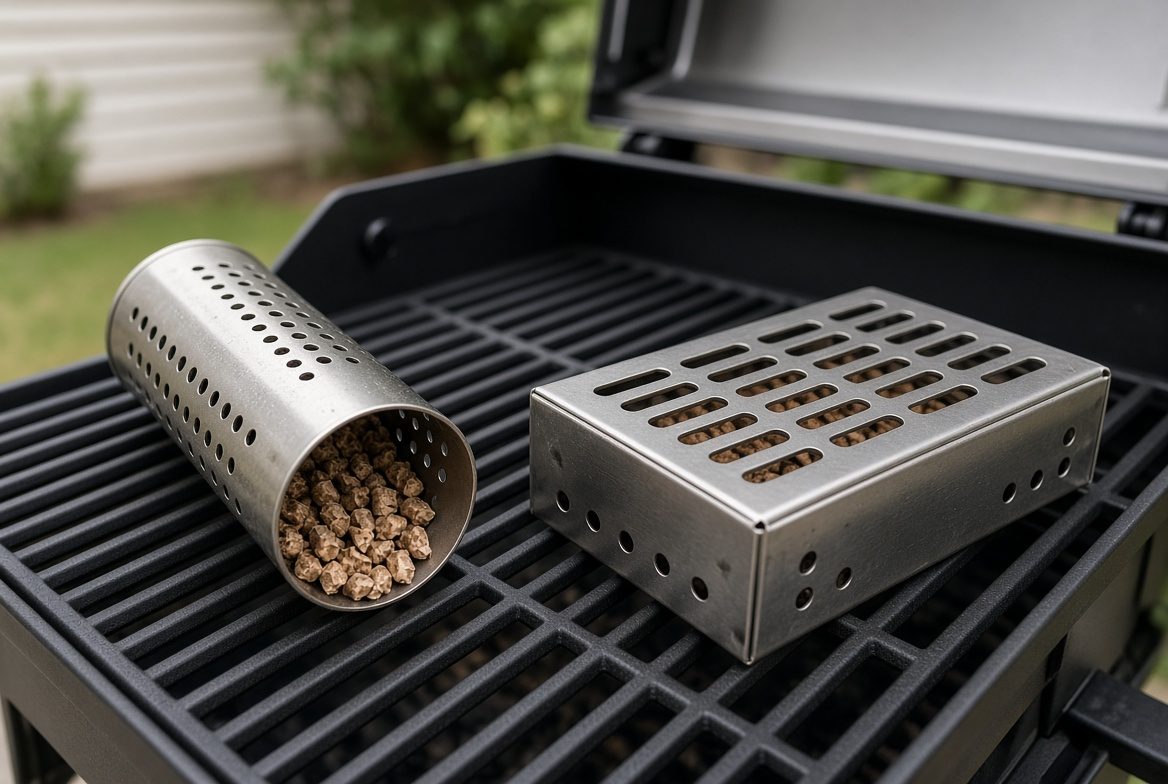
Smoke tube vs smoker box on a pellet grill is not a close call for most backyard cooks. A perforated pellet smoke tube is the accessory that usually belongs on a standard pellet grate. A gas-style chip box was built to sit over an open burner, not over a heat deflector. A built-in Camp Chef Woodwind Pro Smoke Box is a third tool and should not be confused with either grate-top accessory.
Quick Answer: Should You Use a Smoke Tube or a Smoker Box on a Pellet Grill?
Use a pellet smoke tube on a standard pellet grill when the cooker itself still tastes too mild. A grate-top chip box can work, but it often smolders poorly, burns out fast, and needs extra heat the pellet firepot does not put under the box. Fix dry pellets, ash, and a 225°F unwrapped start before buying either gadget.
Key Points
- A smoke tube is a perforated cylinder you fill with dry food-grade pellets, light per the tube maker, then park on the grate to smolder.
- A smoker box is a lidded metal chip box designed to sit over a gas or charcoal heat source. On a pellet grill it sits on a cooler grate above a deflector.
- A 12-inch pellet tube is commonly reported to smolder for about 4 to 6 hours. A chip box is commonly reported to last about 20 to 60 minutes before it needs a refill.
- Do not dump chips, chunks, or extra pellets into the hopper or firepot unless that exact grill manual allows it.
- Camp Chef’s Woodwind Pro Smoke Box sits over the firepot with a butterfly valve. That is factory hardware, not a $15 grate-top box.
- USDA smoking guidance still applies: keep cooker air in the 225–300°F range for smoked meats, thaw food first, and cook to a safe internal temperature with a thermometer.
What Is a Smoke Tube on a Pellet Grill?
A smoke tube is a perforated metal cylinder that holds dry cooking pellets so they smolder independently of the grill’s firepot. You fill it loosely, light one end the way the accessory maker describes, let the visible flame die back to a smolder, then set the tube on the grate where it cannot roll, block a probe port, or sit in dripping fat.
The pellet grill already burns pellets for heat. The tube is extra smoke, not extra temperature control. That is why it is useful on cookers that run very clean at 325°F and above, when the controller is feeding just enough fuel to hold the set point and the exhaust looks almost clear.
Use only dry, food-grade barbecue pellets. Construction lumber, painted wood, pressure-treated wood, and resinous pine do not belong in a cooker. Soaked pellets are a poor idea. Water delays ignition and can push dirty white smoke instead of a clean wood smell.
What Is a Smoker Box, and Why Does It Struggle on a Pellet Grill?
A smoker box is a lidded metal tray made to hold wood chips over a direct heat source, usually a gas burner or a bed of coals. Weber still sells grate-top stainless boxes for gas grills. Those boxes work because a lit burner sits under the chips and drives them to smolder.
A pellet grill does not work that way. The fire lives in a small firepot. A heat deflector or drip tray sits between that fire and the food. The grate is an even oven, not an open flame. A closed chip box on that grate may sit there for a long time before the chips even start, then dump a short burst of smoke and go out.
You can still use a box on a pellet grate if you already own one. Expect short smoke, more lid-opening, and uneven results compared with a tube filled with the same pellets already in the hopper.
Smoke Tube vs Smoker Box on a Pellet Grill: Side-by-Side
The tube wins on a standard pellet grill because it is built for pellets and a long, slow smolder. The box wins on gas. The factory Camp Chef box is a separate category.
| Factor | Smoke tube | Grate-top smoker box | Camp Chef Woodwind Pro Smoke Box |
|---|---|---|---|
| Usual fuel | Dry food-grade pellets | Wood chips; some owners also try pellets | Chips, chunks, or charcoal per Camp Chef |
| How it lights | You light one end, then let it smolder | Needs strong heat under the box | Pellet fire ignites it through a butterfly valve |
| Where it sits | On the grate, away from heavy drips | On the grate; designed for a burner or coals | In a factory slot above the firepot |
| Typical smoke window | Often several hours on a 12-inch tube; treat published times as estimates | Often 20–60 minutes of chips before a refill | As long as you reload the box and follow the manual |
| Best cooker | Most pellet grills, plus gas if you already own a tube | Gas or charcoal with a hot burner or coal bed under the box | Woodwind Pro models with that hardware |
| Honest weakness | Needs lighting; cheap thin tubes warp; open flame is a grease risk | Short burn and weak heat on a pellet grate | Only on that grill family; extra loading and valve steps |
Can You Use a Smoker Box on a Pellet Grill?
Yes, you can set a metal smoker box on a pellet-grill grate, but it is the weaker tool for that cooker. Place it on a stable section of grate, fill it loosely with dry food-grade chips, and do not pack the lid so tight that air cannot move. Keep it off the heaviest drip path.
Do not expect gas-grill behavior. There is no burner under the box. If the chips sit cold, the box is not broken. The heat is in the wrong place. Raising the whole pellet grill to 350–400°F just to wake a chip box also shortens the window when pellet smoke is strongest, which is usually the cooler start of the cook.
A foil packet of chips is the same idea with less durability. It can work for a short cook. It tears, spills ash, and still needs heat under it.
How Do You Use a Smoke Tube on a Pellet Grill?
Fill, light, smolder, then place the tube on the grate and keep the lid closed. Follow the tube manufacturer first. The sequence below matches common accessory directions and the method already used on this site’s smoke-flavor guide.
- Use the grill outdoors only. Keep the cooker on a stable, non-combustible surface away from walls, railings, and overhangs.
- Fill the tube with dry food-grade pellets. Do not ram them in. Air has to move through the holes.
- On a fire-safe surface outside the cook chamber, light the open end the way the tube maker describes.
- Let a visible flame establish for the time the manufacturer lists, then extinguish that flame so the pellets smolder. A tube that keeps a live flame under meat drippings is a grease-fire risk.
- Set the tube on the grate where it cannot roll, block a temperature sensor, or sit under a fatty roast. Close the lid.
- Confirm thin, clean-smelling smoke, not a rolling white cloud. If the tube goes out, remove it with heat-safe tools and relight outside the grill.
- Do not leave the cooker unattended. When the cook is done, let the tube cool fully before dumping ash.
Do not put loose chips, chunks, charcoal, or extra pellets into the hopper or firepot to “boost smoke” unless that exact grill manual says you can. The auger, igniter, and fan were sized for the approved pellet fuel.
Is the Camp Chef Woodwind Pro Smoke Box the Same Thing?
No. Camp Chef’s Smoke Box is factory hardware that sits above the firepot, not a generic grate-top chip box. Camp Chef’s Woodwind Pro manual tells the owner to load wood or charcoal under the brim of the box, slide it closed, turn the valve horizontal so pellet flames can ignite that fuel, then return the valve to vertical so the load smolders. Overfilling keeps the box from closing. The valve must be vertical before the box is opened.
That system can burn chunks or charcoal next to the pellet fire. AmazingRibs.com has described it as a way to add stronger smoke at any set temperature as long as the box is fed. It still does not turn the grill into an offset. It also does not travel to a Traeger, Weber Searwood, Pit Boss, or Z Grills grate. If you do not own a Woodwind Pro, buy a smoke tube rather than hunting for a copy of that box.
When Do You Need Either Accessory?
You need extra smoke gear only after the grill itself is clean, dry, and started low. Many “my pellet grill has no smoke” complaints are damp pellets, a packed firepot, a dirty grease path, food that went on already hot, or a 375°F weeknight cook that never lingered in the 225°F smoke window.
Use a smoke tube when:
- The grill holds temperature and exhaust smells clean, but the meat still tastes mild.
- You are cooking a longer piece — ribs, a small shoulder, a chuck roast — and want extra smoke during the unwrapped first hours.
- The cooker has a Super Smoke or similar low-temperature mode and you still want more wood note after using that mode correctly.
Skip both gadgets when:
- Burgers, chops, or thin chicken will finish in 20 to 40 minutes. The hopper pellets already give a light wood note.
- The firepot is full of ash or the pellets in the hopper are swollen. Fix that first.
- You are chasing thick white smoke. That is usually incomplete combustion, not better barbecue.
Keep smoked meats in the USDA’s 225–300°F cooker-air range when you are truly smoking, use fully thawed food, and cook to a safe internal temperature: 145°F plus a 3-minute rest for whole beef, pork, lamb, and veal cuts; 160°F for ground meat; 165°F for poultry; 145°F for fish; 165°F for leftovers.
Common Mistakes With Tubes and Boxes
The usual failures are lighting a tube into an open flame under dripping fat, packing fuel so tight it cannot breathe, and treating dirty-white startup smoke as a flavor goal.
- Soaking pellets or chips. Water does not make cleaner smoke. Dry fuel lights more evenly.
- Putting the tube under a fatty brisket point or a glazed meatloaf. Grease in a smoldering tube is how a small accessory becomes a flare-up.
- Opening the lid every ten minutes to “check the smoke.” Heat and smoke leave. The controller then dumps more pellets to catch up.
- Using a warped dollar-store tube that rolls. A rolling tube can dump burning pellets onto the deflector.
- Dumping chips in the firepot. That is how igniters and fans get a problem they were not designed to handle.
Frank’s Take
A pellet grill already has a smoke system. The accessory should add a clean extra layer, not fight the cooker. I would rather start a pork shoulder at 250°F with dry oak or hickory and a clean firepot than bury a chip box on the grate and open the lid twice an hour. If the meat still tastes polite after that, a smoke tube is the honest next step. If the cooker is a Woodwind Pro and stronger bark is the point, use the factory box the way Camp Chef wrote it. I would not buy a gas smoker box just to park it on a pellet grate.
Final Verdict: Smoke Tube or Smoker Box on a Pellet Grill?
Buy a smoke tube for a standard pellet grill. Keep the smoker box for gas. Use Camp Chef’s built-in Smoke Box only on the grill that came with it. Fix fuel and maintenance before spending money. Aim for thin, clean-smelling smoke. Let a thermometer, not the color of the exhaust, decide when the food is done.
Frequently Asked Questions
Can you put wood chips in a smoke tube?
Some tube makers allow chips, but pellets are the fuel the tube shape was built around. Chips can flare or burn out faster inside a narrow cylinder. Follow the accessory manual. If chips are all you have, a gas-style box on a gas grill is usually the cleaner match than forcing chips into a pellet tube.
Can you put pellets in a smoker box?
You can, but a closed box packed with pellets may ignite in a lump instead of smoldering in a line. That can mean a short, heavy burst and then nothing. A tube meters the burn better. Never pour loose pellets onto a gas burner or into a pellet firepot as a substitute for a container.
Does a smoke tube replace Traeger Super Smoke?
No. Super Smoke changes fan behavior on compatible Traeger models at low set points. A tube is a separate smoldering charge of pellets. You can use one, the other, or both if the manuals allow the placement. Do not block sensors or airflow.
How long should you run extra smoke?
Most of the useful wood note lands while the meat surface is still cool and unwrapped. An hour or two of clean extra smoke at the start of a shoulder or rib cook is usually enough. Running a tube the entire time a 10-hour butt is on the grate can turn the bark bitter if the smoke stays thick and white.
Is extra smoke safe for cold smoking cheese?
Only with a method the grill and accessory manuals support, outdoors, and with food that will not sit for hours in the bacterial danger zone. Camp Chef documents a fan mode for the Woodwind Pro Smoke Box after proper startup. A hot pellet firepot is the wrong tool if the goal is to keep cheese below cooking temperatures. When in doubt, use a purpose-built cold-smoke setup and keep perishable food out of the 40–140°F range for extended periods.
Related Reading
- How to Get More Smoke Flavor From a Pellet Grill
- How to Add Smoke Flavor to a Gas Grill
- What Is Traeger Super Smoke Mode?
- Pellet Grill Smoke vs Charcoal Smoke
- Thin Blue Smoke vs White Smoke
USDA grilling and smoking safety: FSIS grilling and food safety.
About Frank W. Roberts
Frank W. Roberts is the author of Everything Grill Reviews. He has grilled since 1970 and brings more than 50 years of backyard cooking and cookoff experience to fire management, fuel behavior, smoke, and practical cooker use. This article explains accessory choice from established grilling practice, manufacturer directions, USDA smoking guidance, and published professional notes on the Woodwind Pro Smoke Box. It is not a hands-on test of every tube or box on the market. Last verified September 25, 2026.