
Updated: November 5, 2026
Updated and fact-checked: November 3, 2026
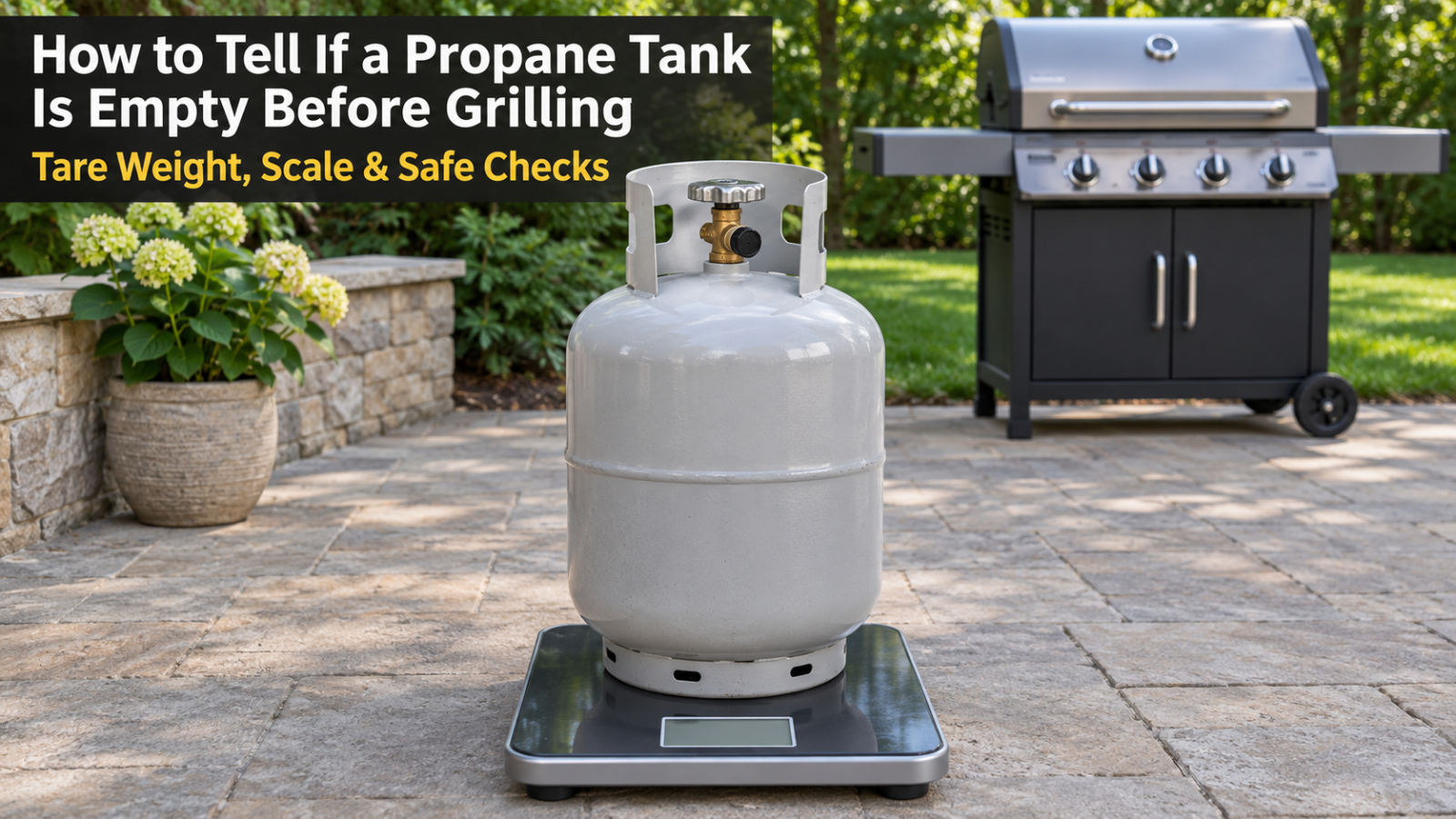
How to tell if a propane tank is empty is easiest with a bathroom or luggage scale and the tare weight stamped on the cylinder collar. Weigh the disconnected cylinder, subtract its tare weight, and the difference is approximately the pounds of propane remaining. A warm-water check can show an approximate liquid level, but it cannot replace the scale when you need a dependable number.
Quick Answer: How Can You Check a Grill Propane Tank?
Turn every burner off, close the cylinder valve, let the grill cool, and disconnect the cylinder outdoors according to the grill manual. Weigh it, then subtract the “T.W.” number stamped on its collar. If a cylinder marked T.W. 17.5 weighs 18.2 pounds, only about 0.7 pound of propane remains. Reconnect it correctly and perform the required leak check before lighting.
Key Points
- Weighing is the most useful home check. Total weight minus the stamped tare weight equals approximate propane weight.
- Read the cylinder collar. “T.W.” means the empty-cylinder weight, not the amount of fuel it holds.
- A standard grill cylinder usually holds up to 20 pounds of propane. The cylinder itself often weighs roughly 16–18 pounds, but use its own stamp.
- The warm-water method is approximate. A cool line on the cylinder wall shows the liquid level, not an exact number of pounds.
- Weak flame does not prove the tank is empty. A tripped regulator, closed valve, blocked burner, leak, or damaged hose can cause similar symptoms.
- Reconnect safely. Check the connection for leaks as the grill manual directs, and never use a flame to find a leak.
Why Is Weighing Better Than Guessing by Flame Size?
Weighing measures how much mass remains in the cylinder, while flame size is affected by the regulator, burner condition, valve position, outdoor temperature, and leaks. A scale answers the fuel question without asking you to light the grill.
Propane inside the cylinder exists mainly as liquid with vapor above it. The pressure can remain usable while liquid propane is still present, so a pressure-style gauge may sit in a broad “good” zone and then fall quickly near empty. A low burner flame is therefore a troubleshooting clue, not a fuel measurement.
If every burner suddenly becomes weak, the tank may be nearly empty, but the regulator’s excess-flow protection may also have been triggered by opening valves in the wrong sequence. The site’s gas grill troubleshooting guide separates fuel problems from regulator and burner problems.
What Does the Tare Weight on a Propane Tank Mean?
Tare weight is the empty weight of that specific cylinder, including its valve. It is stamped on the metal collar as “T.W.” followed by a number, usually expressed in pounds for a U.S. grill cylinder.
Do not use a generic empty weight from the internet when the cylinder has its own stamp. Two 20-pound-capacity cylinders can have different steel thickness, valve hardware, and empty weights.
| Collar marking | Meaning | How to use it |
|---|---|---|
| T.W. 17.5 | Empty cylinder weighs 17.5 lb. | Subtract 17.5 from the current scale weight |
| W.C. | Water capacity used for cylinder specifications | Do not use as the empty weight |
| Date stamp | Manufacture or requalification information | Let the propane retailer determine current fill eligibility |
If the T.W. stamp is unreadable, do not guess. A propane retailer can inspect the cylinder, identify its markings, and determine whether it remains eligible for filling or exchange.
How Do You Weigh a Propane Tank Safely?
Shut down the grill, close the cylinder valve, disconnect it outdoors after the grill is cool, and place the upright cylinder on a scale. Subtract the stamped tare weight from the measured total.
- Finish or stop the cook. Turn all burner controls off. Close the propane cylinder valve clockwise. Follow the shutdown order in your exact grill manual.
- Let the grill cool. Do not work beside hot burners, grease, sparks, cigarettes, or any other ignition source.
- Disconnect outdoors. Keep the cylinder upright on a firm surface. Use the manual’s instructions for the regulator connection; do not use tools unless the connection specifically requires them.
- Inspect before lifting. Do not handle a cylinder that is leaking, badly rusted, bulging, burned, dented at the valve, or otherwise damaged. Move away and contact the propane retailer or emergency services as appropriate.
- Read the T.W. stamp. Find it on the protective collar and write the number down.
- Place the cylinder upright on a scale. A bathroom, shipping, or luggage scale that can safely support the cylinder works.
- Subtract. Current total weight minus tare weight equals approximahow-to-tell-if-a-propane-tank-is-empty-featuredte pounds of propane.
- Reconnect correctly. Keep burner controls off, thread or seat the regulator as the manufacturer directs, then perform the manual’s leak test before lighting.
Use safe lifting technique. A full standard cylinder can weigh close to 40 pounds. If that is too heavy or awkward, ask a propane retailer to weigh it rather than risking a fall or back injury.
How Do You Calculate the Propane Remaining?
Subtract the cylinder’s stamped tare weight from its measured total weight. Divide that fuel weight by the cylinder’s rated propane capacity if you also want an approximate percentage.
Formula: Scale weight − T.W. = pounds of propane remaining
| Example | Calculation | Practical meaning |
|---|---|---|
| T.W. 17.5 lb.; scale reads 37.5 lb. | 37.5 − 17.5 = 20 lb. | Approximately full for a standard 20-lb. fill |
| T.W. 17.5 lb.; scale reads 27.5 lb. | 27.5 − 17.5 = 10 lb. | About half of a 20-lb. propane fill remains |
| T.W. 17.5 lb.; scale reads 18.2 lb. | 18.2 − 17.5 = 0.7 lb. | Nearly empty; exchange or refill before a long cook |
Scale resolution, surface level, and regulator removal affect precision. Treat tenths of a pound as an estimate. The calculation is still far more useful than shaking or tapping the cylinder.
How Long Will the Remaining Propane Last?
Remaining time depends on the total burner input and how high you run the grill. A rough estimate can be made from the propane weight and the grill’s BTU-per-hour rating, but wind, preheating, burner settings, and regulator behavior keep it from being exact.
One pound of propane contains roughly 21,500 BTU of energy. A grill rated at 30,000 BTU per hour would theoretically use about 1.4 pounds per hour with every burner at maximum. Normal cooking often uses less because burners cycle or run below high.
Approximate maximum-output hours: pounds remaining × 21,500 ÷ total grill BTU per hour
Example: 5 pounds remaining in a 30,000-BTU grill gives about 3.6 theoretical hours at full rated input. Do not plan a long brisket or party cook with no margin. Preheating and colder weather consume fuel too.
How Does the Warm-Water Propane Check Work?
Pour warm tap water down one side of the closed, upright cylinder, wait a few seconds, then run your hand down that area. The metal should feel cooler where liquid propane inside absorbs heat; the top of that cool area approximates the liquid level.
- Turn all burners off and close the cylinder valve.
- Keep the cylinder upright outdoors on stable ground.
- Use warm tap water—not boiling water.
- Pour it slowly down one side of the cylinder.
- Wait several seconds, then feel from the top downward.
- Mark the point where the metal changes from warm to noticeably cooler.
The Tennessee Propane Gas Association describes this cool-line method in its guide to checking a grill cylinder. It is useful for a quick level estimate, not a leak test or a precise remaining-weight calculation.
Never heat the cylinder with a torch, flame, heat gun, heater, boiling water, or another improvised heat source. Do not tip, roll, or shake the cylinder to “hear” the fuel.
Do Propane Tank Gauges Work?
A weight-based gauge can provide a useful level estimate, while a simple pressure gauge is better at showing general pressure than exact remaining fuel. Read the gauge maker’s instructions and verify its reading against the tare-weight calculation before relying on it for a long cook.
- Platform or hanging scale: measures cylinder weight and can be reasonably useful.
- Inline pressure gauge: easy to read but affected by temperature and may not show a steady percentage decline.
- Ultrasonic sensor: estimates the liquid boundary through the cylinder wall; placement and cylinder condition matter.
- Adhesive temperature strip: helps reveal the warm-water cool line but remains approximate.
A gauge does not replace inspection, correct regulator connection, or leak testing. If a connected gauge itself introduces a new joint, that connection must be handled exactly as its instructions and the grill manual require.
Does a Weak Flame Mean the Propane Tank Is Empty?
No. A nearly empty cylinder can produce weak or fading heat, but the same symptom can come from a tripped regulator, partially closed valve, dirty burner, blocked air inlet, cold weather, damaged hose, or leak.
| Symptom | Possible cause | Safe next check |
|---|---|---|
| All burners weak | Low fuel or regulator bypass | Turn everything off, weigh the cylinder, then follow the manual’s regulator reset |
| One burner weak | Blocked burner ports or valve issue | Cool the grill and inspect only as the manual directs |
| Yellow, sooty flames | Airflow, blockage, fuel, or combustion problem | Shut down and use the yellow-flame troubleshooting guide |
| Hissing or propane odor | Possible leak | Do not light; close the valve if safe, move away, and get qualified help |
| Grill will not light after cylinder change | Connection, leak, regulator, or ignition issue | Verify the connection and use the site’s gas-grill diagnosis sequence |
Do not keep turning valves, disconnecting parts, or trying to relight when propane odor, hissing, flame near the hose, or fire outside the cookbox is present. Leave the area and call emergency services when the situation is urgent.
How Do You Reconnect the Cylinder Safely?
how-to-tell-if-a-propane-tank-is-empty-featuredReconnect it outdoors with all burner controls off, the cylinder upright, and the regulator aligned exactly as the grill manual shows. Open the cylinder valve only as directed, then check the connection for leaks before ignition.
- Inspect the regulator nut, hose, cylinder valve, and sealing surfaces for visible damage or debris.
- Do not use a cylinder or regulator that looks burned, cracked, badly corroded, or damaged.
- Attach the regulator by hand unless the manufacturer specifies a tool.
- Apply manufacturer-approved leak-detection solution or the soap-and-water method described in the manual.
- Watch for growing bubbles. If bubbles appear, close the valve. Tighten only as directed and retest.
- If the leak continues, do not use the grill. Have the cylinder, regulator, or grill checked by the propane retailer or a qualified gas-appliance professional.
The U.S. Consumer Product Safety Commission advises checking for propane leaks when reconnecting a grill and says never to use a match or flame as the test. Its gas-grill safety guidance also says not to use a leaking grill until the problem is corrected.
What Should You Do If the Tank Runs Out Mid-Cook?
Turn the burner controls off, close the cylinder valve, and move the food to another safe cooking appliance if it cannot wait. Replace or refill the cylinder only after the grill is cool enough to handle and the new connection can be leak-tested.
Perishable food should not sit while you make a long fuel run. Keep hot food at 140°F or above, refrigerate it within two hours—one hour above 90°F—or continue cooking promptly on an indoor oven or another grill. Ground meat must reach 160°F, poultry 165°F, and whole beef, pork, lamb, or veal cuts 145°F followed by a three-minute rest.
Do not place a spare propane cylinder under or beside the operating grill for convenience. Store cylinders upright outdoors in a location allowed by the cylinder supplier and local rules, away from heat and ignition sources. The site’s grill storage guide covers longer shutdowns.
What Propane-Level Mistakes Should You Avoid?
Avoid judging only by flame size, using a generic empty-cylinder weight, heating the tank, testing leaks with fire, storing a spare under the grill, and reconnecting without a leak check. These shortcuts trade a few minutes for unnecessary uncertainty or risk.
- Shaking, rolling, or tipping a cylinder
- Using a torch, heat gun, boiling water, or flame to reveal the liquid line
- Subtracting 17 pounds automatically instead of reading the actual T.W. stamp
- Assuming a pressure gauge is an exact fuel-percentage gauge
- Trying repeated ignition when propane odor is present
- Using matches or a lighter to locate a leak
- Repairing or modifying the cylinder valve, regulator, or hose
- Keeping the cylinder indoors, in a garage, or in an enclosed area
- Leaving a spare cylinder near heat or beneath the grill
Frequently Asked Questions
How much does an empty propane grill tank weigh?
Many standard cylinders weigh roughly 16–18 pounds empty, but the correct figure is the T.W. stamp on that cylinder’s collar. Do not substitute an average when calculating fuel.
How much does a full 20-pound propane tank weigh?
Add 20 pounds to the stamped tare weight. A cylinder marked T.W. 17.5 would weigh about 37.5 pounds when holding 20 pounds of propane.
Can you tell propane level by tapping the tank?
Tapping may produce a change in sound, but it is too subjective for planning a cook. Use the stamped tare weight and a scale, or the warm-water method for a quick approximate level.
Can you use hot water to check a propane tank?
Use warm tap water on a closed, upright cylinder outdoors to find an approximate cool line. Do not use boiling water, flame, a torch, heat gun, or heater.
Why does the propane gauge still show green when the tank feels empty?
Many inline gauges respond to pressure, which is affected by temperature and may remain fairly steady while liquid propane is present. Confirm with a scale and the cylinder’s tare weight.
Should you keep a spare propane tank beside the grill?
No. Propane-safety guidance says not to store or place a spare cylinder under or near a barbecue grill. Keep it upright outdoors in an approved location away from heat and ignition sources.
What if the propane tank weighs less than its tare weight?
Recheck the scale on a level surface and confirm you read the stamp correctly. The cylinder cannot normally weigh less than its own marked empty weight; a conflicting result means the measurement or identification is wrong.
Final Verdict: What Is the Best Way to Check a Propane Tank?
The best way to tell if a propane tank is empty is to weigh the disconnected, upright cylinder and subtract the tare weight stamped on its collar. Use the warm-water cool line only for a quick approximation. If the tank contains little fuel, exchange or refill it before a long cook; if fuel remains but the grill is weak, troubleshoot the regulator and burners instead of assuming the cylinder is empty. Reconnect outdoors and leak-test before lighting.
About the Author
Frank W. Roberts has been grilling since 1970 and writes Everything Grill Reviews to help backyard cooks solve equipment problems without unsafe shortcuts. This guide uses current propane-industry and CPSC safety guidance plus ordinary cylinder-weight calculations. It does not claim a physical test of a particular cylinder, gauge, regulator, or grill.