
Updated: November 25, 2026
By Frank W. Roberts
Updated and fact-checked: November 24, 2026
Knowing how to reheat smoked turkey is mostly about managing the second heating. The turkey already has its smoke flavor. Now it needs to reach a safe temperature without spending extra time uncovered in dry heat. For a family meal, a shallow covered pan is easier to manage than trying to warm an entire leftover bird.
Quick Answer
Reheat refrigerated smoked turkey in a shallow covered pan at 325°F with a little broth. Keep breast slices separate from large bone-in pieces, and check several meat centers with a thermometer. Every portion should reach 165°F before serving. Reheat only what you need.
Jump to the covered-pan method | One-serving options | Storage limits
Key Points
- Use the right endpoint: Homemade turkey leftovers need 165°F throughout when reheated.
- Make an even layer: A deep pile heats less evenly than a shallow arrangement.
- Keep the cover snug: A fitted lid or crimped foil limits evaporation.
- Separate different cuts: Thin breast slices can finish before a large leg.
- Check early: Timing is an estimate; the coldest checked piece decides when the food is ready.
Which Reheating Method Should You Use?
Use a covered oven pan for several servings, a covered skillet for a small amount, or a microwave-safe dish for one plate. Choose the method that fits the portion you actually plan to eat.
| What you have | Practical choice | What to watch |
|---|---|---|
| Several servings of carved turkey | Covered shallow pan in a 325°F oven | Thick pieces and the middle of the pan |
| One or two servings of slices | Covered skillet with a little broth | Dry edges and cold overlapping areas |
| A single lunch portion | Covered, vented microwave-safe dish | Uneven heating; rearrange and check several places |
| A commercially prepared unopened smoked turkey | The exact product’s package directions | Whether it is fully cooked and which packaging can be heated |
These instructions are for fully cooked turkey that was cooled and stored properly. A smoked appearance does not establish that a purchased turkey is ready to eat. Read the label. Once a prepared turkey becomes household leftovers, use leftover-handling guidance.
How Do You Reheat Smoked Turkey in the Oven?
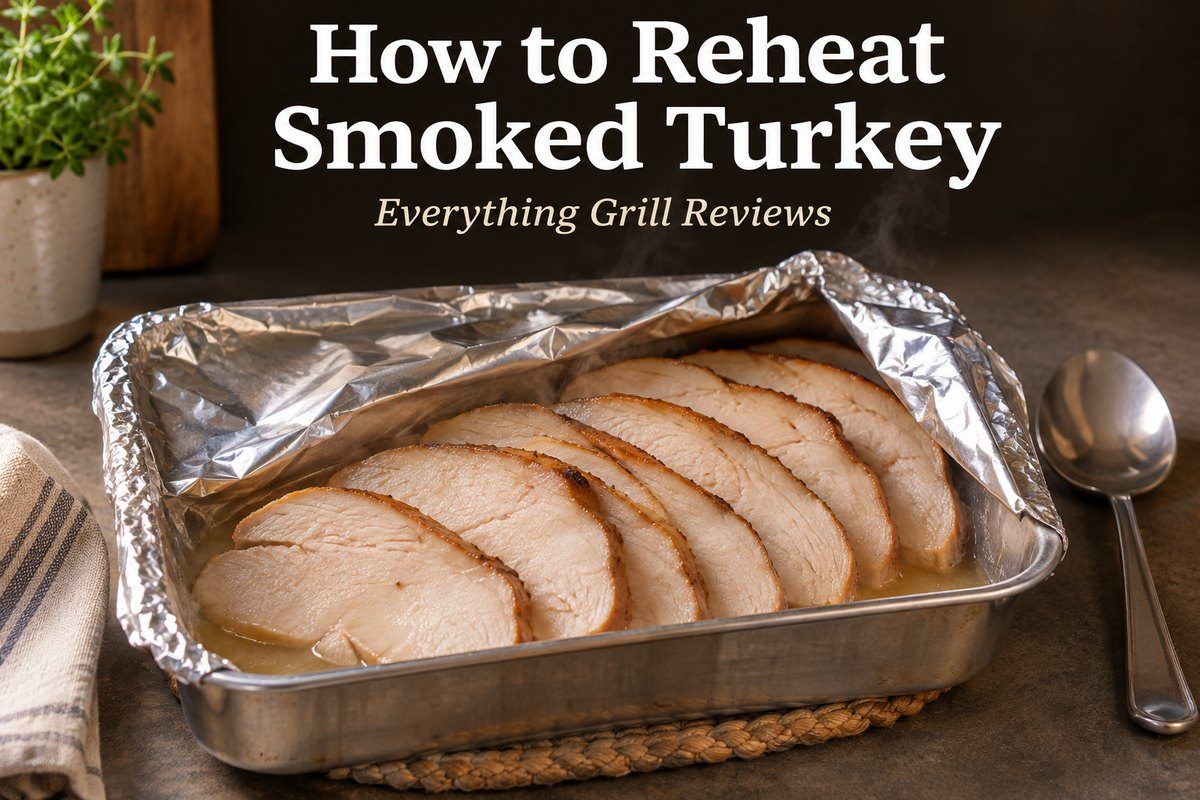
Arrange the chilled meat in a shallow pan, add a small amount of broth, cover tightly, and heat at 325°F until several checked centers reach 165°F. The following batch is sized for 2 pounds of carved turkey.
What You Need
- 2 pounds refrigerated, fully cooked smoked turkey, preferably in similar-size pieces
- ½ cup unsalted or low-sodium turkey or chicken broth
- A shallow metal baking pan, approximately 9 by 13 inches, and foil or a heat-safe fitted lid
- An instant-read food thermometer, serving tongs, and oven mitts
Preparation: About 10 minutes.
Estimated heating for an even layer of slices: About 25–45 minutes; begin checking at 20 minutes.
Yield: About 6–8 servings at 4–5 ounces per person, depending on the meal.
Important: Large bone-in pieces can take substantially longer. This is not a whole-bird timing chart.
- Preheat to 325°F. Keep the turkey refrigerated during preheating. There is no need to leave it on the counter to reach room temperature.
- Sort the meat. Put breast slices together and large legs or thighs in a separate pan. If you have thick boneless breast sections, cut them into roughly ½-inch serving slices for a more manageable reheat. Use a clean board and knife.
- Make a shallow layer. Arrange slices with a little overlap rather than building a deep stack. If 2 pounds will not fit this way, use two pans and divide the broth between them.
- Add the broth. Distribute the ½ cup around the meat. The goal is a little liquid across the bottom, not a pan of soup. Do not add extra salt before tasting; smoked turkey and broth may already supply plenty.
- Cover firmly. Crimp foil around the rim or use a fitted lid. Leave the foil above the food rather than pressing it down into the turkey.
- Start checking at 20 minutes. Pull the pan out with mitts and open a corner away from your face. Probe several thick slices, including pieces near the center. Check meat, not the hot broth or metal pan. Replace the cover and continue in roughly 5-minute intervals if any checked portion is below 165°F.
- Serve when ready. Remove portions that have reached 165°F to a clean serving dish while larger pieces finish. Spoon a little hot pan liquid over the meat and serve promptly.
The USDA’s safe-reheating guidance calls for an oven set no lower than 325°F and leftovers heated to 165°F. Do not use the original low smoking temperature as the reheating setting.
Where Should You Put the Thermometer?
Insert the sensing tip into the center of the thickest meat, preferably from the side of a slice, and check more than one piece. Avoid bone, the pan, and the surrounding liquid.
With thin slices, the probe’s sensing area must still fit inside the food. Use a thin-tip thermometer designed for thin foods and follow its insertion instructions. A reading taken with the tip sticking through the slice can describe the air or broth rather than the turkey.
Our guide to using a meat thermometer correctly explains placement. Start with a clean probe; the guide to cleaning a grill thermometer probe covers the food-contact parts without soaking the electronics.
How Do You Reheat One Serving Without Heating the Oven?
For about 4–6 ounces of sliced turkey, use a covered skillet with 2 tablespoons of broth, or a covered microwave-safe dish with 1 tablespoon. Check the meat’s temperature instead of relying on steam or a fixed number of minutes.
Covered Skillet
Lay the slices in one shallow layer, add the broth, cover, and warm over medium-low heat. Turn the slices carefully and check their centers. If the pan becomes dry, add another spoonful of water or broth. Continue until the meat reaches 165°F; reduce the burner if the liquid boils hard.
Microwave
Use a vented microwave-safe cover and medium power. Begin with a short interval, such as 1 minute, then turn or rearrange the slices and continue in shorter bursts. Follow the microwave’s standing-time instructions and check several spots for 165°F. Power, portion size, and thickness change the timing. Never microwave the foil used for the oven method.
If you want gravy, reheat it separately to a boil before serving it with the hot turkey. The USDA’s leftover reheating advice also explains covering and rotating microwave food to reduce cold spots.
Can You Reheat Smoked Turkey on a Pellet or Gas Grill?
Yes. Use the grill as an outdoor oven: stabilize it at about 325°F, place the covered metal pan over indirect heat, and check the turkey for 165°F. Keep the pan away from direct flames.
On a gas grill, leave the burner beneath the pan off and use the other burners to maintain heat. On a pellet grill, use its normal indirect setup and keep any direct-flame feature closed. Follow your cooker’s operating instructions and leave room around the pan for air to circulate.
A sealed pan will not take on much new smoke. That is fine for this job. Do not add a smoke tube simply to repeat the first cook. Rotate the pan if one side heats faster, and have a preheated indoor oven available if the grill cannot hold temperature.
Why Is the Turkey Still Dry After Adding Broth?
Broth helps the serving stay moist, but it cannot undo every effect of overcooking. Check whether the turkey was already dry, the cover leaked, or the meat stayed in the heat after reaching its reheating temperature.
| Problem | Likely explanation | Useful correction |
|---|---|---|
| Edges dry while the middle is cold | Mixed thicknesses or a deep pile | Separate the pieces, make a shallower layer, and keep covered |
| Pan becomes dry | Loose cover or too little liquid for the pan | Add a small splash of broth and seal the cover again |
| Everything is hot but the breast is tough | Turkey may have been overcooked originally or heated too long | Chop and serve with hot gravy; check earlier next time |
| Skin is soft | Covered moist heating softens the surface | Prioritize the meat; a crisp-skin finish is optional and can dry it further |
How Long Can You Keep Smoked Turkey Leftovers?
Refrigerate promptly in shallow containers at 40°F or below and use within 3–4 days. The usual room-temperature limit is 2 hours, shortened to 1 hour above 90°F. Smoking does not make homemade turkey shelf-stable.
Those limits follow USDA leftover-storage guidance. Freeze meal-size portions if you will not use them in time, and thaw in the refrigerator before using this method. Do not count reheating as a fresh 3–4-day storage period or use it to rescue food left out too long.
Keep the portion for tomorrow chilled while reheating today’s meal. If you are planning the original cook rather than handling leftovers, our grilled turkey legs guide covers the first cooking stage.
FAQ
Does smoked turkey need to reach 165°F again?
Yes, when reheating homemade leftovers. An unopened commercially prepared product may carry specific heating directions; follow its label rather than treating every smoked product alike.
Can you reheat smoked turkey in a slow cooker?
Use the oven, stovetop, or microwave to reheat it. USDA advises against reheating leftovers in a slow cooker because they may warm too slowly.
Should you put butter on every slice?
No. A little broth and a snug cover are enough for the basic method. Butter is an optional flavor addition, not a substitute for checking the meat and stopping the heat on time.
Should you reheat the whole leftover turkey?
Carved portions are easier to arrange and check. Reheating only the amount needed also leaves the rest safely refrigerated. Use the package directions if you bought a whole fully cooked turkey specifically intended to be heated whole.
Final Verdict
For several servings, reheat smoked turkey in a shallow covered pan at 325°F with a little broth. Sort the cuts, begin checking early, and stop each portion at 165°F. The useful upgrade is better control of the pieces you have, not another long smoking session.
About Frank W. Roberts
Frank W. Roberts is the author of Everything Grill Reviews and has grilled since 1970. This guide combines practical cooking analysis with published USDA safety guidance. Heating times are planning estimates; no timed physical test is claimed.