
Updated: October 9, 2026
Updated and fact-checked: October 8, 2026
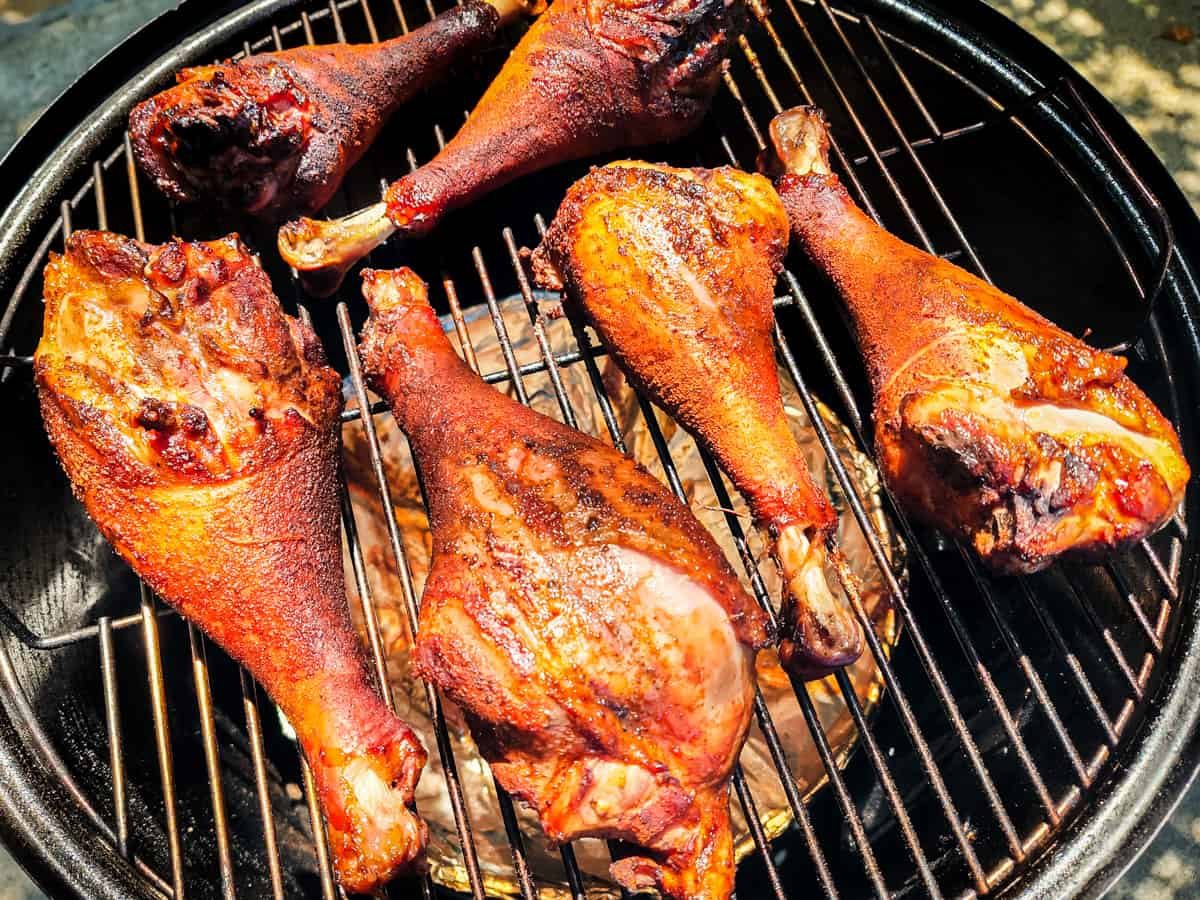
Grilled turkey legs are done at 165°F in the thickest meat, away from the bone, whether the cooker is gas, charcoal, or pellet. The practical setup is indirect heat around 325–350°F so the skin can brown without the meat nearest the bone staying under temperature. Clock time is only an estimate.
Quick Answer: How Do You Grill Turkey Legs on Gas, Charcoal, or Pellet?
Cook turkey legs indirect to 165°F away from the bone. Hold gas or pellet around 325–350°F, or bank charcoal to one side. A 3/4- to 1-pound leg often needs about 1 hour 15 minutes to 2 hours. The thermometer, not the clock, decides.
Key Points
- USDA lists 165°F as the safe minimum for all poultry, including legs, thighs, wings, and ground poultry.
- Probe the thickest meat beside the bone, not the bone itself, and check more than one leg.
- Gas and charcoal want a two-zone fire. A pellet grill already cooks mostly indirectly.
- A long stay at 225°F adds smoke but often leaves turkey skin rubbery. Finish hotter if the skin is still pale.
- Sauce only after the legs are at 165°F and the skin has set. Sugar burns over direct heat.
- USDA oven charts are not grill timers. Weather, grate height, and lid openings change the cook.
What Temperature Are Grilled Turkey Legs Done?
Grilled turkey legs are safe at 165°F in the thickest meat, measured away from the bone. The USDA Food Safety and Inspection Service lists 165°F for all poultry, including breasts, whole birds, legs, thighs, wings, ground poultry, giblets, and stuffing. Color, clear juices, and a loose joint are not proof the leg is safe.
For texture, some cooks leave dark meat on a little longer after it has already reached 165°F. That is a preference, not a second safety rule. If you do it, stay indirect so the skin does not scorch while the meat near the joint finishes. Pull the legs once your chosen temperature is reached in the thickest spot of each leg you plan to serve.
The USDA oven timetable at 325°F lists about 2 to 2¼ hours for drumsticks of ¾ to 1 pound. Use that only as a planning range. A grill is not an oven. Wind, a cold start, a full grate, and opening the lid can stretch or shorten the cook. Last verified against the USDA safe-temperature chart and turkey cooking guidance on October 8, 2026.
What Do You Need for Grilled Turkey Legs?
Start with thawed turkey drumsticks, salt, a two-zone or pellet setup, and a food thermometer. This batch serves four. Buy legs of similar size so they finish together.
Ingredients
- 4 turkey drumsticks, about ¾ to 1 pound each, fully thawed
- 1 tablespoon kosher salt, or about 2 teaspoons fine table salt
- 2 teaspoons black pepper
- 2 teaspoons paprika
- 1 teaspoon garlic powder
- 1 teaspoon onion powder
- 1 tablespoon neutral oil
- Optional glaze after the legs reach 165°F: 1/4 cup barbecue sauce
Equipment
- Gas grill, charcoal grill, or pellet grill
- Instant-read thermometer
- Tongs and a sheet pan for the rest
- Charcoal chimney and an approved starter if you are using charcoal
- Optional: one small wood chunk for charcoal, or a mild pellet such as oak, apple, or pecan
How Do You Prepare Turkey Legs Before They Hit the Grill?
Thaw the legs in the refrigerator, pat them dry, and salt them before they go on the fire. USDA roasting times assume a fully thawed bird held at 40°F or below. A partly frozen leg cooks unevenly and can look done on the outside while the meat near the bone is still under 165°F.
- Thaw in the refrigerator. Do not leave raw turkey on the counter to finish thawing.
- Pat the skin dry with paper towels. Wet skin steams instead of browning.
- Salt the legs at least 1 hour ahead, or the night before, uncovered in the refrigerator if the skin should dry further.
- Just before cooking, add pepper, paprika, garlic powder, and onion powder. Rub on a thin coat of oil so the seasoning sticks.
- Leave the barbecue sauce off. Sugar will darken fast over any hot spot.
Keep raw turkey and its juices off ready-to-eat food. Wash hands, the board, and the tongs that touched raw legs before they touch the finished meat.
How Do You Set Up Gas, Charcoal, and Pellet for Turkey Legs?
Gas and charcoal need a hot side and a cool side. A pellet grill needs a steady set point and space between the legs. The target chamber temperature for the main cook is about 325–350°F on all three.
| Grill | Setup | Main heat | Finish |
|---|---|---|---|
| Gas | Light one side only. Preheat with the lid closed. | Legs on the unlit side, about 325–350°F at the grate | Short move toward the lit side for color, off direct flare-ups |
| Charcoal | Ash a chimney, bank the coals on one side, vents open | Legs opposite the coals, lid on, about 325–350°F | Move closer to the coals only after 165°F if the skin is pale |
| Pellet | Fill the hopper with dry pellets and preheat to the set point | 325–350°F, legs not touching | Raise to 400°F for 5–10 minutes if the skin needs browning |
Two-zone gas and charcoal setup is the same idea used for other thick cuts: fire on one side, food on the other, lid closed. A pellet grill does not bank its firepot to one side the way a kettle does. If the skin still will not crisp, the hotter finish has to come from a higher set point, a gas or charcoal sear, or a hot oven, not from pretending the pellet grate has a true cool zone.
How Do You Cook Turkey Legs on a Gas Grill?
Roast the legs over the unlit burners at about 325–350°F until the thickest meat hits 165°F. Direct heat under a turkey leg burns the skin while the joint is still climbing.
- Turn on the burners on one side only. On a two-burner grill, that is one burner. On a three- or four-burner grill, one or two burners is enough.
- Close the lid and preheat until the cool side is in the 325–350°F range. Use a grate thermometer if the lid gauge sits far from the food.
- Set the legs on the unlit side, skin side up, with space between them. Close the lid.
- Start checking at about 1 hour. Rotate any leg that is browning faster than the others.
- When a leg reads 165°F away from the bone, you can slide it closer to the lit side for a few minutes of color. Watch for flare-ups from rendered fat.
- If you want sauce, brush it on only after 165°F and give it a minute or two to set.
Estimate for ¾- to 1-pound legs: about 1 hour 15 minutes to 2 hours. A cold, windy day can push that longer. Do not raise every burner to high to “catch up.” That is how the skin chars.
How Do You Cook Turkey Legs on a Charcoal Grill?
Bank ashed coals on one side and cook the legs on the empty side with the lid on. Charcoal gives the easiest browning of the three, and also the easiest burnt skin if the legs sit over the coals the whole time.
- Light a full chimney of charcoal. Wait until the top coals are ashed and the lower coals are glowing.
- Pour the coals into a bank on one side of the charcoal grate. Leave the other side empty. Add one small dry wood chunk on the coals if you want light smoke. Skip softwood and anything treated.
- Set the top grate in place, lid on, top and bottom vents partly open. Adjust the vents until the cool side holds about 325–350°F.
- Place the legs opposite the coals. Keep the lid closed except to turn or probe.
- If the fire fades before the legs are done, add a small batch of already-lit coals at the edge of the bank. Do not dump unlit charcoal under the meat.
- Probe each leg. At 165°F, move a pale leg nearer the coals for color, then take it off.
Same size range, same estimate: about 1 hour 15 minutes to 2 hours. Lump and briquettes do not burn at the same pace, so the thermometer on the grate matters more than the brand of charcoal.
How Do You Cook Turkey Legs on a Pellet Grill?
Preheat to 325–350°F and cook the legs until they reach 165°F, then raise the heat if the skin is still soft. Pellet grills are steady and mostly indirect. They are weaker at blistering poultry skin than a charcoal bank or a gas burner.
- Use dry pellets. Oak, apple, or pecan are mild enough for poultry. Do not load swollen or crumbly pellets.
- Preheat to 325°F or 350°F with the lid closed. Confirm the set point before the legs go on.
- Place the legs directly on the grate with space between them. A water pan is optional for a long cook and works against crisp skin, so skip it if browning matters.
- If you want more smoke, you can run 225–250°F for the first 30 to 45 minutes, then raise the grill to 350°F. Longer than that at low heat often leaves the skin rubbery.
- Start probing around 1 hour 15 minutes. Pull each leg at 165°F in the thickest meat.
- If the skin is pale, raise the grill to 400°F for about 5 to 10 minutes. Watch sweet rubs. They darken fast.
Estimate at 325–350°F: about 1½ to 2 hours for a ¾- to 1-pound leg. A low-then-high cook runs longer. Controllers vary, and a cold hopper or a windy patio can slow the climb to the set point.
How Should You Rest and Serve Grilled Turkey Legs?
Rest the legs about 10 to 15 minutes on a clean pan before you slice or pull the meat. USDA suggests a 20-minute stand for a whole roasted turkey so it carves more cleanly. Legs are smaller, so 10 to 15 minutes is enough to let the juices settle. That rest is for texture, not a safety substitute for 165°F.
Slice the meat off the bone, or serve the leg whole with the sauce on the side. Refrigerate leftovers within 2 hours, or within 1 hour if the air is above 90°F. USDA lists 3 to 4 days in a 40°F refrigerator for cooked turkey, and reheating to 165°F. Cut large pieces down before chilling so they cool faster.
What Mistakes Ruin Grilled Turkey Legs?
The usual misses are direct heat the whole time, a thermometer in the bone, and sauce too early. Fix those and the legs are much harder to ruin.
- Skin burns, joint is under 165°F: the leg was over the coals or the lit burners. Move it to indirect heat and finish there.
- Meat is dry: it went well past 165°F on high heat, or the skin was wet and the cook dragged on. Salt ahead, stay near 325–350°F, and pull at temperature.
- Skin is rubbery on the pellet grill: the low-smoke stage ran too long. Finish at 375–400°F, or crisp on a hotter grill.
- One leg is done and another is not: sizes were mixed, or one sat in a hot spot. Probe every leg.
- Pale smoke taste and bitter skin: the charcoal fire was smoldering with the vents choked. Open the vents and burn clean wood or charcoal, not wet fuel.
Final Verdict: Which Grill Should Cook the Turkey Legs?
Use the grill you already have, and cook the legs indirect to 165°F. Charcoal browns the skin most easily. Gas is the simplest two-zone setup if the burners light and hold. A pellet grill is the steadiest temperature and the mildest smoke, with the weakest skin unless you finish hotter. None of the three is safe to judge by color.
Frequently Asked Questions
Can you grill frozen turkey legs?
No. Thaw them in the refrigerator first. USDA cooking times assume a fully thawed turkey at 40°F or below. A frozen center can stay under 165°F after the outside looks done.
Do turkey legs need to rest after grilling?
A short rest helps the meat hold juice, but it does not replace the temperature check. Give the legs about 10 to 15 minutes on a clean pan. The safe minimum is still 165°F before they leave the grill.
What pellets or wood work with turkey legs?
Mild hardwood is enough. Oak, apple, or pecan pellets, or one small hardwood chunk on a charcoal fire, will season the meat without covering it. Do not use treated lumber, softwood scraps, or damp pellets.
How long do grilled turkey legs take?
Plan on about 1 hour 15 minutes to 2 hours for a ¾- to 1-pound leg at 325–350°F indirect. That is an estimate. The USDA 325°F oven chart is about 2 to 2¼ hours for the same size drumstick, and a grill can run faster or slower. Pull each leg at 165°F.
Related Reading
- How to Set Up Two-Zone Grilling on Charcoal or Gas
- How to Light a Charcoal Grill Without Lighter Fluid
- How to Get Crispy Chicken Skin on a Pellet Grill
- Pellet Grill Chicken Breast Recipe (350°F to 165°F)
- USDA safe minimum internal temperature chart
About Frank W. Roberts
Frank W. Roberts is the author of Everything Grill Reviews. He has grilled since 1970 and brings more than 50 years of backyard cooking and cookoff experience to fire management, fuel behavior, smoke, and practical cooker use. This recipe uses that fire-management experience and USDA poultry guidance. It is not a claim that Frank timed these legs on a named gas, charcoal, or pellet model. Last verified October 8, 2026.