
Updated: November 20, 2026
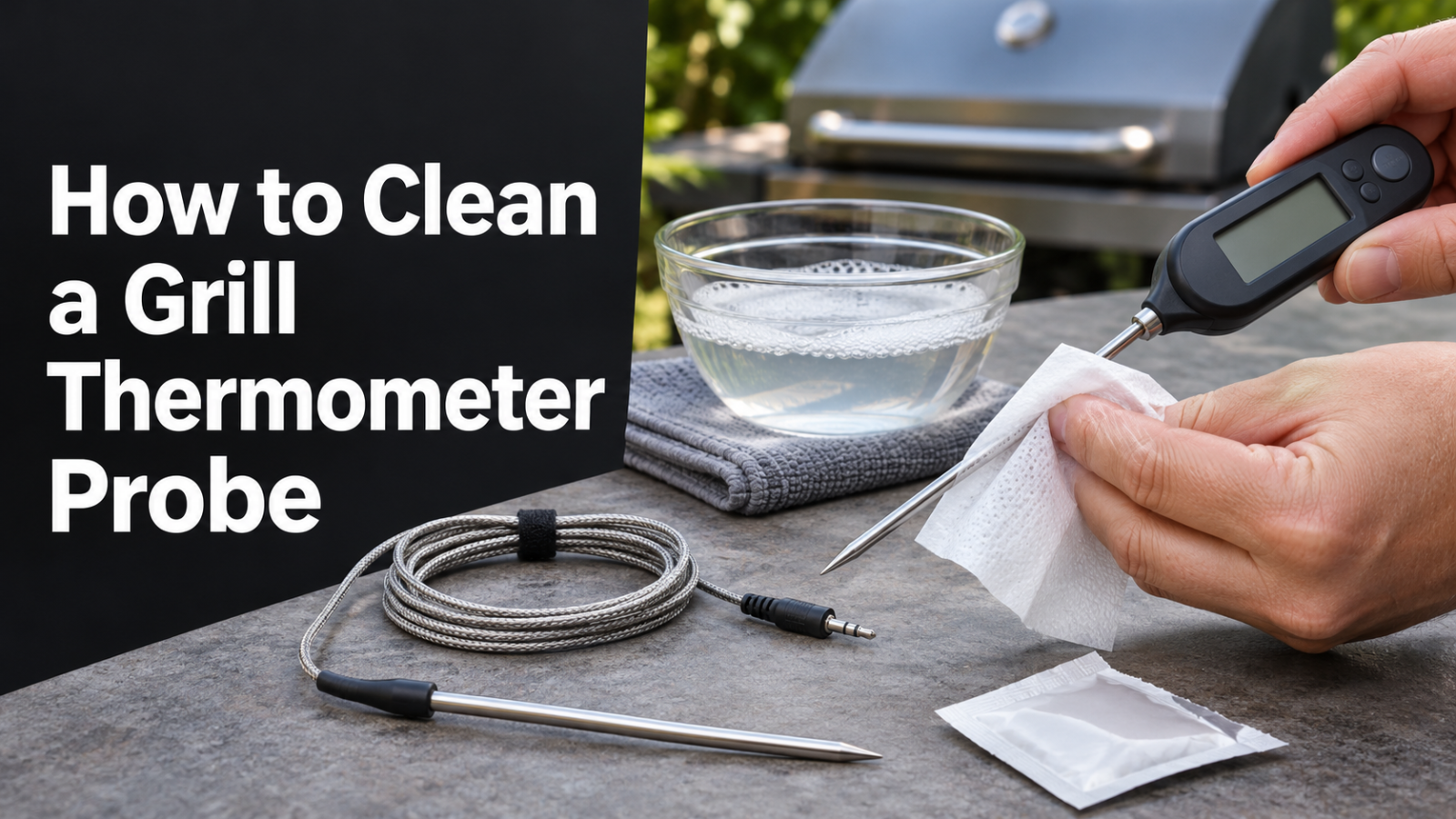
Knowing how to clean a grill thermometer probe prevents raw-meat juices from reaching cooked food and helps the sensor respond properly. The basic method is simple: clean the metal probe after every use, sanitize the food-contact section, keep the electronic housing and cable connection dry, and store the cable without sharp bends.
Quick Answer: How Do You Clean a Grill Thermometer Probe?
Let the probe cool, wipe off food, then wash the stainless-steel food-contact section with warm soapy water. Rinse or wipe away the soap, sanitize with a food-safe alcohol probe wipe or another sanitizer approved by the thermometer maker, and air-dry. Do not submerge the display, connector, cable-to-probe junction, or any part the manual does not identify as waterproof.
Key Points
- Clean and sanitize after contact with raw meat and before testing ready-to-eat food.
- Clean only after the probe has cooled enough to handle safely.
- Waterproof claims apply only to the parts and depth stated in the manual.
- Never soak a wired probe’s braided cable, plug, or probe junction unless the manufacturer specifically allows it.
- A clean probe can still be inaccurate; verify it with an ice-water check when readings seem wrong.
- Replace kinked cables, loose connectors, cracked insulation, or probes that fail the maker’s accuracy check.
Why Does a Grill Thermometer Probe Need Cleaning?
A probe moves between raw and cooked food, so it can carry bacteria just like a knife or cutting board. Grease and carbon also insulate the sensing area, slow response, hide damage, and leave flavors on the next food.
The USDA Food Safety and Inspection Service’s food-thermometer guidance says the thermometer should be washed with hot, soapy water before and after each use. Manufacturer instructions add an important limit: protect housings and connections that are not rated for immersion.
What Type of Thermometer Are You Cleaning?
The safe cleaning boundary depends on the design. Identify the probe before putting any part near water.
| Type | Clean this | Keep dry unless the manual says otherwise |
|---|---|---|
| Folding instant-read | Metal stem and hinge groove | Display, battery door, buttons, and housing |
| Wired leave-in probe | Metal shaft and food-contact tip | Braided cable, plug, cable junction, and display unit |
| Wireless probe | Only to the depth and method specified for that exact model | Charging dock and any unsealed charging contacts |
| Built-in grill sensor | Accessible sensor surface according to the grill manual | Wiring, controller, connectors, and mounting penetrations |
| Analog dial thermometer | Stem and food-contact area | Dial case unless explicitly waterproof |
What Supplies Do You Need?
Use gentle tools that remove grease without scratching the sensor or forcing moisture into the electronics.
- Warm water and a small amount of dish soap
- Soft cloth, nonabrasive sponge, or paper towel
- Food-safe alcohol probe wipes or manufacturer-approved sanitizer
- Clean single-use towel or drying rack
- Cup, ice, and clean water for an optional accuracy check
Skip steel wool, grill brushes, scouring powder, oven cleaner, and strong solvents. They can scratch the probe, damage seals, or contaminate food-contact surfaces.
How Do You Clean an Instant-Read Probe?
Clean the metal stem without soaking the thermometer body.
- Let the metal cool. Fold or retract it only after it is safe to touch.
- Wipe away visible food and grease with a damp towel.
- Wash the stem with warm soapy water, keeping the housing above the water line.
- Wipe or rinse the stem with clean water without running water over the display or battery door.
- Use a food-safe probe wipe on the full food-contact section.
- Air-dry or dry with a clean single-use towel. Clean the hinge groove with a damp cloth, not by soaking it.
ThermoWorks advises cleaning the probe whenever it contacts raw meat and wiping the casing without getting it wet unless the instrument’s IP rating supports water exposure. Follow the exact manual even when a different model looks similar.
How Do You Clean a Wired Leave-In Probe?
Wash the metal shaft, but protect the cable, junction, plug, and display unit.
- Unplug the probe from the thermometer after the cook and let it cool.
- Hold the metal shaft pointed downward so liquid runs away from the cable junction.
- Wipe the shaft with a soapy cloth until grease is gone.
- Wipe again with a clean damp cloth, then sanitize the food-contact area.
- Dry the shaft and inspect the junction for looseness or cracks.
- Coil the cable loosely. Do not wrap it tightly around the display or fold it at the plug.
If grease is baked onto the probe, hold a warm, soapy cloth around the metal for a few minutes, then wipe again. Do not scrape the shaft with a knife or soak the cable junction to soften residue.
How Do You Clean a Wireless or Built-In Probe?
Use the exact manufacturer instructions because water resistance, dishwasher approval, charging contacts, and sensing zones vary widely.
For a wireless probe, confirm whether the whole probe is washable, merely splash-resistant, or dishwasher-safe. Clean charging contacts only as directed and dry them before docking. For a built-in grill sensor, shut the grill down, unplug it, let it cool, and wipe the accessible sensor gently. Do not bend it, sand it shiny, spray cleaner into the controller, or remove it unless the service instructions say it is owner-removable.
What Is the Difference Between Cleaning and Sanitizing?
Cleaning removes grease and food; sanitizing reduces microorganisms on an already clean surface. A sanitizer cannot work reliably through a layer of dried meat juice.
- Clean: remove visible soil with detergent and water.
- Rinse or wipe: remove detergent residue.
- Sanitize: use a food-contact product at its labeled contact time.
- Dry: air-dry or use a clean single-use towel.
A premoistened food-thermometer wipe is the simplest backyard option. Do not invent a stronger chemical mixture, mix sanitizers, or leave a fragranced household cleaner on the food-contact surface.
When Should You Clean the Probe During a Cook?
Clean it whenever moving from raw or undercooked food to food that is ready to eat.
| Situation | What to do |
|---|---|
| Probe checks raw chicken, then a nearly finished breast | Clean and sanitize between checks. |
| Same leave-in probe remains in one piece for the cook | Clean before insertion and after removal. |
| Probe falls on the patio or touches a dirty grate | Clean and sanitize before putting it back in food. |
| Checking several fully cooked portions | Keep the probe clean; sanitize if it touches an unclean surface. |
| Switching between allergen-containing and allergen-free food | Use separately cleaned equipment; a dedicated probe may be safer for severe allergies. |
The site’s guide to grilling chicken without drying it out explains correct probe placement and why a dirty probe can recontaminate cooked poultry.
Should You Check Accuracy After Cleaning?
Routine cleaning does not require calibration every time, but an ice-water check is useful after a drop, sudden reading change, cable kink, or long storage.
- Fill a cup with crushed ice, then add just enough water to fill the gaps.
- Stir and let the mixture settle briefly.
- Insert the sensing area without touching the cup’s sides or bottom.
- Compare the stable reading with the manufacturer’s acceptable tolerance around 32°F.
Some thermometers can be adjusted; others can only be checked. Follow the model instructions. Cleaning cannot repair a water-damaged sensor, a broken conductor, or a melted probe.
What Mistakes Damage Grill Thermometer Probes?
Most premature failures come from heat beyond the probe’s rating, water entering a connection, or repeated cable stress.
- Submerging the display or cable-to-probe junction
- Putting an unapproved probe in a dishwasher
- Closing a grill lid directly on the cable instead of using a probe port
- Letting a probe touch flame, a burner, hot coal, or the grate
- Pulling the probe out by its cable
- Wrapping the cable tightly around the display
- Using abrasives that scratch the metal or seals
- Assuming “water-resistant” means fully submersible
How Should You Store a Clean Probe?
Store it completely dry, protected from impact, and with the cable loosely coiled. Keep instant-read tips folded or capped. Do not trap a damp probe in a sealed case, leave it on a hot grill shelf, or store it where the cable will be crushed.
Frequently Asked Questions
Can You Wash a Meat Thermometer Under the Faucet?
Only if the manual and IP rating allow that exposure. The safer default is to wash the metal stem while keeping the housing and connections out of the water.
Can You Use Alcohol Wipes on a Thermometer Probe?
Yes, when the wipe is approved for food-contact thermometer probes. Remove visible grease with soap and water first, then follow the wipe’s contact and drying directions.
Can You Put a Grill Probe in the Dishwasher?
Only when the manufacturer explicitly labels that exact probe dishwasher-safe. Many wired probes, plugs, and electronic thermometers are not.
Why Does My Probe Read Incorrectly After Washing?
Moisture may have entered a junction or connector, or the probe may have been bent or damaged. Disconnect it, let it dry completely, run the manufacturer’s accuracy check, and replace it if it remains outside tolerance.
How Often Should You Replace a Grill Probe?
There is no universal schedule. Replace it when the cable is kinked or cracked, the junction is loose, the probe was exposed above its rated temperature, or it fails an accuracy check that the model cannot correct.
Verdict: What Is the Best Way to Clean a Grill Thermometer Probe?
Clean the cooled food-contact metal with warm soapy water after every use, sanitize it before it touches ready-to-eat food, and keep unsealed electronics and connections dry. That simple routine prevents cross-contamination and protects the probe better than soaking, scrubbing with abrasives, or guessing at chemical strength.
About the Author
Frank W. Roberts has been grilling since 1970 and writes Everything Grill Reviews for backyard cooks who want practical, safety-first help. This research-based guide uses current food-safety guidance and thermometer-manufacturer care instructions. It does not claim laboratory testing of a specific thermometer.