
Updated: November 27, 2026
By Frank W. Roberts
Updated and fact-checked: November 27, 2026
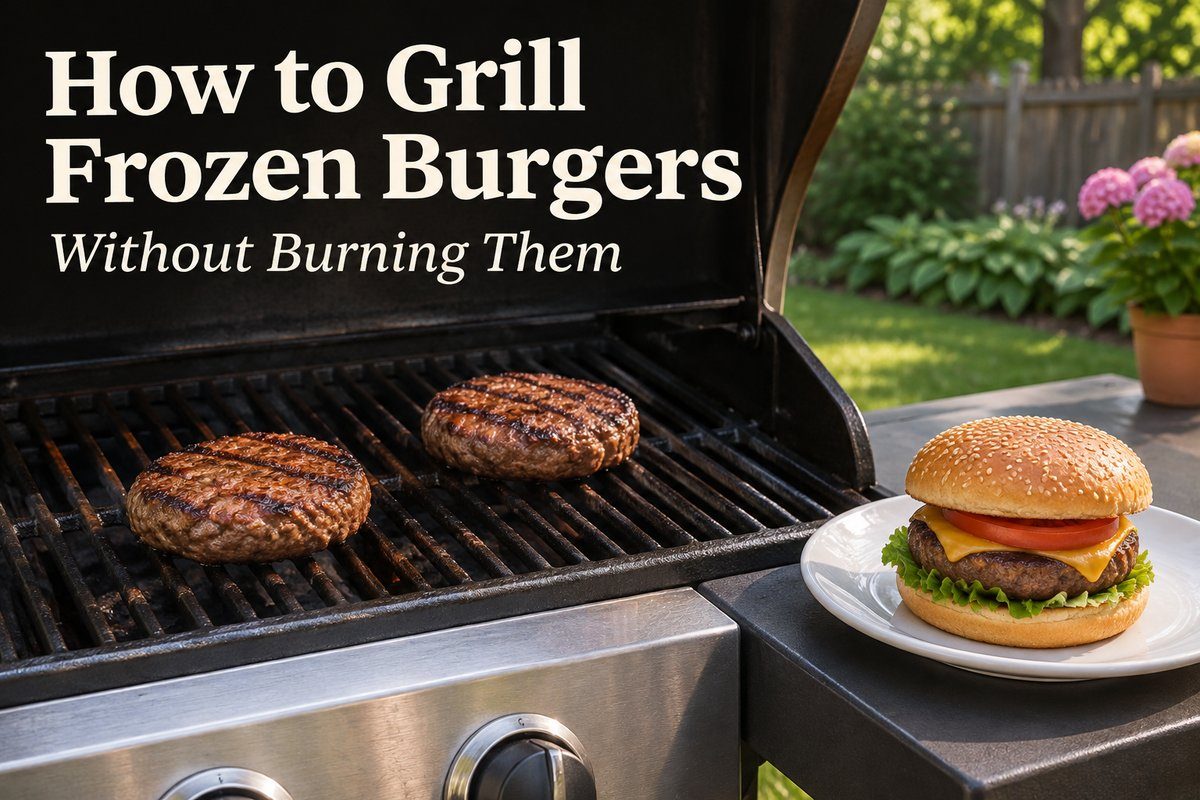
Learning how to grill frozen burgers comes down to managing the difference between the hot outside and the cold center. A patty can have a dark crust while the middle still needs cooking. Start with separate, evenly shaped patties, keep a gentler cooking zone available, and let a thermometer decide when dinner is ready.
Quick Answer
Grill separate, thin frozen beef patties on a preheated grill at roughly 350–400°F, with an indirect zone ready. Turn as the surfaces brown, move away from harsh heat when needed, and cook every patty to 160°F in the center. Follow the package directions; time and color alone cannot confirm doneness.
Jump to grill setup | Jump to the cooking steps | Find a problem and fix
Key Points
- Read the label first. This guide covers ordinary raw beef patties, not every frozen burger product.
- Cook individual patties. Remove all paper separators; do not grill a frozen stack.
- Keep somewhere to move them. An unlit burner area or coal-free side helps when browning gets ahead of the center.
- Measure each burger. Ground beef needs 160°F; burgers containing ground chicken or turkey need 165°F.
- Do not press with the spatula. Pressing sends fat toward the fire and squeezes out moisture.
Is It Safe to Grill Burgers Straight From Frozen?
Yes, uniformly thin frozen hamburger patties can be grilled without thawing. USDA makes that distinction in its guidance on grilling frozen meat. Check the package for the approved method and use a food thermometer rather than assuming a browned surface means a cooked center.
Thick homemade patties, stuffed burgers, and meat frozen in a solid block need a different plan. Thaw them safely in the refrigerator when required by their recipe or label. Do not try to force a knife between hard-frozen patties. If they will not separate easily, refrigerator thawing is safer than wrestling with the stack.
| What is in the package? | What to follow |
|---|---|
| Raw, plain beef patties | Use the label’s grilling method and reach at least 160°F in the center. |
| Raw chicken or turkey patties, including blends | Follow that product’s directions and reach at least 165°F. |
| Stuffed, breaded, fully cooked, or plant-based burgers | Use the product’s own method and temperature. Do not transfer the beef timing to a different product. |
The meat temperatures above follow the FoodSafety.gov minimum-temperature chart. Freezing does not make raw ground meat ready to eat.
What Do You Need Before You Start?
You need frozen patties, a preheated grill, a broad spatula, and a thin-tip instant-read food thermometer. A clean serving plate is just as important as the cooking tools.
- For a simple four-person meal: 4 plain frozen beef patties, about ¼ pound each, of similar thickness
- Salt and pepper to taste, unless the patties are already seasoned
- Optional: 4 buns, 4 cheese slices, and prepared toppings
- A broad grill spatula, heat-resistant gloves, and a clean platter
- A food thermometer whose sensing area fits inside a thin patty
Get toppings ready before the burgers go on. Keep the patties frozen until the grill is ready, and keep raw-meat packaging away from buns, lettuce, and the finished-food plate.
How Should You Set Up the Grill for Frozen Burgers?
Use moderate direct heat for browning and leave an indirect zone available for finishing. Roughly 350–400°F on the closed grill’s lid gauge is a practical starting range, unless the burger package calls for something different.
- Gas grill: Follow the grill’s lighting and preheating instructions. Adjust the lit burners for cooking and leave at least one burner off. Keep part of the grate above that unlit burner free.
- Charcoal grill: Arrange lit coals on one side and leave the other side without coals directly beneath it. Use the lid and the grill’s normal airflow controls to manage heat.
A lid gauge is an approximate chamber reading, not the temperature inside a burger or exactly where it touches the grate. If the surface blackens quickly, reduce the heat reaching the food even if the dial looks reasonable. Our two-zone grilling guide explains the layout.
Clean the cooking grate and check the grease collector before starting. Use the grill outdoors with the clearance its manual requires. Keep all ventilation and grease-drain openings clear.
How Do You Grill Frozen Burgers Step by Step?
Brown the patties over controlled direct heat, turn without pressing, and finish over gentler heat if the centers lag behind. Keep cooking in one continuous session until each burger reaches its safe internal temperature.
- Read, preheat, and prepare. Check the burger package, set up the two cooking zones, and preheat according to the grill’s manual. Set out the thermometer and clean serving platter.
- Separate the patties. Remove the packaging and every paper divider. Place individual frozen patties over the moderate direct-heat area, leaving space between them and keeping the indirect area available.
- Let the first surface begin browning. Close the grill lid between checks. Look after about 3–4 minutes, or at the interval on the package. When a patty releases with gentle spatula pressure, turn it. Do not scrape a stuck burger apart to meet a timer.
- Season and continue cooking. Add a little salt and pepper when the surface is damp enough for them to stick. Turn again as needed, usually checking every few minutes. Do not press down. If either surface is darkening too quickly, move the burger to the indirect side and close the lid.
- Start measuring before you expect them to finish. For thin patties, begin checking around 8–10 minutes, or earlier if directed by the label. Insert the thermometer from the side into the center. Continue cooking and checking until every beef patty reaches at least 160°F.
- Finish and serve. Add optional cheese after the safe temperature is reached and close the lid briefly to melt it. Move burgers to the clean platter with clean utensils. Toast buns separately where they will not touch raw-meat juices.
Do not take a burger off at a lower temperature and rely on resting to finish the safety step. Do not partially cook the patties, refrigerate them, and finish them another day.
How Long Do Frozen Burgers Take on the Grill?
Allow roughly 12–20 minutes for many thin, ordinary frozen beef patties, but start checking sooner and follow the package. Some products finish faster; thicker patties, a crowded grate, wind, or a cooler cooking area can take longer.
Published manufacturer instructions illustrate the variation: BUBBA’s grilling guide gives its own products a shorter range than some general frozen-burger guides. That is a reason to read your box, not a reason to rush a different patty.
Use the time to plan the meal. Use the thermometer to decide when to serve it. A burger parked on the indirect side will usually need more time than one staying over direct heat.
How Do You Check the Center of a Thin Burger?
Insert a suitable thin probe horizontally through the side so its sensing area sits in the middle of the patty, away from the grate. Check more than one location if the readings vary, and check every burger before serving.
A probe pushed down from above can pass through a thin burger and pick up heat from the metal below. Keep the burger steady with the spatula rather than holding it with your fingers. Follow the thermometer’s insertion-depth instructions and let its reading settle.
Clean and sanitize the probe as its manufacturer directs after testing undercooked meat and before a final check. See how to clean a grill thermometer probe. Pinkness, clear juices, and firmness do not replace that measurement.
What Should You Do When Frozen Burgers Burn or Stick?
Change the heat reaching the burger before the surface gets black. Use the checks below to choose the next step; the final beef temperature remains 160°F.
The outside is dark, but the center is below 160°F
Move the patty to the indirect zone, close the lid, and continue cooking. Reduce nearby burner heat if necessary. Recheck the center every few minutes. More intense direct heat will darken the crust faster without solving the temperature difference.
The burger sticks when I try to flip it
Give the surface a little more time to set, then work a broad spatula gently underneath. Keep an eye on the color. For the next batch, check preheating and grate cleanliness before adding patties.
Dripping fat is causing repeated flames
If it is safe, move the food to the unlit or coal-free side and reduce the heat beneath the flare. Never pour water onto burning grease. For a sustained gas-grill grease fire, turn off the burners only if safely reachable, keep the lid closed, and follow the grill’s emergency instructions. If the fire grows or you cannot control it safely, move everyone away and call 911. Our flare-up guide explains prevention and when to stop cooking.
Stay with the grill throughout the cook. The indirect zone helps you manage a small food flare-up; it does not make a growing grease fire safe to stand beside. Weber’s safety guidance also warns against using water to extinguish flames and stresses regular grease-tray cleaning.
How Should You Store and Reheat Leftover Burgers?
Refrigerate cooked burgers in shallow containers within 2 hours, or within 1 hour when the temperature is above 90°F. Keep the refrigerator at 40°F or below, use the burgers within 3–4 days, and reheat leftovers to 165°F.
Store patties separately from buns and cold toppings. These handling limits follow FoodSafety.gov’s safe-handling guidance and its cold-storage chart. Discard perishable food left out beyond the applicable limit.
FAQ
Can you thaw frozen burgers before grilling?
Yes, if the product directions allow it. Thaw in the refrigerator and follow the label’s handling and cooking instructions. Do not thaw raw ground meat on the counter.
Should you flip frozen burgers only once?
There is no single rule for every product. Follow the label, turn gently once the surface releases, and turn again when needed to manage browning. Pressing the patty is unnecessary.
Can a burger still be pink after reaching 160°F?
Yes. Color is not a reliable safety test for ground beef. Measure the center with a suitable thermometer and check different locations when needed.
Can you use the same timing for frozen turkey burgers?
No. Follow the turkey burger’s own package instructions and cook it to at least 165°F. Different ingredients, thicknesses, and processing can change the cooking time.
Final Verdict
Knowing how to grill frozen burgers gives you a convenient dinner without a last-minute thaw. Keep the patties separate, manage browning with two cooking zones, and check each center. Moderate heat and a thermometer do more useful work than a stopwatch alone.
About Frank W. Roberts
Frank W. Roberts has grilled since 1970 and writes Everything Grill Reviews. This guide draws on USDA and FoodSafety.gov guidance and published manufacturer instructions. It is research-based guidance, not a claim that Frank physically tested every frozen burger or grill.