
Updated: November 29, 2026
By Frank W. Roberts. Updated and fact-checked: November 28, 2026.
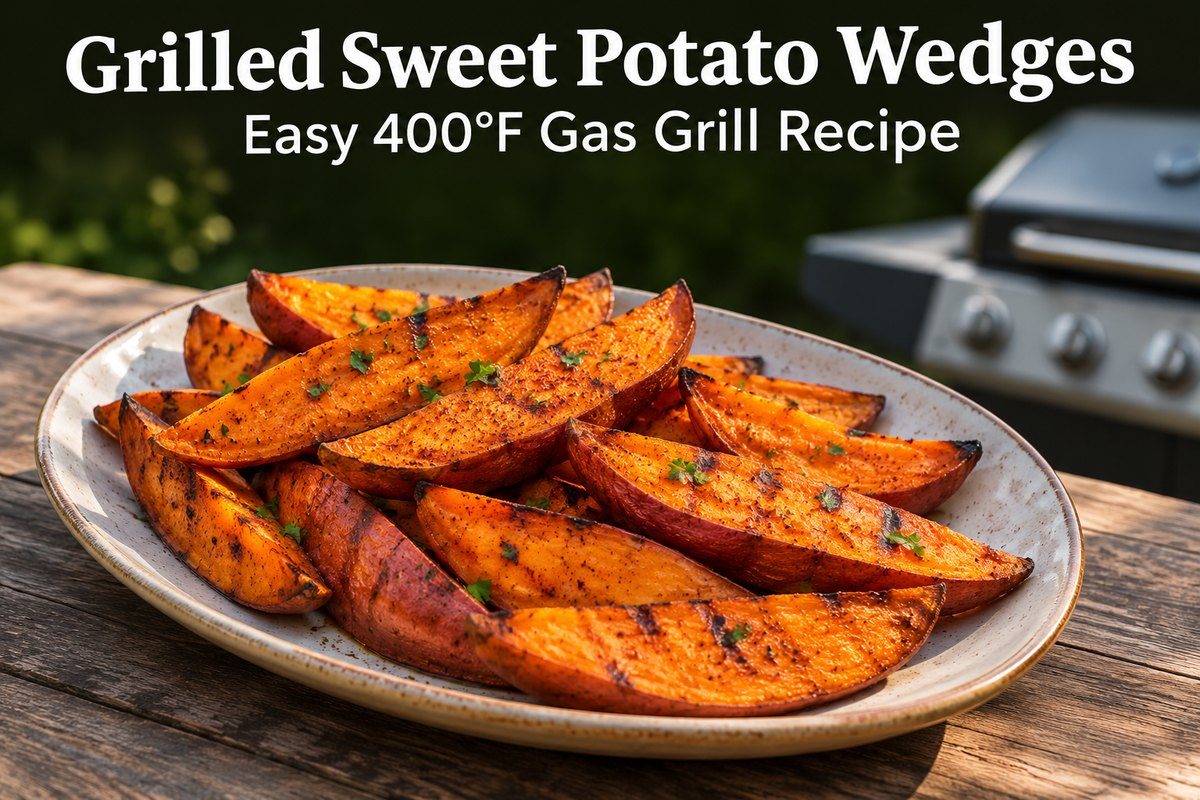
These grilled sweet potato wedges cook over indirect heat first, giving the centers time to soften before a short finish over a lit burner. You need sweet potatoes, oil, and a few pantry seasonings. The method uses raw wedges, so there is no pot of boiling water to carry or drain.
Quick Answer
Cut 1½ pounds of sweet potatoes into wedges no thicker than ¾ inch. Toss with oil and seasonings. Grill over indirect heat at about 400°F for 25–35 minutes, turning halfway, until tender. Finish over direct heat for 2–4 minutes total if more browning is needed. Allow roughly 30–40 minutes of grill time.
Key Points
- Yield: 4 side-dish servings.
- Prep: About 15 minutes; preheat the grill while preparing the potatoes.
- Grill time: Roughly 30–40 minutes; thickness and actual heat can extend the cook.
- Grill setting: About 400°F with a genuine indirect area above an unlit burner.
- Doneness: A small knife slides easily into the thickest part; the center is soft.
- Texture: Tender inside with browned edges, rather than deep-fried crunch.
What ingredients do you need for grilled sweet potato wedges?
For four side servings, use 1½ pounds of orange-fleshed sweet potatoes, 2 tablespoons of oil, and the seasonings below. Buying by weight is more reliable than counting potatoes, which vary considerably in size.
- 1½ pounds orange-fleshed sweet potatoes, about 2–3 medium
- 2 tablespoons olive oil or avocado oil
- 1 teaspoon smoked paprika
- ½ teaspoon garlic powder
- ½ teaspoon fine table salt
- ¼ teaspoon ground black pepper
- Optional for serving: 1 tablespoon lemon juice and 1 tablespoon chopped parsley
You also need a sturdy cutting board, a sharp knife, a mixing bowl, long-handled tongs, and a clean serving platter. Heat-resistant grill mitts are useful. A perforated grill basket is optional for pieces that would slip through widely spaced grates.
How do you grill sweet potato wedges step by step?
Cut the wedges evenly, cook them beside the flame until soft, and use direct heat only for the final browning. Test several thick pieces before serving; dark marks alone do not show that the center is cooked.
- Set up the gas grill. Follow the manufacturer’s lighting and preheating directions. Establish an indirect cooking area and adjust the lit burner or burners to hold about 400°F with the lid closed. On a three-burner grill, the center can remain off with the outer burners on. On a two-burner grill, leave one burner off and cook above it. The temperature is the cooking-chamber reading, not a burner-knob label.
- Wash and cut the sweet potatoes. Scrub under running water and dry well. Trim the ends; leave the sound skins on. Cut each potato lengthwise in half, then place the flat side down and cut each half into wedges. Aim for ½–¾ inch at the thickest part, splitting oversized wedges again. Keep the cutting board stable and do not force the knife through a rolling potato.
- Season lightly and evenly. Mix the oil, paprika, garlic powder, salt, and pepper in the bowl. Add the wedges and turn until coated. The oil should form a thin film rather than collect in a puddle.
- Cook over indirect heat. Arrange the wedges in one layer above the unlit burner, with room between them. Place them across the grate bars so they cannot drop through. Close the lid and cook for about 25–35 minutes, turning halfway. Start checking the smaller pieces at about 20 minutes. Rotate the positions if one edge of the cooking area runs hotter.
- Check the centers. Insert a small knife into the thickest part of several wedges. It should slide in easily, and a cut-open piece should be soft throughout. Give firm pieces another 5 minutes over indirect heat, then check again. Remove tender smaller pieces to a clean platter as needed.
- Brown briefly if needed. When the wedges are tender, move them over a lit burner for about 1–2 minutes on each cut side, 2–4 minutes total. Watch continuously and use less time over a strong flame. Skip this finish if the edges are already browned. Return previously removed tender pieces only if they also need a little color.
- Serve. Transfer to the clean platter. Add the optional lemon juice and parsley, then serve while warm. No mandatory resting period is needed.
The clock is a planning guide. A cooler grill or thicker wedge can take longer than 40 minutes. For a visual explanation of burner placement, see how to set up two-zone grilling on gas or charcoal.
Why cook the wedges indirectly before browning them?
Indirect heat gives a dense raw wedge time to soften without keeping its surface over the flame for the entire cook. The short direct finish adds color after the center is ready.
Weber also uses indirect cooking for sweet potato wedges. This recipe gives a specific cut thickness, a gas-grill setup, and a tenderness check so the method is easier to judge on your own grill.
This is a research-based recipe, with cooking times provided as estimates. It has not been physically tested by Frank. Expect soft centers and some browned edges; a grill does not produce the same crust as a deep fryer.
Can you use a grill basket or a smaller grill?
Use a perforated basket when your wedges cannot sit securely on the grate. Keep it above an unlit burner for the softening stage, spread the wedges loosely, and follow the basket’s heat limits and handling instructions.
A basket changes contact with the grate, so expect different marks and possible timing changes. Stir or turn the pieces halfway through and check the same soft-center endpoint. Move the basket over direct heat only briefly if more browning is needed. Use mitts for the basket and handle.
The guide to using a grill basket for vegetables explains spacing and sticking. Avoid crowding a small basket with the whole batch. Cook in batches when necessary.
A single-burner grill needs a manufacturer-approved way to cook indirectly. If it cannot provide one, roast the seasoned wedges in one layer on a metal baking sheet in a 400°F oven instead. Start checking at about 25 minutes, turn halfway through, and continue until the centers are tender. Oven timing will vary; the broiler is unnecessary.
Why are the wedges burned outside but hard inside?
The surface is receiving too much heat for the wedge’s thickness. Move the pieces off direct heat, close the grill lid, and continue cooking gently until the thick centers soften.
| Problem | Likely reason | What to do |
|---|---|---|
| Dark edges with a firm center | Too much direct heat or oversized pieces | Finish indirectly; cut the next batch more evenly. |
| Little browning despite tender centers | Gentle indirect heat or limited grate contact | Use the brief direct finish while watching closely. |
| Pieces stick when turned | Dirty grates, inadequate preheat, or turning before they release | Use clean, preheated grates and a thin oil coating; loosen gently rather than tearing. |
| Some pieces collapse while others stay firm | A large difference in wedge thickness | Remove tender pieces individually and give thicker ones more time. |
| Soft, damp surfaces | Crowding, stacking, or holding under a tight cover | Use one layer and serve promptly; skip a tightly covered holding pile. |
What substitutions and serving ideas work?
Keep the potato weight, wedge thickness, and heat arrangement the same when changing seasonings. The cooking endpoint remains a soft center.
- Milder seasoning: Use sweet paprika in place of smoked paprika, or omit the paprika.
- A warmer flavor: Replace the paprika with ½ teaspoon ground cinnamon. Keep the garlic out for this version.
- A sweet finish: Drizzle the cooked batch with 1 tablespoon maple syrup after removing it from the grill. Adding it at the end avoids exposing the syrup to the searing step.
- Peeling: Peel after washing if you prefer. Keep the same cutting and doneness checks.
Serve these grilled sweet potato wedges beside burgers, pork chops, or maple-Dijon chicken thighs. Coordinate grill space carefully so the wedges have a true indirect area and stay away from raw-meat juices. For another substantial vegetable side, try grilled cabbage wedges.
How do you store and reheat leftover wedges?
Refrigerate in shallow containers within 2 hours, or within 1 hour when the temperature is above 90°F. Keep the refrigerator at 40°F or below, use the leftovers within 3–4 days, and reheat to 165°F.
These handling limits follow FoodSafety.gov’s cooling guidance, its leftover-storage advice, and its 165°F reheating target for leftovers. Do not leave the wedges outside to cool completely before refrigerating.
Reheat in one layer in a 375°F oven, checking after about 10 minutes and continuing until the thickest pieces reach 165°F. A microwave works for small portions, with turning and temperature checks, although the surface will be softer.
FAQ
Do you need to boil sweet potatoes before grilling?
No. This method cooks evenly cut raw wedges over indirect heat until tender. Preboiled potatoes need a different schedule and can break apart if cooked as long as the raw wedges.
Can you double the recipe?
Yes. Use 3 pounds of sweet potatoes, 4 tablespoons oil, 2 teaspoons paprika, 1 teaspoon garlic powder, 1 teaspoon fine salt, and ½ teaspoon pepper. Use twice the optional finishing ingredients. Keep one uncrowded layer above unlit burners; cook in batches if the grill cannot accommodate that arrangement.
What temperature should the sweet potatoes reach inside?
For the initial cook, judge these plain vegetable wedges by tenderness: a small knife should slide easily into the thickest part. There is no meat-style minimum temperature assigned to sweet potato wedges in the federal chart cited here. Reheated leftovers should reach 165°F.
Can you use frozen sweet potato fries?
Use the package’s approved cooking instructions instead. Frozen fries can have coatings, different thicknesses, and partial cooking that make this raw-wedge schedule unsuitable.
Final Verdict
For grilled sweet potato wedges that soften before they scorch, keep the cuts even and let indirect heat do most of the work. Add a brief direct finish only when needed. The knife test tells you more than a dark grill mark or an exact number of minutes.
About the Author
Frank W. Roberts has been grilling since 1970. Everything Grill Reviews combines practical backyard experience with source-based cooking and equipment guidance. This recipe is an independently developed, research-based method with estimated timing.