
Updated: November 25, 2026
By Frank W. Roberts
Updated and fact-checked: November 24, 2026
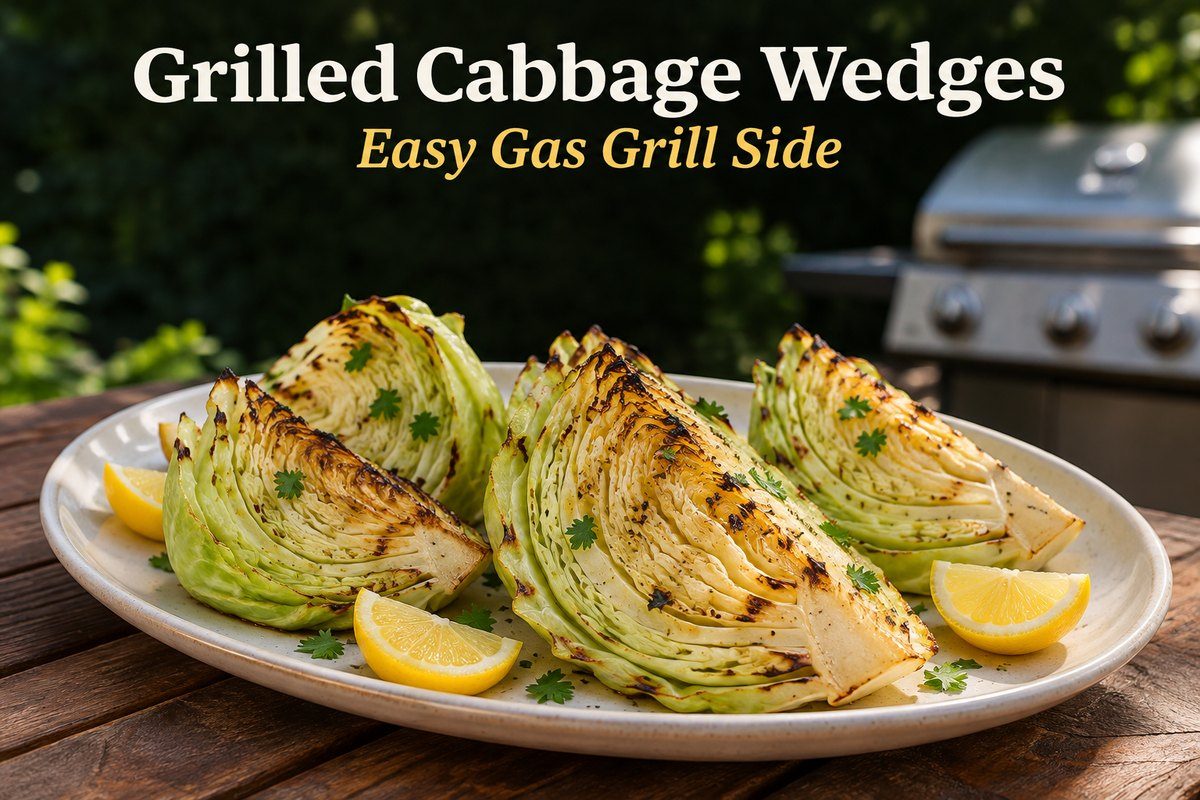
Grilled cabbage wedges turn an ordinary head of green cabbage into a useful side for chicken, pork chops, or burgers. The cut faces brown against the grate while the layered middle softens under the closed lid. Leaving a little core in every wedge makes the pieces much easier to turn.
Quick Answer
Cut a 2-pound green cabbage into 8 wedges through the core. Brush with oil and seasoning, then grill at about 400°F for 4–6 minutes on each cut face. Move to the unlit side, close the lid, and finish until the thick leaves are tender. Begin checking at 15 minutes total.
Jump to the ingredients and method | Fix burned edges and hard centers
Key Points
- Yield: 8 wedges, or 4 side-dish servings of 2 wedges each.
- Heat: About 400°F with one burner off for the finishing zone.
- Cut: Wedges through the stem end, with some core left in every piece.
- Finish test: A fork enters the thick inner leaves with only slight resistance.
- Simple seasoning: Oil, garlic powder, salt, pepper, and an optional squeeze of lemon.
What Do You Need for Grilled Cabbage Wedges?
You need a 2-pound green cabbage, 3 tablespoons of oil, a few pantry seasonings, and a gas grill with room for direct and indirect cooking. No boiling, blender dressing, or special basket is needed for intact wedges.
Servings: 4 as a side.
Prep: About 10 minutes.
Estimated cooking: 18–27 minutes; start checking tenderness at 15 minutes total.
Total: About 28–37 minutes, plus any preheating that does not overlap preparation.
Ingredients
- 1 medium green cabbage, about 2 pounds before trimming
- 3 tablespoons olive oil or a neutral cooking oil
- ½ teaspoon garlic powder
- ½ teaspoon fine table salt
- ¼ teaspoon ground black pepper
- Optional for serving: 1 lemon cut into wedges and 1 tablespoon chopped parsley
- Only if needed for the covered-pan finish: 2 tablespoons water
Equipment
- A covered gas grill with independently controlled burners
- A sturdy knife, nonslip cutting board, measuring spoons, bowl, and basting brush
- A wide spatula, long tongs, heat-resistant gloves, and a clean serving platter
- A fork; optional shallow grill-safe metal pan and foil for a softer finish
Method
- Preheat and make two zones. Follow the grill’s lighting directions. Preheat the cooking grate, clean it, then leave one burner off and adjust the others to maintain about 400°F with the lid closed. Keep enough unlit grate available for all the wedges to finish.
- Wash and trim. Remove damaged outer leaves. Rinse the cabbage under running water before cutting and dry well. Trim only the dry projecting end of the stem; do not cut out the inner core.
- Cut 8 wedges. Halve the cabbage through the stem, halve each piece through the core again to make quarters, then split each quarter once more through its share of the core. Keep the wedges similar in size.
- Season the cut faces. Mix the oil, garlic powder, salt, and pepper. Brush both cut faces of every wedge, dividing the mixture across all 8 pieces. Use a thin even coating rather than letting oil drip.
- Brown the first side. Lay a cut face over a lit burner and close the lid. Check after about 4 minutes. Turn when the face has browned patches and releases with a gentle lift, usually around 4–6 minutes. Move it sooner if the edges are burning.
- Brown the other cut face. Support the wedge with the spatula, guide it with the tongs, and turn onto its second cut face. Grill another estimated 4–6 minutes with the lid closed.
- Finish beside the heat. Move the wedges over the unlit burner. Close the lid and cook until a fork enters the thick inner leaves with only slight resistance, commonly another 10–15 minutes. Begin the first tenderness check at 15 minutes of total cooking; smaller wedges may finish earlier.
- Serve. Transfer to the clean platter and add the optional lemon and parsley. Tell diners they can leave the firm core on the plate. Taste before adding more salt.
The times are estimates for a 2-pound head cut into 8 pieces. Cabbage density, wedge thickness, grate heat, and wind can change them. A lid reading of 400°F describes the chamber near the gauge; the metal grate over a lit burner can be much hotter.
Why Leave the Core in the Cabbage?
The core acts as an anchor for the leaves while the wedge is being moved. Removing it before grilling makes the layers easier to scatter through the grate.
Keep some core in each wedge by cutting from the leafy top through the stem end every time. Crosswise discs are a different shape and do not give every slice the same support. If a wedge starts to separate, stop squeezing it with tongs and slide a broad spatula underneath.
Small loose pieces can go into a grill basket instead. The guide to using a grill basket for vegetables explains how to keep them in a loose layer.
How Tender Should Grilled Cabbage Be?
The thick leaves should be easy to pierce while the wedge still holds its shape. Some people prefer a little crunch; others want a softer center. Test the leaves just beside the core rather than expecting the core itself to feel like cooked leaf.
A brown surface is only a browning cue. It does not tell you how far heat has reached into the wedge. Check a thick piece from the cooler part of the grate as well as one that browned quickly.
For a softer result, place the browned wedges in a shallow grill-safe metal pan on the unlit side, add 2 tablespoons water, and cover with foil. Check after about 5 minutes and continue as needed. Open the cover away from your face. This changes the finish to moist heat, so the browned edges will soften too.
Why Are the Edges Burning While the Middle Is Hard?
The outside is getting more direct heat than the center can use. Move the wedges to the unlit side and let the covered grill finish the inner leaves. More time over a strong flame makes that mismatch worse.
| What you see | Likely cause | What to do |
|---|---|---|
| Black edges, hard inner leaves | Too much direct heat or unusually thick wedges | Finish indirectly; use the covered-pan option for a softer result |
| Leaves fall apart during turning | Core was removed or tongs squeezed too hard | Support with a spatula; move loose leaves to a basket |
| Oil causes brief flare-ups | Excess oil drips onto the heat source | Move the food to the unlit side and use a thinner coating next time |
| One wedge darkens much faster | A hotter patch of grate | Move it earlier and let the other wedges catch up |
| Cabbage stays pale | Wet cut faces, crowding, or insufficient preheat | Dry well, leave space, and preheat fully |
If the same part of the grate repeatedly scorches food, the guide to finding gas-grill hot and cold spots can help you choose better positions.
Can You Change the Seasoning or Use Red Cabbage?
Yes. Keep the basic oil coating and adjust the finishing flavor. Red cabbage also works, but its density and the size of your wedges can change the cooking time.
- No garlic powder: Leave it out or substitute ½ teaspoon onion powder.
- Prefer a smoky seasoning: Add ¼ teaspoon smoked paprika to the oil mixture. Watch the color because spices can darken before the cabbage is tender.
- Want a richer finish: Add a little grated Parmesan at the table. Taste first because it adds salt.
- No lemon: Serve plain, or add a few drops of cider vinegar to each portion after cooking.
- Cooking for two: Use half the cabbage, make 4 wedges, and halve the oil and seasonings. Keep wedge thickness similar; do not automatically halve the time.
For a second vegetable that cooks in its own packet, grilled carrots in foil are an easy companion. Start the carrots first and give each dish its own tenderness check.
How Do You Prepare Cabbage Safely Around Raw Meat?
Wash the cabbage under running water, dry it, and keep it away from raw-meat juices. Use clean utensils and a clean platter when the vegetables come off the grill.
The FDA’s produce-handling guidance recommends washing produce before preparation, drying it, and preventing contamination from raw meat. Do not set the cabbage where raw chicken can drip onto it, and do not reuse the chicken’s unwashed tongs or marinade brush for serving.
How Do You Store and Reheat Leftover Grilled Cabbage?
Refrigerate in shallow covered containers at 40°F or below within 2 hours, or within 1 hour above 90°F. Use within 3–4 days and reheat leftovers to 165°F.
These limits follow USDA storage guidance and its reheating guidance. A covered microwave-safe dish with a small splash of water is convenient for one portion. Rearrange during heating and check the thickest area. Expect softer edges after storage.
FAQ
Do you have to boil cabbage before grilling it?
No. This method uses direct heat for browning and covered indirect heat to finish the leaves. The optional covered-pan finish helps if you want softer cabbage.
Should the grill lid stay open or closed?
Keep it closed between checks so heat reaches the upper surfaces and center. Open it briefly to inspect, turn, move, and test the wedges.
Can you prepare the wedges ahead?
Yes. Cut and dry them earlier the same day, keep covered in the refrigerator, and brush with the oil mixture just before grilling. Keep cut cabbage chilled rather than leaving it beside the grill during a long preheat.
Can you use a pellet grill instead?
Use its normal indirect setup at about 400°F and cook to the same leaf-tenderness cue. Expect different browning and timing from the gas-grill method; do not assume a pellet grate has an unlit burner zone.
Final Verdict
Grilled cabbage wedges are a practical side when you want browned vegetables without a complicated sauce. Keep the core attached, use modest oil, and move the wedges off direct heat once their cut faces have color. Judge the middle with a fork before serving.
About Frank W. Roberts
Frank W. Roberts is the author of Everything Grill Reviews and has grilled since 1970. This is an original, research-based recipe formulation. Cooking times are estimates; no physical test cook or measured nutrition analysis is claimed.