
Updated: November 18, 2026
Updated and fact-checked: November 17, 2026
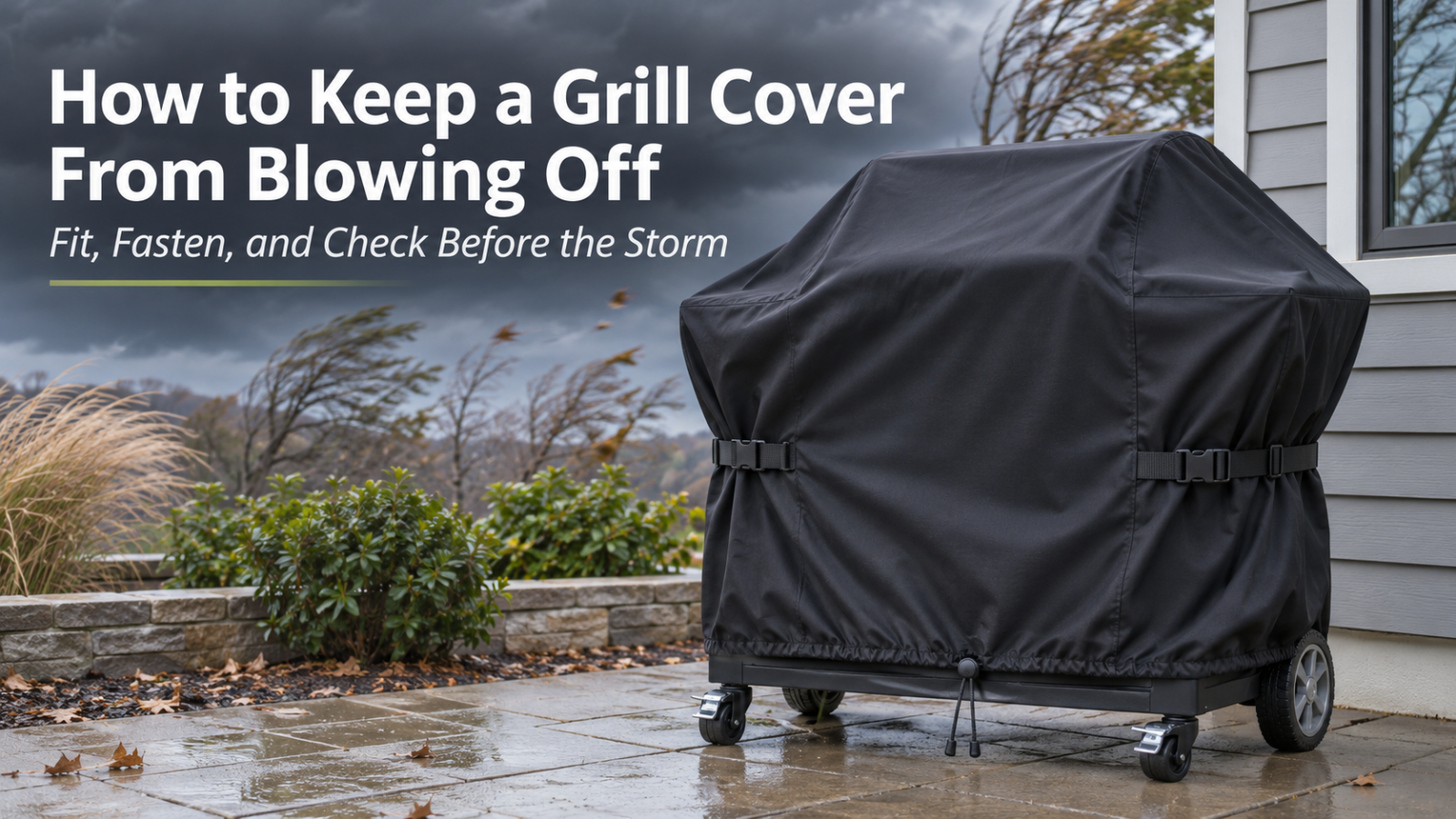
Learning how to keep a grill cover from blowing off starts with fit, not weight. A cover that follows the grill’s shape and closes below the shelves gives wind less loose fabric to grab. Tighten its built-in straps or drawcord, lock the grill’s casters, and inspect every lower edge before a storm. If severe winds are expected, move the completely cold grill to a safer manufacturer-approved outdoor storage location instead of piling heavy objects on top.
Quick Answer: How Do You Stop a Grill Cover From Blowing Away?
Use a correctly sized cover with working fastening straps, buckles, a drawcord, or a zip closure. Smooth out air pockets, secure every factory closure around the points the cover maker intended, and check that no loose hem can lift. Lock the grill wheels and place the cold grill in a sheltered permitted location. Never fasten anything to a propane hose, regulator, power cord, grease bucket, control knob, or hot grill.
Key Points
- Fit first: An oversized cover becomes a sail; an undersized cover strains seams and slips off corners.
- Use the cover’s closures: Fasten every strap, buckle, drawcord, elastic hem, or zipper as designed.
- Keep wind out: Smooth the cover and close lifting gaps at the bottom.
- Keep moisture out—but allow ventilation: Use built-in vents and never cut your own holes.
- Secure the grill too: Lock casters and use a stable, level storage position.
- Avoid improvised hazards: Do not place bricks on top or stretch ordinary bungee cords where they can snap back.
- Know the limit: No cover is storm-proof. Move a cold grill when the manufacturer permits and dangerous wind is forecast.
Why Does a Grill Cover Blow Off?
A cover blows off when wind gets under a loose lower edge and inflates the fabric. Poor fit, unfastened straps, worn elastic, missing clips, and a grill sitting broadside to the wind all make lifting easier.
The problem is not simply that the cover is light. A heavy loose cover can still balloon, flap against sharp corners, and pull hard on weak seams. The most effective approach reduces the opening where wind enters, keeps the fabric close to the grill, and uses secure attachment points low on the cart.
| What you see | Likely reason | First correction |
|---|---|---|
| Whole cover lifts from the bottom | Hem is loose or straps are open | Tighten the drawcord and fasten every lower strap |
| One corner repeatedly slips off | Cover is too small, crooked, or caught on a shelf | Realign it; replace it if the fit remains strained |
| Fabric balloons but stays attached | Wind enters faster than built-in vents release it | Close lower gaps and orient the grill more favorably |
| Cover stays on but flaps hard | Excess fabric or worn side straps | Draw the sides inward with their intended closures |
| Strap will not hold tension | Worn hook-and-loop, elastic, buckle, or stitching | Replace the strap or cover rather than trusting it in a storm |
How Do You Check Whether the Cover Fits?
A useful cover should clear the grill’s widest fixed points without stretching, hang low enough to protect the cabinet, and leave only modest extra fabric. It should not drag on the ground or form large pockets over folded shelves.
- Let the grill cool completely and wipe away standing moisture.
- Set folding shelves in the position specified by the cover maker.
- Pull the cover down from the highest point without forcing it over handles or sharp corners.
- Center the seams and logo or front marker if the cover has one.
- Check that the hem sits evenly and does not rest on the patio.
- Look for deep billows at the sides. Large loose panels mean the cover is too wide or not tightened.
- Check that the fabric is not stretched tight over control knobs, display screens, or shelf corners.
Measure width, depth, and height with side shelves in their normal covered position before buying a universal cover. Model-specific covers usually fit wind better because their seams and closures match the grill’s shape.
Which Fastening Method Works Best?
The best fastening method is the one built into a correctly fitted cover. Two independent closures—such as side straps plus a lower drawcord—usually control loose fabric better than an elastic hem alone.
| Closure | What it does | What to inspect |
|---|---|---|
| Hook-and-loop side straps | Pull loose side fabric inward | Lint, weak grip, torn stitching, and straps that no longer reach |
| Buckle straps | Hold the hem or cover to a designated cart point | Cracked buckles, frayed webbing, and loose anchors |
| Drawcord | Tightens the entire lower opening | Broken cord locks, uneven tension, and a dangling trip loop |
| Elastic hem | Gathers fabric around the base | Stretched elastic that stays loose |
| Zipper | Closes a fitted cover around the grill profile | Missing teeth, jammed sliders, and fabric caught in the track |
Weber’s current Performer Smart cover uses two straps that connect to the cart specifically to keep the cover secure in wind. That is a good example of matching the closure to the grill rather than wrapping a random cord around the appliance. See Weber’s official cover description.
How Do You Secure the Cover Step by Step?
Cool and dry the grill, position the cover evenly, close its lowest fasteners first, tighten the sides, and finish with a walk-around inspection.
- Shut the grill down: Turn off burners and fuel as the grill manual directs, or complete the pellet-grill shutdown cycle. Never cover a warm cooker.
- Dry the grill: Wipe away rain or condensation. A secure wet cover can trap moisture just as effectively as it blocks wind.
- Lower the cover evenly: Start at the highest point and guide the fabric over shelves and handles without dragging it across sharp edges.
- Smooth the top and sides: Remove large air pockets and straighten twisted seams.
- Close the bottom: Tighten the elastic or drawcord evenly so one side does not remain open.
- Fasten the straps: Attach each buckle or strap only to the cover maker’s intended location.
- Lock the wheels: Lock every locking caster. Confirm the grill stands level and does not rock.
- Walk around it: Check the back, the side facing the wind, and every lower corner for a lifting edge.
This is a storage procedure for a cold grill. Wind can also disturb burner heat, so the site’s guide to uneven heat on a gas grill explains what can be repositioned safely and why an improvised close windbreak is risky. Never cook with a storage cover partly attached.
Can You Add an Aftermarket Strap?
Yes, when it is made for securing outdoor-equipment covers and can be routed around the cover body and a rigid cart member without contacting fuel or electrical parts. The grill and cover manuals still take priority.
Choose a broad adjustable webbing strap with a buckle rather than a thin cord. Broad webbing spreads force and is less likely to cut the fabric. Route it low enough to resist lift but high enough to stay off the ground. It must not touch or compress:
- a propane hose, regulator, cylinder valve, or natural-gas connection;
- a power cord, controller, probe wire, or electrical connector;
- a grease cup, drain, ash catcher, or pellet cleanout;
- control knobs, ignition buttons, screens, doors, or sharp sheet-metal edges.
Do not tighten the strap until the cart bends or the fabric creases sharply. The goal is to remove slack, not clamp the grill. Check the strap after the first windy day because webbing can settle.
Should You Use Bungee Cords, Clips, or Weights?
Built-in fasteners or a purpose-made adjustable cover strap are safer choices. Ordinary bungee cords can slip or recoil, generic clips may tear coated fabric, and heavy objects placed on top can dent the lid, abrade the cover, or fall during a gust.
| Improvised method | Main problem | Better choice |
|---|---|---|
| Brick or paver on top | Concentrated weight, abrasion, and falling-object risk | Secure the lower hem and use the correct fit |
| Loose rope | Knots slip; thin rope can cut fabric or contact unsafe parts | Wide purpose-made adjustable strap |
| Ordinary bungee cord | Hook release and snapback injury | Buckled webbing with no elastic recoil |
| Spring clamp | Point pressure can puncture a coating or scratch the grill | Cover’s sewn strap or replacement cover |
| Magnets | May scratch finishes, fail on nonmagnetic panels, or affect electronics placement | Manufacturer-approved closure system |
If a cover needs several improvised devices every time, it is probably the wrong size or its closures are worn out.
Do Cover Vents Help in Wind?
Built-in vents can let pressure escape and reduce ballooning, but they do not replace straps. They also help moisture leave the covered space when designed and positioned correctly.
Do not cut holes into an unvented cover. A homemade opening can tear farther, admit rain, expose sharp edges, and void a warranty. If ballooning remains severe after the hem is secured, replace the cover with a better-fitting vented design approved for the grill.
Where Should You Park the Grill Before a Storm?
Park a completely cold grill in a level, sheltered outdoor location that preserves the clearances and storage conditions in its manual. Lock the casters and orient the narrowest stable side toward the expected wind when the design and location allow.
Do not push a grill tightly against combustible siding merely to shelter the cover. Do not move a connected grill in a way that strains its gas hose or power cord. Never store a propane cylinder inside a home, basement, garage, shed, tent, or vehicle. If the grill maker permits moving the cold grill into a secure storage area, disconnect or store fuel exactly as its manual and local rules require.
During dangerous wind, personal safety comes first. Do not go outside in the middle of a storm to retrieve a cover or wrestle with a rolling grill. Secure it before conditions deteriorate.
How Do You Keep the Cover From Trapping Moisture?
Cover only a cool, dry grill, keep factory vents unobstructed, and inspect beneath the cover after wet or humid weather. Wind security should not turn the grill into a sealed damp package.
Remove the cover on a dry day if condensation has formed. Wipe the grill and let both the grill and cover air-dry before reinstalling it. The site’s grill winter-storage checklist explains why a cover cannot replace cleaning, drying, and correct fuel storage.
When Should You Replace the Cover Instead of Securing It?
Replace it when the fabric has torn around a strap, the buckle will not hold, the elastic stays loose, the coating is brittle, or the cover remains badly oversized after every adjustment.
- Strap stitching pulls away from the fabric.
- A drawcord channel tears or the cord lock no longer grips.
- Hook-and-loop material opens with light hand pressure.
- Fabric cracks at corners or exposes the grill.
- The cover repeatedly collects a large pool of water.
- The bottom drags on the patio and wicks moisture.
- Universal sizing leaves several inches of loose sail-like fabric on every side.
A small loose seam may be repairable with a kit recommended by the cover maker. Do not puncture a waterproof cover with improvised screws, wire, or sharp hooks.
What Is the 30-Second Wind Check?
Use this static checklist whenever wind or a storm is expected:
- Grill completely off, cool, and dry
- Cover centered with no strained corners
- Every factory strap, buckle, zipper, or drawcord secured
- No lower edge open toward the wind
- Vents uncovered and no water pocket on top
- Casters locked and grill stable
- No strap touching fuel, grease, or electrical parts
- Safer storage chosen before severe weather arrives
Frequently Asked Questions
Can I tie the cover to the grill legs?
Only when the cover or aftermarket strap maker identifies that rigid cart area as an acceptable attachment point. Keep every tie away from hoses, regulators, wires, wheels, and grease components.
Is a heavier grill cover always better in wind?
No. Weight helps less than correct fit and secure lower closures. A heavy oversized cover can still balloon and pull against the grill.
Should the cover touch the ground?
No. A dragging hem collects grit, can snag around wheels, and may wick water upward. The cover should protect the lower grill without lying on the patio.
Can I cover the grill while it is still warm?
No. Wait until the grill is fully shut down and cool. Heat can damage the cover, trap moisture, and create a fire hazard.
Should I leave a grill uncovered in very high wind?
A loose cover can become debris, but the better plan is to secure or relocate the cold grill before the storm according to its manual. Do not remove a cover or move equipment once dangerous conditions have begun.
Can I use the grill cover as a windbreak while cooking?
No. A storage cover must be completely removed before lighting the grill. It is not a heat shield or cooking windbreak.
Conclusion: What Is the Best Way to Keep a Grill Cover On?
The best way to keep a grill cover from blowing off is to stop wind from getting underneath it. Use the right size, smooth the fabric, fasten every designed closure, lock the grill’s casters, and inspect the lower edges before the weather turns. Replace failed straps or a bad-fitting cover instead of piling weight on top. When severe wind is forecast, secure or move the completely cold grill early and follow the manufacturer’s storage rules.
About the author: Frank W. Roberts has grilled since 1970 and writes Everything Grill Reviews for readers who want practical backyard solutions without unsafe shortcuts. This guide is based on current manufacturer cover guidance and a full step-by-step safety review; it does not claim testing in a measured wind tunnel or guarantee that any cover will remain attached in severe weather.