
Updated: August 26, 2026
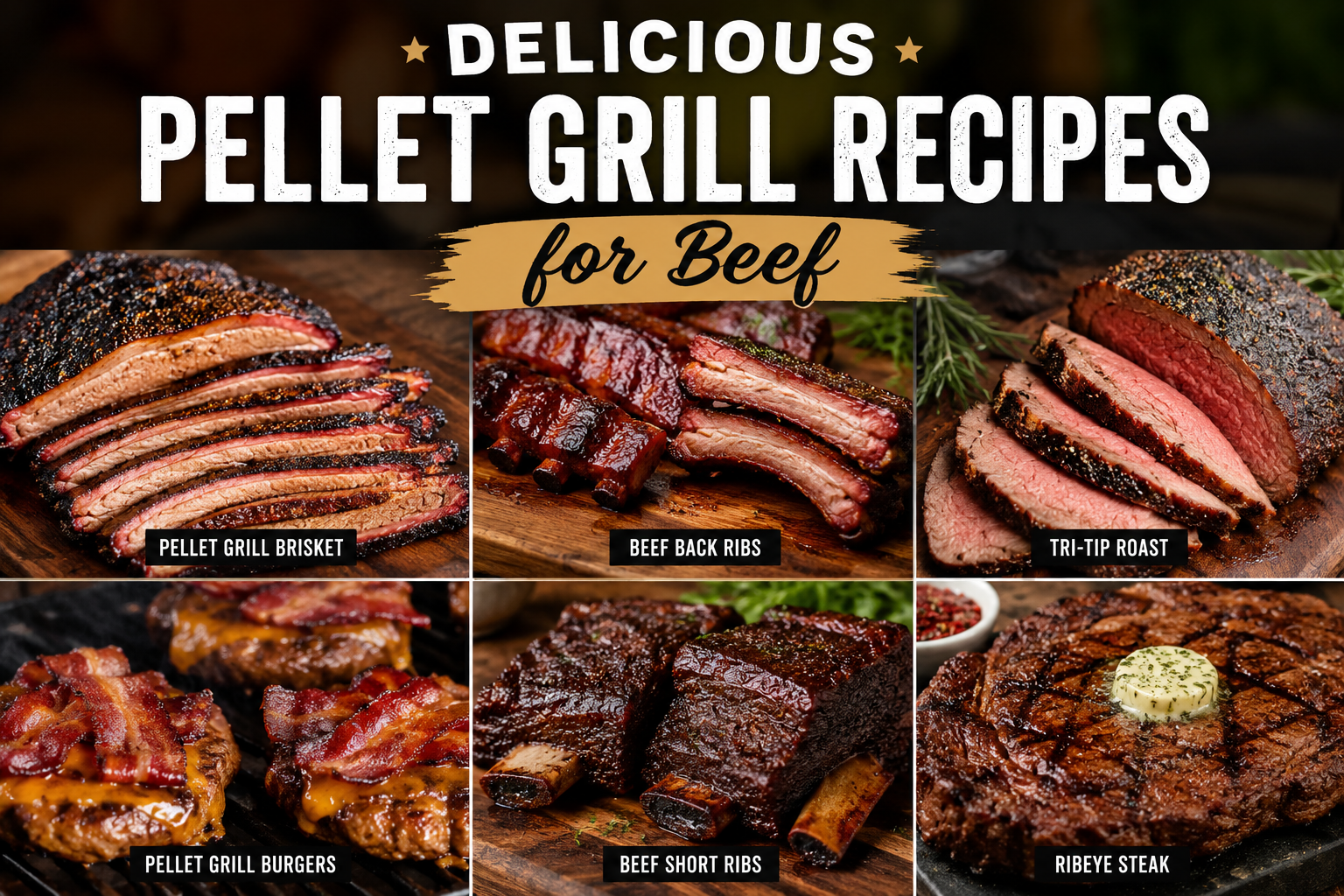
These pellet grill recipes for beef cover six useful cooks: smoked brisket, beef plate ribs, reverse-seared ribeye, smoked tri-tip, chuck roast burnt ends, and smoked prime rib. Each recipe includes a grill temperature, a doneness guide, and the decision points that matter more than a rigid cooking time.
A pellet grill is especially useful when a beef recipe needs steady indirect heat. It can smoke and roast well, but many models need help from a hot cast-iron pan, griddle, sear station, or separate grill when you want a deep steak crust. The recipes below make that tradeoff clear instead of pretending every pellet grill sears the same way.
Choose your beef recipe
- Best all-day barbecue project: Smoked brisket
- Best rich, forgiving cut: Beef plate short ribs
- Best steak method: Reverse-seared ribeye
- Best quicker roast: Smoked tri-tip
- Best party bites: Chuck roast burnt ends
- Best holiday centerpiece: Smoked prime rib
What temperatures matter when smoking beef?
Use two temperature measurements: the air temperature beside the food and the internal temperature of the beef. The controller setting is only a target; a grate-level probe tells you what the food is actually experiencing. The USDA smoking guidance says the smoker or grill should remain between 225°F and 300°F during smoking. USDA also recommends cooking whole beef steaks and roasts to at least 145°F followed by a three-minute rest. Ground beef should reach 160°F. Brisket, chuck roast, and plate ribs normally go far beyond the safety minimum because their connective tissue needs more heat and time to become tender.
Safety note: Some steak recipes use lower restaurant-style doneness temperatures. Those temperatures are below USDA guidance. This article uses 145°F plus a three-minute rest as the safe minimum for whole beef steaks and roasts. Always check the thickest part with a food thermometer.
Which wood pellets are best for beef?
Oak is the most flexible starting point for beef because it provides a noticeable but balanced smoke profile. Hickory and mesquite are stronger; pecan and fruitwood blends are milder. Wood choice is personal, so start moderate and add intensity on later cooks rather than overwhelming an expensive cut.
| Pellet wood | Smoke character | Good beef uses | Main caution |
|---|---|---|---|
| Oak | Balanced and medium | All six recipes | Few; it is the easiest all-purpose choice |
| Hickory | Stronger and traditional | Brisket, ribs, and chuck | Can dominate a long cook |
| Mesquite | Very bold | Shorter steak and tri-tip cooks | Easy to overdo; consider a blend |
| Pecan | Mild, nutty, and slightly sweet | Prime rib and longer cooks | May be too mild for cooks wanting heavy smoke |
| Hardwood or competition blend | Balanced blend; varies by brand | General-purpose cooking | Read the bag because blends differ |
Use only food-grade barbecue pellets intended for cooking, and keep them dry. For more help choosing fuel, see the guide to the best wood pellets for grilling.
What is the easiest way to choose among these beef recipes?
Choose by available time, desired texture, and whether you can finish over high heat. Brisket and ribs need patience and are finished by tenderness. Ribeye, tri-tip, and prime rib are tender cuts finished by internal temperature. Chuck burnt ends sit between those two groups.
| Recipe | Pellet grill setting | Finish guide | Planning range |
|---|---|---|---|
| Whole brisket | 250°F | Probe tender, often near 195°F to 205°F | About 10 to 16 hours, plus a protected rest |
| Plate short ribs | 275°F | Probe tender, commonly around 200°F to 210°F | About 6 to 9 hours, plus rest |
| Thick ribeye | 225°F, then high-heat sear | 145°F and a three-minute rest | Usually under 2 hours; thickness controls the time |
| Tri-tip | 250°F, then high-heat sear | 145°F and a three-minute rest | Roughly 1.5 to 3 hours, plus rest |
| Chuck burnt ends | 250°F | Probe tender before cubing and glazing | Allow most of a day; chuck roasts vary |
| Prime rib | 225°F, then high-heat finish | 145°F and a three-minute rest | Several hours; use weight only for planning |
Times are planning estimates, not promises. Meat size, starting temperature, weather, grill recovery, and actual grate temperature can change the cook substantially.
How do you smoke a brisket on a pellet grill?
Smoke a whole brisket at 250°F until the bark is set, wrap only when the color and bark are where you want them, and continue until a probe slides into the flat with very little resistance. The internal temperature is a guide; tenderness makes the final decision.
Smoked brisket ingredients
- 1 whole packer brisket, approximately 12 to 14 pounds
- Coarse kosher salt
- Coarse black pepper
- Granulated garlic, optional
- Oak pellets or an oak-forward blend
- Uncoated butcher paper or heavy-duty foil, optional
Smoked brisket instructions
- Trim the brisket. Remove hard exterior fat and silverskin. Shape thin edges that would burn, and leave roughly a quarter-inch fat cap where practical.
- Season evenly. Mix equal parts kosher salt and coarse pepper, adding garlic if desired. Apply an even layer without building a thick salt crust.
- Preheat the grill to 250°F. Place a grate probe close to the brisket. Position the fat cap toward the strongest heat source; on many pellet grills, that means fat-side down because the heat comes from below.
- Build the bark. Leave the brisket undisturbed for the first few hours. After the surface has darkened, spritz lightly with water only if dry spots are forming.
- Wrap when the bark is set. This often happens somewhere around 160°F to 175°F internal, but color and texture matter more than the number. Use butcher paper for a firmer bark or foil for a faster, softer finish.
- Cook until probe tender. Begin checking the thickest part of the flat as the brisket approaches the high 190s. Many finish between 195°F and 205°F, but remove it only when the probe enters with little resistance.
- Rest safely. Keep the brisket wrapped and rest at least one hour. For a longer hold, monitor it and keep the meat at or above 140°F rather than leaving it in an unmonitored cooler for hours.
- Slice against the grain. Separate the flat and point if needed because their grain directions differ. Slice only what you are ready to serve.
For a more detailed trimming, wrapping, resting, and slicing walkthrough, use the separate ultimate smoked brisket recipe.
How do you smoke beef plate ribs on a pellet grill?
Cook three-bone beef plate ribs at 275°F with the bone side down until the bark is dark and a probe slides into the meat without tight resistance. Plate ribs are rich and generally more forgiving than the lean flat of a brisket.
Beef plate rib ingredients
- 1 three-bone plate of meaty beef short ribs
- Coarse kosher salt
- Coarse black pepper
- Granulated garlic
- Oak or oak-hickory pellets
Beef plate rib instructions
- Trim the top. Remove loose fat and tough silverskin from the meat side. Leave the firm membrane on the bone side unless it is already loose; it helps hold the rack together.
- Season. Mix the salt, pepper, and garlic in roughly equal proportions and coat all exposed meat surfaces.
- Preheat to 275°F. Put the ribs on bone-side down with space for air to move around them.
- Smoke until the bark is set. Avoid repeated lid opening. Spritz lightly with water only if the surface looks dry after the bark has begun to form.
- Check tenderness. Start probing between the bones as the meat enters the 200°F range. The finish may fall around 200°F to 210°F, but a soft probe feel is more reliable than one exact number.
- Rest before slicing. Rest 30 to 60 minutes, then slice between the bones.
How do you reverse sear a ribeye on a pellet grill?
Smoke a thick ribeye gently at 225°F, remove it before the final temperature, and finish it over high heat for browning. The low stage adds smoke and brings the interior up evenly; the hot finish creates the crust a pellet grill may not produce at smoking temperature.
Reverse-seared ribeye ingredients
- Ribeye steaks, ideally 1.5 to 2 inches thick
- Coarse kosher salt
- Coarse black pepper
- Oak pellets or an oak-mesquite blend
- A small amount of high-heat cooking oil for the searing surface, if needed
Reverse-seared ribeye instructions
- Dry-brine when possible. Salt the steaks and refrigerate them uncovered overnight. If time is short, salt at least 40 minutes before cooking. Add pepper just before the grill.
- Preheat the pellet grill to 225°F. Insert a probe from the side into the center of the thickest part, avoiding bone and large fat pockets.
- Smoke gently. Cook until the center reaches roughly 115°F to 120°F, leaving room for the sear. Exact timing depends on thickness and starting temperature.
- Prepare high heat. Heat a cast-iron pan, griddle, sear station, or grill surface to at least 450°F. Pat the steak dry before searing.
- Sear both sides. Turn as needed to build an even brown crust without burning the exterior.
- Verify the finish. For USDA guidance, the thickest part must reach at least 145°F before removal, followed by a three-minute rest.
How do you cook tri-tip on a pellet grill?
Smoke tri-tip at 250°F, finish it over high heat, and slice each section against its own grain. The roast has two grain directions, so correct slicing is just as important as the grill temperature.
Smoked tri-tip ingredients
- 1 tri-tip roast, approximately 2 to 3 pounds
- Coarse kosher salt
- Coarse black pepper
- Granulated garlic
- Paprika, optional
- Oak or oak-mesquite pellets
Smoked tri-tip instructions
- Trim and season. Remove silverskin and loose exterior fat. Coat the roast evenly with salt, pepper, garlic, and optional paprika.
- Preheat to 250°F. Insert a temperature probe into the thickest center section.
- Smoke to the searing stage. Remove the tri-tip from low heat around 125°F to 130°F so there is room for the final sear.
- Sear over high heat. Brown every broad surface and edge. Continue until the thickest part reaches at least 145°F.
- Rest. Rest for at least three minutes; 10 minutes makes slicing easier.
- Cut at the grain change. Find the point where the fibers change direction and divide the roast there. Slice each piece thinly across its own grain.
How do you make poor man’s burnt ends on a pellet grill?
Smoke a whole chuck roast until the bark sets, braise it until probe tender, then cube, sauce, and return the pieces uncovered to set the glaze. This is not identical to brisket-point burnt ends, but it is a practical way to make rich barbecue bites without cooking a full packer brisket.
Chuck roast burnt ends ingredients
- 1 chuck roast, approximately 3 to 4 pounds
- Coarse kosher salt
- Coarse black pepper
- Granulated garlic
- 1/2 cup beef broth
- 1 cup barbecue sauce
- 2 tablespoons brown sugar, optional
- Oak or hickory pellets
Chuck roast burnt ends instructions
- Preheat to 250°F. Season the chuck roast with salt, pepper, and garlic.
- Smoke until the bark sets. This commonly occurs around 160°F to 170°F internal, but judge the dry, dark exterior rather than wrapping by temperature alone.
- Braise until tender. Move the roast to a foil pan with the broth, cover tightly, and return it to the grill. Cook until a probe meets little resistance, often around 200°F to 205°F.
- Rest briefly and cube. Let the roast settle for about 20 minutes, then cut it into bite-size cubes. Handle it gently because tender chuck can fall apart.
- Sauce the cubes. Toss with barbecue sauce and optional brown sugar. Spread the pieces in one layer.
- Set the glaze. Return the pan uncovered for approximately 30 to 45 minutes, stirring once if needed, until the sauce clings to the meat. Do not cook until the sugar burns.
How do you smoke prime rib on a pellet grill?
Cook prime rib slowly at 225°F and finish it over high heat for a browned exterior. Because the roast is large and expensive, use a center probe and allow enough time for a proper rest instead of relying on minutes per pound.
Smoked prime rib ingredients
- 1 bone-in standing rib roast, approximately 4 to 6 bones, or a boneless ribeye roast
- Coarse kosher salt
- Coarse black pepper
- 2 tablespoons granulated garlic
- Chopped rosemary and thyme, optional
- A thin layer of oil or Dijon mustard, optional
- Oak or pecan pellets
Smoked prime rib instructions
- Salt ahead. Season with salt and refrigerate uncovered for 24 to 48 hours when possible. This seasons the roast and dries the surface.
- Add the remaining seasoning. Apply pepper, garlic, and optional herbs. Use only a thin binder layer if desired.
- Preheat to 225°F. Place the temperature probe in the center of the thickest section without touching bone.
- Smoke to the high-heat stage. Remove the roast from low heat around 120°F to 125°F while the searing surface heats.
- Brown the exterior. Finish at 450°F or higher, turning when practical, until the center reaches at least 145°F.
- Rest before carving. Rest for at least three minutes; 20 to 30 minutes is more practical for a roast this size. Remove the bones before slicing if that makes carving easier.
What common pellet grill beef mistakes should you avoid?
The biggest mistakes are trusting the clock, ignoring actual grate temperature, running out of pellets, and slicing too soon or in the wrong direction. Each one can ruin good beef even when the recipe itself is sound.
- Cooking by time alone: Use estimated time only to plan. Finish tender cuts by safe internal temperature and tough cuts by probe tenderness.
- Trusting only the controller: Check temperature beside the food, especially during cold or windy weather.
- Starting with damp pellets: Swollen or crumbly pellets can feed poorly and create unreliable combustion.
- Running low during a long cook: Begin with enough dry pellets and check the hopper regularly while following the grill manufacturer’s operating instructions.
- Over-smoking: Strong smoke for too long can make the surface bitter. Start with oak or a balanced blend.
- Wrapping before the bark sets: Early wrapping can soften the exterior and limit smoke exposure.
- Skipping the rest: A rest helps temperatures settle and makes slicing cleaner.
- Slicing with the grain: Cut across visible muscle fibers. Brisket and tri-tip both change grain direction.
- Smoking frozen beef: Thaw meat safely in the refrigerator before smoking so it moves through low temperatures predictably.
Who should use these pellet grill recipes?
Use this collection if you own a pellet grill, have a dependable food thermometer, and want a mix of long barbecue cooks and quicker beef recipes. The recipe chooser lets a beginner start with ribeye or tri-tip before committing to an overnight-size brisket project.
- Pellet grill owners who want beef-specific temperatures and methods
- Beginners learning the difference between temperature doneness and probe tenderness
- Experienced cooks who want one reference for six common beef cuts
- Hosts choosing between a party appetizer, main roast, or barbecue centerpiece
Who should choose another cooking method?
Choose another method if you want a fast direct-fire sear and do not have a suitable high-heat finishing surface. A charcoal or gas grill may be simpler for thin steaks, while an oven can be easier for cooks who do not want smoke flavor or outdoor temperature changes.
Pellet grill recipes for beef FAQs
What is the best beef cut for a beginner on a pellet grill?
A thick ribeye or a tri-tip is easier to schedule than brisket because the cook is shorter and the finish is based on internal temperature. Chuck roast burnt ends are also forgiving, but they still require several hours to become tender.
What temperature should a pellet grill be set to for beef?
Most smoked beef recipes work between 225°F and 275°F. This guide uses 225°F for tender cuts before searing, 250°F for brisket and chuck, and 275°F for plate ribs. USDA advises keeping smoker air between 225°F and 300°F.
Can a pellet grill sear a steak?
Some pellet grills can sear better than others, but low smoking heat will not create a strong crust. Use the grill’s approved high-heat or direct-flame setup, a cast-iron pan, a griddle, a sear station, or another grill for the finishing step.
Do you have to wrap brisket on a pellet grill?
No. Wrapping is optional. Butcher paper or foil can shorten the stall and protect the surface after the bark has set. Leaving the brisket unwrapped can produce a firmer bark, but the cook may take longer and the lean flat receives less protection.
What are the best pellets for brisket?
Oak is the safest all-around choice for brisket. Oak-hickory blends add more smoke strength, while mesquite blends produce a bolder flavor. Use food-grade cooking pellets and avoid damp or crumbling fuel.
How long does brisket take on a pellet grill?
A whole packer brisket may take roughly 10 to 16 hours at 250°F before the rest, but that is only a planning range. Size, thickness, weather, wrapping, and actual grate temperature all affect the finish. Cook until the flat is probe tender, not until a timer expires.
What temperature is beef safe to eat?
USDA recommends at least 145°F with a three-minute rest for whole beef steaks, chops, and roasts, and 160°F for ground beef. Check the current USDA safe minimum internal temperature chart.
Where should the temperature probe go in beef?
Insert the probe into the thickest center portion without touching bone, a large fat seam, or the cooking grate. For brisket, judge tenderness in the thickest part of the flat. Use an instant-read thermometer to confirm several spots before removing the meat.
What is the bottom line on pellet grill beef recipes?
The best recipe depends on the meal you want and the time you have. Brisket and plate ribs reward patience; ribeye and tri-tip give you a faster smoke-and-sear meal; chuck burnt ends are built for sharing; and prime rib makes a centerpiece. Final takeaway: Keep the pellets dry, measure the temperature beside the food, use internal temperature or probe tenderness instead of the clock, rest the beef, and slice against the grain. Those habits matter more than a secret rub or one exact brand of pellet.
Experience and accuracy note
Frank W. Roberts has been grilling since 1970 and has participated in cookoffs. Pellet grills and cuts of beef vary, so this guide treats cooking times as estimates and separates personal preference from USDA food-safety guidance.