
Updated: August 6, 2026
A complete mid-range gas grill comparison plus deep dive into infrared searing technology
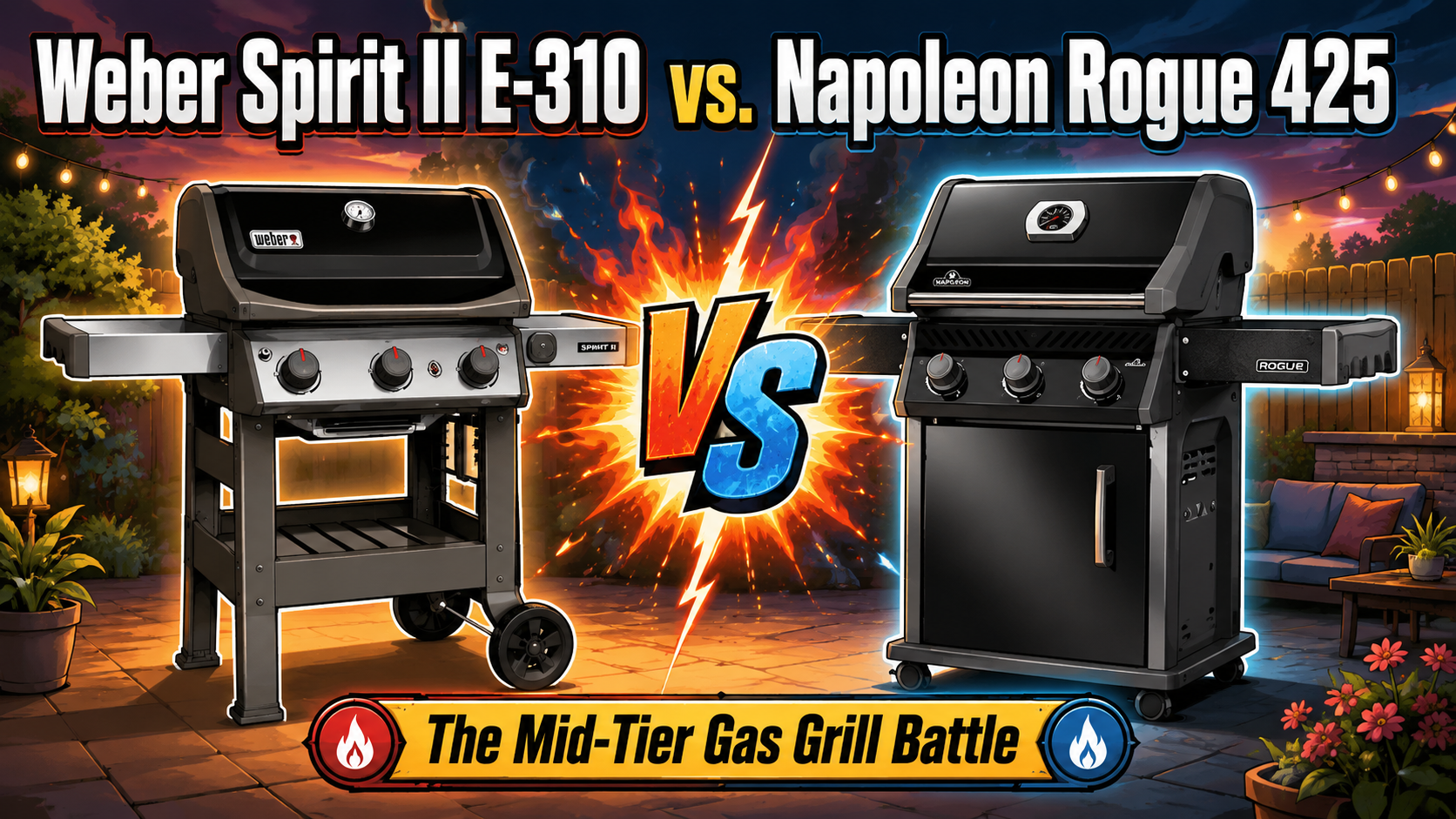
Weber Spirit II E-310 vs Napoleon Rogue 425
Both grills target backyard cooks who want reliable performance without jumping to premium Genesis or Prestige models. They offer similar primary cooking space for 4–6 people but differ in power, features, warranty, and price.
Spec Comparison
| Feature | Weber Spirit II / Spirit E-310 | Napoleon Rogue 425 |
|---|---|---|
| Primary cooking area | ~360–424 sq in | ~425–428 sq in (23.75″ × 18″) |
| Total cooking area | ~450–529 sq in | ~570–576 sq in |
| Main burners / BTU | 3 stainless steel / 24,000–30,000 BTU | 3 stainless steel / 42,000 BTU |
| Cooking grates | Porcelain-enameled cast iron | Porcelainized cast iron WAVE pattern |
| Ignition | Snap-Jet / Infinity electronic | JETFIRE battery-free |
| Side burner (base model) | No | No (available on higher trims) |
| Side shelves | Fixed or fold-down | Folding (space-saving) |
| Warranty | 10-year limited (key parts) | 15-year limited |
| Typical price (USD) | ~$499–$650 | ~$700–$799 MSRP |
Note: Exact specs can vary by model year, fuel type (LP vs NG), and region. Always verify the current manufacturer page for the specific SKU.
Cooking Performance
The Napoleon Rogue 425 delivers higher power (around 42,000 BTU) so it heats faster and reaches higher temperatures more easily—helpful for searing. Its WAVE cast-iron grates produce distinctive sear marks and hold heat well. Dual-level stainless sear plates help manage drippings and reduce flare-ups.
The Weber Spirit prioritizes even heat distribution. Its Flavorizer bars vaporize drippings for classic Weber grilled flavor while minimizing flare-ups. Many expert tests praise it for consistent results on burgers, chicken, vegetables, and indirect cooking. It is frequently ranked as a top everyday performer in its price class.
Bottom line: Napoleon has the edge for high-heat searing and faster preheat. Weber wins on evenness and set-it-and-forget-it consistency for most users.
Build, Features & Usability
Napoleon stands out with battery-free JETFIRE ignition, folding side shelves (great for smaller patios), locking caster wheels, and a stronger overall warranty. Cast aluminum components add durability appeal.
Weber emphasizes simplicity and proven design: solid porcelain-enameled grates, effective grease management, tool hooks, built-in lid thermometer, and excellent parts availability. Newer Spirit models add Weber Works side rails for accessories. The brand’s widespread service network is a practical advantage.
Pros & Cons
Weber Spirit II / E-310 – Pros
- Excellent even heat and flavor
- Strong value for the money
- Reliable ignition and grease management
- Widely available parts and support
- Frequently recommended by experts
Weber – Cons
- Lower peak BTU
- Fewer premium touches on the base model
- Simpler cabinet design on some versions
Napoleon Rogue 425 – Pros
- Higher power and faster searing
- Distinctive WAVE grates
- Battery-free ignition
- Folding shelves for space savings
- Stronger 15-year warranty
Napoleon – Cons
- Higher price
- Can feel like overkill for basic grilling
- Slightly heavier
Which should you buy?
Choose the Weber Spirit if you want the best overall value, proven even cooking, and a grill that many testers call a top everyday performer. Ideal for most families and weekend grillers.
Choose the Napoleon Rogue 425 if you want more raw power for searing, space-saving folding shelves, the WAVE grate performance, and longer warranty peace of mind—and you’re willing to pay the premium.
Infrared Sear Zones Explained
Infrared (IR) sear zones—also called infrared side burners, Sizzle Zones, or dedicated sear stations—deliver intense radiant heat for restaurant-style crusts on steaks, chops, and similar foods. They differ significantly from standard gas burners.
How They Work
Standard gas burners primarily heat the air inside the grill (convection). Heat transfers more slowly, typical surface temperatures top out around 500–700°F, and more moisture can escape during longer cook times.
Infrared burners use a gas flame to heat a ceramic, metal, or glass emitter plate. The plate radiates short-wave infrared energy directly onto the food. This produces much higher surface temperatures (often 800–1,800°F), faster preheat (usually 2–5 minutes), more efficient energy transfer, and less drying of the interior. Flare-ups are reduced because fat drips are less likely to hit open flames.
Infrared vs Traditional / Concentrated Gas Sear Zones
| Aspect | True Infrared (e.g. Napoleon Sizzle Zone) | Concentrated Gas / Sear Station (common on Weber) | Standard Main Burners |
|---|---|---|---|
| Heat type | Radiant (direct infrared) | Mostly convection + concentrated flame | Convection |
| Typical max temp | 1,000–1,800°F | Higher than standard (~600–900°F range) | 500–700°F |
| Preheat time | Very fast (2–5 min) | Faster than standard | 10–15+ min |
| Sear quality | Excellent crust, rapid Maillard reaction | Good grill marks and browning | Adequate but slower |
| Moisture retention | Generally better (seals faster) | Good | More potential drying |
| Flare-ups | Minimal | Reduced vs open flame | More common |
| Usable area | Often smaller (side burner for 1–2 steaks) | Can be larger (integrated into main grate) | Full cooking surface |
Brand Approaches
Napoleon Sizzle Zone is a true ceramic infrared burner, typically mounted as a side burner (or sometimes integrated). It is a signature feature on many Rogue SE/PRO, Prestige, and higher models. Claims reach approximately 1,500–1,800°F. Excellent for aggressive searing and can also be used with pans or woks.
Weber Sear Station / Sear Zone on most Genesis models uses closely spaced high-output traditional gas burners to create a concentrated hot zone within the main cooking area. It delivers strong searing and larger usable space, but is generally not ceramic infrared (true infrared appears more on higher Summit models). Effective but typically less extreme in peak temperature than Napoleon’s ceramic IR.
Pros & Cons of Infrared Sear Zones
Pros
- Superior steakhouse-style crust while keeping the interior juicier
- Very fast preheat and cooking times
- Efficient energy use for high-heat tasks
- Fewer flare-ups
- Excellent for reverse-sear techniques
Cons
- Easy to over-sear or burn food if timing is off
- Limited surface area on most side-burner versions
- Higher cost to add to a grill
- Ceramic elements need careful handling
- Less ideal as the sole cooking method for everything
Infrared sear zones shine for people who regularly cook thick steaks or want maximum crust quality. For everyday mixed grilling, a well-designed standard or concentrated-gas sear zone is often more versatile and sufficient.
Note: The base Weber Spirit II E-310 and Napoleon Rogue 425 do not include dedicated infrared. Higher-trim versions (Rogue with SIB/Sizzle Zone, Genesis with Sear Station) add these features.
Ceramic vs Metal Emitters
Both ceramic and metal emitters convert gas flame energy into radiant infrared heat, but they differ in peak temperature, intensity, durability, and versatility.
How Each Works
Ceramic emitters use a porous ceramic plate (often honeycomb-style with thousands of tiny ports). Gas and air mix and burn across or through the ceramic surface. The ceramic absorbs the heat, glows (often bright orange), and radiates intense short-wave infrared energy. This is the technology in Napoleon’s Sizzle Zone and many high-end sear burners.
Metal emitters typically use a stainless-steel tube burner topped with a perforated metal plate, mesh, or sheet. The metal heats up and radiates infrared energy. These are more common on entry-level or hybrid IR systems.
Ceramic vs Metal Comparison
| Feature | Ceramic Emitters | Metal Emitters |
|---|---|---|
| Peak temperatures | Highest (typically 600–1,000°F+; some claim 1,500–1,800°F) | Lower (typically 300–650°F) |
| Preheat time | Very fast (often 2–5 minutes) | Fast, but usually slower than ceramic |
| Heat evenness | Excellent | Good to very good |
| Sear intensity | Superior crust / Maillard reaction | Solid but milder searing |
| Low-temp capability | Limited (best at high heat) | Better (more versatile) |
| Flare-up risk | Can be higher if open flame reaches food | Generally lower |
| Durability | Good, but vulnerable to thermal shock | Higher impact and thermal-shock resistance |
| Common use | Premium sear zones (e.g. Napoleon Sizzle Zone) | Entry-level IR or hybrid systems |
| Cost | Higher | Lower |
Pros & Cons
Ceramic – Pros
- Maximum searing power for steakhouse-style crusts
- Excellent evenness
- Very efficient radiant heat
- Fast results with good moisture retention
Ceramic – Cons
- Steeper learning curve (food can burn quickly)
- More fragile if mishandled (thermal shock risk)
- Less ideal for delicate items or low-and-slow
- Potential for more flare-ups in some designs
Metal – Pros
- More durable and forgiving
- Easier temperature control across a wider range
- Lower flare-up risk
- Better for mixed or delicate cooking
- Usually more affordable
Metal – Cons
- Lower peak heat = less aggressive searing
- May not match high-end ceramic intensity for thick steaks
Which emitter is better?
Choose ceramic if your priority is the hottest, most intense sear possible (thick steaks, chops, reverse-sear finishing). This is why Napoleon features ceramic Sizzle Zones on many models.
Choose metal (or metal + protective glass systems) if you want greater durability, easier everyday use, better moderate-heat control, or a more budget-friendly IR option.
Final Takeaways
- For pure everyday value and even cooking → Weber Spirit series.
- For higher power, WAVE grates, and longer warranty → Napoleon Rogue 425.
- For maximum searing performance → look for a true ceramic infrared sear zone (common on higher Napoleon trims).
- Both base models lack infrared; step up to models with Sizzle Zone or Sear Station if searing is a top priority.
Always measure your space, decide whether searing power or evenness/value matters more, and check current pricing and promotions. Proper care (regular cleaning of burners, grates, and grease trays) will keep either grill performing well for years.