
Updated: August 21, 2026
Weber Spirit II E-310 vs. Napoleon Rogue 425: Which Should You Buy?
Best for: Backyard grill buyers
A solid option worth comparing before you buy.
Check Price on Amazon (paid link)As an Amazon Associate I earn from qualifying purchases.
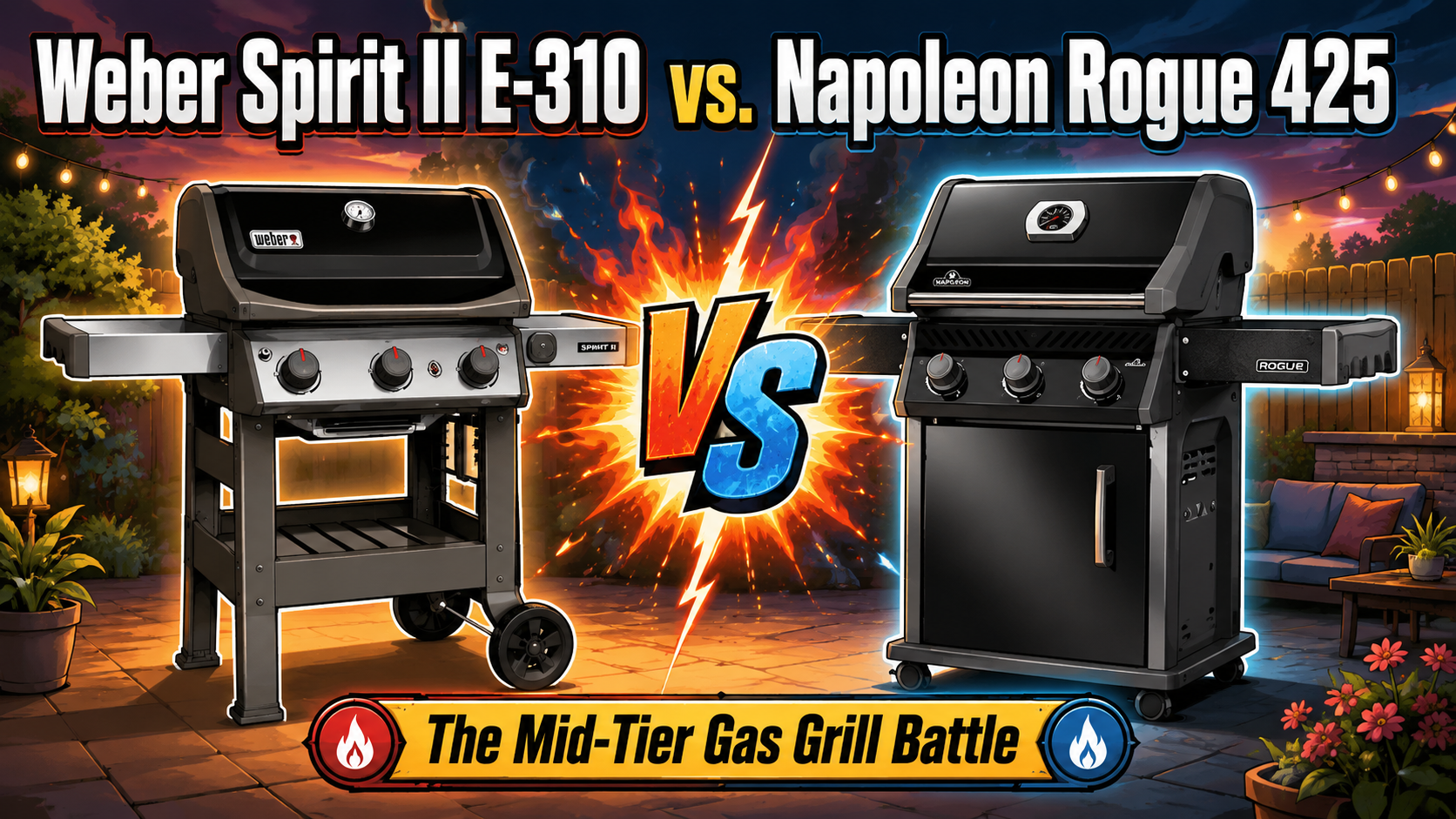
Weber Spirit II E-310 vs. Napoleon Rogue 425 is a close comparison because both are three-burner gas grills with nearly the same main-grate footprint. The meaningful differences are the cart design, listed heat input, ignition, shelf storage, warranty, current availability, and price for the exact model you find. The Weber Spirit isnt on Amazon now.
Quick Answer: The Weber Spirit II E-310 is the better buy for most value-focused shoppers when the exact grill is new, complete, and properly warrantied. Choose the Napoleon Rogue 425 for its cabinet cart, two folding shelves, battery-free ignition, higher listed output, and 15-year warranty. Neither base model has infrared.
Current Weber Alternative on Amazon
Amazon is not regularly listing the older Weber Spirit II E-310. The current three-burner Weber alternative is the Spirit E-325. It is a different model, so its features and specifications should not be treated as identical to the E-310.
Check the Weber Spirit E-325 on Amazon (paid link)
Disclosure: This article may contain affiliate links. If you buy through one of those links, Everything Grill Reviews may earn a commission at no extra cost to you. Always verify the model number, fuel type, current specifications, and warranty terms before ordering.

In This Comparison
- Which grill is better?
- How do the specifications compare?
- Which grill has more cooking space?
- Which burner system is better?
- Which design is easier to live with?
- Which warranty is better?
- Do either of these grills have infrared?
- Who should buy or skip each grill?
- What is the final verdict?
- Frequently asked questions
Which Grill Is Better: Weber Spirit II E-310 or Napoleon Rogue 425?
The better grill depends on the deal and the features you will actually use. The Weber is the practical value choice; the Napoleon offers the more feature-rich cart, a longer stated warranty, and more manufacturer-listed burner input.
| Your Priority | Better Fit | Why |
|---|---|---|
| Best value at a lower purchase price | Weber Spirit II E-310 | It covers the three-burner basics without charging for a cabinet cart or longer warranty. |
| Longer stated warranty | Napoleon Rogue 425 | Napoleon lists a 15-year warranty for eligible Rogue grills; Weber lists 10 years for Spirit II parts, subject to each company’s terms. |
| Smallest stored width | Napoleon Rogue 425 | Napoleon lists a 35-inch width with the shelves folded. |
| Open access to tools and supplies | Weber Spirit II E-310 | Its open-cart shelf keeps frequently used items visible and easy to reach. |
| Enclosed appearance and locking casters | Napoleon Rogue 425 | The Rogue uses a cabinet-style cart and locking caster wheels. |
| Built-in infrared searing | Neither exact model | The base Rogue 425 and Spirit II E-310 both use conventional gas burners without a dedicated infrared sear burner. |
Current Weber Alternative on Amazon
Amazon is not regularly listing the older Weber Spirit II E-310. The current three-burner Weber alternative is the Spirit E-325. It is a different model, so its features and specifications should not be treated as identical to the E-310.
Do not choose from the brand name alone. First confirm whether the listing is for the Spirit II E-310, the newer Spirit E-310, the base Rogue 425, or the infrared-equipped Rogue PRO 425 SIB. Those names describe different grills.
How Do the Weber Spirit II E-310 and Napoleon Rogue 425 Specifications Compare?
They provide similar main cooking space, but Napoleon lists more heat input and more total cooking area. Weber counters with a simpler open cart and a lower-cost position when the Spirit II is available at a discount.
| Feature | Weber Spirit II E-310 | Napoleon Rogue 425 |
|---|---|---|
| Main burners | 3 stainless-steel burners | 3 stainless-steel main burners |
| Manufacturer-listed heat input | 30,000 BTU per hour | 42,000 BTU |
| Main cooking surface | About 60 x 45–46 cm, depending on regional SKU | 23.75 x 18 inches (about 60 x 46 cm) |
| Total cooking area | About 521–529 sq. in., depending on regional SKU | 576 sq. in. |
| Cooking grates | Porcelain-enameled cast iron | Porcelainized cast iron with WAVE pattern |
| Heat shields | Porcelain-enameled Flavorizer bars | Dual-level stainless-steel sear plates |
| Ignition | Infinity electronic ignition; AA battery listed | Battery-free JETFIRE ignition |
| Side burner | No | No on the base Rogue 425 |
| Dedicated infrared burner | No | No on the base Rogue 425 |
| Cart and shelves | Open cart; left shelf folds | Cabinet-style cart; folding side shelves; locking casters |
| Stated warranty | 10 years on Spirit II parts, excluding normal wear and subject to terms | 15 years for eligible Rogue purchases, subject to terms |
Specification note: Model numbers and equipment can vary by fuel type, finish, country, and production year. The figures above were checked against Weber and Napoleon manufacturer pages on August 20, 2026. Verify the exact SKU before buying.
Which Grill Has More Cooking Space?
The main grates are essentially the same size, while the Rogue 425 has the larger manufacturer-listed total area. That means the Napoleon advantage is mainly above the primary grate rather than a dramatic increase in the direct grilling surface. Both main grates are roughly 60 by 46 centimeters. Either gives a family-size three-burner layout with enough width to establish direct and indirect zones. If you regularly cook tall food or use the warming rack for buns and finished food, compare the rack shape and lid clearance in person instead of relying only on the total-square-inch number. The practical question is not how many burgers a marketing photo claims will fit. It is whether you can leave part of the grate open as a cooler zone. Crowding every inch makes it harder to handle fatty food, move items away from a flare-up, or finish thick cuts indirectly.
Which Grill Has the Better Burner and Heat-Control System?
Napoleon has the higher listed gas input, but the specification alone does not prove that it cooks more evenly, preheats faster, or makes better food. Burner placement, cookbox shape, venting, wind, grate position, and maintenance all affect usable heat.
How does the Weber GS4 system work?
Weber’s GS4 system combines Infinity ignition, three burner tubes, Flavorizer bars, and a grease-management system. The Flavorizer bars cover the burners, intercept drippings, and direct grease away from the flame path. The open-cart design keeps the lower area accessible, but supplies stored there remain visible.
How does the Napoleon Rogue 425 system work?
The Rogue 425 uses three tube burners beneath dual-level stainless-steel sear plates. Napoleon says those plates catch and vaporize drippings while protecting the burners. Its JETFIRE system lights each burner with a jet of flame and does not require an ignition battery. Higher BTU input can provide more heat capacity, but BTU measures fuel input—not grate temperature, heat evenness, or efficiency. If high-heat steak cooking is your main priority, look for a controlled temperature test of the exact SKU or buy from a seller with a sensible return policy. Do not treat 42,000 versus 30,000 as a guaranteed cooking score.
Which Grill Is Easier to Use, Store, and Clean?
The Weber is simpler and more open; the Napoleon stores more compactly and looks more enclosed. Your patio and maintenance habits should decide which arrangement is better.
Why choose the Weber open cart?
Choose it when you want quick access to tools, a visible propane setup, and fewer cabinet surfaces to wipe down. The left shelf folds, while the right shelf stays available for prep. The tradeoff is that weatherblown dust and stored items remain in view.
Why choose the Napoleon cabinet cart?
Choose it when you prefer an enclosed appearance, locking casters, and two shelves that fold for storage. Napoleon lists the Rogue 425 at 51 inches wide with the shelves up and 35 inches with them down. Measure the full depth and required safety clearances too; folded width does not make a grill safe for indoor use or eliminate clearance requirements.
Which grease system is easier to maintain?
Both require regular cleaning below the grates, not just a quick brush across the cooking surface. Weber uses Flavorizer bars and a grease-management path; Napoleon uses dual-level sear plates and a removable grease system. The easier system is the one you can access, empty, and reinstall correctly without putting the job off. Before every cook, inspect the catch pan and grease tray. After the grill is cold, remove heavy deposits according to the owner’s manual. For more help, read how to prevent flare-ups on a gas grill.
Which Grill Has the Better Warranty?
Napoleon has the longer stated period, but both warranties have conditions that matter. Napoleon lists 15-year coverage for Rogue models purchased after January 1, 2020, while Weber lists all Spirit II parts for 10 years, excluding normal wear and subject to its terms. A warranty is not the same as a promise that every cosmetic or wear problem will be covered. Keep the receipt, register the grill, follow the maintenance instructions, and confirm that the seller is authorized. This matters especially if the Weber Spirit II E-310 is remaining inventory or used. A low price is less attractive if the exact purchase does not qualify for the coverage you expect. Read the current Weber warranty terms and Napoleon 15-year warranty terms before treating either number as a deciding factor.
Do the Weber Spirit II E-310 or Napoleon Rogue 425 Have an Infrared Sear Zone?
No. Neither exact base model includes a dedicated infrared sear burner. The phrase “sear plates” on the Rogue 425 refers to the metal shields above its conventional tube burners; those shields are not Napoleon’s ceramic infrared SIZZLE ZONE. This distinction prevents an expensive ordering mistake:
- Napoleon Rogue 425: three conventional main burners; no infrared side burner.
- Napoleon Rogue PRO 425 SIB: an upgraded model with an infrared SIZZLE ZONE side burner.
- Weber Spirit II E-310: three conventional burners with Flavorizer bars; no dedicated sear burner.
If infrared is essential, compare the price of the Rogue PRO 425 SIB with other grills that explicitly list a dedicated searing system. Do not assume that every Rogue 425 listing includes it.
What is an infrared emitter?
An infrared emitter is a heated surface that radiates energy toward the food instead of relying only on hot moving air. Some systems use a ceramic element with many small ports; others use a metal emitter between the flame and grate. The design, usable area, and temperature control vary widely. Ceramic infrared side burners are built for a small, intense searing zone. Metal-emitter systems may spread radiant heat across a broader section and shield food from direct flame. Neither description applies to the standard burner-and-shield layout of these two base grills. Flavorizer bars and Rogue sear plates manage heat and drippings, but that does not turn either grill into a dedicated infrared model.
Do you need infrared to sear a steak?
No. A clean, well-preheated conventional gas grill can brown and sear food. Infrared is an optional way to concentrate radiant heat; it is not a requirement for a good crust. Dry the meat’s surface, preheat as the manual directs, avoid crowding, and finish thick cuts over a cooler zone so the exterior does not burn before the center is ready.
Who Should Buy or Skip Each Grill?
Buy based on your actual patio, budget, warranty eligibility, and searing expectations—not on the badge. These profiles make the choice simpler.
Who should buy the Weber Spirit II E-310?
Buy the Weber if you find the exact Spirit II model at a clearly lower price and want a straightforward family-size grill.
- You prefer an open cart and visible access to tools.
- You want three burners for direct and indirect cooking.
- You value Weber’s Spirit II parts coverage and can confirm that your purchase qualifies.
- You do not need a side burner, cabinet, or infrared sear zone.
- You have verified that the listing is the Spirit II E-310—not a different Spirit E-310 generation.
Who should skip the Weber Spirit II E-310?
Skip it if the price is close to a newer or more capable alternative, the warranty status is uncertain, or you want enclosed storage. Also skip it if a dedicated sear burner is on your must-have list.
Who should buy the Napoleon Rogue 425?
Buy the Napoleon if its 15-year warranty, compact folded width, locking casters, cabinet styling, and battery-free ignition justify the extra cost to you.
- You want the larger listed total cooking area.
- You value two folding shelves for storage.
- You prefer WAVE cast-iron grates and dual-level sear plates.
- You want the higher listed main-grill heat input without moving to a four-burner grill.
- You are buying through an authorized seller and have checked the exact warranty terms.
Who should skip the Napoleon Rogue 425?
Skip it if you are paying mainly because you think it includes infrared—it does not. It may also be poor value if you do not care about the cabinet, folding shelves, ignition design, or longer warranty and the Weber costs substantially less.
What Are the Pros and Cons of Each Grill?
The Weber’s strengths are simplicity and value; the Napoleon’s strengths are features, storage width, and warranty length.
Weber Spirit II E-310 Pros
- Three-burner layout supports direct and indirect cooking.
- Main-grate size is close to the Rogue 425.
- GS4 system includes Flavorizer bars and grease management.
- Left folding shelf and open-cart access.
- 10-year Spirit II parts warranty, subject to terms.
- Can be the better value when discounted.
Weber Spirit II E-310 Cons
- No cabinet, side burner, or dedicated sear burner.
- Only one shelf folds.
- Lower listed gas input than the Rogue 425.
- Easy to confuse with other Spirit E-310 generations.
- Warranty eligibility needs extra attention on old stock or used listings.
Napoleon Rogue 425 Pros
- Three burners and a family-size primary grate.
- Higher manufacturer-listed heat input.
- Two folding shelves reduce stored width.
- Battery-free JETFIRE ignition.
- Locking casters and cabinet-style cart.
- 15-year warranty for eligible purchases, subject to terms.
Napoleon Rogue 425 Cons
- Usually requires a larger investment than a discounted Spirit II.
- No side burner or infrared burner on the base model.
- The words “sear plates” can be mistaken for an infrared sear zone.
- Extra listed BTUs do not guarantee better real-world heat distribution.
What Is the Final Verdict?
Choose the Weber Spirit II E-310 for value; choose the Napoleon Rogue 425 for the stronger feature package. The primary cooking surfaces are so similar that grate size should not settle the decision. The Weber makes the most sense when it is meaningfully cheaper, the exact purchase carries valid coverage, and you want a simple three-burner grill. The Napoleon earns its premium when you will benefit from its two folding shelves, battery-free ignition, cabinet cart, locking casters, larger listed total area, and 15-year warranty. My practical verdict: For most value-focused family cooks, I would choose a new, complete, properly warrantied Spirit II E-310 when it costs substantially less. I would pay more for the Rogue 425 only when its cabinet cart, two folding shelves, ignition design, locking casters, and longer warranty are features I genuinely want. If infrared searing is non-negotiable, buy neither base model and compare the Rogue PRO 425 SIB or another grill that explicitly includes a dedicated sear burner. For a broader checklist before spending, use this gas grill buying guide. If you are deciding whether premium features are worth the difference, see cheap vs. expensive gas grills.
Frequently Asked Questions
Is the Napoleon Rogue 425 better than the Weber Spirit II E-310?
The Rogue 425 is better equipped, while the Spirit II E-310 can be the better value. Napoleon lists more heat input, two folding shelves, battery-free ignition, locking casters, and a longer warranty. Weber remains attractive when its purchase price is substantially lower.
Does the Napoleon Rogue 425 have an infrared side burner?
No, the base Rogue 425 does not have an infrared side burner. Look for the Rogue PRO 425 SIB designation if you want Napoleon’s infrared SIZZLE ZONE side burner.
Does the Weber Spirit II E-310 have a sear zone?
No, the Spirit II E-310 does not have a separate dedicated sear burner. It uses three conventional burners beneath Flavorizer bars. It can still brown food over a properly preheated hot zone.
Which grill has more primary cooking space?
Neither has a meaningful primary-grate advantage. Their manufacturer-listed main surfaces are both approximately 60 by 46 centimeters. The Rogue 425 has the larger listed total area after the warming space is included.
Which grill is better for a small patio?
The Rogue 425 stores narrower because Napoleon lists a 35-inch width with its shelves folded. The Weber’s left shelf also folds, but you must measure the complete operating footprint and follow the manufacturer’s outdoor-clearance rules for either grill.
Can either grill be converted from propane to natural gas?
Buy the factory model made for your fuel instead of assuming it can be converted. Both product families have appeared in propane and natural-gas versions, but parts and certification are model-specific. Match the listing and model number to your fuel supply.
Is 42,000 BTU automatically better than 30,000 BTU?
No. BTU measures fuel input, not cooking quality. The higher rating may provide more available heat, but grill design, venting, burner placement, weather, cleanliness, and temperature control determine how that input performs at the grate.
How This Comparison Was Researched
This article compares manufacturer-published specifications, feature descriptions, and warranty terms for the exact named models. It does not claim that Frank personally performed side-by-side instrumented testing of these two grills. Where specifications vary by region or SKU, the difference is identified instead of hidden. Frank W. Roberts has been grilling since 1970 and has experience in competitive cookoffs. He uses that background to focus on the decisions that matter in a backyard: usable cooking zones, maintenance access, flare-up control, storage, fuel choice, replacement support, and whether an upgrade is worth its cost.