
Updated: September 3, 2026
Quick Answer: How Do You Use a Meat Thermometer?
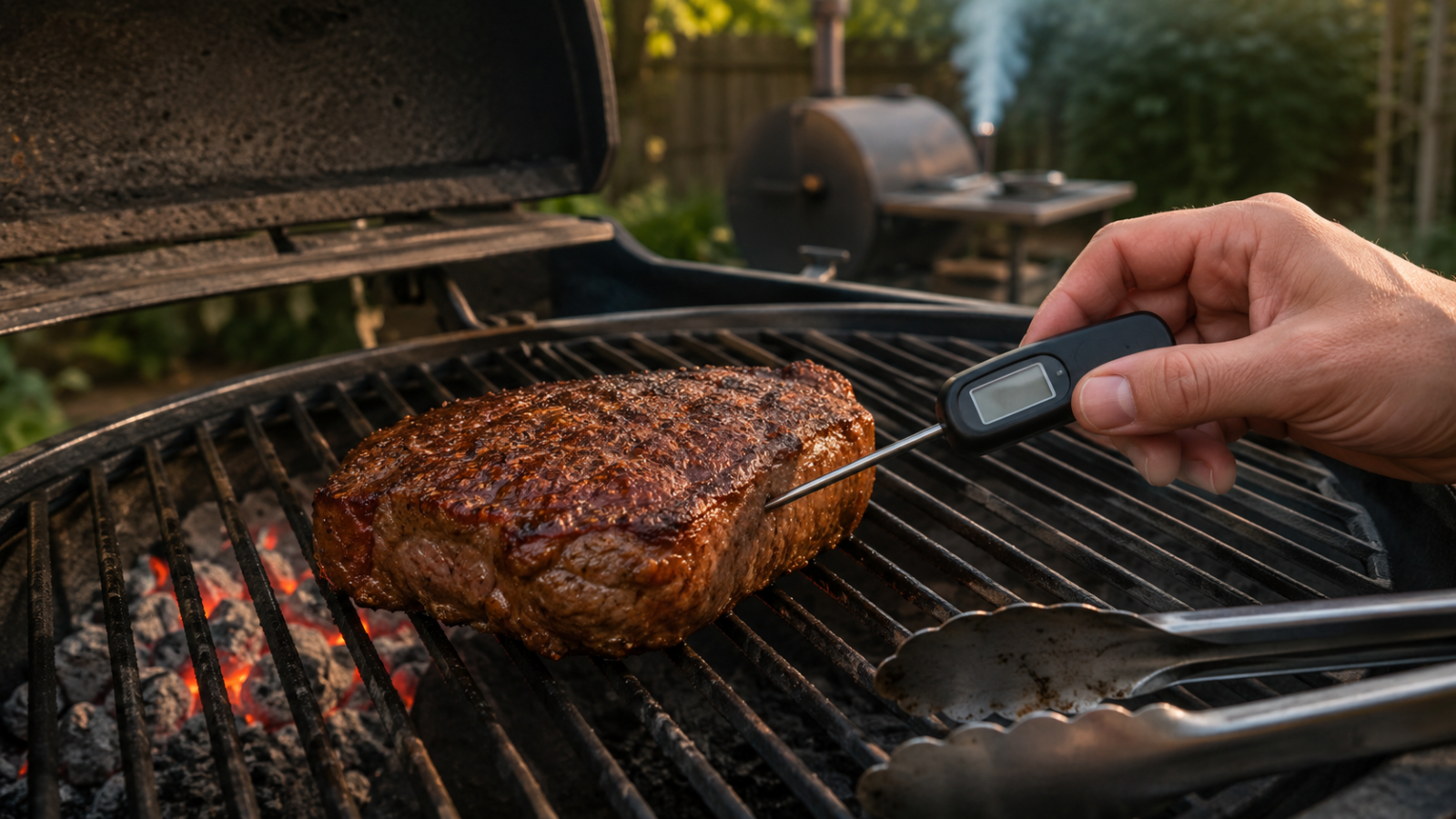
Insert the probe into the thickest part of the food, away from bone, fat, and gristle. For thin burgers or chops, insert it from the side. Check more than one spot and cook whole beef, pork, lamb, and veal to at least 145°F plus a 3-minute rest, ground meat to 160°F, and poultry to 165°F.
Key Points
- Measure the food, not the grill. A lid thermometer shows cooker air, not the center of the meat.
- Avoid bone, thick fat, and empty cavities. They can produce a misleading reading.
- Approach the center from the side on thin food. This works better for burgers, thin steaks, chops, and boneless chicken breasts.
- Check several locations. Large roasts and whole birds rarely heat perfectly evenly.
- Use temperature for safety and feel for tenderness. Brisket can be safe but still tough.
- Clean the probe between checks. Do not carry raw-meat juices onto cooked food.
Which Meat Thermometer Should You Use?
Use an instant-read thermometer for final spot checks and a leave-in probe for watching a long cook. If you can own only one, a dependable instant-read thermometer is the most useful because it works with steaks, burgers, chicken pieces, roasts, and leftovers.
| Thermometer Type | Best Use | Main Limitation |
|---|---|---|
| Digital instant-read | Checking several spots near the end of cooking | Most models should not be left in the meat during cooking |
| Leave-in wired probe | Brisket, pork shoulder, turkey, and other long cooks | One fixed location may miss a colder part of the meat |
| Wireless meat probe | Remote monitoring without a cable through the lid | Range, charging, and heat limits depend on the model |
| Grate or air probe | Measuring smoker temperature close to the food | Does not measure internal meat temperature |
| Dial instant-read | Larger roasts and general kitchen checks | Usually slower and harder to position accurately in thin food |
| Infrared thermometer | Checking a griddle or other surface | Reads surface temperature only and cannot prove meat is safely cooked inside |
A grill’s built-in lid gauge is useful for watching general cooker behavior, but it is not a food thermometer. The air at the lid can differ from the air beside the meat, and neither reading tells you the temperature at the center of a chicken thigh or hamburger.
How Do You Use an Instant-Read Meat Thermometer Step by Step?
Open the grill only when needed, insert the clean probe into the center of the thickest edible portion, wait for the reading to settle, and repeat in another spot. Do not leave an ordinary instant-read thermometer inside a closed grill unless its instructions specifically say it is oven-safe.
- Know the safe target before cooking. Do not try to remember the number while smoke is in your eyes and food is nearing done.
- Begin checking near the expected finish. Checking early is better than discovering the meat is already overcooked.
- Move the food away from direct flame. Use the indirect side of the grill when possible so your hand and thermometer are not over intense heat.
- Insert the probe into the thickest part. Aim for the thermal center, not simply the easiest place to reach.
- Avoid bone, fat pockets, and gristle. Withdraw and reposition the probe if the reading changes suddenly or does not make sense.
- Wait for a stable reading. Follow the response-time instructions for your thermometer.
- Check another location. Use the lowest reliable reading when deciding whether the entire food has reached its safe minimum.
- Clean the probe. Wash the food-contact portion with hot, soapy water before and after use, following the thermometer’s care instructions.
The USDA also advises checking food before you expect it to be finished and cleaning a food thermometer with hot, soapy water before and after use. Its thermometer guidance says to measure the thickest part without touching bone, fat, or gristle.
Where Should You Insert a Meat Thermometer?
Insert the thermometer where the food is likely to be coldest: normally the center of its thickest solid section. Correct placement changes with the shape of the food, so the top-down approach is not always best.
| Food | Where to Place the Probe | What to Avoid |
|---|---|---|
| Steak or pork chop | Enter from the side and aim for the center of the thickest portion | Bone, edge fat, and a probe tip that passes through the center |
| Hamburger or sausage patty | Insert sideways into the center; lift thin food with a clean spatula if needed | A shallow top-down reading near the hot surface |
| Chicken breast | Center of the thickest section, approached from the side when practical | Rib bone or a pocket next to the bone |
| Chicken thigh or drumstick | Thickest meat near—but not touching—the bone; check more than one piece | The joint, exposed bone, or a thin flap of meat |
| Whole chicken or turkey | Innermost thigh, innermost wing, and thickest part of the breast | Bone and the empty body cavity |
| Brisket or pork shoulder | Deep in the thickest solid muscle; verify several areas with an instant-read probe | Large fat seams, bone, and a thin end that cooks faster |
| Ribs | Meatiest area between bones, using a thin probe | Bone and meat too thin to surround the sensing tip |
| Meatloaf or ground-meat casserole | Center of the thickest section; check two locations | The pan, filling pockets, or a browned outer edge |
For thin foods, the USDA recommends inserting the thermometer from the side so the sensing area reaches the center. The agency’s full food thermometer guide also recommends checking whole poultry in the thigh, wing, and thickest breast area.
How Do You Find the Center Without Pushing the Probe Too Far?
Estimate half the food’s thickness and watch for the lowest reading as you slowly move the probe through the center. If the probe tip passes beyond the cold center and approaches the hot opposite surface, the displayed temperature may begin climbing again. On a steak or burger, insert from the side until the tip reaches the middle. On a thick roast, insert deep enough to reach the center, then slowly withdraw the probe. The lowest stable temperature you find in solid meat is usually more useful than the first number that flashes on the screen. Do not repeatedly stab a small piece in every direction. Two or three carefully chosen checks are normally enough. For a large irregular roast, check the thick end, center, and any area shielded from the hotter side of the cooker.
What Internal Temperatures Make Grilled Meat Safe?
USDA minimums are 145°F with a 3-minute rest for whole beef, pork, lamb, and veal cuts; 160°F for ground meat; and 165°F for all poultry. Temperature must be measured before food is removed from the heat source. Do not depend on carryover heat to rescue meat that has not reached its safety minimum.
| Food | Safe Minimum Internal Temperature | Rest Time |
|---|---|---|
| Beef, pork, lamb, and veal steaks, chops, and roasts | 145°F | At least 3 minutes |
| Ground beef, pork, lamb, and veal | 160°F | None required by the chart |
| Chicken, turkey, duck, and other poultry, including ground poultry | 165°F | None required by the chart |
| Fish with fins | 145°F | None required by the chart |
| Leftovers and casseroles | 165°F | None required by the chart |
Use the current USDA Safe Minimum Internal Temperature Chart as the authority when a package, recipe, or remembered rule conflicts with the table. Package instructions may require additional handling or a higher temperature for a particular prepared product.
Is a Safe Temperature the Same as Tender or Ready to Serve?
No. Safety, doneness preference, and tenderness are related but different decisions. A pork chop can be safe at 145°F after its rest. A pork shoulder at 145°F is also past the whole-cut safety minimum, but its connective tissue may still be too firm for pulled pork. Brisket, chuck roast, and pork shoulder often become tender in a much higher temperature neighborhood, commonly around 190–205°F. That range is not a safety requirement or a guaranteed finishing number. Begin probing for tenderness and remove the meat when the probe slides into several areas with little resistance. Ribs are especially awkward to measure because the bones are close together and the layer of meat is thin. Verify safe temperature in the meatiest available area, then use bend, surface cracking, and probe resistance to judge texture.
How Do You Use a Leave-In Probe on a Smoker?
Place the leave-in probe in the thickest central muscle before closing the smoker, keep it away from bone and large fat seams, and confirm the result with an instant-read thermometer near the finish. One fixed probe is a trend monitor, not proof that every part of the meat is equally hot.
- Inspect the probe and cable for damage before cooking.
- Insert the probe so its sensing end is surrounded by solid meat.
- Route a wired cable through the cooker’s probe port when one is available.
- Keep the cable and probe within the heat limits listed by the manufacturer and away from direct flame.
- Set a food alarm near the temperature where you want to begin checking, not as permission to ignore the cook.
- Near the finish, verify the thickest area and at least one second location with a clean instant-read thermometer.
For a long charcoal cook, pair the meat probe with a grate-level air probe. The air probe should measure the cooking zone close to the food without touching the meat or sitting directly over the fire. This guide explains how to hold a charcoal grill near low-and-slow temperatures.
Where Does the Probe Go in Brisket or Pork Shoulder?
Put the probe into the thickest solid section and away from the largest fat seam or bone. In brisket, the flat is often the more useful monitoring location because it is leaner, but you should check both the flat and point before calling the entire brisket ready. In a bone-in pork shoulder, aim for the center of the meat without touching the blade bone. If the reading jumps higher as soon as the tip moves, you may have entered a fat pocket or approached bone. Reposition it and compare the new reading. Large barbecue cuts can vary from one end to the other. A leave-in probe tells you the direction and pace of the cook. An instant-read probe tells you whether the rest of the roast agrees.
How Should You Check Chicken on a Grill?
Check the thickest meat in each type of chicken piece and keep the probe off the bone. A breast, thigh, and drumstick do not necessarily finish together, even when they went onto the grill at the same time.
- Boneless breast: Insert from the side into the thickest center.
- Bone-in breast: Check deep in the thickest meat without touching the ribs.
- Thigh: Probe the thickest meat beside the bone, not the joint.
- Drumstick: Check the thickest portion from the side and avoid the central bone.
- Whole bird: Check the innermost thigh and wing and the thickest breast. Every location must reach at least 165°F.
Use indirect heat to finish chicken after browning so you can take readings without working over constant flames. The site’s two-zone grilling guide shows how to create a hot side and a safer finishing side. For a whole smoked bird, see how to smoke a turkey.
How Do You Test a Meat Thermometer for Accuracy?
Test it in a properly made ice-water bath; it should settle at about 32°F. Check a new thermometer before trusting it, and test it again after it is dropped, exposed to excessive heat, or begins giving suspicious readings.
- Fill a tall glass generously with ice.
- Add cold water until the gaps are filled, keeping plenty of ice in the glass.
- Stir and let the mixture settle briefly.
- Insert only the sensing portion of the probe into the center of the ice water.
- Do not let the probe touch the glass sides or bottom.
- Wait for the reading to stabilize. A correctly reading thermometer should show about 32°F.
- If it is off, calibrate it according to its instructions. If a nonadjustable thermometer remains unreliable, replace it rather than guessing during food-safety checks.
The USDA describes both ice-water and boiling-water calibration methods. Ice water is simpler for most backyard cooks because the boiling point changes with altitude and atmospheric conditions. Never submerge the display or handle unless the model is rated for it.
How Often Should You Clean a Meat Thermometer?
Clean the food-contact part before and after every use and whenever it moves from raw or undercooked food to food that may be ready to serve. A dirty probe can transfer raw-meat juices even when the final temperature reading is safe. Use hot, soapy water on the probe and follow the maker’s instructions for the body, cable, and connector. Some thermometers are waterproof; others are not. Do not put an electronic unit into a dishwasher or sink unless its instructions specifically allow it.
What Are the Most Common Meat Thermometer Mistakes?
The most common mistakes are touching bone, checking only one location, and confusing cooker temperature with internal food temperature. Most bad readings come from placement or handling rather than complicated technology.
| Mistake | Why It Fails | Better Move |
|---|---|---|
| Touching bone | Bone can heat differently from the surrounding meat | Back the probe out and approach the center from another angle |
| Probing a fat pocket | It may not represent the coldest solid muscle | Check multiple solid sections |
| Entering a thin burger from the top | The sensing tip may pass through the center or sit near a hot surface | Insert sideways into the middle |
| Trusting color or clear juices | Appearance does not prove a safe internal temperature | Use the correct thermometer reading |
| Checking only one chicken piece | Piece size and grill hot spots vary | Check the largest pieces in different areas |
| Leaving an instant-read unit in the grill | A model not rated for continuous heat can be damaged | Use a leave-in probe or remove the instant-read unit after checking |
| Putting the cable over direct flame | Excess heat can damage insulation or the probe connection | Use a probe port and follow the rated heat limits |
| Using an infrared thermometer on meat | It measures only the outside surface | Use a penetrating food probe for internal temperature |
Final Verdict: What Is the Right Way to Use a Meat Thermometer?
Use a clean, accurate thermometer in the coldest part of the thickest meat, check more than one location, and compare the lowest reliable reading with the correct safety minimum. That simple routine matters more than extra app features or a long list of preset temperatures. An instant-read thermometer handles the final decision. A leave-in probe makes long cooks easier to monitor. A grate probe helps you manage the smoker. None of them replaces the others, and a lid gauge cannot tell you whether dinner is safe inside. Most importantly, do not let color, cooking time, or habit overrule the thermometer. Place the probe correctly, give it time to settle, and check again when a number looks wrong.
Frequently Asked Questions
Can you leave a meat thermometer in the grill?
Only if it is designed as an oven-safe or leave-in thermometer. Remove an ordinary instant-read thermometer after checking. Follow the model’s temperature limits for the probe, cable, and electronic body.
How far should you insert a meat thermometer?
Insert it far enough for the sensing area to reach the center of the thickest solid meat. The sensing location differs by thermometer, so check its instructions. With many digital instant-read models, temperature is measured near the probe tip.
Why does my meat thermometer give different readings?
Different areas of food cook at different speeds, and fat, bone, thickness, or grill hot spots can change the reading. Check several solid-meat locations and use the lowest stable result when confirming safety.
Can a meat thermometer touch bone?
No, not for an accurate meat reading. Bone can heat differently from the surrounding muscle. Reposition the probe into thick meat beside the bone without touching it.
Do you check meat temperature while it is still on the grill?
Yes. USDA safe minimums should be reached before the food is removed from the heat. Move the food to an indirect zone for a safer, steadier check when possible.
Can you use a meat thermometer for grill temperature?
Only a probe specifically designed to measure cooker air should be used that way. A meat probe is made to sit inside food, while an air probe is positioned near the grate. Follow the thermometer manufacturer’s instructions.
Is an instant-read or leave-in thermometer better?
An instant-read thermometer is better for final checks; a leave-in probe is better for tracking a long cook. For smoking brisket, pork shoulder, or turkey, using both gives you better information than relying on either one alone.