
Updated: September 9, 2026
How long a 20-lb propane tank lasts depends on pounds of propane actually in the cylinder and how hard the burners run, not on the “20-lb” name on an exchange cage. A grill almost never burns its full rated input for the whole cook.
Quick Answer: How Long Does a 20-Lb Propane Tank Last?
A true 20-lb fill lasts about 8 to 20 burner-hours on a typical backyard gas grill; a 15-lb exchange fill lasts less. Use pounds left times about 21,500 Btu, then divide by the Btu your burners are using. Preheat, extra burners, wind, and cold weather shorten the tank.
Key Points
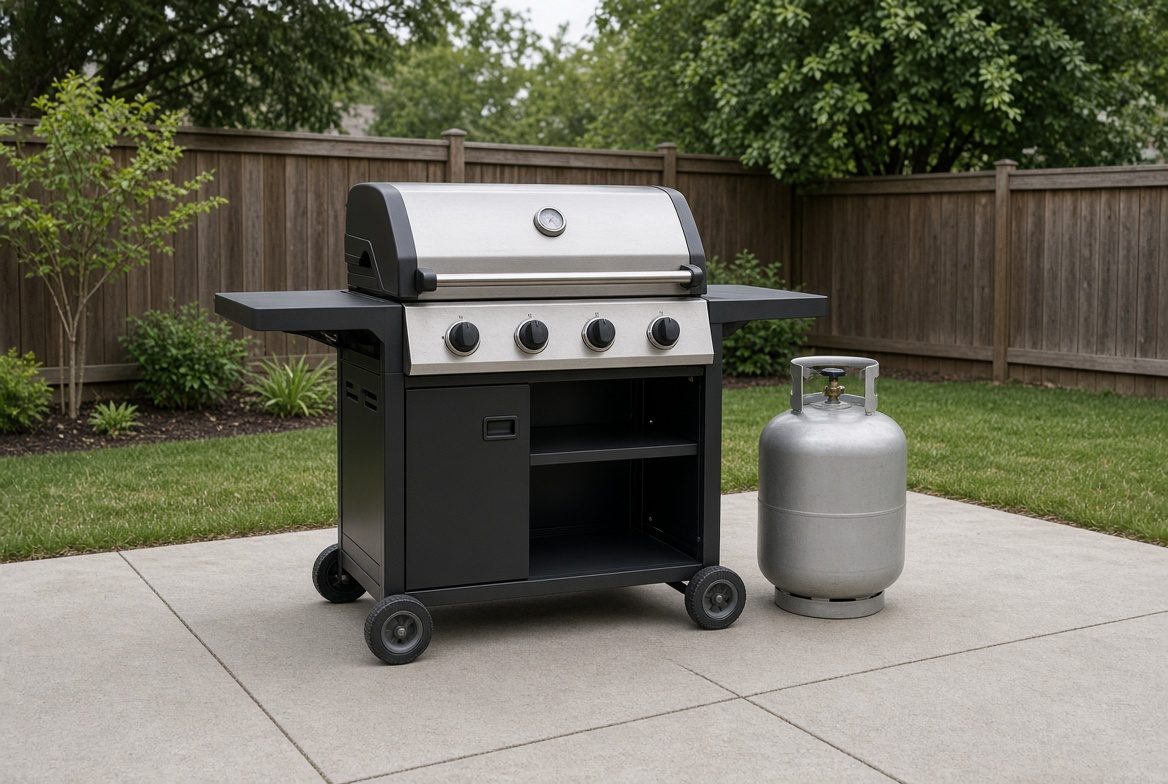
- A 20-lb grill cylinder is named for the propane it is sized to hold, about 20 pounds, or roughly 4.7 gallons.
- Propane has about 21,500 Btu per pound, so 20 pounds is about 430,000 Btu and 15 pounds is about 322,500 Btu.
- Exchange brands such as Blue Rhino state that their grill tanks contain a net 15 pounds of propane.
- Runtime equals remaining Btu divided by the Btu your burners are actually using, not the grill’s peak rating on the spec sheet.
- Weigh the cylinder and subtract the stamped tare weight (TW) to see how much propane is left.
- Store cylinders upright outdoors. Do not keep them in a garage, shed, basement, tent, or under the grill.
Safety first: Propane is flammable. Keep the cylinder upright, outdoors, and away from ignition sources. If you smell gas, do not light the grill. If it is safe, close the cylinder valve, leave the area, and call 911 or the fire department for an active leak you cannot shut off. Do not store a spare cylinder under or beside a hot grill.
How Much Propane Is in a 20-Lb Tank?
A 20-lb grill cylinder is built to hold about 20 pounds of propane when it is filled to the legal limit, which is about 4.7 U.S. gallons. Liquid propane weighs about 4.24 pounds per gallon near 60°F, so 20 ÷ 4.24 ≈ 4.7 gallons. That weight rating already describes the propane inside the cylinder. Do not apply the 80% fill rule a second time and assume a “20-lb tank” only holds 16 pounds.
The 80% rule still matters, but it is applied to the cylinder’s water capacity when the tank is manufactured and when a refill station fills to the overfill-protection device. The result of that limit is the familiar 20-pound propane charge, not a hidden 16-pound charge on top of the name.
What you actually take home is often less than 20 pounds:
- Tank exchange: Blue Rhino states that its propane grill tanks contain a net weight of 15 pounds of propane. Other exchange cages follow the same short-fill pattern.
- Refill station: A qualified filler stops at the OPD valve. That fill is usually closer to the cylinder’s legal maximum than an exchange tank, but the exact pounds still vary with temperature, scale accuracy, and station practice.
- A used tank: Whatever remains after the last cook. The label on the cage does not tell you that number.
| What you bought | Propane inside | Approx. gallons | Approx. total Btu |
|---|---|---|---|
| Legal full 20-lb fill | About 20 lb | About 4.7 gal | About 430,000 |
| Typical exchange cylinder | About 15 lb | About 3.5 gal | About 322,500 |
| Half a full 20-lb fill | About 10 lb | About 2.4 gal | About 215,000 |
The U.S. Energy Information Administration lists propane at 91,452 Btu per gallon. Divided by about 4.24 pounds per gallon, that is about 21,500 Btu per pound. Use the per-pound number for grill math. It does not bounce around with temperature the way gallons do.
How Do You Calculate How Long the Tank Will Last?
Divide the Btu still in the tank by the Btu your burners are using that hour. Remaining hours ≈ (pounds of propane left × 21,500) ÷ Btu per hour in use.
Find the grill’s maximum input on the rating plate or in the manual. That number is the high-fire rating, not your average cook. A three-burner grill listed at 30,000 to 40,000 Btu per hour only burns that much when every main burner is wide open. Medium heat, a two-zone setup, and a closed lid use less. A side burner, sear burner, or infrared zone adds its own rating on top of the mains.
| Steady burner draw | Hours from 20 lb | Hours from 15 lb exchange | What that draw looks like |
|---|---|---|---|
| 20,000 Btu/hr | About 21.5 | About 16 | Low to medium on a small grill; one or two burners |
| 30,000 Btu/hr | About 14 | About 11 | Typical three-burner cook after preheat |
| 40,000 Btu/hr | About 11 | About 8 | Most burners medium-high, or mains plus a side burner |
| 50,000 Btu/hr | About 8.5 | About 6.5 | Large grill on high, or mains plus sear and side burner |
| 60,000 Btu/hr | About 7 | About 5.5 | High-output grill wide open |
Those hours assume a constant draw. Real cooks are not constant. You preheat on high for 10 to 15 minutes, drop the heat to cook, and may shut a burner off for a cool zone. A weeknight burger session might burn 30 to 45 minutes of mixed heat. An all-afternoon pizza or steak party on high heat can empty an exchange tank in a few long sessions.
Manufacturer input ratings give the scale. Weber lists the Spirit E-325 main burners at 31,000 Btu per hour. Several current Genesis three-burner models list about 39,000 Btu per hour on the mains, and four-burner Genesis models list 48,000 Btu per hour on the mains before adding a sear zone or side burner. Use the plate on your own grill. Model lines change.
How Long Does a 20-Lb Tank Last on a Typical Cookout?
Translate burner-hours into the cook in front of you: short medium-heat dinners stretch a tank; long high-heat sessions spend it fast.
- Weeknight burgers, dogs, or boneless chicken: Short preheat, two or three burners at medium, lid closed. One tank can last a stretch of dinners if you are not running a side burner the whole time.
- Steak night or pizza on high heat: Long preheat and high burner settings. Expect far fewer hours than the “21 hours at 20,000 Btu” line in the table.
- Indirect roast or a long smoke on gas: Lower burner input, but the clock runs for hours. A foil pouch or smoker box does not change the propane math much; the burners still have to hold the cooker. See the site guide to adding smoke flavor on a gas grill if that is the cook.
- Patio heater on the same cylinder: A 40,000 Btu heater on high can drain a full 20-lb tank in around 10 hours of continuous use. Do not guess. Use the heater’s rated input in the same formula.
If the flame dies mid-cook, do not keep clicking the igniter. Close the burner knobs and the cylinder valve. An unexpected shutdown is sometimes an empty tank, and sometimes a regulator, hose, or burner problem. The site’s gas grill troubleshooting guide covers weak flame, yellow flame, and lighting faults.
What Shortens a 20-Lb Propane Tank Faster?
High burner settings, extra burners, wind, cold metal, and a short-filled exchange tank are the usual reasons a cylinder dies sooner than the chart suggests.
You are using more Btu than you think
Preheat on high is the most expensive part of many cooks. A side burner for sauce or a kettle of water is a second appliance. Sear zones and infrared burners add their own input. Leaving all burners on high with the lid open dumps heat into the air and the tank.
The tank was never a full 20 pounds
Start the math with 15 pounds if the cylinder came from an exchange cage unless you have weighed it. A 15-pound fill has about one-quarter less energy than a 20-pound fill. That is why two “full” tanks from different sources do not last the same number of cooks.
Cold weather and a low tank
Propane has to boil into vapor before the grill can burn it. A cold cylinder with little liquid left cannot vaporize as fast as a large grill on high. The tank may frost, pressure falls, and the burners starve even though a scale would still show some propane. Bring the cylinder up to outdoor air temperature. Do not heat it with a torch, hair dryer, or hot water from a stove, and never take it into a garage or house to “warm it up.”
Wind, dirty burners, and a failing regulator
Wind makes you open the burners further to hold temperature. Clogged burner ports and a regulator stuck in bypass mode look like a dying tank. If a freshly exchanged cylinder still gives a weak flame after a proper leak check and the grill’s regulator-reset steps in the manual, treat it as a grill problem, not a fuel mystery.
How Can You Tell How Much Propane Is Left?
Weigh the cylinder and subtract the tare weight stamped on the collar. That is the most reliable backyard method for a 20-lb tank. Built-in pressure gauges are a poor stand-in for quantity until the tank is nearly empty.
1. Weigh it
- Close the cylinder valve. Disconnect the regulator only after the grill is off and the valve is closed, following the grill manual.
- Set the cylinder upright on a bathroom or luggage scale.
- Read the collar stamp marked TW or tare weight. On common steel 20-lb cylinders that number is often in the mid-teens to about 18 pounds. Use the stamp on your cylinder, not an average from a chart.
- Subtract: scale weight − TW = pounds of propane left.
- Estimate remaining hours with (pounds left × 21,500) ÷ Btu per hour you plan to use.
Example: the collar says TW 17.2, the scale reads 24.2, and you have about 7 pounds of propane. At a 30,000 Btu draw, that is roughly 5 hours. The example is math, not a promise.
2. Use the warm-water line
Pour warm tap water down one side of the cylinder and run your hand from top to bottom. The metal usually feels cooler where liquid propane is still sitting. The method is rough. It works better when the tank is not almost empty and when the side of the cylinder is easy to reach.
3. Treat cheap pressure gauges as a last-gasp warning
Propane vapor pressure stays relatively steady through most of the tank and then falls near the end. An inline gauge that reads “half” can still be looking at pressure, not pounds. A scale or a purpose-built tank scale under the cylinder is more useful than a $10 pressure dial.
How Should You Store and Handle a 20-Lb Tank?
Keep the cylinder upright outdoors, valve closed, away from heat and ignition, and never in an enclosed space. The Propane Education & Research Council says not to use or store portable cylinders in a basement, garage, shed, or tent, even when the cylinder seems empty. The U.S. Consumer Product Safety Commission says not to store a spare LP cylinder under or near the grill, and not to use a grill indoors, in a garage, breezeway, carport, porch, or under a combustible overhang.
- Leave a spare cylinder outdoors, upright, and away from the grill cabinet.
- Close the valve whenever the grill is off and whenever the cylinder is disconnected.
- Transport the cylinder upright and secured so it cannot roll. Drive it home and take it out of the vehicle. Do not leave a cylinder in a hot closed car or trunk.
- Have the cylinder filled only by a qualified propane dispenser. Do not fill it yourself.
- Do not use a cylinder with a damaged valve, heavy rust, dents, fire damage, or an expired requalification date. Exchange programs and refill stations can refuse those tanks.
The same outdoor-storage rule applies when you put the grill away for winter. The grill body may go in a garage if the manufacturer allows it. The cylinder stays outside. Details are in the site’s guide to winterizing a gas, pellet, or charcoal grill.
When Should You Stop and Get Help?
Stop and get qualified help for a leak you cannot shut off, a damaged cylinder, a relief valve that has discharged, or a grill that still will not hold a normal flame on a known-good tank.
- You smell propane and cannot close the valve, or you hear hissing you cannot stop.
- The relief valve has vented, or the tank was in a fire or a serious drop.
- The collar date is expired and a filler will not service the cylinder.
- A new tank still produces a tiny flame after you follow the grill manual’s regulator-reset and leak-test steps.
Do not bypass an OPD valve, freeze a regulator with starting fluid, or warm a cylinder with open flame.
Final Verdict: How Long Will One 20-Lb Tank Last?
Weigh the cylinder, then run the Btu math for the cook you are about to do. The Quick Answer hours are a planning range. A scale plus the grill’s real burner setting beats any cage sticker. Keep the spare tank outdoors and upright.
Frequently Asked Questions
How many gallons and Btu are in a 20-lb propane tank?
About 4.7 gallons and 430,000 Btu when the cylinder actually holds 20 pounds of propane. EIA lists propane at 91,452 Btu per gallon, or about 21,500 Btu per pound. A 15-pound exchange fill is about 3.5 gallons and 322,500 Btu.
Does a Blue Rhino tank last as long as a refilled 20-lb tank?
Usually no. Blue Rhino states that its grill tanks contain 15 pounds of propane. A refill station that stops at the OPD valve typically puts more propane in the same cylinder. Compare by weight.
Why did my tank frost and the grill die in cold weather?
The liquid propane could not vaporize fast enough for the burner demand. A cold, low tank is the usual combination. Let the cylinder warm in outdoor air, turn the burners down, and weigh the tank. Do not heat it with a flame or store it indoors.
Is the hot-water method accurate?
It is a rough level check, not a measurement. The cool band shows where liquid is sitting that moment. Subtract the stamped TW from the scale weight when you need hours remaining.
Can I store the propane tank in the garage for winter?
No. PERC tells owners not to store portable cylinders in a garage, shed, basement, or tent. Even an “empty” cylinder can still hold propane. Keep it upright outdoors with the valve closed.
Related Reading
- How to Winterize a Grill: Gas, Pellet & Charcoal
- Gas Grill Problems: The Real Reasons Your Grill Won’t Cooperate
- How to Add Smoke Flavor to a Gas Grill
- How to Deep Clean a Gas Grill
About Frank W. Roberts
Frank W. Roberts is the author of Everything Grill Reviews. He has grilled since 1970 and brings more than 50 years of backyard cooking and cookoff experience to fire management, fuel behavior, and practical cooker use. This article uses published energy figures, manufacturer input ratings, and official propane-safety guidance. It is not a laboratory measurement of any one grill or cylinder, and it does not replace the manual for your grill or the label on your tank. Last verified September 9, 2026.