
Updated: August 16, 2026
Quick Answer
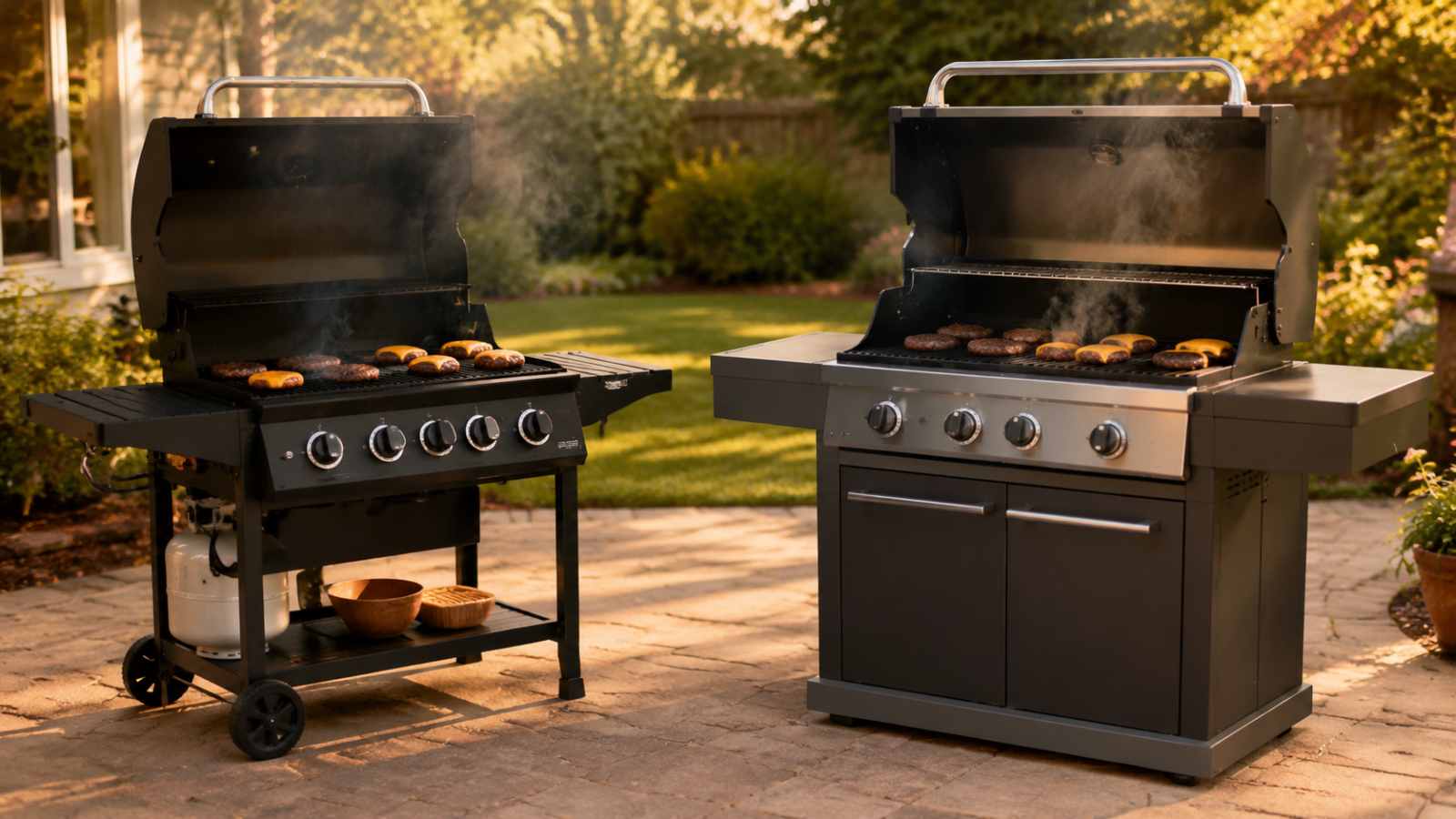
Cheap vs. expensive gas grills can both cook excellent food. Premium models are worth the extra money only when their sturdier construction, longer component warranties, steadier heat control, or easier parts support match how often you grill and how long you plan to keep the grill.
The current Char-Broil Performance Series specifications and Weber Genesis specifications show why price alone is a poor quality test: both use stainless burners and porcelain-coated or enameled cast-iron grates, but their weight, features, and component warranties differ sharply.
“You get what you pay for” is only half an answer. Sometimes the higher price buys stronger construction and a warranty that protects the expensive parts. Sometimes it buys a finish, a connected thermometer, or an accessory system you may never use.
The smart way to compare cheap vs. expensive gas grills is to ignore the logo for a moment and look at the cookbox, burners, grates, heat-control design, grease system, replacement parts, and warranty for the exact model. That is where the real value hides.
Table of Contents
Who Should Buy a Budget Grill—and Who Should Pay More?
Occasional grillers, beginners, renters, and shoppers who need the most cooking area per dollar should usually choose a budget grill. Frequent grillers should consider paying more when the premium model provides stronger construction, longer component coverage, and features they will use regularly.
Buy the budget grill if:
- You grill occasionally rather than several nights every week.
- You are new to outdoor cooking and still learning what features matter to you.
- You rent, move often, or do not want to haul a 130-pound grill to the next house.
- You need the most cooking area for the least money.
- You are comfortable cleaning the grill, replacing wear parts, and protecting it from the weather.
Consider the premium grill if:
- You grill frequently and small annoyances will be repeated dozens of times each year.
- You value a more substantial cart, tighter-fitting parts, and a longer model-specific warranty.
- You want to keep one grill for many years and can confirm replacement-part availability.
- You need a proven sear zone, accessory system, or remote temperature monitoring and will actually use it.
- You live in a humid, coastal, or poolside environment and are willing to pay for suitable materials and perform the extra maintenance that environment requires.
Important: Price is not a durability certificate. An expensive grill can still have ordinary painted-steel panels or short coverage on electronics. A budget grill can still use stainless burners and cast-iron grates. Compare the exact parts, not the category label.
A Current Example: $349 Char-Broil vs. $999 Weber
To keep this comparison honest, here are two real manufacturer-listed models checked on August 16, 2026. Prices and availability can change. This is not a claim that these are the only grills worth buying; it is a clear example of where a $650 price gap does—and does not—show up.
| Specification | Char-Broil Performance FlavorMax 4-Burner | Weber Genesis E-325W Titanium Edition |
|---|---|---|
| Manufacturer-listed price | $349 | $999 |
| Main burners | 4; 409 stainless steel | 3; stainless steel |
| Primary cooking area | 435 sq. in. | 513 sq. in. |
| Cooking grates | Porcelain-coated cast iron | Porcelain-enameled cast iron |
| Listed weight | 79 lb. | 135 lb. |
| Extra cooking feature | 11,000-BTU side burner | Large Sear Zone; manufacturer states up to 750°F |
| Key warranty terms | 5 years burners; 2 years lid/firebox; 1 year grates and other parts | 12 years cookbox/lid; 10 years burners and listed grate/bar components; 5 years remaining parts |
| Price per primary sq. in. | About $0.80 | About $1.95 |
The budget grill clearly wins on burners and cooking area per dollar. It also disproves two common shortcuts: budget does not automatically mean non-stainless burners, and premium does not automatically mean stainless-rod grates. These two models both use stainless burners and porcelain-coated or enameled cast-iron grates.
The premium grill is 56 pounds heavier, has a larger main cooking surface, a dedicated high-heat searing arrangement, and much longer component coverage. Weight alone does not tell us the gauge of every panel, but a difference this large does tell us that you are not comparing two identical structures with different badges.
Where the Extra Money Can Actually Go
1. Cookbox, lid, cart, and hardware
The firebox and lid live through repeated heating, cooling, grease, moisture, and weather exposure. Stronger castings, heavier panels, better fasteners, sturdier hinges, and a more stable cart cost money. Unfortunately, manufacturers do not always publish metal thickness, so you cannot prove quality by tapping the lid or reading the word “stainless.”
In a store, open the lid several times, push gently on each side shelf, roll the grill a few feet, and check whether the doors and grease tray line up. That will not predict an exact lifespan, but it can expose a wobbly cart, flexing shelves, rough hinges, or awkward maintenance access before you buy.
2. Burner and heat-distribution design
Burner count is not a performance score. Four weakly arranged burners are not automatically better than three well-designed burners. What matters is whether the flame pattern, heat tents or bars, cookbox shape, and grate position work together across the usable surface.
Both manufacturers in the comparison claim even heat for these models. A product page cannot settle which is more even in a real backyard. For that, look for a controlled test that records temperatures in several grate locations, or buy from a retailer with a sensible return policy. After purchase, a bread-slice or biscuit test can reveal hot and cool zones so you know where to place food.
3. Low-temperature control
A grill that can settle at a steady indirect temperature is easier to use for chicken, roasts, ribs, and brisket. More mass can reduce short temperature swings, but burner turndown, wind, ambient temperature, lid opening, and cookbox ventilation also matter. Do not assume that price alone guarantees low-and-slow control.
4. Grease management and cleanup
A removable grease tray that can be reached without dismantling half the grill has real value every week. Look at the drip path, pan size, access direction, and whether replacement liners are a special size. Easy maintenance is not glamorous, but a clean grill is safer, more pleasant to use, and less likely to hold moisture-soaked grease against metal.
5. Parts support
Burners, ignition parts, heat tents, and grates are replaceable wear items. Before buying, search the exact model number on the manufacturer’s parts page. A grill that accepts readily available parts can be worth repairing; a discontinued grill with model-specific parts may become disposable even if the cabinet still looks good.
Stainless Steel: Useful Information, Bad Shortcuts
The original version of this comparison treated 430 stainless as “cheap,” 304 as automatically premium, and a magnet as a quality meter. That is too simple.
Worldstainless describes 304 as the familiar 18/8 or 18/10 grade with excellent general corrosion resistance, 316 as a molybdenum-enhanced grade with better resistance to salt and acids, and 430 as a low-nickel magnetic grade used in appliances and some cookware. An Outokumpu grade guide also lists 409 stainless for high-temperature applications such as exhaust systems. That helps explain why the $349 Char-Broil can legitimately use 409 stainless burner tubes.
What the magnet test can and cannot tell you
A magnet can often suggest whether a panel is ferritic stainless, austenitic stainless, or ordinary painted steel. It cannot identify the exact alloy, thickness, fabrication quality, coating, or expected life. A Nickel Institute technical guide also notes that some austenitic stainless can become slightly magnetic after cold working. A strong magnetic pull is information—not a verdict that the grill is fake stainless or low quality.
The better questions are:
- Which exact part is stainless: the burner, lid skin, heat tent, shelf, or firebox?
- Does the manufacturer name the grade?
- Is the critical part thick enough and properly supported?
- What does the warranty cover if it rusts through?
- Can the part be replaced without retiring the whole grill?
For coastal or humid locations, alloy choice matters, but maintenance still matters. Weber’s own coastal-care guidance calls for extra cleaning where salt, humidity, or chlorine is present. No consumer stainless steel should be treated as maintenance-free.
Grates: The Budget Grill May Already Have the Material You Want
Porcelain-coated cast iron is not reserved for premium grills. Both models in the current comparison use it. Cast iron provides useful thermal mass, while the porcelain surface reduces direct exposure of the iron. The tradeoff is that a chipped or damaged coating can expose iron to corrosion.
Stainless-rod grates are easier to live with in wet environments and do not have porcelain that can chip, but rod diameter and spacing matter. Thin stainless rods and heavy cast-iron bars are not an apples-to-apples comparison. Buy the grate you will clean and maintain, and price a replacement set before assuming an upgrade will be cheap.
The Warranty: Read the Parts List, Not the Biggest Number
A grill advertised with a “12-year limited warranty” does not necessarily give every component identical protection for 12 years. The current Weber Genesis coverage lists 12 years for the cookbox and lid, 10 years for burner tubes and specified grate/bar components, and 5 years for remaining parts. The Char-Broil page lists 5 years for burners, 2 years for the lid/firebox, and 1 year for grates and other parts.
Also note the phrase rust-through or burn-through. Surface discoloration or ordinary wear may not qualify. Warranty language is protection against defined failures; it is not a manufacturer’s promise that the entire grill will look new or remain repair-free for that many years.
Four warranty questions worth asking
- How long are the cookbox, lid, burners, grates, ignition, and electronics covered separately?
- Is coverage limited to rust-through or burn-through rather than surface rust?
- Must you register the grill or keep proof of purchase?
- Who pays shipping, diagnosis, installation, or service under the current written terms?
Save the receipt, model number, serial number, and a copy of the warranty that applied on the purchase date. Product lines and terms change.
Features That May Not Be Worth the Upgrade
Premium features are not foolish; unused premium features are. Put every extra through one test: Will this change how I cook at least once a month?
- Wi-Fi or Bluetooth monitoring: useful for long cooks and remote alerts, unnecessary if you prefer a separate thermometer or mostly cook quick foods.
- Side burner: valuable for sauces, frying, or keeping heat out of the kitchen; wasted space if you never use a pan outdoors.
- Sear zone: useful when you cook several steaks and want a concentrated high-heat area; less important for burgers, vegetables, and indirect cooking.
- Accessory system: convenient when you already want the matching griddle, pizza stone, basket, or storage pieces; expensive clutter when you do not.
- Cosmetic stainless and lighting: appearance and convenience, not proof of a better cookbox or better food.
The Honest Value Math
The original version estimated that one grill would last 3–5 years and the other 10–15 years. Those figures were not supported by the manufacturers and should not be presented as facts. Warranty length is not the same thing as expected service life.
Here is the math we can defend. At the listed prices, the $999 grill costs about 2.86 times as much as the $349 grill. To equal the budget grill’s purchase cost per year, the premium grill must last about 2.86 times as long, before considering repairs, resale value, features, or the value you place on using it.
| If the $349 grill lasts… | Its purchase cost per year is… | The $999 grill must last this long to match it… |
|---|---|---|
| 4 years | $87.25 | About 11.4 years |
| 5 years | $69.80 | About 14.3 years |
| 6 years | $58.17 | About 17.2 years |
That does not mean the premium grill is a bad value. It means durability alone may not repay the whole price gap. You may also be buying easier temperature control, a more stable work surface, a larger sear zone, longer warranty protection, better day-to-day fit and finish, or simply fewer reasons to wish you had bought differently.
A covered, cleaned budget grill can outlast a neglected expensive grill. Weber’s storage guidance specifically notes that grease and food residue can trap moisture and promote corrosion. Maintenance is part of the value equation at every price.
Would I Trust an Expensive Brisket to Either Grill?
Yes—if the grill can hold an indirect cooking temperature and you monitor both grate and meat temperature. A gas grill is not automatically the wrong tool for brisket. Weber publishes a gas-grill brisket method using indirect heat at 225–275°F, a water pan, a smoker box over the lit burners, and a probe in the meat.
Set up the grill with the food over unlit burners and the active burner or burners away from the meat. Use a probe at grate level because the lid thermometer measures a different location. Wind and cold can change the burner setting you need, so do not walk away from a new setup for hours without checking it.
A dedicated smoker or pellet grill can still be the easier choice if brisket, ribs, and pork shoulder are your main reason for buying. It gives you a cooking chamber designed around low-and-slow heat and smoke. If 90 percent of your meals are burgers, chops, chicken, fish, and vegetables, a gas grill remains the faster weeknight tool.
What to Check Before You Spend the Money
- Measure your real cooking needs. Count the food you normally cook, not the biggest party you might host once.
- Compare primary area, not total area alone. Warming racks inflate the total but do not replace the main grate for high-heat cooking.
- Identify materials by part. “Stainless steel grill” may describe the lid skin while the firebox or cart uses another material.
- Check burner, grate, and heat-tent materials. These are heat-exposed wear parts.
- Read every warranty line. Focus on cookbox, lid, burners, grates, ignition, electronics, and exclusions.
- Search the exact model number for parts. Confirm that burners, igniters, heat shields, and grates can be ordered.
- Test stability and access. Open the lid, move the cart, inspect the grease tray, and see whether the propane tank is awkward to install.
- Price the whole setup. Include delivery, assembly, a properly fitting cover, thermometer, and any accessory you truly need.
- Ignore fake urgency. A clearance price is useful only when the exact model fits your needs and still has acceptable parts and warranty support.
Frequently Asked Questions
These quick answers cover the most common buyer questions about cheap vs. expensive gas grills.
Does a more expensive gas grill make food taste better?
Not automatically. A budget grill can cook an excellent burger or steak. A better-designed grill may make results easier to repeat by giving you more usable heat zones and steadier control, but the food, seasoning, timing, and cook still matter more than the price tag.
Can a magnet tell whether grill stainless steel is good?
No. A magnet can provide a clue about the steel family, but it cannot identify the exact grade, thickness, finish, construction quality, or expected lifespan. Magnetic stainless steel is still real stainless steel.
Is 304 stainless always better than 430 or 409 in a grill?
No single grade is best for every part. Type 304 offers strong general corrosion resistance, while 316 is better suited to salt and some aggressive environments. Ferritic grades such as 430 and 409 can be appropriate in appliances and high-temperature components. Part design, thickness, exposure, maintenance, and replaceability also matter.
Is a 12-year grill warranty the same as a 12-year expected life?
No. A warranty covers defined failures under written conditions. Different components may have different terms, and surface rust or ordinary wear may be excluded. It is not a lifespan forecast.
Should a beginner buy cheap now and upgrade later?
Usually, a well-chosen budget or midrange grill is sensible when you are still learning what you enjoy cooking. If you already grill several times a week and know you value sturdy construction, long component coverage, and specific premium features, buying once may be more satisfying.
Can I smoke brisket on a gas grill?
Yes. Use indirect heat, place the brisket over unlit burners, add smoke with a smoker box, and monitor grate and meat temperature with probes. A dedicated smoker is generally more convenient when low-and-slow barbecue is your main cooking style.
Final Verdict
Buy the budget gas grill when cooking area per dollar, a lower upfront cost, and simple weeknight grilling matter most. The current Char-Broil example already provides stainless burners, cast-iron grates, four cooking zones, and a side burner for $349.
Pay more for the premium grill when the exact model gives you benefits you will use: a more substantial structure, larger primary grate, stronger searing setup, longer component warranties, convenient cleanup, and dependable parts support. The current Weber example makes that case with a 135-pound build and far longer coverage, not with a promise that the first burger will taste three times better.
The best value is not always the cheapest grill or the grill built like a tank. It is the least expensive model that meets your cooking needs, survives your environment with reasonable care, and does not make you want to replace it every time you cook.
Related Reading
Sources Checked
Specifications, prices, and warranty terms were checked on August 16, 2026. Manufacturer prices and product availability can change.
- Char-Broil Performance Series FlavorMax 4-Burner product page
- Weber Genesis E-325W Titanium Edition product page
- Weber warranty terms by product line and component
- Worldstainless guide to 304, 316, and 430 stainless steel
- Outokumpu stainless grade and application guide
- Nickel Institute guide covering magnetic response after cold working
- Weber indirect gas-grill brisket method
- Weber grill cleaning and storage guidance
- Weber coastal and humid-area maintenance guidance
About the Author
Frank W. Roberts is the voice behind Everything Grill Reviews and has been grilling since 1970. With more than five decades of hands-on barbecue experience, he has cooked on and evaluated pellet grills, gas grills, smokers, and other outdoor cooking equipment in real cooking conditions. He has also entered competitive cookoff events where temperature control and dependable equipment matter. His goal is simple: help readers choose equipment that fits the way they actually cook.
Affiliate disclosure: Everything Grill Reviews may earn a commission from qualifying purchases made through links on this site, at no additional cost to you. Product specifications, prices, and warranty terms should always be confirmed with the manufacturer or retailer before purchase.