
Updated: September 27, 2026
Updated and fact-checked: September 26, 2026
Pellet grill chicken breast is a 350°F cook that ends at 165°F in the thickest part of the meat. Time after preheat is an estimate of 25–40 minutes for typical boneless 6–8 oz breasts. A thermometer decides doneness, not color and not the clock.
Quick Answer: How Do You Cook Chicken Breast on a Pellet Grill?
Preheat to 350°F, season dry boneless breasts, and cook to 165°F in the thickest part. Flip once if you want even color. Rest about 5 minutes before slicing. USDA lists 165°F as the safe minimum for all poultry. Leftovers go in the fridge within 2 hours and reheat to 165°F.
Key Points
- Set the pellet grill to 350°F after a full preheat with the lid closed.
- The USDA safe minimum for chicken breast is 165°F, measured with a food thermometer.
- Grill time of 25–40 minutes after preheat is an estimate. Thickness, starting meat temperature, weather, and lid openings change it.
- Pound or trim so the pieces are close to the same thickness.
- Do not rinse raw chicken. Pat it dry and keep raw juices off ready-to-eat food.
- 165°F is a safety number. It is not the same kind of target as 195–205°F on pork shoulder or brisket.
What Temperature Should Pellet Grill Chicken Breast Reach?
Cook chicken breast to 165°F in the thickest part. The USDA and FoodSafety.gov list 165°F for all poultry, including breasts, whole birds, legs, thighs, wings, ground poultry, giblets, and stuffing. The chart does not attach a required 3-minute rest to poultry the way it does to whole beef, pork, lamb, and veal cuts at 145°F.
A short 5-minute rest still helps juices settle so the slices do not empty onto the board. That rest is for serving quality. It is not a substitute for hitting 165°F on the grill. Details on rest times by cut are in how to rest meat after grilling.
| Food | USDA minimum | Notes |
|---|---|---|
| Chicken breast, boneless or bone-in | 165°F | Probe the thickest part, not a thin edge |
| All other poultry cuts | 165°F | Check away from bone on bone-in pieces |
| Leftover cooked chicken | 165°F | Reheat, then serve |
| Whole beef, pork, lamb, or veal cuts | 145°F + 3-minute rest | Do not apply this rule to chicken breast |
Last verified September 26, 2026 against the USDA FSIS safe-temperature chart and FoodSafety.gov.
What Ingredients and Equipment Do You Need?
Four even boneless breasts, oil, a simple seasoning, dry pellets, and a thermometer cover a weeknight cook. Skip a long brine unless you already planned one. The bigger problem on this cut is overcooking past 165°F, not a shortage of spice.
Shopping list for this cook
- 4 boneless, skinless chicken breasts, about 6–8 oz each
- 1–2 Tbsp olive oil or another neutral oil
- 1½ tsp kosher salt
- 1 tsp black pepper
- 1 tsp garlic powder
- 1 tsp paprika
- ½ tsp onion powder, optional
Equipment
- Pellet grill that can hold 350°F
- Oak, cherry, apple, or a mild competition blend
- Instant-read or leave-in probe thermometer
- Tongs and a clean cutting board for cooked meat only
Skin-on breasts follow the same 165°F finish. If you want crisp skin, use the method in how to get crispy chicken skin on a pellet grill and keep the hot finish short so the lean meat does not dry out.
How Do You Set Up the Pellet Grill?
Preheat to 350°F with the lid closed and use dry, mild hardwood pellets. Do not start the chicken on a cold grate and wait for the grill to catch up. That stretches the cook and dries the thin end first.
- Confirm the hopper has dry pellets. Swollen or crumbly pellets belong in the trash, not the fire pot. Storage details are in how to store wood pellets and charcoal.
- Set the controller to 350°F and preheat with the lid closed until the grill is stable.
- Clean the grates if last night’s sauce is still on them. A light oil film on the grates is enough.
- Keep the lid closed except to place, flip, and probe the meat.
Oak is the everyday pellet. Cherry or apple add a little sweetness without burying a lean cut. Thick white smoke during a short 350°F cook is usually leftover startup smoke or wet fuel, not extra flavor. Clean exhaust is the goal. See thin blue smoke vs white smoke.
How Do You Prepare the Chicken?
Pat the breasts dry, even out the thickness, oil lightly, and season both sides. Do not rinse raw chicken in the sink. USDA guidance is that rinsing spreads bacteria onto nearby surfaces. Cooking to 165°F is what makes the meat safe.
- Thaw in the refrigerator if the meat is frozen. Do not leave raw chicken on the counter to thaw.
- Keep raw chicken on its own board and wash hands, knives, and that board with hot soapy water before you touch cooked food or sides.
- Pat each breast dry with paper towels.
- If one end is twice as thick as the other, pound the thick end gently under plastic wrap until the pieces cook at a similar pace.
- Coat with a thin film of oil. Season both sides with salt, pepper, garlic powder, and paprika.
- Let the seasoned meat sit 20–30 minutes at cool room temperature while the grill preheats, or keep it refrigerated until the grill is ready if your kitchen is hot.
How Do You Cook Chicken Breast Step by Step?
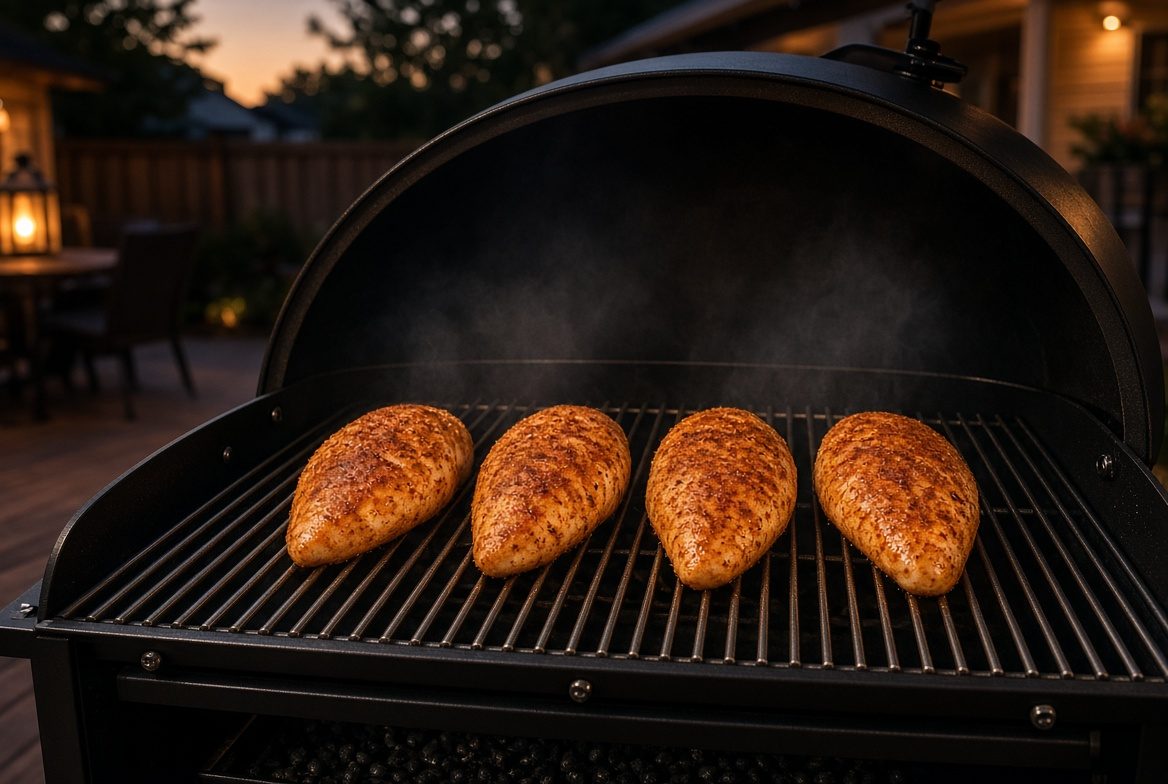
Place the breasts on the hot grates, close the lid, and cook to 165°F. Flip once around the halfway mark if you want color on both sides. Time after preheat is an estimate of 25–40 minutes for 6–8 oz boneless pieces.
- Set the breasts on the grates with space between them so air can move.
- Close the lid. Do not stand there peeking every two minutes.
- At about 12–15 minutes, flip once if you want even browning.
- Start probing the thickest part from the side. Stop when that spot reads 165°F. Do not average a thin tail with the center.
- Move the cooked chicken to a clean platter. Rest about 5 minutes.
- Slice across the grain or serve whole.
Bone-in breast halves take longer. USDA’s approximate oven chart at 350°F lists 20–30 minutes for a 4 oz boneless half and 30–40 minutes for a 6–8 oz bone-in half. A pellet grill is not an indoor oven, so treat those numbers as planning aids only.
How Should You Rest, Slice, and Store Leftovers?
Rest about 5 minutes, then refrigerate leftovers within 2 hours. USDA leftover rules still apply on a weeknight cook. Eat refrigerated cooked chicken in 3–4 days or freeze it. Reheat leftovers to 165°F.
- Leave the rest uncovered or with a loose tent. A tight foil wrap steams the surface.
- Slice only what you will eat now. Whole pieces hold moisture better in the fridge.
- Cool in shallow containers. Do not leave a platter on the picnic table past the 2-hour window, or past 1 hour if the air is above 90°F.
- Reheat covered with a splash of broth or water if the meat looks dry. Stir or turn so you are not serving a cold center.
The leftover-temperature rule is the same one used for leftover pulled pork: 165°F on the reheat, not a second trip to barbecue-tender numbers.
What Are the Common Mistakes?
The usual failure is mixed thickness plus a clock instead of a thermometer. A thin tail can be dry while the thick end is still under 165°F.
- Uneven pieces on the same grate. Pound them or start the thicker breasts a few minutes earlier.
- Guessing doneness by color. Poultry can look done and still be under, or look pink near bone and already be safe. Measure.
- A long 225°F smoke on boneless breast. Extra time at low heat dries a lean cut. If you want more smoke, keep that stage short, then finish at 350°F to 165°F.
- Sauce too early. Sugar burns while the center is still climbing. Sauce in the last few minutes, or after the rest.
- Using the raw-chicken board for slicing. That puts raw juices back on cooked meat.
Final Verdict: Is 350°F the Right Call for Pellet Grill Chicken Breast?
Yes for boneless weeknight breasts, as long as 165°F is the finish line. 350°F is hot enough to cook through in a useful window without parking the meat in a long low-and-slow stall that only helps connective tissue on a shoulder or brisket. If you want darker skin on a skin-on piece, use a short hotter finish and watch the lean meat. If you want pulled texture, cook thighs or a whole bird instead of forcing a breast past the point where it turns stringy and dry.
Frequently Asked Questions
Can you pull chicken breast at 160°F and rest to 165°F?
Do not plan on carryover to finish a safety minimum that has not been reached. Measure 165°F in the thickest part before the breast leaves the grill. A short rest after that is for slicing, not for catching up an undercooked center.
Should you brine pellet grill chicken breast?
A simple dry season is enough for a 25–40 minute cook. A salt brine can help moisture if the breasts are extra thick or you have had dry results, but brine is optional. Overshooting 165°F by a wide margin dries the meat faster than skipping a brine.
Can you cook frozen chicken breast on the pellet grill?
Thaw in the refrigerator first. Frozen centers cook late while the outside dries. USDA storage guidance for fresh chicken parts is 1–2 days in the refrigerator or up to 9 months in the freezer for quality. Cooked leftover chicken keeps 3–4 days refrigerated.
What pellets work best with chicken breast?
Use a mild hardwood: oak, apple, cherry, or a competition blend. Heavy mesquite on a short lean cook is easy to overdo. Dry pellets matter more than a fancy bag name.
Is chicken breast done when the juices run clear?
No. Clear juices are not a safety test. Use a thermometer. Color and juice can mislead, especially near bone on a bone-in piece.
Related Reading
- How to Get Crispy Chicken Skin on a Pellet Grill
- How to Rest Meat After Grilling
- How to Reheat Leftover Pulled Pork to 165°F
- Smoke Pork Shoulder on a Pellet Grill at 250°F
- Thin Blue Smoke vs White Smoke
About Frank W. Roberts
Frank W. Roberts is the author of Everything Grill Reviews. He has grilled since 1970 and brings more than 50 years of backyard cooking and cookoff experience to fire management, fuel behavior, smoke, and practical cooker use. This article is a cooking-method recipe based on USDA and FoodSafety.gov temperature rules plus standard pellet-grill practice. It is not a product review and does not claim a test of a named grill model. Last verified September 26, 2026.