
Updated: August 17, 2026
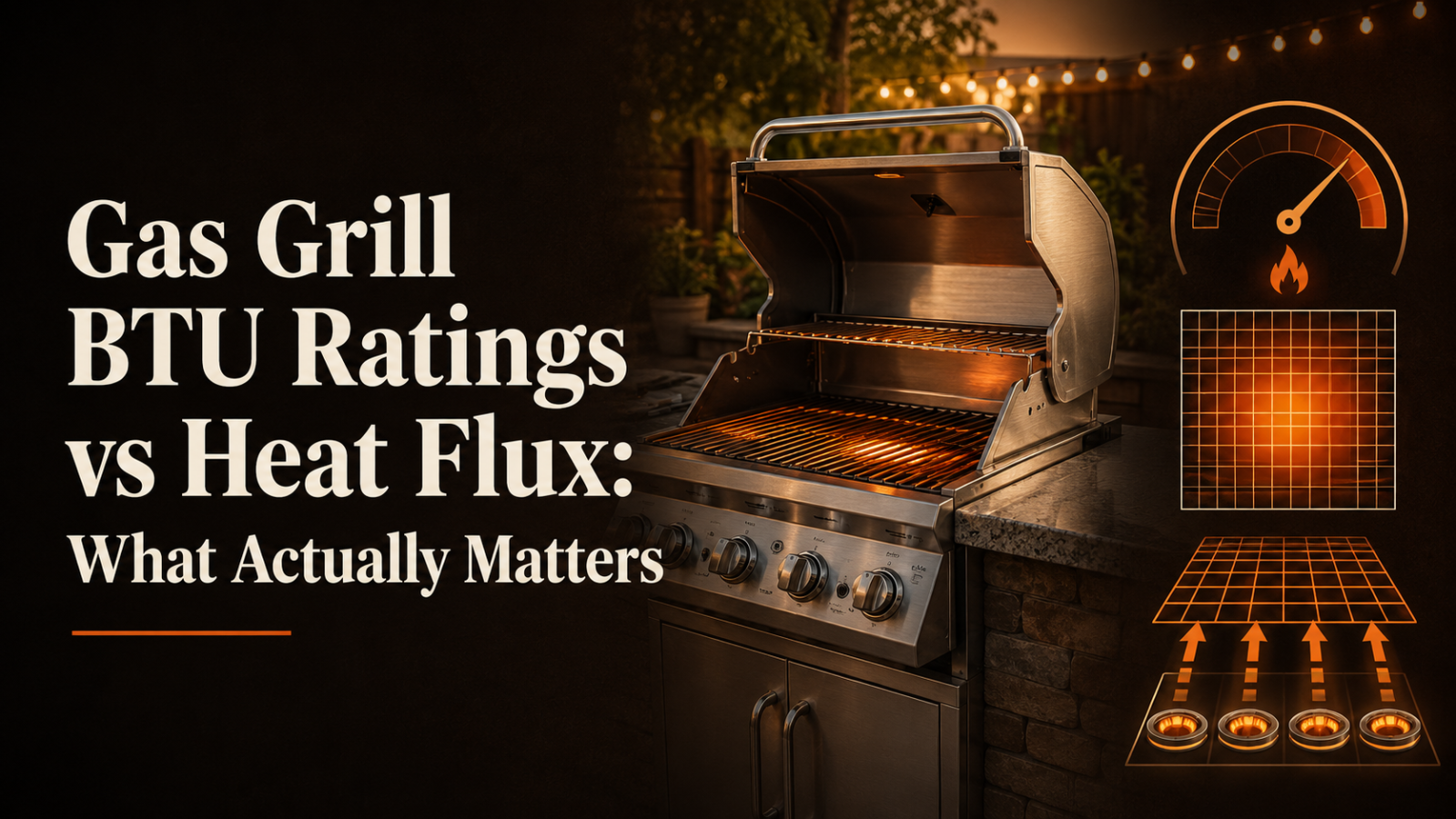
Quick Answer: Gas grill BTU ratings tell you the burners’ maximum fuel-input rate, not how hot or evenly the grates will cook. For a fairer size-adjusted comparison, divide the main-burner BTU-per-hour rating by the primary cooking area. Treat the result as a screening tool only: 80–100 BTU per square inch is a common rule of thumb for conventional open-flame grills, not a universal performance standard.
Key Takeaways
- Gas-grill burner ratings are properly expressed in BTU per hour (BTU/hr), even when a product page shortens that to “BTU.”
- Total BTU is not a temperature rating. A larger grill may need more input simply because it has more burners and more space to heat.
- The commonly used “heat flux” calculation is main-burner BTU/hr divided by primary cooking area.
- That calculation is an input-per-area ratio, not a measurement of the heat that reaches the food.
- Compare the ratio only among broadly similar grill designs, then check heat evenness, low-temperature control, recovery, burner layout, and construction.
What Gas Grill BTU Ratings Actually Tell You
A British thermal unit, or BTU, is a unit of energy. The U.S. Energy Information Administration defines one BTU as the energy needed to raise one pound of water by one degree Fahrenheit. A grill burner’s rating is an energy-input rate, normally stated as BTU per hour.
In practical terms, the rating describes how much fuel energy the burner is designed to take in while operating at its rated maximum. It does not directly state:
- the maximum temperature at the cooking grate;
- how quickly the grill preheats;
- how evenly heat is distributed;
- how well the grill holds heat in wind or cold weather; or
- how low the burners can be turned for gentler cooking.
Those outcomes depend on the complete cooking system. Weber makes the same central point in its explanation of gas-grill temperature and BTU ratings: a higher BTU number does not necessarily make one grill hotter than another, and larger grills often have higher ratings because they contain more burners and a larger body.
Why Total BTU Can Create a Bad Comparison
Imagine two conventional gas grills:
| Hypothetical grill | Main-burner input | Primary cooking area | Input per square inch |
|---|---|---|---|
| Grill A | 36,000 BTU/hr | 450 sq. in. | 80 BTU/hr per sq. in. |
| Grill B | 44,000 BTU/hr | 600 sq. in. | 73 BTU/hr per sq. in. |
Grill B has the larger headline number, but it also spreads that rated input across a larger primary grate. Grill A has the higher input-per-area ratio. That makes the comparison more informative, but it still does not prove that Grill A sears better, preheats faster, or cooks more evenly. The calculation cannot account for heat lost through the firebox, burner placement, grate height, wind, or the grill’s heat-distribution system.
Heat Flux vs. BTU per Square Inch: An Important Distinction
Grill makers and reviewers often call the BTU-per-square-inch ratio “heat flux.” The label is convenient, but it is not technically exact. In engineering, NIST defines heat flux as the rate of heat transfer to a surface per unit area. Dividing a burner’s rated fuel input by grate area does not measure the heat transferred to the grate or food. It measures rated input per unit of cooking area.
This article uses “heat flux” when discussing the familiar grill-shopping term, but BTU-per-square-inch input ratio is the more accurate description. Keeping that distinction in mind prevents a useful comparison shortcut from becoming a false performance score.
How to Calculate the Ratio Correctly
BTU-per-square-inch input ratio = main-burner BTU/hr ÷ primary cooking area in square inches
1. Use the main-burner rating
Find the combined rating for the burners that heat the primary cooking grate. Do not automatically use a manufacturer’s “total BTU” figure. That total may also include a side burner, rear rotisserie burner, smoker burner, or separate sear burner.
2. Use only the primary cooking area
Do not include a warming rack. A product page may advertise “total cooking area,” which combines the main grate and secondary rack. Look for a separate specification labeled primary cooking area, main cooking area, or main grilling surface.
3. Keep dedicated burners separate
A side burner does not heat the main grate, so it should not be in the numerator. A dedicated sear burner or rear infrared burner should be evaluated as a separate feature unless the manufacturer clearly includes it as part of the main cooking system and explains which area it heats.
4. Compare like with like
The ratio is most useful when comparing conventional open-flame gas grills of similar size and layout. It is much less useful across fundamentally different systems such as an infrared grill, a gas griddle, a compact portable grill, or a hybrid cooker.
5. Check that the units match
Use BTU per hour and square inches for both models. If a manufacturer lists kilowatts or square centimeters, convert the figures before comparing. Do not mix main cooking area for one grill with total cooking area for another.
Is 80–100 BTU per Square Inch a Good Target?
For a conventional, open-flame gas grill, 80–100 BTU/hr per square inch is a reasonable rule-of-thumb range—not a pass/fail line. Both Char-Broil’s BTU guide and Napoleon’s BTU explanation cite that general range for a standard gas grill.
The limitation matters as much as the number. Char-Broil gives a different range for its infrared-style Amplifire system, illustrating why design changes the meaning of the ratio. A compact or more enclosed cooking system may perform as intended with less rated input per square inch. An inefficient firebox could post a high ratio while wasting more heat.
Use the number this way:
- Near 80–100 on a conventional grill: A useful sign that the burner input is proportionate to the primary grate, but not proof of good performance.
- Well below the range: Ask for credible evidence about preheat, recovery, and high-heat cooking before rejecting the grill. An efficient or infrared design may make the comparison inappropriate.
- Well above the range: Do not assume “more power” is automatically better. Check low-end control, heat evenness, ventilation, and whether the advertised figure includes extra burners.
There is no single ideal number for every grill architecture, cooking style, climate, and grate size. The ratio narrows a shopping list; it should not choose the winner.
What Matters More in Real Cooking
Heat distribution
Burner spacing, flame tamers, diffusers, and the distance between the flame and grate affect where heat goes. A grill can have ample input and still create pronounced hot and cool zones. Some variation is useful for two-zone cooking, but the pattern should be predictable.
Control range and burner independence
Maximum input matters less when a grill cannot hold a moderate temperature or create distinct direct and indirect zones. Independently controlled burners make it easier to sear over one section and cook gently over another.
Firebox, lid, and wind behavior
Materials, fit, venting, and overall geometry influence heat retention. Weather also changes how a grill behaves; Weber notes that outdoor temperature and other operating conditions can affect grill performance. If you routinely cook in exposed or cold conditions, look for tests performed in stated conditions rather than relying on a spec-sheet ratio.
Grates and heat-delivery design
Grate material, mass, shape, and distance from the burners influence how energy reaches food. Dedicated infrared elements can deliver intense radiant heat to a limited zone without making the main-grill ratio directly comparable to a conventional burner system.
Preheat, recovery, and evenness evidence
A useful independent review should explain its method and conditions. Look for measured preheat time, temperatures across several grate locations, recovery after the lid is opened, and low-temperature stability. One center-grate temperature or an unlabeled thermal image cannot describe the whole cooking surface.
Serviceability and construction
Burners, igniters, heat shields, grease-management parts, and grates are wear items. Parts availability, access for cleaning, stable construction, and clear support information may matter more over years of ownership than a small difference in BTU-per-square-inch ratio. Our cheap vs. expensive gas grill comparison explains which construction differences are worth examining.
Match the Grill to the Way You Cook
| Your priority | Give more weight to | Do not rely on |
|---|---|---|
| Frequent steak searing | Documented grate-level high heat, a usable sear zone, recovery, and even contact with the grate | Total BTU alone |
| Chicken, roasts, and two-zone cooking | Independent burner control, predictable indirect zones, lid clearance, and moderate-temperature stability | Maximum-temperature claims alone |
| Cooking for a crowd | Usable primary grate area, evenness, recovery, workflow, and enough independent zones | A large “total cooking area” that includes the warming rack |
| Small patio or portable use | Footprint, safe clearances, fuel setup, stability, and design-specific performance | The 80–100 rule across unlike grill types |
| Cold or windy conditions | Wind behavior, heat retention, recovery evidence, and manufacturer operating guidance | A laboratory-style ratio with no test conditions |
For the rest of the decision—size, fuel, burner count, materials, and features—use our gas grill buying guide.
Who Should Use This Metric—and Who Should Skip BTU-Led Shopping?
Use the ratio as a buying filter if:
- you are comparing two or more conventional gas grills with similar layouts;
- the manufacturers separately disclose main-burner input and primary grate area;
- you want to spot an inflated “total BTU” number that includes unrelated burners; and
- you will confirm the shortlist with credible cooking or temperature-distribution evidence.
Skip a BTU-led decision if:
- you are comparing infrared, griddle, portable, hybrid, and conventional systems as if they transfer heat the same way;
- the seller does not separate main-burner output from side, rear, or sear burners;
- the advertised area includes a warming rack but the main-grate area is missing;
- your main need is low-and-slow control, strong indirect cooking, or a specific sear zone; or
- you are choosing between grills based on a difference of only a few ratio points.
Hold off on a model when its listing leans heavily on a large total-BTU claim but withholds the two figures needed for a fair calculation. Missing specifications do not prove the grill is poor, but they prevent the advertised number from being meaningfully compared.
A Five-Minute Gas Grill Spec Check
- Write down main-burner BTU/hr. Exclude unrelated burners.
- Write down primary grate area. Exclude the warming rack.
- Divide input by area. Keep the result as a rough ratio, not a temperature prediction.
- Identify the heat system. Conventional, infrared-assisted, full infrared, griddle, and hybrid designs should not be compared blindly.
- Check the controls. Count independently controlled main burners and consider whether they can create the zones you need.
- Look for test evidence. Prioritize evenness, preheat, recovery, low-end control, and clearly stated conditions.
- Check ownership factors. Review cleaning access, grease management, parts information, dimensions, and required clearances.
After You Buy: A Simple Reality Check
Follow the owner’s manual for placement, leak checks, lighting, and preheating. Once the grill is operating normally, learn its heat pattern instead of chasing a single maximum-temperature number. Cook a familiar food across different parts of the grate, note where browning happens sooner, and test whether you can maintain distinct direct and indirect zones.
If a grill that previously worked well suddenly heats poorly, the nameplate BTU rating has not changed. Check the fuel supply, regulator procedure, burner-port blockage, grease buildup, and damaged parts according to the manual. Our guide to common gas grill problems can help you organize that diagnosis. Stop using the grill and follow manufacturer guidance if you smell gas, see damaged fuel components, or cannot confirm a safe connection.
Frequently Asked Questions
Does a higher BTU rating mean a gas grill gets hotter?
No. BTU/hr describes rated energy input, not grate temperature. Grill size, efficiency, heat loss, burner layout, airflow, and heat-delivery design all affect the temperature that reaches the cooking surface.
What is a good BTU rating for a gas grill?
There is no single good total-BTU number without knowing the primary cooking area and grill design. For comparable conventional grills, calculate main-burner BTU/hr per square inch of primary grate. The often-cited 80–100 range is a rough screening guide, not a universal requirement.
How do I calculate gas grill heat flux?
Divide the combined main-burner BTU/hr rating by the primary cooking area in square inches. Exclude side and rear burners from the input, and exclude the warming rack from the area. Technically, the result is a rated-input-per-area ratio rather than measured heat flux at the grate.
Should a side burner or rotisserie burner count?
No, not when you are evaluating heat input over the primary grate. Treat a side burner, rear rotisserie burner, or separate sear station as its own feature and evaluate the area it is designed to heat.
Can BTU per square inch predict searing performance?
Not by itself. It can flag how much rated input is available relative to grate size, but searing also depends on radiant heat, grate temperature, grate contact, burner-to-grate geometry, recovery, and heat loss.
Should I include the warming rack in the cooking area?
No. Use only the primary cooking grate. Including a warming rack enlarges the denominator even though that rack is not heated in the same way as the main surface.
Is a grill below 80 BTU per square inch automatically underpowered?
No. Infrared, compact, enclosed, or otherwise efficient designs can fall outside the conventional rule of thumb. Check design-specific guidance and credible performance evidence before accepting or rejecting the grill.
Verdict
Do not buy a gas grill because it has the biggest total BTU number. First separate the main-burner rating from accessory burners, divide it by primary grate area, and use the result to compare similar grill types. For a conventional open-flame grill, roughly 80–100 BTU/hr per square inch is a useful reference range—but it is neither a guarantee nor a universal target.
The better purchase is the grill whose heat system matches your cooking: enough usable space, predictable zones, credible evenness and recovery evidence, suitable low-end control, and construction you can clean and maintain. BTU helps you question the spec sheet. It cannot replace evaluating the complete grill.