
Updated: August 25, 2026
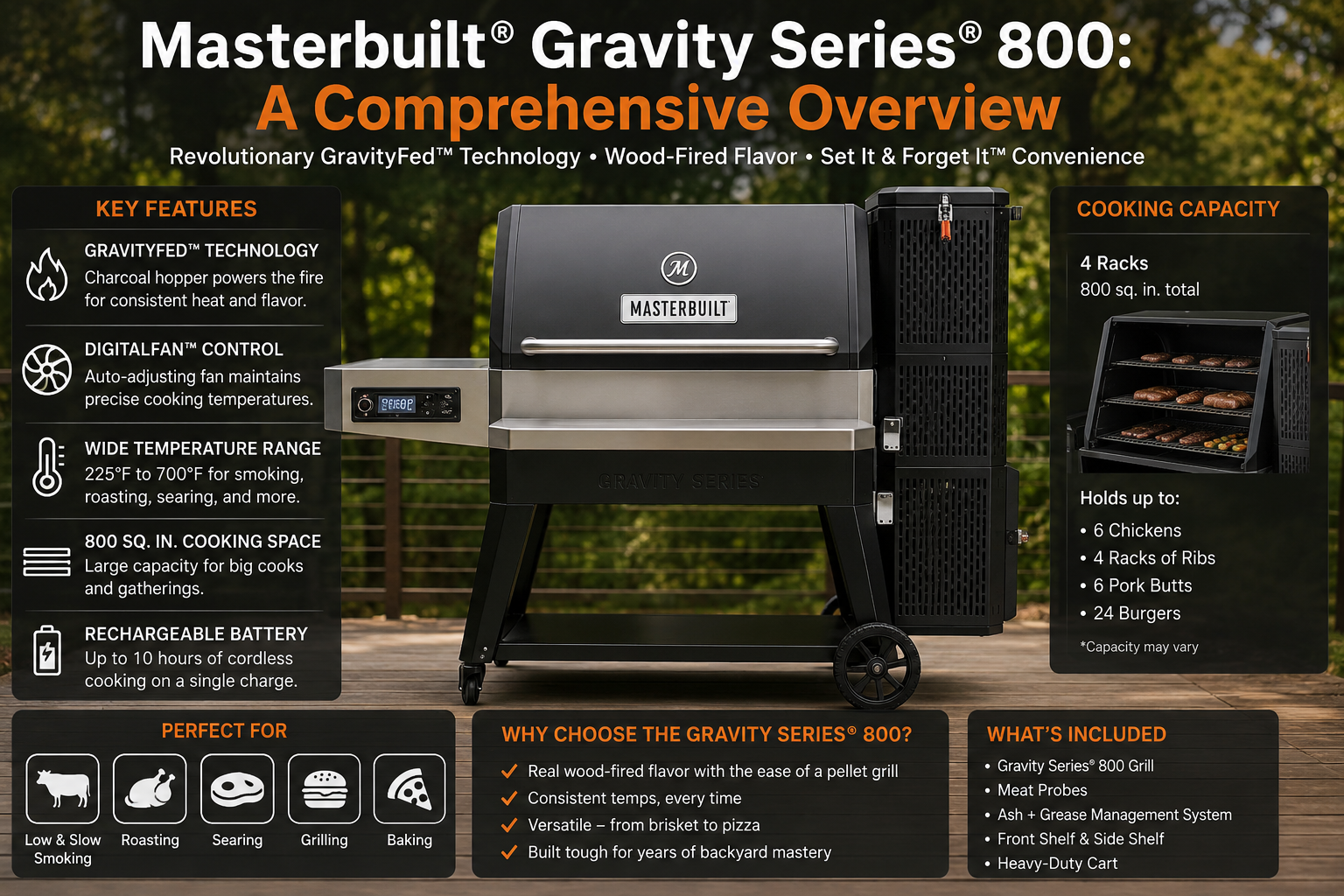
Quick Answer: The Masterbuilt Gravity Series 800 is worth considering if you want charcoal flavor with digital temperature control. Model MB20040221 offers 800 square inches, a 225–700°F range, and an included griddle. Its tradeoffs are required electricity, a one-year warranty, lighter construction, and more electronic parts than a basic charcoal grill.
The Masterbuilt Gravity Series 800 combines a charcoal grill, smoker, and flat-top griddle with a controller and fan that manage airflow for you. It is designed for cooks who like charcoal flavor but do not want to adjust vents throughout a long smoke. That convenience is real, but it comes with more switches, wiring, and maintenance points than a kettle grill.
How this review was prepared: Frank W. Roberts has grilled since 1970 and uses that experience to judge the cooker’s design and tradeoffs. This review does not claim hands-on testing of this exact model. Product facts were checked against Masterbuilt, variant details against Costco, and performance observations against named independent reviews.
Table of Contents
- Is the Gravity Series 800 worth buying?
- How does it work?
- What are the key specifications?
- Is the griddle included?
- How well does it smoke, grill, and griddle?
- What problems should buyers consider?
- Who should buy or skip it?
- What is the final verdict?
- Frequently asked questions
Is the Masterbuilt Gravity Series 800 worth buying?
Yes—for the right buyer. It is a strong fit when charcoal flavor, low-and-slow smoking, high-heat grilling, and flat-top cooking all matter more than simple construction or complete freedom from electricity.
The central buying decision is not whether the Gravity 800 can cook several ways. It can. The decision is whether its convenience is worth accepting electronic controls and safety switches on a charcoal cooker. A traditional kettle has fewer failure points but needs more fire management. A pellet grill offers similar push-button convenience but uses pellets instead of lump charcoal or briquettes.
| Buying factor | Gravity Series 800 | Traditional kettle | Pellet grill |
|---|---|---|---|
| Fuel | Lump charcoal or briquettes | Lump charcoal or briquettes | Wood pellets |
| Temperature control | Digital controller and fan | Manual vents | Digital controller, auger, and fan |
| Electricity required | Yes | No | Yes |
| High-heat ability | Rated up to 700°F | Strong direct-coal heat | Varies by model |
| Flat-top cooking | Griddle included with MB20040221 | Accessory or separate pan needed | Usually requires an accessory |
How does the Masterbuilt Gravity Series 800 work?
The Gravity Series 800 burns charcoal at the bottom of a vertical hopper while a digitally controlled fan regulates airflow and heat. Gravity moves fresh fuel down as the charcoal below is consumed.
You load lump charcoal or briquettes into the hopper, light the bottom of the fuel column, remove the shutdown slides, close the hopper and ash doors, and select a cooking temperature. The controller then changes fan speed to feed the fire the air it needs. The same basic system can maintain smoking heat or drive the cooker toward searing temperatures.
This design reduces vent adjustments, but it does not make the grill independent of power. The controller and DigitalFan need a household outlet. If power is lost, the automatic airflow control stops. That is an important difference from a conventional charcoal grill.
What are the key Masterbuilt Gravity Series 800 specifications?
The official MB20040221 specifications are 800 square inches of total cooking space, a 225–700°F temperature range, and a hopper that holds about 10 pounds of lump charcoal or 16 pounds of briquettes.
| Feature | Official detail for MB20040221 | Why it matters |
|---|---|---|
| Cooking space | 800 sq. in. | Room for family meals and multi-rack smoking |
| Temperature range | 225–700°F | Covers low smoking through high-heat grilling |
| Charcoal capacity | Up to 10 lb lump or 16 lb briquettes | Masterbuilt advertises up to 10 hours of cooking |
| Controller | Digital panel plus Wi-Fi/Bluetooth app control | Allows remote monitoring and temperature changes |
| Meat probes | Supports monitoring up to four probes; check the listing for included probes | Lets you monitor food without repeatedly opening the lid |
| Cooking surfaces | Reversible cast-iron grates, warming racks, and griddle | Supports smoking, grilling, and flat-top cooking |
Masterbuilt says the cooker can reach 225°F in about 8 minutes and 700°F in about 14 minutes. Treat those as manufacturer claims, not guaranteed warm-up times in every weather condition. Cold air, wind, fuel type, ash buildup, and how often the lid is opened can change real-world results. See the official Masterbuilt Gravity Series 800 page for the current specifications.
Does every Masterbuilt Gravity Series 800 include the griddle?
No. The standard MB20040221 version includes the flat-top griddle, but the Costco MB20040122 listing specifically says the griddle insert is not included.
This model-number difference matters because the griddle is one of the best reasons to choose the 800 over another Gravity Series size. Before buying, check the exact model number and the list of box contents. Do not assume that every product labeled “Gravity Series 800” includes the same accessories.
The included griddle on MB20040221 uses a separate heat manifold. Switching modes requires removing the grill grates and grill manifold, installing the griddle manifold, and placing the griddle on top. Independent testing describes the griddle as heavy cold-rolled steel with a grease drain. It must be seasoned before cooking. The current Costco listing identifies its no-griddle version as MB20040122.
How well does the Gravity Series 800 smoke, grill, and griddle?
It is unusually versatile because the same charcoal fire can support low-and-slow smoking, high-heat grilling, and flat-top cooking. Its strongest advantage is changing cooking styles without buying three separate cookers.
Does the Gravity Series 800 hold a steady smoking temperature?
It can hold a set temperature with much less attention than a manual charcoal grill when the hopper feeds properly and the fan, switches, and controller are working correctly.
The controller adjusts airflow rather than asking you to chase the fire with vents. Even so, the displayed temperature and the temperature at every point on the grate will not always be identical. For brisket, pork shoulder, or another important long cook, place a reliable independent probe near the food and learn where your cooker runs warmer or cooler.
An AmazingRibs temperature test sometimes quoted for a 15–20°F variation was performed on the smaller Gravity Series 560, not this 800. It is useful evidence about the Gravity platform, but it should not be presented as a measured result for the 800.
Does the Gravity Series 800 produce more smoke flavor than a pellet grill?
It can produce a stronger charcoal character than a pellet grill because charcoal is the primary fuel and wood chunks can be added for extra smoke. Flavor preference remains personal, so “better” is not guaranteed.
Masterbuilt advises placing wood chunks in the ash bin for on-demand smoke or layering a limited amount with charcoal for controlled smoke. Follow the current manufacturer guidance instead of packing the hopper with too much wood. The fire is off to the side, so grease does not drip directly onto live coals beneath the food as it does on a kettle. Buyers who prize that exact direct-coal flavor should keep this difference in mind.
Can the Gravity Series 800 sear steaks and burgers?
Yes. Masterbuilt rates the closed-lid cooking range up to 700°F, and the fan can drive the charcoal fire hard enough for high-heat grilling.
The lid safety switch changes how high-heat cooking works. An independent Gravity 800 review reports that the controller limits the setting to 500°F while the main lid is open. Preheating the cast-iron grates and using the proper “sear” side will matter more than chasing a display number.
Is the included griddle useful?
Yes, if you will cook flat-top foods. It adds a practical surface for smashburgers, breakfast, fajitas, vegetables, and other foods that can fall through grill grates.
The tradeoff is extra handling and storage. You must swap the manifold and cooking surface when changing between griddle and grill modes. The griddle also needs seasoning and prompt drying to resist rust. If you rarely cook on a flat top, a different Gravity Series model may fit your needs without paying for an attachment you will store.
What problems should Masterbuilt Gravity Series 800 buyers consider?
The main concerns are dependence on electricity, safety switches that can interrupt fan operation, lighter sheet-metal construction, grease management, and a short warranty. None automatically makes the cooker a bad buy, but each should be understood before purchase.
Can the safety switches stop the fan?
Yes. The fan is designed to stop when a hopper or ash door is open, and the main-lid switch limits high-temperature operation. A misaligned or failed switch can therefore look like a controller or fan failure.
Do not permanently bypass a safety switch. First make sure the doors close fully and the switch plungers move freely, then use Masterbuilt’s troubleshooting or support process. Masterbuilt currently lists a replacement Lid/Door Switch Kit that fits MB20040221, which makes this part serviceable.
Does exposed firebrick mean the firebox has failed?
Not necessarily. Masterbuilt’s Gravity Series FAQ says the metal panels in front of the firebrick are expected to degrade after use and may expose the high-temperature firebrick.
That official explanation is important because some reviews describe any missing inner metal as “burn-through.” Exposed intact firebrick can be normal for this design. Crumbling material, major air leaks, loose structural metal, or unsafe operation still deserves inspection by Masterbuilt support. Replacement firebrick and related parts are listed for MB20040221.
Can grease buildup cause flare-ups?
Yes. A greasy cooking chamber can flare when the grill is later heated for searing, especially after fatty low-and-slow cooks.
Empty the grease tray, remove heavy deposits, and clean only after the grill is fully cool. Keep grease pathways open and never line parts with foil if doing so blocks designed airflow or drainage. A clean chamber is especially important before moving from a fatty smoke to a high-temperature cook.
Is the Gravity Series 800 built like a heavy offset smoker?
No. It uses lighter sheet-metal construction and should not be judged as a quarter-inch-steel offset or a ceramic kamado.
An independent long-term review described the metal as thinner and questioned whether the cooker should be expected to last 20 years. A fitted cover, dry storage, cleaning, and periodic seasoning can help, but they do not turn it into a heavy-gauge pit.
Is the Masterbuilt app completely reliable?
Do not rely on the app as your only check. Remote monitoring is convenient, but a long cook still deserves occasional confirmation at the cooker.
A 2021 Gravity 800 review reported two unexpected shutdowns while the testers were using the app. That is one older test, not proof that every unit or the current app behaves the same way. Keep the controller visible when possible and consider an independent thermometer with its own alarm for overnight cooks.
How can owners reduce Gravity Series 800 problems?
Owners can reduce avoidable trouble by keeping the cooker dry, cleaning ash and grease, checking door-switch movement, and following the correct startup and shutdown sequence.
- Before lighting: Clear ash from the charcoal grate, confirm the fan path is open, and make sure the hopper and ash doors latch fully.
- During cooking: Keep the shutdown slides completely removed and stored in their proper location.
- After fatty cooks: Clean grease deposits before the next high-heat session.
- After shutdown: Reinsert the slides as instructed so the fire is starved of oxygen and unused charcoal can be saved.
- For storage: Let the cooker cool completely, keep the griddle dry and seasoned, and use a fitted cover in a protected location.
- For electrical care: Avoid pulling or sharply wrapping the controller cable. Disconnect it from the controller before wrapping if the cable routing puts strain on the connection.
What are the Masterbuilt Gravity Series 800 pros and cons?
The biggest pros are charcoal flavor, digital control, broad temperature capability, and the included griddle. The biggest cons are reliance on power, more possible repair points, routine grease and rust prevention, and a one-year warranty.
| Pros | Cons |
|---|---|
|
|
Masterbuilt’s current U.S. warranty covers defects in materials and workmanship for one year under proper assembly, normal use, and recommended care. It excludes rust and paint finish. Read the current Masterbuilt warranty before buying because warranty terms can change.
Who should buy or skip the Masterbuilt Gravity Series 800?
Buy it if digital convenience and charcoal cooking matter more to you than mechanical simplicity. Skip it if you want a cooker with no cord, no controller, and as few failure points as possible.
Who should buy the Gravity Series 800?
It is best for a buyer who wants one charcoal cooker to handle smoking, grilling, and griddle meals with less fire management.
- You want charcoal flavor but do not enjoy adjusting vents for hours.
- You plan to use the griddle for breakfast, fajitas, or smashburgers.
- You want higher advertised heat than many pellet grills provide.
- You have a safe outdoor electrical outlet near the cooking area.
- You are comfortable cleaning, covering, and occasionally servicing a switch or electronic part.
Who should skip the Gravity Series 800?
It is a poor fit for buyers who value rugged simplicity, direct-coal grilling, or off-grid operation above digital convenience.
- You want a charcoal grill that works normally during a power outage.
- You prefer thick steel or ceramic construction intended for very long ownership.
- You want food directly over glowing coals so drippings hit the fire.
- You dislike controllers, apps, wiring, or safety-switch troubleshooting.
- You will not use the griddle and can buy a better-matched model for your cooking style.
What should buyers check before ordering the Gravity Series 800?
Check the exact model number, included accessories, warranty source, and replacement-part availability before paying. “Gravity Series 800” alone does not guarantee that the griddle is in the box.
- MB20040221: Masterbuilt’s standard version with the flat-top griddle included.
- MB20040122: The current Costco-listed version without the flat-top griddle insert.
- Used units: Confirm that the grill manifold, griddle manifold, griddle, shutdown slides, power supply, and meat probe are present.
- Warranty: Verify that the seller is authorized and save the receipt.
- Parts: Masterbuilt currently lists switches, fan parts, firebrick, grates, and manifolds for these model numbers, but stock can change.
What is the final Masterbuilt Gravity Series 800 verdict?
The Gravity Series 800 is a capable but maintenance-dependent charcoal multitasker. Its combination of digital airflow control, real charcoal fuel, high-heat capability, and an included griddle gives it a clear purpose that a basic kettle or pellet grill does not duplicate exactly.
The honest tradeoff is complexity. Electricity, switches, a fan, an app, and a controller make charcoal cooking easier while creating more possible trouble points. The one-year warranty and lighter construction also argue against treating it as a buy-it-for-life pit.
Bottom line: Choose it for charcoal flavor with push-button convenience and genuine three-way versatility. Choose a kettle for simplicity, a kamado for heat retention and durable ceramic construction, or a pellet grill if pellet-fed smoking is your priority.
What sources support this Masterbuilt Gravity Series 800 review?
This review separates official specifications from independent observations and does not present another model’s test result as if it came from the Gravity 800.
- Masterbuilt Gravity Series 800 product specifications
- Masterbuilt Gravity Series firebrick and operation FAQ
- Masterbuilt limited warranty
- Masterbuilt replacement parts for MB20040221
- Costco MB20040122 listing and included-accessory note
- The Barbecue Lab’s hands-on Gravity Series 800 review
- AmazingRibs Gravity Series 560 platform test
Masterbuilt Gravity Series 800 Frequently Asked Questions
Does the Masterbuilt Gravity Series 800 need electricity?
Yes. The controller and DigitalFan require a household electrical outlet. The cooker still burns charcoal, but it cannot provide normal automatic temperature control without power.
How long can a full charcoal hopper last?
Masterbuilt advertises up to 10 hours from a full hopper. Actual time depends on cooking temperature, fuel, wind, weather, lid opening, and how tightly the doors seal.
Can the Gravity Series 800 use lump charcoal and briquettes?
Yes. Masterbuilt lists capacity for up to 10 pounds of lump charcoal or 16 pounds of briquettes. Briquettes are more uniform, while large or irregular lump pieces may need attention if they bridge in the hopper.
Can wood chunks be used in the Gravity Series 800?
Yes. Masterbuilt permits wood chunks in the ash bin for on-demand smoke or in controlled layers with charcoal. Follow the manufacturer’s current quantity and placement instructions.
Is the Gravity Series 800 griddle included at Costco?
No, not with the current Costco MB20040122 listing. Costco states that its flat-top griddle insert is not included. The standard Masterbuilt MB20040221 version includes the griddle.
What should I check if the Gravity Series 800 fan will not run?
Confirm that the cooker has power, all hopper and ash doors are fully closed, the safety switches move correctly, the shutdown slides are removed for cooking, and ash is not blocking airflow. Do not bypass a safety switch; use Masterbuilt support if the problem remains.
Does exposed firebrick mean I need a new firebox?
Not automatically. Masterbuilt says the protective metal panels may degrade and expose the high-temperature firebrick during normal use. Contact support if the brick is crumbling, the structure is loose, or the cooker no longer operates safely.
What warranty comes with the Gravity Series 800?
Masterbuilt currently lists a one-year U.S. limited warranty for defects in material and workmanship under proper assembly, normal use, and recommended care. Rust and paint finish are excluded, and proof of purchase is required.
What should you read next?
Continue with these charcoal grill and smoker guides from Everything Grill Reviews: