Updated: October 2, 2026
Updated and fact-checked: September 30, 2026
A 30-day gas grill how-to is burner practice, not a recipe streak. Learn the lighting order, a real preheat, and a two-zone layout before you chase color on the meat. Leave at least one burner off when the food needs indirect heat. Judge doneness with a thermometer.
Quick Answer: How Do You Run a 30-Day Gas Grill How-To?
Spend 30 days on lighting, preheat, two-zone heat, grease control, and shutdown. Leave one burner off for indirect food. Whole beef, pork, lamb, and veal need 145°F plus a 3-minute rest, ground meat 160°F, poultry 165°F, and fish 145°F, per USDA FSIS. Times are estimates.
Key Points
- Open the lid, confirm every control is off, then open the fuel valve. Light with the lid open.
- Preheat with the lid closed. A gas grill that is still warming will stick and cook unevenly.
- Two-zone on gas means at least one burner off. Sear on the lit side. Finish on the unlit side.
- Most weeknight problems are a dirty grease path, a weak cylinder, or a burner that was never mapped.
- If you smell gas and cannot find a simple loose connection, shut the valve and stop. Do not keep clicking the igniter.
- Store propane cylinders outdoors, upright, and not under the grill or in a garage, shed, or basement.
What Safety Rules Come Before the First Light?
Use the grill outdoors, lid open to light, and stop if you smell gas you cannot explain. The U.S. Consumer Product Safety Commission tells owners not to use a grill indoors, in a garage, or under a surface that can catch fire, and not to store a spare gas container under or near the grill or a full container indoors. Follow the clearances in your manual if they are stricter.
This plan assumes a standard propane grill with its own cylinder. A natural-gas grill stays on the house line. Do not disconnect that line, and do not use the propane lighting steps on it unless the manual says the control order is the same. If the hose is cracked, the regulator is damaged, or flames stay yellow and lazy after the burner is clean, shut the fuel off and have the grill serviced. Do not bypass a safety device.
Food rules do not change because the fuel is gas. Whole beef, pork, lamb, and veal steaks, chops, and roasts need 145°F and a 3-minute rest. Ground meat needs 160°F. Poultry needs 165°F. Fish needs 145°F, or opaque flesh that flakes. Those minimums are on the USDA FSIS safe temperature chart. Refrigerate leftovers within 2 hours, or 1 hour above 90°F, and reheat them to 165°F.
What Do You Need Before Day 1?
You need a gas grill with at least two burners, a full or known-good cylinder, a leak-check bottle, and a thermometer. One burner can sear. It cannot give you a true cool zone. A side burner is optional and stays off unless that day’s step uses it outdoors as the manual allows.
- Soapy water in a spray bottle for connection checks. Bubbles mean stop. Do not hunt a leak with a match.
- An instant-read thermometer. The lid gauge is a warm-up hint, not the meat temperature.
- A metal smoker box or a foil packet if you want smoke later in the month. Smoke setup is in how to add smoke flavor to a gas grill.
- The manual’s lighting order if you still have it. Where this plan and the manual disagree, use the manual.
A common 20-pound propane cylinder is the usual backyard tank. How long it lasts depends on burner count, how high you run them, and whether you preheat forever. That estimate lives in how long a 20-lb propane tank lasts on a grill.
How Is the 30-Day Gas How-To Built?
Week 1 is a safe light, a mapped grate, and two-zone heat. Week 2 is smoke and flare-ups. Week 3 is indirect roasts. Week 4 is maintenance and a cook from memory. Weeknights stay in the 15- to 60-minute range after preheat. The longer indirect cook sits on a weekend. A gas grill can hold ribs. It is a compromise for an all-day pork shoulder, and the plan says so on that day.
What Is the 30-Day Gas Grill How-To Plan?
Follow the skill and the burner layout, then confirm the internal temperature. “Pass when” is the skill check. Nobody eats until the food hits the USDA number.
| Day | Skill | Practice cook | Burners | Pass when |
|---|---|---|---|---|
| 1 | Leak check and first light | None | One burner, lid open to light | No bubbles; burner lights and is shut down in order |
| 2 | Preheat and hot-spot map | Bread slices or a blank grate | All main burners medium | You can name the hot side and the cool side |
| 3 | Two-zone burgers | Beef burgers | One side on, one side off | 160°F in the center; food moved once |
| 4 | High vs medium | Thick pork chops | Sear high, finish medium indirect | 145°F plus a 3-minute rest |
| 5 | Grease-path check | Trimmed sausages | Medium, two-zone | 160°F in fresh sausage; flare-up moved, not watered |
| 6 | Weekend indirect chicken | Whole chicken or thighs | Outer burner low or medium, food over off burners | 165°F in breast and innermost thigh, or thickest thigh |
| 7 | Shutdown order | Leftovers, or none | Controls off, then cylinder valve | Valve closed; leftovers 165°F if reheated |
| 8 | Smoke box or foil packet | Pork chops | Wood over a lit burner, food indirect | Clean thin smoke before food; 145°F plus rest |
| 9 | Sear finish | Steaks | Indirect first if thick; high or sear burner last | 145°F plus rest for the USDA minimum |
| 10 | Vegetables on the cool side | Peppers, onion, zucchini | One burner medium | Tender with color, not collapsed |
| 11 | Uneven-heat fix | Burgers or chicken pieces | Mapped from day 2 | Food rotated or shifted; safe internal temperature hit |
| 12 | Kebabs, not crowded | Beef or chicken kebabs | Medium-high direct, cool zone open | Beef 145°F plus rest; chicken 165°F |
| 13 | Weekend ribs, indirect | Spare or baby-back ribs | Low lit burner, optional smoke box | Bend test; well past 145°F |
| 14 | Leftover reheat | Ribs in a covered pan | Medium indirect, or stovetop | 165°F throughout |
| 15 | Low hold for a roast | Pork loin | One burner low, food indirect | 145°F plus a 3-minute rest |
| 16 | Probe placement | Boneless chicken breasts | Indirect medium | 165°F in the thickest part |
| 17 | Fish on a gentle zone | Salmon fillets | Medium, oiled grates | 145°F or opaque and flaking |
| 18 | Flare-up drill | Skin-on thighs | Two-zone | 165°F; food moved, lid used, no water on grease |
| 19 | Cool grease-system clean | None | Gas off, grill cold | Tray emptied; no scraper in a burner port |
| 20 | Long indirect, with a limit | Small chuck or pork shoulder only if the grill holds low | Lowest stable indirect | Probe-tender, often 195–205°F; or stop and use the oven if the grill will not hold |
| 21 | Sandwich reheat | Chopped leftovers | Covered pan, medium | 165°F |
| 22 | Two-stage wings | Chicken wings | Lower indirect, then hotter direct | 165°F and rendered skin |
| 23 | High-heat bread only if the grill allows | Flatbread, cooked toppings | Hot, lid closed | Crust browned; no raw meat added on the grill |
| 24 | Repeat fish or a chop | Trout, salmon, or chops | From the day 17 or day 4 setup | 145°F, plus rest on the chops |
| 25 | Weeknight from memory | Burgers | Two-zone | 160°F without rereading the light sequence |
| 26 | Pan on the grill | Stuffed peppers | Indirect, about medium | 165°F in the filling |
| 27 | Cylinder check | Short cook or none | Known fuel level before you light | You know if the tank will finish supper |
| 28 | Cold burner look | None | Gas off, grill cold | Ports inspected; damaged burner means stop, not a poke |
| 29 | Storage shutdown | None | Valve closed; cylinder stays outdoors | No cylinder in a garage, shed, or basement |
| 30 | Free cook | Any weeknight meal | Your layout | Safe internal temperature and a closed cylinder valve |
How Do You Light a Gas Grill Safely?
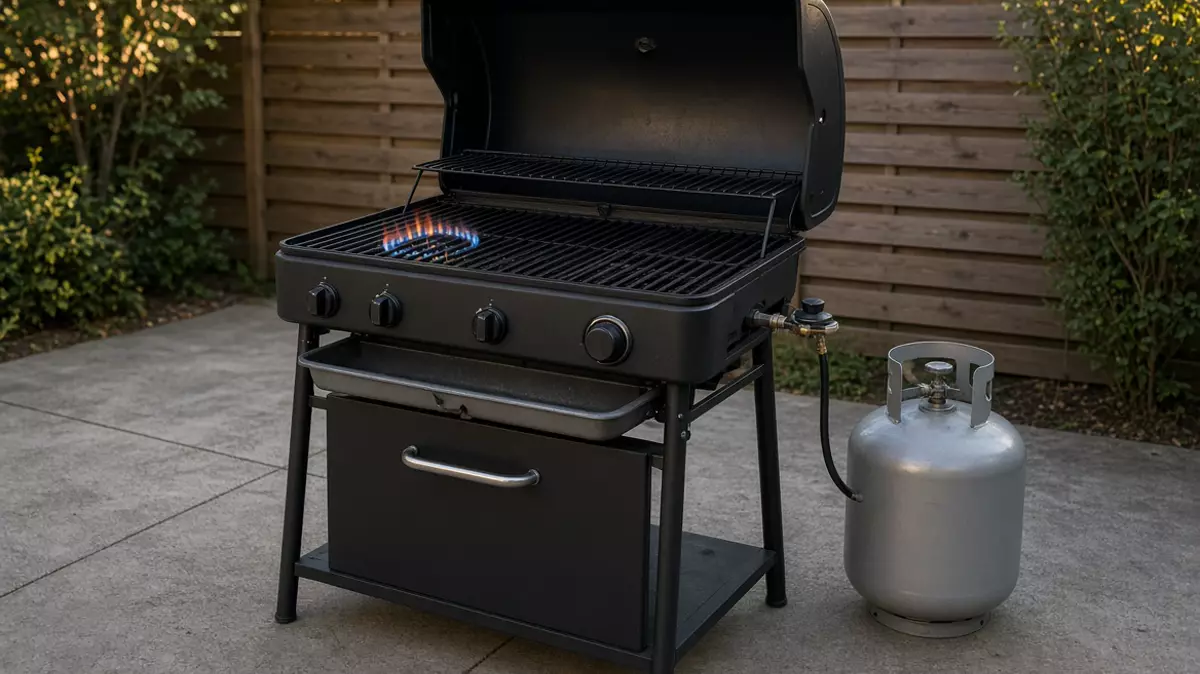
Lid open, every control off, then fuel on, then one burner lit. A common manual order is: set the grill outdoors, open the lid, turn every knob off, open the cylinder valve slowly, wait a moment, then light one burner with the igniter or a long match as the manual describes. Your manual wins if the order differs.
- Clear the area. Open the lid.
- Confirm main, side, and sear controls are off.
- Look at the hose. Cracks, burns, or a chew mean stop.
- Spray soapy water on the connection if you just attached a cylinder. Growing bubbles mean shut the valve and do not light.
- Open the valve, then light one burner with the lid still open.
- If it does not light, turn the control off, leave the lid open, wait, and try once more. Do not keep the gas running while you click.
Tiny flames on every burner often mean an empty cylinder, a closed valve, or a flow-limiting regulator after a valve was opened too fast. Diagnosis steps are in gas grill problems. Reset only with the sequence in your manual.
How Do You Set Up Two-Zone Heat on Gas?
Light the burner or burners on one side and leave the other side off. Preheat with the lid closed. Cook on the lit side, then finish over the unlit burners. A two-burner grill uses one on and one off. A three-burner grill can run one or two on, with at least one off. The layout is the same idea as charcoal and is written up in how to set up two-zone grilling on charcoal or gas.
Day 2’s bread test shows the real hot spot. Many grills run hotter in the back or over the center burner. If the map is badly uneven, use how to fix uneven heat on a gas grill before you blame the meat. Rotate food. Do not stand there with the lid up.
How Do You Add Smoke Without a Charcoal Fire?
Put dry hardwood in a smoker box or foil packet over a lit burner, and put the food over an unlit burner. Wait until the smoke thins and smells like wood, not steam. Stop adding wood once the surface has color. Soaked chips mostly make steam. Packing the box tight chokes it.
Gas smoke is lighter than a charcoal or offset fire. That is a limit of the tool, not a failure of the cook. A gas grill is the right weeknight cooker if you want heat in minutes. It is the wrong tool if deep bark is the whole point.
How Do You Stop a Flare-Up?
Move the food to the unlit side, close the lid, and turn the hot burner down. Do not pour water on a grease fire. Trim heavy fat before the cook, and empty the grease tray when the grill is cold. A short flame under a fatty burger can be normal. A fire that keeps building in the tray is a shutdown: controls off, cylinder valve closed, lid closed, and everyone back. Prevention is in how to prevent grill flare-ups.
How Do You Cook the Longer Days?
Indirect heat, lid closed, thermometer in the thickest part. Chicken is the weekend cook that teaches the layout: lit burner to one side, bird over the off burners, 165°F in the breast and the innermost thigh. Ribs can sit on that same indirect setup with an optional smoke box. They are tender by bend, after they are long past 145°F.
A small chuck or pork shoulder on day 20 is optional. Probe-tender is often around 195–205°F, which is texture, not the safety minimum. If the grill will not hold a low indirect temperature, finish in the oven instead of fighting a 350°F gas box for eight hours. Reverse sear for a thick steak is indirect first, hot burner or sear burner last, and it is covered in how to reverse sear a steak on a grill. Rest before you slice. That hold is in how to rest meat after grilling.
How Do You Shut Down and Store the Cylinder?
Turn the burner controls off, then close the cylinder valve, and leave the cylinder outdoors. Closing the valve first and burning the line dry is another manual-approved order on some grills. Use the order your manual prints. Do not store the cylinder in a garage, shed, basement, or under the grill. Keep it upright.
Cover the grill only after it is cool and the grease tray is empty enough that you are not sealing in a fire load. Off-season steps are in how to winterize a grill. On a cold inspection day, look for cracked burners and blocked ports. If a port is melted or the burner is split, stop and replace the part. Do not drill new holes.
What Mistakes Ruin the 30 Days?
The usual miss is lighting with the lid closed, or cooking before the grate is hot. Other misses are every burner on high for a whole chicken, a smoke box on the same side as the meat, and a cylinder stored in the garage because it might rain.
| What you see | Likely cause | First fix |
|---|---|---|
| No light | Valve closed, empty tank, bad battery, or wet electrode | Lid open, controls off, check fuel, then the manual’s light sequence |
| All flames tiny | Empty cylinder or a tripped regulator | Stop and use the manual reset. Do not force the valve |
| One burner weak | Clogged ports or a blocked venturi | Cold inspection. Insects in the tube are a known grill issue |
| Grease fire | Full tray or heavy fat over a hot burner | Lid closed, burners off, cylinder valve closed. No water |
Frank’s Take
Gas is the weeknight tool if the burners are clean and one of them can stay off. I have cooked over charcoal and wood since 1970, and I still use gas when supper has to happen without a chimney. The flavor will not match a live coal bed. The control will, if you stop running every knob on high. This calendar is owner practice, not a test of a named grill. The manual overrides any general lighting note here.
Final Verdict: Can You Learn a Gas Grill in 30 Days?
Yes, if shutdown and two-zone heat become automatic. Thirty days will not turn a gas grill into an offset. They will stop the raw-middle chicken and the garage-stored cylinder. If you want fire-management practice instead, use the charcoal how-to calendar once it is up. If you want a pellet recipe month, the site already has the 30-day pellet grill recipe plan.
Frequently Asked Questions
Do you have to cook all 30 days in a row?
No. Keep the skill order and skip a night when you need to. Do not skip the leak check on day 1 or the cylinder storage step. Those are the ones that prevent a bad habit.
Can a two-burner grill do this plan?
Yes. One burner on and one burner off is the whole two-zone setup. You will have less cool-zone space than a four-burner grill. Cook in smaller batches instead of covering both burners.
Should you soak wood chips for the smoke day?
No. Use dry chips or pellets in a box or packet. Wet chips steam. Gas heat is already short on smoke. Do not pile chips on an open burner without a container.
What if the grill will not hold low heat for ribs?
Use the lowest stable setting and a cool zone, or move the cook indoors. Some gas grills run hot even on low. Forcing an eight-hour shoulder on that grill wastes fuel. Chicken and ribs still teach the indirect skill.
Related Reading
- How to Set Up Two-Zone Grilling on Charcoal or Gas
- How to Add Smoke Flavor to a Gas Grill
- How to Fix Uneven Heat on a Gas Grill
- Gas Grill Problems
- How to Winterize a Grill
About Frank W. Roberts
Frank W. Roberts is the author of Everything Grill Reviews. He has grilled since 1970 and brings more than 50 years of backyard cooking and cookoff experience to fire management, fuel behavior, smoke, and practical cooker use. This how-to is technique guidance, not a hands-on test of a named gas grill. Last verified September 30, 2026.